The cheapest, safest way to ship food packaging equipment internationally is ocean freight in a full container load (FCL), with air freight reserved for urgent parts and rail freight as the China-to-Europe middle option. A complete door-to-door move, from our factory floor to yours, typically runs 75 to 135 days depending on destination, machine size, and the Incoterms you choose.
Here’s the counterintuitive truth most buyers miss: the freight quote is the easy part. The real cost of food packaging equipment shipping lives in the places nobody quotes up front, demurrage fees after a port delay, a misclassified HS code that spikes your import duty, and a machine that arrives out of calibration because its control panel wasn’t crated for the ocean.
You already know the machine matters. We agree. What you may not realize is that packaging equipment, with its sensors, heat-sealing bars, film rollers, and touchscreen controls, is the most sensitive stage of your production line to move. Get the crating and the terms right, and it lands ready to run. Get them wrong, and you pay twice: once for the freight and again to repair or recalibrate what arrived damaged.
This guide gives you the full playbook. You’ll learn the three shipping methods and when to use each, what the freight really costs including the hidden fees, how to read Incoterms, how to protect precision electronics in transit, and what to do the day the crate arrives.
Key Takeaways
- Ocean freight (FCL) is the cheapest, safest default for food packaging equipment shipping, with full door-to-door timelines of roughly 75 to 135 days.
- Air freight costs more per kilogram but delivers in 5 to 10 days, making it the right choice for urgent spare parts and control panels.
- The headline freight rate is not the real cost. Budget separately for duty, cargo insurance, demurrage, and inland rigging.
- Packaging equipment needs special crating: seaworthy wooden crates, ISPM-15 compliance, and moisture and shock protection for electronics and sealing components.
- Incoterms decide who owns risk at every mile. FOB suits first-time importers; DDP trades convenience for a higher all-in price.
What Is Food Packaging Equipment Shipping?

Food packaging equipment shipping is the process of moving filling, sealing, wrapping, and packing machinery from its manufacturer to a buyer’s facility, including crating, freight, customs clearance, and final delivery. For most buyers, it spans multiple transport modes, several documents, and weeks of lead time.
Packaging machinery is not like shipping a pallet of finished goods. It is heavy, it is valuable, and much of it is precision-built. A vertical form fill seal (VFFS) machine may weigh over 2,200 kilograms, while a flow wrapper carries delicate film-feed rollers and heat-sealing jaws that must stay aligned to within fractions of a millimeter. That is why food packaging equipment shipping deserves its own plan rather than a generic freight quote.
The equipment also sits inside a regulatory frame. Packaging machines that touch food-contact surfaces often need certification, such as CE marking for the European market, and accurate classification under HS code 8422. Get either wrong and the shipment stalls at the border.
Shipping Methods for Food Packaging Equipment
You have three practical choices for food packaging equipment shipping: ocean, air, and rail. Each has a clear job. The mistake most buyers make is treating them as interchangeable.
Ocean Freight (FCL vs. LCL): The Default for Heavy Lines
Ocean freight carries roughly 80% of global trade by volume, and for packaging machinery it is almost always the right first answer. It is the lowest cost per kilogram and the most tolerant of heavy, oversized loads.
Full container load (FCL) means the container is yours alone. It is sealed at the factory and opened only at your destination, which dramatically lowers damage risk. For a complete packaging line or a machine that fills most of a container, FCL is the standard choice. A 20-foot container holds about 28 cubic meters; a 40-foot container holds about 58.
Less-than-container load (LCL) shares space with other shippers. It costs less upfront for a single small machine, but it means more handling and more chance of damage, and it is slower overall. We generally recommend FCL for any packaging equipment bigger than a tabletop sealer.
Transit times vary by route. From Chinese ports, expect roughly 7 to 14 days to Southeast Asia, 18 to 25 days to the Middle East, 25 to 35 days to Europe, and 14 to 20 days to North America’s west coast. Budget the full picture, including crating, clearance, and inland trucking, rather than the sailing time alone. Production time adds more: a standard packaging line takes about 20 working days to build, and a fully integrated line can run 30 to 60 days before it ships.
Air Freight: For Urgent or Small, Sensitive Components
Air freight is the fastest option, with door-to-door delivery in roughly 5 to 10 days. It is also the most expensive, and its volumetric-weight rules punish large, light items. A single pallet of packaging equipment by air can cost more than an entire 20-foot container by sea.
That is why smart buyers use air freight surgically. Send the main machine by sea and fly the replacement control panel, sensors, or a small tabletop sealer when timing matters.
When Priya’s protein bar line in Mumbai lost a control panel three weeks before launch, she had a choice: wait for the replacement to sail with the next consolidated load, or fly it. She paid about $350 to air-freight the 22-kilogram panel, which landed in four days. The line started on schedule. The panel cost less to fly than a single week of idle production would have cost her.
Rail Freight: The China-to-Europe Middle Ground
For buyers in Europe and Central Asia, China-Europe rail freight has become a genuine third option. Transit runs roughly 15 to 20 days, faster than sea and cheaper than air. It suits landlocked destinations where a sea container would still need a long inland leg.
Rail is not right for every route, but if you are moving packaging equipment into Europe on a timeline that sea freight can’t meet and air freight can’t justify, it is worth a quote.
| Method | Best for | Transit time | Cost |
|---|---|---|---|
| Ocean (FCL) | Complete lines, heavy machines | 20 to 45 days sailing | Lowest per kg |
| Ocean (LCL) | Small loads under ~14 CBM | Slower | Low, more handling |
| Air | Urgent parts, control panels | 5 to 10 days | Highest |
| Rail | China to Europe / Central Asia | 15 to 20 days | Medium |
How Much Does It Cost to Ship Food Packaging Machinery?
There is no single number for food packaging machine shipping cost, and any seller who quotes one without asking about destination, weight, and Incoterms is guessing. But you can build a realistic estimate from the known ranges.
The Headline Freight Rate Is Only Part of the Picture
Ocean freight for packaging machinery commonly lands around **0.84perkilogram∗∗witha50−kilogramminimumonconsolidatedroutes,withtransitof17to24days.Astandard20−footcontainerrunsroughly∗∗0.84perkilogram∗∗witha50−kilogramminimumonconsolidatedroutes,withtransitof17to24days.Astandard20−footcontainerrunsroughly∗∗1,000 to 2,500∗∗dependingonorigin,destination,andseason.Airfreighttypicallyruns2,500∗∗dependingonorigin,destination,andseason.Airfreighttypicallyruns5 to $10 per kilogram or more.
Those are the numbers everyone quotes. They are also the smallest part of the total. The full cost of food packaging equipment shipping stacks several layers on top of the freight rate.
Hidden Costs: Duty, Insurance, Demurrage, and Detention
Build your budget around the full list, not the first number:
- Machine price and options, including any customization.
- Export crating and protective materials, which for a large machine means a custom seaworthy wooden crate, waterproof film, and desiccants.
- Factory pickup and origin handling at the port.
- Export customs and documentation fees.
- Main freight, whether sea, air, or rail.
- Cargo insurance, which you should always buy even if the terms say insurance is included.
- Import duty, VAT, or GST, calculated on machine value plus freight plus insurance, and set by the HS code.
- Customs brokerage, inspection, and permit fees at destination.
- Destination terminal and handling charges.
- Demurrage and detention, the fees that bite when a container sits at the port past the free period.
- Inland heavy transport, crane hire, and rigging to position the machine.
Marco, a biscuit manufacturer in Italy, signed a clean FOB quote and thought he was done. Then a port strike left his 40-foot container sitting for 12 days past the free storage window. The demurrage bill came to about $1,800, on top of the inland transport he had already arranged. He told us later he wished the quote had listed demurrage as its own line item, because he would have budgeted for it and pushed his forwarder to clear the container the day it landed.
The lesson is simple. Ask every supplier for a dated quote that lists origin, destination, Incoterm, container count, equipment type, gross weight, what is included, what is excluded, and how long the quote is valid. If they won’t itemize it, keep looking.
Incoterms for Packaging Equipment Shipments

Incoterms, the International Commercial Terms published by the ICC, define who pays for what and, more importantly, who carries the risk at each mile. For food packaging equipment shipping, four terms cover nearly every deal.
FOB (Free on Board) is the most common recommendation for first-time importers. The seller loads the machine onto the vessel at the origin port, and risk passes to you the moment it is on board. You arrange freight, insurance, and clearance. It gives you control and usually a better freight price, but it puts more on your plate.
CIF (Cost, Insurance, and Freight) has the seller arrange and pay for freight and basic insurance to the destination port. Risk still passes to you at the origin port, and you handle clearance and inland delivery. It is convenient but often not ideal for containerized cargo, where FOB gives you cleaner control.
EXW (Ex Works) puts almost everything on the buyer. You collect the machine from the seller’s facility and handle every step after. It is cheap on paper and often expensive in practice for buyers without local logistics experience.
DDP (Delivered Duty Paid) is the most convenient. The seller handles freight, import clearance, duties, and delivery to your door. You still arrange local cranes and rigging to offload, but the surprise port fees disappear. That convenience comes at a premium, and it is genuinely useful for heavy packaging machinery where local port costs are hard to predict.
There is no universally correct term. Match it to your logistics experience and risk tolerance. First shipment? Start with FOB and a licensed freight forwarder. Buying a complete line and want one accountable partner? Ask about DDP.
Crating and Protecting Precision Packaging Equipment
This is where food packaging equipment shipping differs most from moving a pallet of boxes. The machine’s value is in its precision, and the ocean is not gentle.
Seaworthy Crates and ISPM-15 Compliance
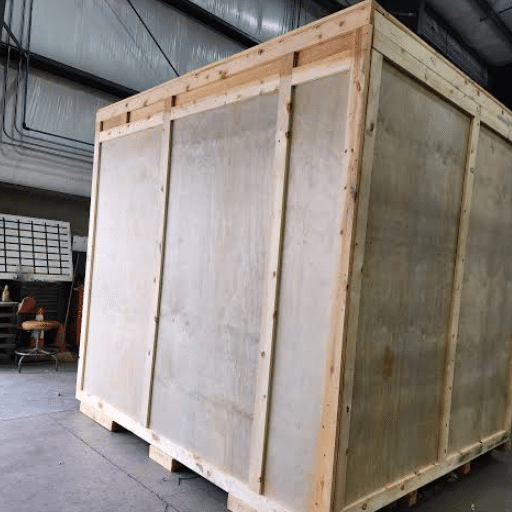
A seaworthy crate is a custom-built wooden box engineered for stacking, lifting, and weeks of vibration and humidity. Corners are reinforced, the machine is bolted down, and the crate is rated for the weight it holds. Bottom supports and securing timber must be ISPM-15 compliant, meaning fumigated and stamped, to pass customs without quarantine delays.
Protecting Electronics, Sensors, and Sealing Bars from Shock and Corrosion
The components that make packaging equipment precise are also the ones most likely to fail in transit. Foam and rubber mounts isolate motors and gearboxes from vibration. Waterproof film and desiccants keep moisture off stainless steel surfaces, while VCI (vapor corrosion inhibitor) materials protect precision metal from rust over weeks at sea.
Every crate is numbered and cross-referenced to the packing list, so nothing arrives as a mystery box. For food-contact machinery, packaging is clearly marked for food contact, and any hygiene or lubricant documentation travels with it.
Factory Acceptance Testing Before the Crate Closes
The single best way to avoid a costly surprise on arrival is to catch the problem before it leaves. Factory Acceptance Testing (FAT) verifies the machine runs correctly, to your specifications, while it is still on our floor. Fixing a calibration issue at the factory takes hours and costs nothing. Fixing it after a 30-day ocean voyage takes days and costs real money.
Want to see how this works end to end? Explore our complete food production lines, where packaging is integrated, tested, and crated as part of one turnkey system.
Shipping Documentation and Customs Clearance
Paperwork is unglamorous, but it is where shipments quietly die. For food packaging equipment shipping, a consistent, accurate document set is non-negotiable.
The Document Set You’ll Need
Expect to provide, at minimum, a commercial invoice, a detailed packing list with serial numbers and weights, the bill of lading, a certificate of origin where required, and an insurance certificate. Depending on destination, you may also need a CE declaration of conformity, a sanitary certificate for food-contact machinery, and ISPM-15 wood packaging confirmation.
The rule that saves the most trouble: descriptions, quantities, weights, values, and consignee details must match across every document. A mismatch between the invoice and the packing list is the fastest way to get a container flagged for inspection.
Why HS Code 8422 Accuracy Saves You Money
Packaging and sealing machinery falls under HS code 8422. Get it right and duties stay low. Get it wrong and a small classification error can push your import duty from near zero to over 5%, or trigger a customs valuation dispute that holds your machine at the border.
For a complete line with multiple modules, including control cabinets, spare parts, and packaging units, classify by functional module rather than as one lump sum. Give your broker technical descriptions, photographs, materials, and the machine’s principal function so they can confirm the right code before the vessel sails.
From Arrival to Production: Commissioning After Transit
Shipping is not finished when the crate lands on your dock. What happens next determines whether the machine runs to spec.
Inspection on Arrival: What to Check Before Signing
Before you sign anything, check the container seal, count the crates against the packing list, and photograph every side of every crate. Note any dents, water marks, or shifted load. If damage is visible, photograph it before opening and note it on the delivery receipt. That record is the evidence you need to back an insurance claim.
Re-Leveling, Calibration, and Startup
Once the machine is out of its crate, it needs to be re-leveled on its foundation, its sealing bars and film rollers checked for alignment, and its electronics re-verified. Transit vibration can nudge even a well-crated machine. This is normal, and it is why a commissioning step, not just delivery, belongs in your timeline.
When Daniel, a snack producer in Accra, received his corn puff line with its integrated packaging module, he budgeted delivery but not commissioning. The VFFS sealing jaw had shifted a fraction in transit. A two-hour re-alignment by a local technician, guided by our remote support, brought it back to spec the same day. He told us the extra half-day he had scheduled for startup was the cheapest insurance he’d bought all year.
This is the strongest argument for buying packaging equipment as part of a turnkey line rather than as an isolated machine. When the processing line and its packaging stage ship together, they arrive tested together, and startup is one coordinated process instead of two disconnected ones. Learn more in our guide to shipping a full food production line.
Shipping Packaging Equipment as Part of a Turnkey Line

Most of the packaging equipment we ship does not travel alone. It is the final stage of a complete production line, and that changes the math.
When a corn puff or snack production line ships with its packaging module in the same FCL container, several costs collapse into one. You pay for one container, one customs entry, and one commissioning visit instead of two or three. The processing and packaging stages are FAT-tested together, so the hand-off between the fryer or extruder and the packaging machine is already proven before the crate closes.
That integration is exactly what we build for. Our lines pair snack food machinery with integrated packaging, and our protein bar production lines ship complete with wrapping and sealing stages ready to run. When the whole line arrives as one tested system, your job on delivery day is startup, not troubleshooting.
Ready to see the difference a tested, integrated shipment makes? Get a shipping-inclusive quote for your packaging line and we’ll itemize the freight, the terms, and the timeline before you commit.
Conclusion
Food packaging equipment shipping is a solvable problem, but it rewards planning. The method you choose, the Incoterms you sign, the crate you insist on, and the HS code your broker files all shape whether your machine arrives ready to run or ready for the repair bench.
Remember the essentials. Ocean FCL is your default for cost and safety. Air freight is your scalpel for urgent parts. Rail is your middle path into Europe. Budget for the hidden fees, not just the freight rate, and always buy cargo insurance. Insist on seaworthy crating and FAT testing before the crate closes. And treat commissioning, not delivery, as the true finish line.
Shandong Loyal Industrial has shipped CE-certified machinery to clients in more than 50 countries, with packaging integrated, tested, and crated as part of one turnkey system. When you are ready to move your packaging equipment, or an entire production line, contact us for a shipping-inclusive quote and a transparent, itemized timeline. We’ll help you get your line from our floor to yours, intact and ready to produce.