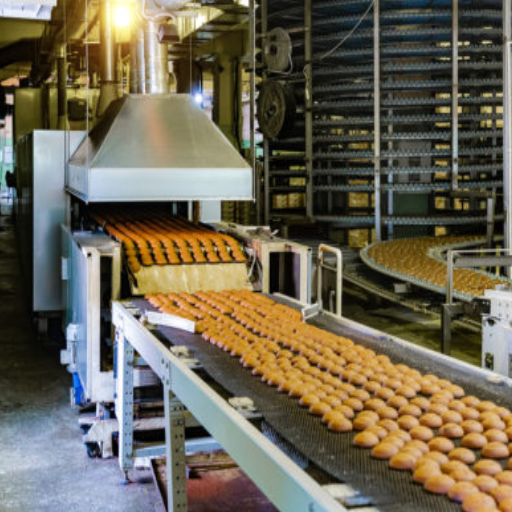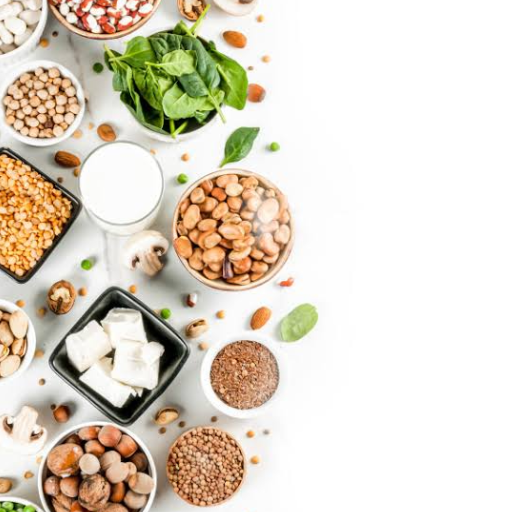
A pet food production line for small factory operations is a compact, integrated system that produces 100–1,000 kg/h of dry pet food within 200–800 m² of floor space, typically requiring a total investment of 30,000–30,000–300,000. It transforms raw ingredients into finished, shelf-stable kibble through grinding, mixing, extrusion, drying, coating, and packaging — all scaled to fit the constraints of limited capital, space, and staffing.
When Carlos Mendez launched his pet food brand in Guadalajara in 2024, he had 40,000anda400m2warehouse.Industrialsuppliersquotedhim40,000anda400m2warehouse.Industrialsuppliersquotedhim500,000 for lines designed for multinational brands. The equipment would not fit his space. The power requirements exceeded his building’s capacity. The staffing models assumed twenty operators he could not afford. He almost gave up.
Then he discovered compact dry-type twin-screw lines built specifically for small factories. Carlos invested 35,000inequipment,spent35,000inequipment,spent8,000 on facility upgrades, and hired two operators. Within fourteen months, his 200 kg/h line was producing 1,600 kg of premium grain-free kibble daily. He broke even in month fourteen. Currently, he is scaling up to the second line.
This is what this guide is all about. Most pet food production guides assume industrial scale. They talk about 5-ton-per-hour plants and million-dollar investments. If you are an entrepreneur, a startup founder, or a small distributor looking to launch production in under 1,000 m² with a six-figure budget or less, those guides leave you guessing. This article covers equipment selection, factory layout, startup budgets, utilities, staffing, regulations, and scaling — written specifically for small factory realities.
Key Takeaways
- A small pet food production line produces 100–1,000 kg/h in 200–800 m², with total startup investments ranging from 30,000to30,000to300,000 depending on capacity and automation level.
- Dry-type twin-screw extrusion is the best starting point for small factories because it avoids steam boiler infrastructure and offers recipe flexibility for future premium SKUs.
- A functional small factory requires 8 core machines (mixer, extruder, dryer, coater, cooler, packaging) plus quality control equipment, staffed by 2–7 people per shift.
- Small pet food factories can achieve 8–18 month equipment payback and 25–40% gross margins when positioned in the premium or private-label segment.
- CE certification, reference installations, and modular upgrade paths are the three most important criteria when selecting a manufacturer for small-scale equipment.
What Is a Small Pet Food Production Line?
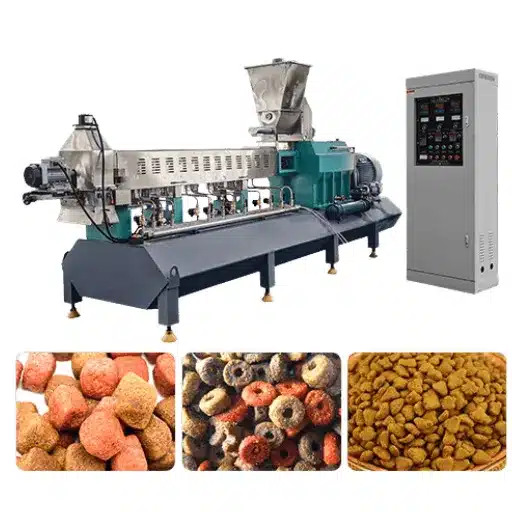
A small pet food production line is an integrated set of machines designed to produce 100–1,000 kg/h of dry pet food within a factory footprint of 200–800 m². It is staffed by 1–5 operators per shift and requires a total investment of 30,000–30,000–300,000. The line transforms raw materials — meat meal, grains, fats, and vitamins — into finished kibble through a continuous process of grinding, mixing, extrusion, drying, coating, cooling, and packaging.
Small factories differ from industrial operations in every dimension except product quality. The same twin-screw extrusion technology that produces kibble for global brands works at 200 kg/h. The difference lies in floor space, automation level, and capital outlay. A small line uses semi-automatic controls instead of full PLC/SCADA systems. It runs with a handful of operators instead of a full production department. And it fits in a converted warehouse instead of a purpose-built facility.
How “Small” Differs from Industrial Scale
| Factor | Small Factory | Industrial Factory |
|---|---|---|
| Capacity | 100–1,000 kg/h | 1,500–10,000+ kg/h |
| Floor Space | 200–800 m² | 1,500–5,000+ m² |
| Investment | 30,000–30,000–300,000 | 500,000–500,000–3M+ |
| Staff per Shift | 1–5 operators | 10–30+ operators |
| Automation | Semi-auto to basic PLC | Full PLC/SCADA |
| Product Range | 2–5 SKUs | 20–100+ SKUs |
Three Capacity Tiers for Small Factories
Micro line (100–200 kg/h) suits home-based or micro-factory operations. These lines are often manual or semi-automatic. They are ideal for testing recipes, serving local markets, or producing specialty functional treats. Total investment starts around $30,000.
Small commercial line (300–500 kg/h) represents the most popular entry point for boutique brands and regional distributors. These lines use twin-screw extruders with gas or electric dryers and semi-automatic packaging. They balance output with affordability. Investment typically ranges from 60,000to60,000to150,000.
Growing small factory (500–1,000 kg/h) serves regional brands with expansion plans. These operations use higher automation, multi-pass dryers, and PLC-controlled packaging. They are ready for export market certifications. Investment runs from 150,000to150,000to300,000.
Equipment List for a Small Pet Food Production Line
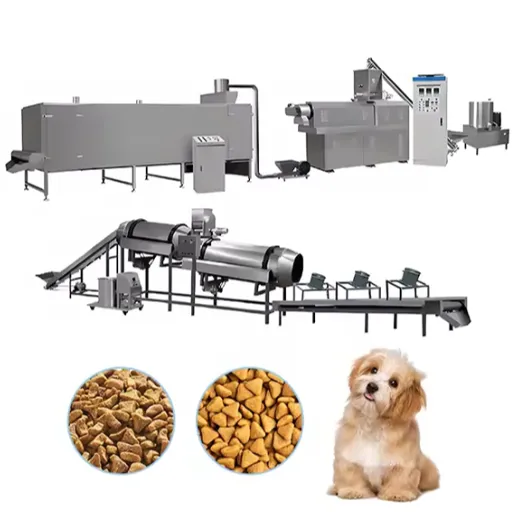
A complete small pet food production line requires eight core machines arranged in sequence. Each machine plays a specific role, and the output of one becomes the input of the next. Understanding what each machine does helps you evaluate quotes, plan your layout, and troubleshoot production issues.
1. Batch Mixer. The mixer combines dry ingredients — grains, protein meals, vitamins, and minerals — with added water or fat to form a uniform dough. For small lines, a 50–200 kg batch mixer handles 5–10 minutes per batch. The key quality metric is coefficient of variation: target 5% or less. An uneven mix leads to inconsistent extrusion and rejected product.
2. Screw Feeder. This simple conveyor transports mixed dough from the mixer to the extruder inlet. It maintains a steady feed rate, which is critical for consistent extrusion output. Most suppliers include this in the turnkey package.
3. Twin-Screw Extruder. The extruder is the heart of the line. It cooks the dough under high temperature (110–180°C) and pressure (3–15 MPa), then forces it through a shaped die to form kibble. For small factories, a dry-type twin-screw extruder is the recommended starting point. Twin-screw designs handle diverse recipes better than single-screw units, including high-meat formulas up to 40% fresh meat content. Small factory extruders typically run 22–75 kW motors and produce 100–500 kg/h.
4. Air Conveyor. This transports freshly extruded product from the extruder to the dryer. It is a simple, low-maintenance component that prevents product damage during transfer.
5. Belt Dryer. The dryer reduces product moisture from 20–25% down to 8–12% for shelf stability. Small lines use electric or gas-fired belt dryers operating at 80–130°C. Drying time runs 15–25 minutes depending on product density and target moisture.
6. Hoister / Elevator. This lifts dried product to the flavoring station. It is a simple mechanical conveyor that saves floor space by moving product vertically.
7. Flavoring Drum / Coater. The coater applies fat, oil, and palatants to the surface of the kibble. Small lines typically start with a simple rotating drum coater. As volume and product range grow, a vacuum coater provides superior fat retention and supports premium SKU development.
8. Cooling Conveyor. Cooling brings product to room temperature before packaging. Warm product sealed in bags creates condensation, which leads to mold. A 5–10 minute cooling cycle prevents this.
9. Packaging Machine. Small lines start with semi-automatic weighing and sealing machines. An operator places the bag, the machine dispenses the target weight, and heat-seals the package. At 300+ kg/h sustained output, upgrading to a multi-head weigher with form-fill-seal capability reduces labor by 30–50%.
Optional Equipment Worth Adding Early
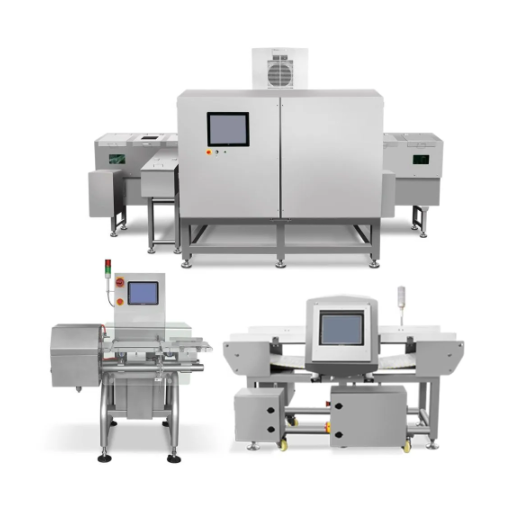
A metal detector is critical for food safety. Even small factories should budget 2,000–2,000–5,000 for a conveyor-mounted unit. A vibrating sieve removes fines and broken pieces, improving product appearance. Storage silos for raw material organization reduce handling time and contamination risk.
Dry Type vs. Wet Type: The Small Factory Decision
Small factories should almost always start with dry-type extrusion. Wet extrusion requires a steam boiler, water treatment, and more complex infrastructure. A steam boiler adds 5,000–5,000–20,000 to initial capital and requires certified boiler operators in many jurisdictions. Dry extrusion uses electric or gas barrel heating and avoids this entirely. You can always add preconditioning later when volume justifies the investment.
Want to see how a small pet food production line fits your space and budget? Explore our CE-certified pet food production lines with capacities starting at 100 kg/h and turnkey packages from $5,500 per piece.
Small Factory Layout and Space Planning
Space planning is where small factories win or lose. A well-designed layout lets 400 m² produce as efficiently as a poorly planned 800 m² facility. The goal is one-way flow: raw materials enter one side, production moves in a single direction, and finished goods exit the opposite side.
Floor Space by Capacity Tier
| Capacity | Minimum Floor Area | Recommended Layout |
|---|---|---|
| 100–200 kg/h | 200–300 m² | Single-room with zoning; raw at one end, finished at other |
| 300–500 kg/h | 400–600 m² | Two-zone layout; separate raw material and production areas |
| 500–1,000 kg/h | 600–900 m² | Three-zone layout; adds dedicated packaging and finished goods |
The Four Zones of a Small Pet Food Factory
Raw Material Zone occupies 15–20% of floor space. It stores dry ingredients in bulk bags or silos, houses the weighing station, and keeps allergens segregated. This zone should have humidity control. Many raw materials are hygroscopic and degrade in damp conditions.
Production Zone consumes 50–60% of floor space. It houses the mixer, extruder, dryer, coater, and cooler. This is the highest-traffic area. Leave 1–2 meters of clearance around each machine for cleaning and maintenance. Position the extruder centrally, since it is the heaviest and most vibration-prone machine.
Packaging Zone requires 10–15% of floor space. It needs a cleaner environment than production. Dust control matters here because airborne particles contaminate open bags. Consider a partial partition or positive air pressure if budget allows.
Finished Goods Zone takes 10–15% of floor space. Pallet storage, staging for shipping, and a small loading area belong here. Keep this zone physically separate from raw materials to prevent cross-contamination.
One-Way Flow Design
One-way flow means raw materials never cross paths with finished products. Ingredients enter the raw zone, move through production in a linear sequence, and exit as packaged goods. This principle supports HACCP compliance even in small spaces. It also makes inspections easier and reduces contamination risk.
Planning for Expansion
Smart small factories design for growth on day one. Leave 2–3 meters of clear space beside the extruder for a future preconditioner. This single upgrade can increase throughput 10–15% without replacing the core machine. Design the electrical panel with spare breaker capacity for additional motors. Position the dryer to allow upgrade from a single-pass to multi-pass configuration without moving walls. These small foresight decisions save tens of thousands in future renovation costs.
Startup Budget: What a Small Pet Food Factory Really Costs
Equipment prices tell only part of the story. A realistic startup budget includes building preparation, raw material inventory, packaging materials, licenses, utilities, and working capital. Below are three investment tiers based on actual small factory deployments.
Tier 1: Micro Factory (30,000–30,000–60,000)
| Category | Cost (USD) | Notes |
|---|---|---|
| Equipment (basic line) | 15,000–15,000–30,000 | Single-screw or small twin-screw, semi-auto |
| Building/renovation | 5,000–5,000–15,000 | Rent deposit, flooring, electrical, ventilation |
| Raw material inventory | 2,000–2,000–5,000 | First 1–2 months of production |
| Packaging materials | 1,000–1,000–3,000 | Bags, labels, cartons |
| Licenses and permits | 500–500–2,000 | Varies by country and region |
| Utilities setup | 1,000–1,000–3,000 | Three-phase power, water, compressed air |
| Working capital | 3,000–3,000–5,000 | Covers first 2–3 months of operations |
| Total | 30,000–30,000–60,000 |
Tier 2: Small Commercial (60,000–60,000–150,000)
| Category | Cost (USD) | Notes |
|---|---|---|
| Equipment (twin-screw line) | 40,000–40,000–80,000 | Twin-screw extruder, gas dryer, semi-auto packaging |
| Building/renovation | 10,000–10,000–25,000 | 400–600 m² facility fit-out |
| Raw material inventory | 5,000–5,000–10,000 | |
| Packaging materials | 3,000–3,000–6,000 | |
| Licenses and permits | 1,000–1,000–3,000 | |
| Utilities setup | 3,000–3,000–8,000 | Larger power connection, ventilation system |
| Quality control equipment | 2,000–2,000–5,000 | Moisture meter, metal detector, scale |
| Working capital | 5,000–5,000–15,000 | |
| Total | 60,000–60,000–150,000 |
Tier 3: Growing Small Factory (150,000–150,000–300,000)
| Category | Cost (USD) | Notes |
|---|---|---|
| Equipment (automated line) | 100,000–100,000–180,000 | Twin-screw, multi-pass dryer, auto packaging, PLC |
| Building/renovation | 20,000–20,000–40,000 | 600–900 m² with clean-room packaging |
| Raw materials and packaging | 10,000–10,000–20,000 | |
| Licenses and certifications | 3,000–3,000–8,000 | CE, ISO 22000, HACCP audit preparation |
| Utilities and infrastructure | 8,000–8,000–15,000 | |
| QC lab setup | 5,000–5,000–10,000 | Basic nutrition testing equipment |
| Working capital | 15,000–15,000–30,000 | |
| Total | 150,000–150,000–300,000 |
Hidden Costs Most Suppliers Do Not Mention
Shipping and customs often add 10–20% to equipment cost for international buyers. Installation and commissioning runs 2,000–2,000–10,000 depending on location and supplier. Operator training costs 1,000–1,000–5,000 — verify whether your supplier includes this. Spare parts inventory should be 2,000–2,000–5,000 for critical wear items like screws, dies, and bearings. Factory and product liability insurance varies by region but is essential before your first commercial batch.
Power, Utilities, and Infrastructure
Utilities are the silent factor that kills small factory projects. A buyer secures a great building, orders equipment, and then discovers the power supply is inadequate. Planning utilities early prevents expensive surprises.
Electricity Requirements by Capacity
| Capacity | Total Power | Notes |
|---|---|---|
| 100–200 kg/h | 30–50 kW | Single-phase or small three-phase possible |
| 300–500 kg/h | 50–80 kW | Three-phase 380V required |
| 500–1,000 kg/h | 80–150 kW | Dedicated transformer may be needed |
The extruder is the largest power consumer, typically using 40–50% of total line consumption. The dryer is second, especially electric models. Gas dryers reduce electrical demand significantly but require gas line installation and ventilation.
Water, Air, and Ventilation
Small pet food factories need 500–2,000 liters of water daily for equipment cleaning and minor process use. Compressed air at 0.4–0.6 MPa powers packaging machines and pneumatic conveyors. A small compressor costs 500–500–2,000.
Ventilation is critical and often underestimated. Extrusion and drying generate heat and dust. An exhaust system budget of 2,000–2,000–8,000 prevents operator discomfort and maintains product quality. In humid climates, dehumidification in the raw material zone prevents ingredient degradation.
Infrastructure Checklist
Before finalizing your facility, verify these items:
- Three-phase power is available and sufficient for your target capacity
- Floor load capacity handles the extruder and mixer weights
- Ceiling height is minimum 3.5–4 meters for hoisters and ventilation ducts
- Drainage exists for cleaning operations
- Fire safety compliance addresses grain and flour dust explosion risks
- Loading dock or ground-level access accommodates pallet delivery
Staffing Your Small Pet Food Factory
Small factories run lean. The right team structure keeps labor costs low while maintaining quality and safety.
Staffing by Capacity Tier
| Role | 100–200 kg/h | 300–500 kg/h | 500–1,000 kg/h |
|---|---|---|---|
| Production Manager | 1 (part-time) | 1 | 1 |
| Machine Operators | 1–2 | 2–3 | 3–5 |
| Packaging/Packing | 1 | 1–2 | 2–3 |
| QC / Lab | 0 (outsource) | 0–1 (part-time) | 1 |
| Sales/Admin | 1 (part-time) | 1 | 1–2 |
| Total per shift | 2–4 | 4–7 | 7–12 |
At 100–200 kg/h, a single skilled operator can manage mixing, extrusion, and drying. Packaging may require a second person during peak output periods. At 300–500 kg/h, dedicated operators for extrusion and packaging improve efficiency. At 500+ kg/h, a part-time QC person performing moisture checks, weight verification, and visual inspection becomes essential.
Skills Your Team Needs
Machine operators need basic mechanical aptitude for die changes, screw adjustments, and troubleshooting. They must understand HACCP principles and cleaning protocols. Quality awareness matters: operators are your first line of defense for catching off-spec product. Safety training for rotating machinery and hot surfaces is non-negotiable.
Most equipment suppliers include operator training in their commissioning package. Supplement this with online pet food manufacturing courses and local food safety certification programs. A well-trained operator prevents downtime that costs far more than the training investment.
Regulatory Compliance for Small Pet Food Factories
Regulations vary dramatically by market. Understanding the rules before you buy equipment prevents costly retrofits and legal issues.
China Regulations
China requires a special pet feed production license for facilities producing 5 tons per hour or more. Most small factories operate well below this threshold. Below-threshold operations can run with a basic food business license plus product registration for each SKU. If you plan to export, CE marking becomes essential for EU-bound equipment.
European Union Regulations
EU Regulation (EC) 767/2009 governs pet food production and labeling. Equipment used in EU-facing production must carry CE marking, certifying compliance with the Machinery Directive 2006/42/EC. HACCP implementation is mandatory. Even small factories must document critical control points, particularly the extrusion kill step and moisture control during drying.
United States Regulations
The FDA Food Safety Modernization Act (FSMA) requires pet food facilities to register with the FDA and implement preventive controls. AAFCO guidelines set nutritional adequacy standards. While AAFCO is not law, it is the industry standard that retailers and consumers expect. State-level regulations vary: some states require additional pet food manufacturing licenses beyond federal registration.
Southeast Asia and Other Markets
Most ASEAN countries follow tiered licensing systems similar to China. Small factories often qualify for simplified registration pathways. The key is understanding your target market before designing your facility. A factory built only for domestic sales may lack the documentation and design features needed for export certification.
Our recommendation: Consult a local regulatory expert before finalizing your factory design. The cost of an hour with a consultant is trivial compared to redesigning your layout to meet a standard you did not know existed.
Scaling from Small to Medium: A Growth Roadmap
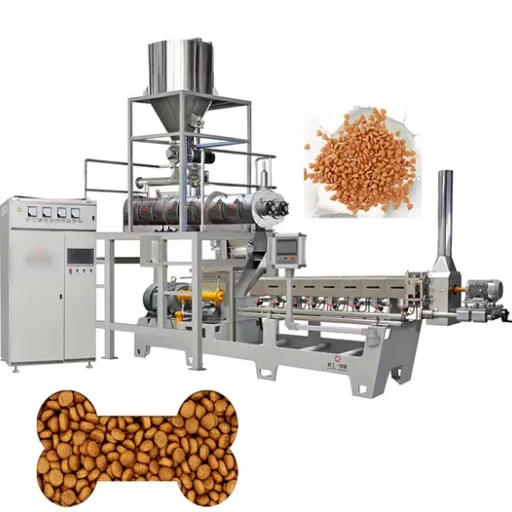
The best small factories are designed to grow. Modular thinking from day one transforms a 60,000starterlineintothefoundationofa60,000starterlineintothefoundationofa300,000 regional operation without replacing your core equipment.
Phase 1: Launch (Months 1–6)
Focus on proving product-market fit with 1–3 SKUs. Use a dry-type twin-screw line at 100–300 kg/h. Run with 2–4 people per shift. Target break-even within 12–18 months. Do not over-automate. Manual packaging and simple controls keep capital low while you learn what your market actually wants.
Phase 2: Stabilize (Months 6–18)
Expand your SKU count and improve consistency. Add a preconditioner for 10–15% throughput boost and better starch gelatinization. Upgrade to a vacuum coater if you are launching premium grain-free or functional lines. Move from semi-automatic to PLC-controlled packaging as sustained daily output exceeds 2,000 kg. Target 300–500 kg/h sustained production.
Phase 3: Scale (Months 18–36)
Pursue regional expansion and export preparation. Add a second extruder line or upgrade to a larger single extruder. Install automated raw material handling. Pursue ISO 22000 and full HACCP certification. Target 800–1,500 kg/h across one or two lines.
When Maria Santos launched her pet food brand in São Paulo, she started with a 200 kg/h line much like Carlos in Mexico. After eighteen months, her grain-free line was selling faster than she could produce it. Instead of replacing her equipment, she followed a modular upgrade path. She added a jacketed preconditioner for $12,000 and gained 15% more output from the same extruder. Six months later, she added a vacuum coater and launched a premium SKU at 2.5x the price of her standard line. By month thirty, she had doubled her output and tripled her average selling price — all in the same 500 m² facility.
Modular Upgrade Path
| Upgrade | When to Add | Expected Benefit | Cost Range |
|---|---|---|---|
| Preconditioner | 6–12 months in | +10–15% throughput | 5,000–5,000–15,000 |
| Vacuum coater | Launching premium SKU | Better fat retention, premium pricing | 8,000–8,000–20,000 |
| Auto packaging | 300+ kg/h sustained | Reduce labor 30–50% | 10,000–10,000–30,000 |
| Second extruder | 500+ kg/h demand | Double output without new building | 25,000–25,000–60,000 |
| Metal detector + X-ray | Export market entry | Food safety compliance | 5,000–5,000–15,000 |
Ready to plan your scaling path? Contact us for a free customized factory layout that includes modular expansion zones designed around your growth targets.
ROI and Profitability for Small Pet Food Factories
Small pet food factories can be highly profitable when positioned correctly. The key is understanding where margin lives.
Simplified ROI Model (300–500 kg/h Line)
| Metric | Value |
|---|---|
| Equipment investment | 60,000–60,000–100,000 |
| Daily output (8-hour shift) | 2,400–4,000 kg |
| Annual output (250 days) | 600,000–1,000,000 kg |
| Revenue per kg (wholesale) | 1.50–1.50–3.00 |
| Gross margin | 25–40% |
| Annual gross profit | 225,000–225,000–1,000,000 |
| Operating expenses | 80,000–80,000–200,000/year |
| Net profit (Year 2–3) | 100,000–100,000–500,000/year |
| Equipment payback period | 8–18 months |
These numbers assume a wholesale model. Direct-to-consumer sales through online channels can capture 2–3x the wholesale price per kilogram, though marketing costs rise accordingly.
Where Profit Lives
Raw materials represent 50–65% of product cost. Negotiating bulk purchasing agreements after six months of consistent volume typically reduces ingredient costs 8–15%. Premium positioning matters enormously. Economy kibble sells at thin margins. Grain-free, high-protein, or functional pet food commands 2–3x pricing with only modestly higher ingredient costs.
Private label manufacturing provides stable baseline revenue. Producing for other brands under their labels gives you predictable volume while your own brand builds market presence. Many successful small factories run 60–70% private label and 30–40% branded production.
Buying from a Manufacturer: Red Flags and Checklist
Choosing the wrong equipment supplier is the most expensive mistake a small factory can make. A cheap machine that breaks down monthly costs more than a reliable machine at twice the price.
Pre-Purchase Checklist
- CE certification verified: Request the certificate number and verify validity online
- Video proof: Demand video of the exact machine model running your target recipe
- Reference customers: Contact 2–3 existing small-factory customers in your region
- Installation scope: Confirm whether installation, commissioning, and training are included
- Spare parts package: Ensure first-year critical spare parts are quoted with lead times
- Warranty terms: Minimum 12 months on mechanical parts; 24 months is preferable
- Remote support: Can the supplier diagnose issues via video call?
- Layout drawing: Will the supplier provide a factory layout optimized for your space?
- Voltage compatibility: Confirm 220V/380V/440V configuration matches your region
- After-sales presence: Does the supplier have agents or service partners in your country?
Red Flags Specific to Small Factory Equipment
James Chen, a distributor in Jakarta, nearly wired a $3,000 deposit to a supplier offering a “complete pet food line” at half the market rate. The website looked professional. The photos were crisp. But something felt wrong. James asked for a video of the machine running. The supplier sent stock footage from another brand. He asked for CE certificate numbers. The supplier stopped responding. James later learned the “company” was a reseller with no manufacturing capability and zero installations.
His second approach was different. He verified CE certificates directly with the issuing body. He video-called reference customers in Thailand and Vietnam. He requested a factory layout drawing before placing an order. The supplier he chose — a manufacturer with 10+ years of experience and 50+ small-factory installations — cost 40% more upfront. But the machine arrived on spec, installation took one week, and his first batch ran successfully on day three.
Be wary of these specific warning signs:
- Single-screw extruders quoted for recipes with more than 20% fresh meat content
- No CE marking for equipment destined for European or export markets
- Pricing that seems too good to be true — complete lines under $3,000 are impossible at genuine quality
- Suppliers who cannot provide video of their actual machines running
- No English-language manual or operator documentation
- Warranty shorter than 12 months
- No small-factory reference installations you can verify
Conclusion
A small pet food production line is not a scaled-down industrial system. It is a purpose-built solution designed for the realities of limited space, tight capital, and lean staffing. The entrepreneurs who succeed understand that starting small does not mean compromising on quality or future growth.
The five principles that separate successful small factories from struggling ones are straightforward. Start with a dry-type twin-screw line to avoid steam boiler costs and maintain recipe flexibility. Budget 30,000–30,000–150,000 for the complete micro-to-small commercial setup, including the hidden costs most guides ignore. Design your layout for one-way flow and modular expansion from the first day. Verify CE certification and speak to reference customers before signing any purchase order. And choose equipment that grows with you — the cheapest line is the one you do not have to replace in twelve months.
The global pet food market reached $134 billion in 2026 and continues growing at over 5% annually. Small factories are capturing an outsized share of the premium and private-label segments because they can adapt faster, test recipes quicker, and serve local markets more responsively than industrial players. Your size is your advantage — if you equip yourself correctly.
Ready to start your small pet food factory? Contact Shandong Loyal Industrial for a free customized factory layout and equipment proposal. Our CE-certified small pet food production lines start from $5,500 per piece, with full installation support, operator training, and modular upgrade paths designed for growing brands.