The global food extrusion market is worth roughly US76to76to97 billion in 2025, and it is growing at 5 to 9 percent every year. That single number hides a bigger story: almost every source that reports it sits behind a paywall, and almost none of them explain what extrusion actually is or how to buy the machinery. This guide fixes both problems in one place.
Priya is a founder building a plant-based snack brand out of a small facility in Mumbai. When she searched for “food extrusion market” in early 2026, she wanted one thing: a straight answer on whether the category was big enough and where it was headed. Instead she found a wall of $4,000 market reports and no explanation of the twin-screw extruder she would need to buy. She wasted two weeks stitching the picture together from fragments.
You are likely in Priya’s position. You agree that market size matters, but you also need to understand the technology and the equipment before you spend a cent. That is exactly what you will get here. In this guide we will cover the market’s size and growth, how food extrusion works, the main extruder types, the applications, current trends, and how to source a CE-certified line. By the end you will know the market, the machine, and your next step.
Key Takeaways
- The food extrusion market sits between 76billionand76billionand97 billion in 2025, growing 5 to 9 percent a year, with snack foods and plant-based protein driving the demand.
- Extrusion is a high-temperature short-time (HTST) process that cooks, shapes, and textures food under heat, pressure, and shear in under a minute.
- Twin-screw extruders now hold about 64 percent of revenue and are displacing single-screw machines for flexible, high-moisture, and high-protein products.
- Asia-Pacific leads the market at roughly 40 percent share, with China alone near 32 percent.
- High-moisture extrusion for meat alternatives and Industry 4.0 process control are the two trends shaping 2026.
What Is Food Extrusion?

Food extrusion is a continuous process that forces mixed ingredients through a shaped opening, called a die, under heat, pressure, and mechanical shear. The combination cooks, mixes, and forms the material in one machine. It is often described as a short bioreactor because so much transformation happens in a matter of seconds.
The process matters because it is the workhorse behind a surprising share of what is on supermarket shelves. Breakfast cereals, corn puffs, pasta, snack pellets, textured vegetable protein, pet food, and even some confectionery all pass through an extruder at some point. Extrusion is efficient, consistent, and versatile, which is why it has become the default production method for expanded and shaped foods.
You will see two terms used almost interchangeably. Extrusion cooking is the hot process that gelatinizes starch and denatures protein. Cold extrusion shapes material without cooking it, as in pasta. Both belong under the same umbrella, and both are covered in this guide. For a deeper look at the physics and benefits of the technology, see our guide to food extrusion technology.
Food Extrusion Market Size, Growth & Forecast
Here is the first honest caveat: the market numbers you see vary because researchers measure different things. Some count the extruded products themselves, worth tens of billions. Others count only the extrusion machinery, worth a few billion. When you see a wide range, that is the reason.
The broad food extrusion market, which includes the extruded products and processing, is most commonly valued at between 75.99billionand75.99billionand97.19 billion in 2025. The spread comes down to scope and methodology, not disagreement about direction. Every source agrees the market is growing.
The most cited growth paths are these:
- 105.53billionin2026,reaching105.53billionin2026,reaching149.76 billion by 2030 at a 9.1 percent compound annual growth rate (CAGR), per The Business Research Company.
- 79.83billionin2025,reaching79.83billionin2025,reaching121.83 billion by 2032 at a 6.22 percent CAGR, per 360iResearch.
- 81.2billionin2025,reaching81.2billionin2025,reaching153.6 billion by 2034 at a 7.3 percent CAGR, per Research and Markets.
If you are buying machinery rather than studying the whole market, the numbers are smaller and more relevant. The food extrusion equipment market was about 1.5billionin2024andisprojectedtoreach1.5billionin2024andisprojectedtoreach2.6 billion by 2034 at a 5.2 percent CAGR, according to Global Market Insights. The narrower machine market grows from roughly 1.95billionto1.95billionto3.25 billion over the same window.
Market Size by Region
The regional split tells you where the growth is coming from.
| Region | Approximate Share | Key Market |
|---|---|---|
| Asia-Pacific | ~40% | China (~32% share, fastest-growing) |
| Europe | ~27–29% | Germany (~19% share) |
| North America | ~22–24% | United States (~82% of region) |
| Rest of world | ~8–10% | Brazil, Middle East, others |
Asia-Pacific leads and is the fastest-growing region. China alone accounts for nearly a third of global extrusion demand, driven by urbanization, snack consumption, and a booming plant-based sector. Europe is steady, with Germany as the manufacturing anchor, pushed along by strict EU hygiene and energy standards. North America is mature but still growing, with the United States generating around $420 million of the equipment market in 2024.
What Is Driving the Growth
Three forces explain most of the momentum. First, demand for convenient, ready-to-eat foods, snacks, cereals, and pasta keeps rising, especially in urban Asia. Second, plant-based protein has moved from niche to mainstream, and extrusion is the technology that turns plant proteins into meat-like textures. Third, automation and energy efficiency are making extruders cheaper to run, which shortens payback periods and pulls in new buyers.
This is where the market data connects to a real purchase decision. Understanding the market is step one. Understanding the machine is step two. If you want to see how this technology fits into a complete production line, explore our turnkey food production lines.
Types of Food Extrusion: Hot vs. Cold, Dry vs. Wet
Not all extrusion is the same. The two axes that matter are temperature and moisture, and they determine what a machine can make.
Hot extrusion, or extrusion cooking, runs above 100 degrees Celsius. It gelatinizes starch, denatures protein, and sterilizes the product in one pass. This is how you make puffed snacks, breakfast cereals, and textured protein. Cold extrusion runs below 100 degrees, shaping dough without cooking it, which is how pasta and some confectionery are formed.
Moisture splits the process another way. Dry extrusion keeps moisture under 40 percent and relies on friction and mechanical energy to generate heat. Wet extrusion, also called high-moisture extrusion when moisture climbs above 40 percent, adds water and steam to create the fibrous, layered texture needed for plant-based meat. The difference between dry and wet extrusion shapes everything from texture to energy cost, and it is worth its own dedicated comparison.
How the Food Extrusion Process Works (Step by Step)

The process is continuous, but it breaks into six clear stages.
- Feeding: Raw ingredients, flours, starches, proteins, and water are metered into the barrel through a hopper.
- Preconditioning: Steam and water pre-mix and pre-heat the material, cutting energy use and improving consistency.
- Cooking: Inside the barrel, the rotating screws shear, compress, and heat the material, cooking it in seconds.
- Forming: The pressurized melt is forced through a die, which gives the product its shape and controls expansion.
- Cutting: A rotating knife slices the extrudate to length as it exits the die.
- Drying and cooling: The product is dried or cooled to its final moisture, then moves to coating and packaging.
The whole journey can take under a minute. That speed is the secret to extrusion’s efficiency and its consistency. For the full equipment mapping at each stage, see our step-by-step food extrusion process guide.
The Science of Extrusion Cooking
Under the hood, extrusion cooking is a study in transformation. Starch granules absorb water, swell, and gelatinize, turning a dry flour into a cohesive, expandable dough. Proteins denature and re-align, which is what gives plant-based meat its chew and fibrous bite.
Temperature, pressure, and shear work together, and the operator controls all three. Shear comes from the screws, pressure builds at the die, and heat comes from both barrel heaters and friction. The measure of mechanical energy input is specific mechanical energy, or SME, and it is one of the most important dials a production team tunes. Higher SME means more cooking and more expansion. Too much means scorching and off flavors.
This is the part product developers care about most. Get the shear and moisture right and you can turn pea protein into something that flakes like chicken. Get it wrong and you have a dense, rubbery pellet. For the full chemistry, see our guide to extrusion cooking.
Extruder Types: Single-Screw vs. Twin-Screw
The single most consequential equipment decision is the screw configuration.
A single-screw extruder uses one rotating screw in a barrel. It is simpler, cheaper to buy, and easier to maintain. It handles starch-heavy, low-fat recipes well, which is why it still dominates small and mid-sized snack and cereal lines, especially in developing markets. Its limits show up with high-fat, high-moisture, or high-fiber recipes, where mixing and heat transfer fall short.
A twin-screw extruder uses two intermeshing, co-rotating screws. The screws self-wipe, which means no dead zones where material burns, and they mix far more aggressively. This lets twin-screw machines handle fat, fiber, fresh meat, and high moisture that would stall a single-screw. That flexibility is why twin-screw now holds about 64 percent of market revenue, even though single-screw still leads in raw unit volume.
Marco runs a mid-sized snack company in Italy that has used a single-screw line for corn puffs for a decade. When he wanted to add a high-protein, chickpea-based puff with 15 percent fat, his old line could not run it. The single-screw overloaded and the product came out dense and greasy. He moved the new SKU to a twin-screw line and cut his energy per kilogram by a fifth, because the machine cooked more efficiently. The upgrade paid for itself in under a year.
The rule of thumb is simple. Choose single-screw for simple, fixed, low-volume starch recipes. Choose twin-screw for high-moisture, high-fat, high-protein, or frequently changing products. For the full decision table and specification guidance, see our single-screw vs. twin-screw selection guide.
Extrusion Die Design & Product Shaping
The die is where the product becomes a product. Die geometry controls expansion, density, and shape, and small changes produce big differences in the final snack or cereal.
A die can be a single hole, a multi-hole plate, or a co-extrusion die that wraps one material around another, think a filled pillow snack. The ratio of die opening to final size, along with moisture and temperature, controls how much the product puffs. Quick-change die inserts let a single machine produce bone, star, ring, and pellet shapes without buying new equipment.
Because the die interacts with every upstream variable, it is usually the last thing a buyer specifies and the first thing a production team tweaks. If you want to understand the die types and how to pick one, see our guide to extrusion die design.
Food Extrusion Applications: Snacks, Cereals, Pasta & Protein
Extrusion’s reach is wide, and each application uses the technology differently.
- Snacks are the largest application, holding about 31 percent of market share. Corn puffs, pellets, and direct-expanded snacks all rely on extrusion for their crunch and shape.
- Breakfast cereals use twin-screw extrusion to produce flakes, puffs, and shredded forms with precise texture.
- Pasta uses cold extrusion to shape dough into macaroni and other forms without cooking it.
- Protein and meat alternatives use high-moisture extrusion to create the fibrous texture of chicken, fish, and beef from soy, pea, and wheat.
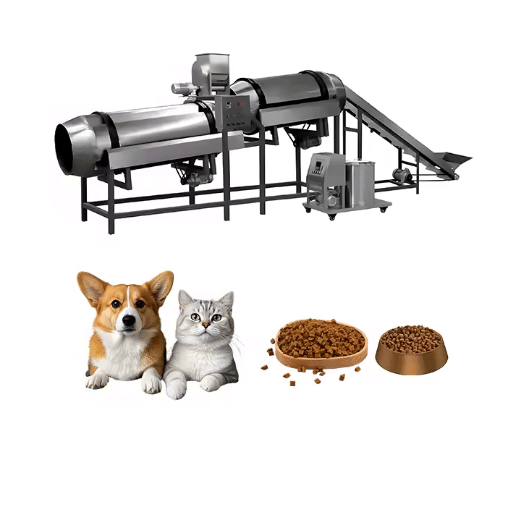
- Pet food runs its own parallel cluster, with extruders producing dry kibble and treats at high volume.
Each of these is a door into Loyal’s product lines. See our corn puff snacks production line, our pasta macaroni production line, and our protein bar production line for the machinery behind each application.
Confectionery & Specialized Extrusion Systems
Confectionery is a smaller but profitable extrusion niche. Candy, licorice, gum, and filled chocolates are all shaped through specialized extrusion and co-extrusion systems that run at low temperature and high precision.
These lines differ from snack extruders in their temperature control and die design, because sugar and chocolate behave very differently from starch dough. For the details on cook-extrude lines, deposition, and filled products, see our guide to confectionery extrusion systems.
Food Extruder Cost & Buying Considerations
What you pay depends on screw type, capacity, and origin. As a rough guide, a small pilot twin-screw extruder starts in the low five figures in US dollars, a mid-range commercial unit in the tens of thousands, and an industrial line with multiple barrels and high throughput can reach six figures.
Purchase price is only the start. The extruder is the largest single electricity load on most lines, often 60 percent or more. Screws and barrels are wear parts that need replacement, and twin-screw maintenance typically runs 10 to 15 percent of the purchase price each year. Buyers who plan around total cost of ownership, rather than sticker price, consistently make better capital decisions.
One more thing to weigh is origin. Chinese-built extruders are often one-third to one-half the price of equivalent European equipment, a gap worth understanding when you are comparing quotes. For the full price ranges, cost drivers, and a vendor checklist, see our food extruder machine cost and buying guide.
Food Extrusion Trends to Watch in 2026
Five trends are shaping where this market goes next.
- High-moisture extrusion for plant-based meat. Running at 40 to 80 percent moisture, this is the standard method for turning soy, pea, and other proteins into fibrous, meat-like textures. It is the fastest-growing application in the market.
- Industry 4.0 and AI process control. IoT sensors and machine learning now monitor temperature, pressure, and moisture in real time. Reports show energy reductions of 15 to 20 percent and overall equipment effectiveness above 85 percent.
- Advanced cooling-die design. New cooling dies set the fibrous structure of meat analogues before they exit, giving better texture and higher throughput.
- Protein-source diversification. Beyond soy and pea, manufacturers are testing faba bean, mung bean, lupin, microbial protein, and even insect protein. Each needs a slightly different extrusion profile.
- Sustainability and energy efficiency. Heat recovery and variable-frequency drives are cutting specific mechanical energy input by 25 to 35 percent, which lowers both cost and carbon footprint.
These trends reward buyers who choose flexible, modern machinery. That is exactly the equipment Loyal builds.
Why Choose Shandong Loyal’s Extrusion Systems

Shandong Loyal Industrial has spent more than a decade building extrusion systems for snack, cereal, pasta, and protein producers in over 50 countries. Our lines are CE-certified, customizable to your recipe, and delivered as turnkey installations so you start producing quickly.
What sets us apart is that we engineer the machine to your product, not the other way around. Tell us your recipe, your target capacity, and your budget, and we will specify the extruder, die, and downstream equipment to match. From consultation to installation, we keep you informed at every step.
Whether you are starting a single snack line or scaling a plant-based protein operation, we can help you plan it. Learn more about our snack food machinery or explore our food production lines to see the full range.
Frequently Asked Questions
What is food extrusion?
Food extrusion is a continuous process that forces mixed ingredients through a shaped die under heat, pressure, and shear, cooking and forming them in one machine. It is the method behind breakfast cereals, snacks, pasta, and textured protein.
What is the food extrusion market size?
The food extrusion market is valued between roughly 76billionand76billionand97 billion in 2025, depending on scope, and is forecast to grow at 5 to 9 percent annually through the early 2030s.
What is the difference between single-screw and twin-screw extrusion?
Single-screw extruders are simpler and cheaper and suit low-fat, starch-heavy recipes. Twin-screw extruders mix and cook better, handle high moisture, fat, and protein, and now hold most of the market’s revenue.
What is hot extrusion vs. cold extrusion?
Hot extrusion, or extrusion cooking, runs above 100 degrees Celsius and cooks the product. Cold extrusion runs below 100 degrees and shapes dough without cooking it, as in pasta.
What foods are made by extrusion?
Breakfast cereals, corn puffs and snack pellets, pasta, textured vegetable protein, plant-based meat, pet food, and some confectionery are all made by extrusion.
How much does a food extruder machine cost?
Food extruder prices range from the low five figures for small pilot units to six figures for industrial lines, and they vary widely by screw type, capacity, and country of origin.
Who are the leading food extrusion machine manufacturers?
Leading players include GEA, Wenger, Baker Perkins, Leistritz, CPM, Bühler, and Clextral, along with value-focused turnkey manufacturers like Shandong Loyal Industrial.
Next Steps: Get a Custom Extrusion Line Quote
You now have the market, the technology, and the trends in one place. The next step is to turn that understanding into a decision.
Start by defining your recipe, target capacity, and budget. Then talk to an engineering team that can translate those into a specific extruder, die, and line configuration. Whether you are planning your first line or expanding an existing plant, a tailored quote is the fastest way to get real numbers.
Contact us to discuss your project, and we will prepare a detailed proposal designed around your production goals.