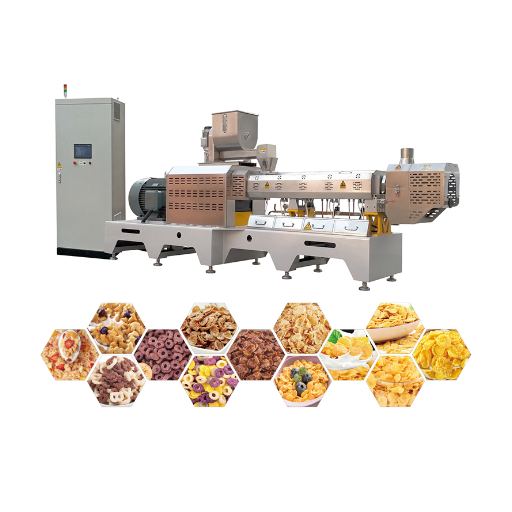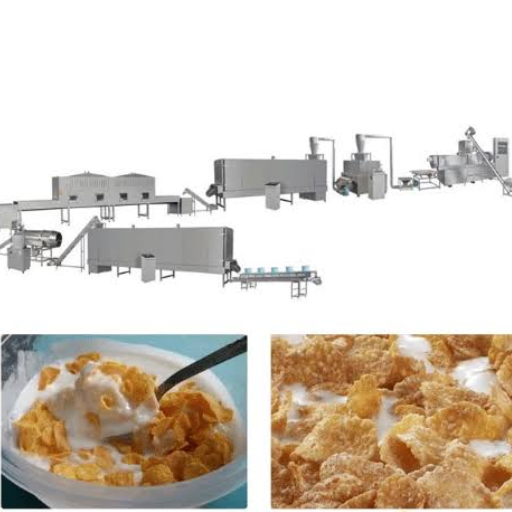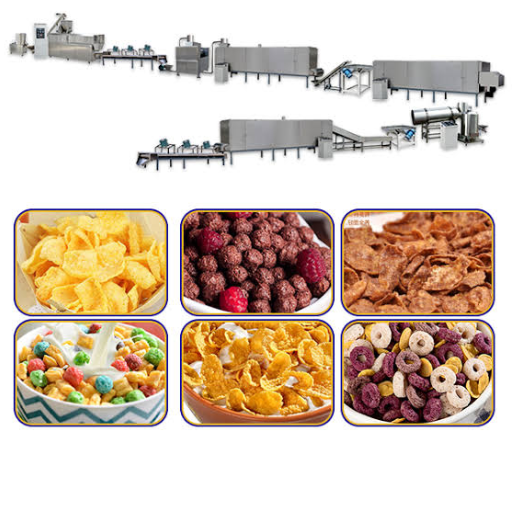
An oat flakes production line is one of two very different machines that share a name. The first is a rolled-oats mill: clean, dehull, kiln, cut, steam, flake, dry. The second is an extrusion line: mix, extrude, pelletise, press, toast, dry. They make different products, and a quotation for one tells you almost nothing about the other.
That’s why the same phrase produces machine lists that barely overlap. A buyer we’ll call Ade shortlisted two quotations in Lagos in early 2026. One described an eight-step mill with a dehuller and a kiln. The other described a five-step extrusion line.
Both documents carried the heading “oat flakes production line.” The prices sat about 40% apart, which is what he noticed first. The products were not comparable at all, which is what he noticed when the samples arrived.
This guide separates the two routes, walks through what each machine set does to the oat, and shows how to compare published capacities, building space and product specs before you commit. By the end you’ll know which line you’re actually buying, and which questions expose a supplier who hasn’t decided either.
Key Takeaways
- Rolled oats and extruded oat flakes are different products made on different lines; the US definition of rolled oats lists steaming, cutting, rolling and flaking, with no extrusion step.
- A rolled-oats mill is built around four machines that set everything downstream: dehuller, kiln, cutter and flaking mill.
- Published line output is quoted in kg/h and length in metres, while mills are often quoted in tonnes/day. Convert before you compare two prices.
- Flake thickness comes from the roller gap, and it decides cook time and which retail tier you can sell into.
- Building length and clear height outlive the machine decision, and they are the hardest things to change later.
What an oat flakes production line actually is
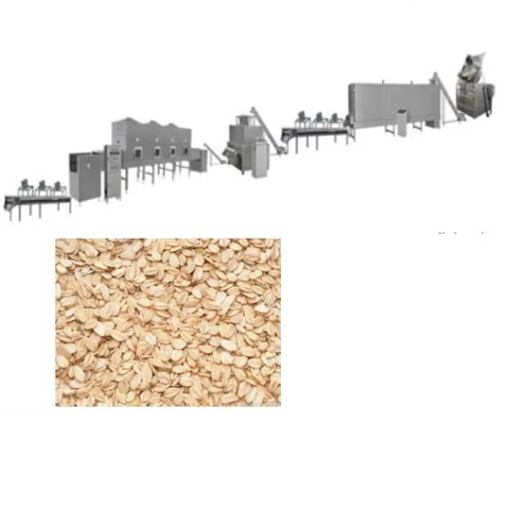
Two production routes hide behind the phrase, and most vendor pages don’t separate them.
| Rolled oats | Extruded oat flakes | |
|---|---|---|
| What the flake is | A dehulled, heat-stabilised groat flattened between rollers | An oat-flour dough cooked in an extruder, pelletised, pressed and toasted |
| Core steps | Clean, dehull, kiln, cut, steam, flake, dry, pack | Mix, extrude, pelletise, flake, dry, coat, dry, pack |
| Capacity quoted in | Tonnes/day or kg/h of groats | kg/h of finished flakes |
| Typical buyer | Oat miller, porridge and muesli brand | Breakfast cereal plant, private-label cereal producer |
If your route is the extruded one, our breakfast cereal production line page lists the machine sequence we publish, and it’s the one to compare against your own process drawing. If your route is rolled oats, keep reading: the section after this one is the machine list to demand by name.
The naming collision isn’t an accident of translation. Both products are thin, both are called flakes, and both end up in a bowl. The difference sits in what happens before the flake is formed, and it changes texture, density, cook time and cost per tonne.
The US Food and Drug Administration settles one half of the question. Its standard for oat products describes rolled oats as produced from dehulled, clean oat groats by steaming, cutting, rolling and flaking, and it sets a beta-glucan floor of 4% on a dry weight basis for the claim (21 CFR 101.81). No extruder appears in that sequence. An extruded oat flake is a legitimate cereal product, but it isn’t rolled oats.
Rolled oats: the eight-step line
A rolled-oats mill is a chain of unit operations where each stage protects the next. Skip one and the product still looks like a flake, then fails in storage or in the bowl. This is the half of the oat flakes production line question that most vendor pages skip.
Cleaning and dehulling
Oats arrive with foreign matter, and the hull is roughly a quarter of the kernel’s weight. Dehulling continues until about 85% of the hulls are removed, according to a review of oat processing in the British Journal of Nutrition (Decker, Rose and Stewart, 2014). Groat moisture of 12 to 13% gives the best dehulling efficiency, so the dryer upstream and the dehuller downstream are tuned against each other.
Kilning
Kilning is the step buyers underestimate. It applies live steam, then dry heat, and finishes the groat at about 10% moisture. The purpose is enzyme control: heat inactivates lipase and lipoxygenase, the enzymes that turn oat lipids rancid. Mills track peroxidase inactivation as the sign that the heat treatment worked.
An unkilned groat flakes beautifully and goes bitter in a warehouse. That’s the whole argument for the kiln in one sentence.
Cutting and steaming before flaking
Whole groats become old-fashioned oats. Cut groats become quick or instant oats. The cut happens before flaking, because cutting after rolling produces fines instead of a clean flake.
Groats are then steamed to add 3 to 5% moisture over 20 to 30 minutes. The moisture softens the groat so the rollers flatten it instead of shattering it, and the steam also partially pre-gelatinises surface starch, which shortens cooking time.
Flaking, drying and packing
Flaking runs the conditioned groat between two counter-rotating rollers. The gap between them sets flake thickness, and the source review is direct about the consequence: thinner flakes cook faster. After flaking, the flake is dried and cooled to a stable moisture, then packed.
A composite story from a quotation review. A mill in Izmir asked three suppliers for a flaking line in 2025 and signed with the cheapest. The drawing had no kiln. The supplier argued that the customer’s groats were already heat-treated upstream.
They weren’t. The first container shipped in spring developed the cardboard note that comes from lipid oxidation, and the rework cost more than the kiln would have.
Any oat flake machine quotation for the rolled route should name each of these:
- Cleaner and destoner
- Dehuller with aspiration
- Kiln
- Cutter
- Steam conditioner
- Flaking mill
- Dryer and cooler
- Packing line
Extruded oat flakes: a different line with the same name
The extrusion route starts with flour, not groats, and it builds the flake from a recipe.
Oat flour is blended with other cereal flour, sugar, malt or syrup and water. The mix is cooked inside a twin-screw extruder under pressure and shear, then expelled through a die and cut into pellets. The pellets pass through a flaking unit that presses them into thin discs, and the discs are dried, coated if the product calls for it, dried again and cooled.
What this route does well:
- Recipe flexibility. Corn, wheat, rice, barley and oat flours run on the same line with different formulations.
- Shape and coating. Cocoa, honey, sugar and vitamin slurries can be applied because the flake holds its shape after toasting.
- Fast cook. The extrusion cook gelatinises starch, so the finished flake softens quickly in milk or hot water.
- Throughput per metre. A 39 m line covers the full sequence from mixing to packing.
What it doesn’t do is make rolled oats. The texture is more uniform and the density is lower than a rolled groat flake, because the flake is a re-formed pellet rather than a flattened kernel. Instant oatmeal sachets and many private-label “oat flakes” cereals come off this kind of line. Porridge oats and muesli bases usually don’t.
Our published equipment for this route is the corn flakes production line, a twin-screw extrusion line that the product page describes as able to run wheat, rice and oat flakes alongside corn. That page is the honest starting point for an oat-flake cereal project, as long as you go in knowing which product you’re making.
Published configurations for an oat flakes production line
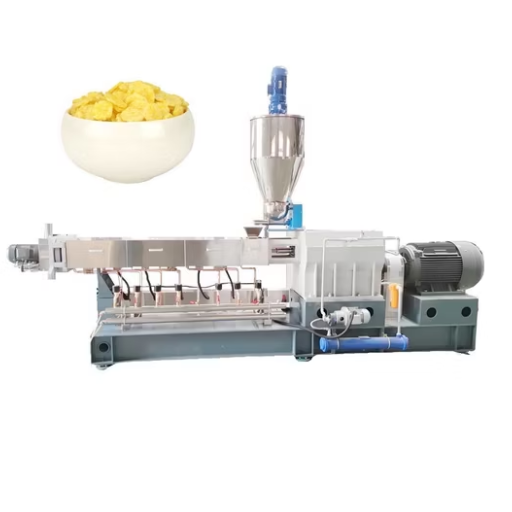
Vendors in this category rarely publish dimensions, and almost nobody publishes power. Here are the two configurations we publish, so you have something concrete to compare against any quotation.
Table 1: extruded cereal line, published configurations. Final configuration is confirmed per project.
| Model | Output | Installed power | Running power | L × W × H |
|---|---|---|---|---|
| LY65 | 120–150 kg/h | 140 kW | 90 kW | 39,000 × 1,200 × 2,200 mm |
| LY70 | 180–220 kg/h | 160 kW | 120 kW | 41,000 × 1,500 × 2,200 mm |
| LY85 | 300–500 kg/h | 190 kW | 140 kW | 43,000 × 3,500 × 4,300 mm |
| LY90 | 800–1,000 kg/h | 240 kW | 190 kW | 65,000 × 5,000 × 4,300 mm |
Two things to notice. First, length grows only 39 to 43 m between LY65 and LY85 while output roughly triples, because the drying and toasting sections scale in width and airflow before they scale in length. Second, the jump to LY90 costs 22 m of building, which is a different kind of project.
For drying and sterilising oat groats, flakes or oatmeal, we publish a continuous microwave range. Our continuous microwave drying and sterilization page carries the full table; the first and last models are enough for planning.
Table 2: continuous microwave dryer and sterilizer, published configurations.
| Model | Power | Dehydration | Sterilization capacity | Size |
|---|---|---|---|---|
| LY-12KW | 12 kW | 12 kg/h | 120–150 kg/h | 7,010 × 840 × 1,750 mm |
| LY-30KW | 30 kW | 30 kg/h | 300–380 kg/h | 11,690 × 840 × 1,750 mm |
| LY-50KW | 50 kW | 50 kg/h | 500–630 kg/h | 11,690 × 1,060 × 1,750 mm |
| LY-80KW | 80 kW | 80 kg/h | 800–1,000 kg/h | 12,680 × 1,200 × 1,750 mm |
| LY-100KW | 100 kW | 100 kg/h | 1,000–1,250 kg/h | 15,200 × 1,200 × 1,750 mm |
| LY-150KW | 150 kW | 150 kg/h | 1,500–1,850 kg/h | 21,050 × 1,200 × 1,750 mm |
The range runs at 2450 ± 50 MHz and 380 V ± 10%, 50 Hz, three-phase five-wire. Belt speed is adjustable from 0 to 10 m/min. Plan the dryer as part of the line layout, not as an add-on, because a 21 m unit decides where the building door goes.
The arithmetic worth doing. LY65 at 120 to 150 kg/h over an eight-hour shift is 0.96 to 1.2 t per shift. At 300 single-shift days that is roughly 288 to 360 t a year at rated output, before any utilisation factor. A mill that quotes you 5 t/day is quoting 1,250 kg/h over an eight-hour day, which is above LY90. Now the two prices are comparable, or they aren’t, and you can see it on one line of paper.
Ready to compare properly? Send us your product specification, target output per shift and building dimensions, and we’ll map them against the published configurations rather than a generic catalog page.
Flake thickness, moisture and shelf life
Three numbers decide whether the flake you make is the flake you can sell, and all three are set on the same oat flakes production line.
Thickness is set by the roller gap, and it’s the product design decision, not a machine setting to tune later. Thin flakes hydrate faster, which is why instant oats are thin and old-fashioned oats are thick. Change the gap and you change the cook time on the back of the pack.
Moisture has two targets. The kiln finishes groats near 10%. Steaming before flaking adds 3 to 5%. After flaking, the flake is dried back to a stable level, usually below 10%, before packing. A flake packed wet develops mould; a flake packed over-dried cracks and produces fines in the bag.
Enzyme inactivation is the shelf-life control. Lipase splits oat lipids into free fatty acids, and lipoxygenase drives the oxidation that tastes like cardboard. Kilning handles both. This is also why the drying step after flaking matters: residual moisture and residual enzyme activity together decide how the product behaves after six months on a shelf.
Nutrition labelling follows from the same process. Rolled oats carry a beta-glucan claim at 4% or more on a dry weight basis and at least 10% total dietary fibre under the FDA standard, and a daily intake of 3 g of beta-glucan from whole oats supports the soluble fibre and heart disease claim. Flaking doesn’t strip whole-grain status either: the Whole Grains Council definition keeps flaked and rolled grain as whole grain as long as bran, germ and endosperm remain in their original proportions.
When the drying step is the bottleneck, an industrial microwave oatmeal dryer shortens residence time compared with a hot-air tunnel. Treat the manufacturer’s time and energy figures as claims to verify on your own product, not as guaranteed results.
Space, clear height and services for an oat flakes production line
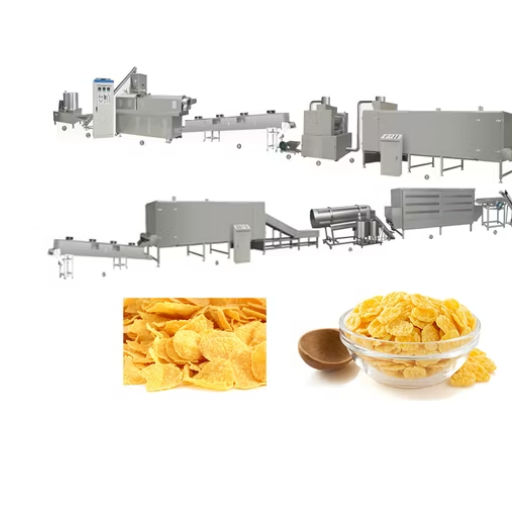
Most oat flakes production line projects fail on the building before they fail on the machine. The arithmetic is simple enough to do before you sign anything.
Length. LY65 is 39 m of equipment. Add roughly 4 m for raw material intake and 4 m for packing and palletising, and you need about 47 m of internal length. LY85 at 43 m needs about 51 m. Add the microwave dryer and the total grows by 7 to 21 m depending on model.
Footprint. The published width is the machine width, not the working envelope. A practical envelope is the line length times three widths: 39 × 3.6 ≈ 140 m² for LY65, and 43 × 4.7 ≈ 200 m² for LY85. Double it before you add raw material stores, finished goods, a laboratory and utilities, so plan on roughly 280 m² for LY65 and 400 m² for LY85.
Clear height. Equipment height plus hood plus service access. LY65 and LY70 stand at 2.2 m, so 2.2 + 1.0 to 1.5 m of hood + 0.5 to 1.0 m of access gives 3.7 to 4.7 m, and 4.5 m is a sensible specification. LY85 and LY90 stand at 4.3 m, which pushes the requirement to 5.8 to 6.8 m, so specify 6 m or more. These are planning estimates; confirm them against the general arrangement drawing.
Services. Steam, compressed air, water, drainage and floor loading aren’t published for either range. Ask for the utility schedule, the floor loading per module and the connection points before the civil work starts. A flaking mill and a dryer both want to sit on a slab that was designed for them, not poured around them.
If your plan is to sell flakes onward rather than pack them as porridge, the granola bar production line is the downstream product to cost at the same time. Flake thickness and fines rate set how much binder the bar line needs, and that’s a purchasing decision, not a production detail.
What to specify before you ask for a quotation
A quotation for an oat flakes production line is only as good as the specification behind it. These six items separate a real quote from a brochure.
- Product definition. Rolled or extruded. Flake thickness in millimetres. Target cook time. Organic or gluten-free segregation, which changes cleaning and conveying design.
- Capacity in your unit. kg/h at the flake, not at the mixer, plus shifts per day and days per year. State whether the number is finished product or groat input.
- Raw material. Groat size, moisture on arrival, origin and dehulling yield. A mill that assumes 85% hull removal and receives 78% groats will under-deliver on every tonne.
- Building. Internal length, clear height, floor loading, door widths and the position of utility connection points.
- Acceptance tests. Moisture, thickness distribution, fines percentage, peroxidase or lipase result, and a shelf-life check at 30 and 60 days.
- Documentation. General arrangement drawing, utility schedule, spare parts list, and the current certificate for the model quoted.
The last one matters more than buyers expect. Our product pages list CE, ISO9001, SGS and BV, and any supplier’s certificate should be checked against the exact model and year, not accepted as a logo on a page.
A composite case on specification. A buyer in Nairobi specified 500 kg/h and nothing else, and received a flake that met the number and cooked in eleven minutes. His retail customer wanted four minutes.
The line was fine. The specification was one line short, and the second set of rollers cost more than the original quotation difference.
Frequently asked questions
What is the difference between rolled oats and oat flakes?
Rolled oats are dehulled groats that have been steamed, cut and flattened between rollers. “Oat flakes” is used for those same rolled oats in some markets, and also for extruded oat flakes made from oat flour on a cereal extrusion line. The process and the texture differ, so ask which one a supplier means.
How much does an oat flakes production line cost?
Cost depends on route, capacity and the drying and packing sections, and published prices go stale fast. Ask for a quote against a written specification that includes output, flake thickness, moisture targets and the building dimensions, then compare the machine lists rather than the totals.
What capacity can a small oat flakes line run?
Our smallest published extrusion configuration, LY65, runs 120 to 150 kg/h, which is about 1 t per eight-hour shift. A rolled-oats mill at the same throughput is usually quoted in tonnes per day, so convert both to the same unit before comparing.
What equipment is needed to make instant oatmeal?
A cutter that produces small groat pieces, a steam conditioner, a flaking mill set to a thin gap, a dryer and a cooler, plus packing. Instant oats are a cut and thickness decision on a rolled-oats line, not a separate process.
Can one line make both rolled oats and extruded flakes?
No. The two routes use different feed material, different core equipment and different drying, and a shared building is the only realistic overlap. Plan for one route and specify it properly.
The next step
Choose an oat flakes production line in this order: product first, then machine, then building. Rolled oats need a dehuller, a kiln and a flaking mill, and those three names should appear in any quotation you accept. Extruded oat flakes need a mixer, an extruder, a flaker, a dryer and a toaster, and the published LY range covers that sequence from 120 to 1,000 kg/h.
We should be straight about scope. Loyal publishes the extrusion line and the microwave drying and sterilization range. We do not publish a dehuller, kiln or rolled-oats flaking mill, so if your project is a rolled-oats mill, this page is a specification checklist rather than a product page, and you should ask every supplier, us included, for the four machine names above.
Either way, the useful next move is the same. Write down the product, the output per shift and the building dimensions, then send them to us and we’ll tell you which published configuration fits and which parts of your plan still need a drawing.