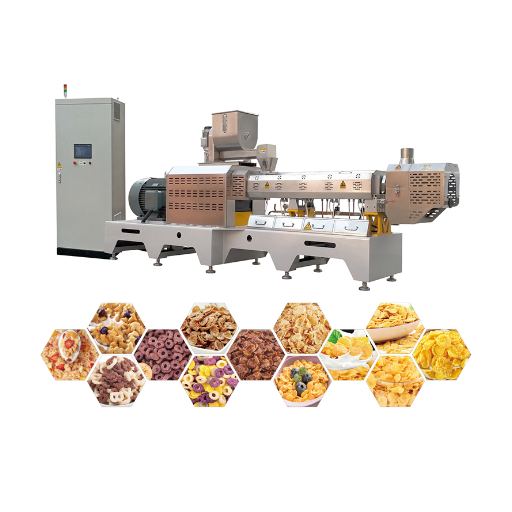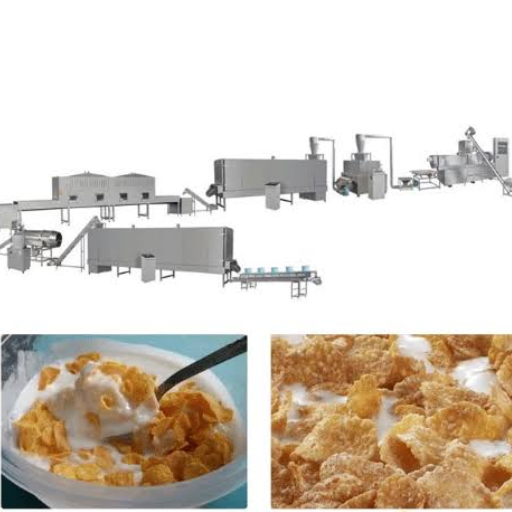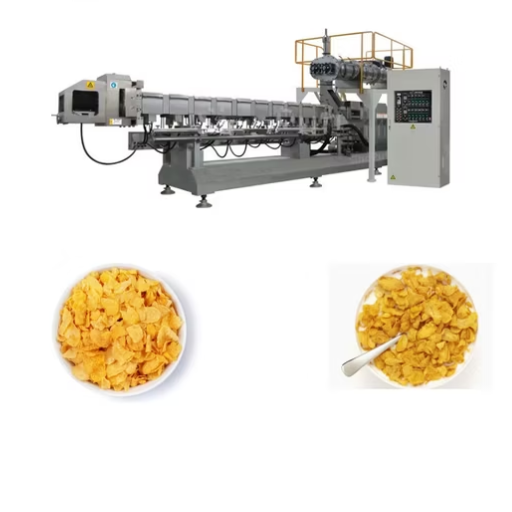
Breakfast cereal is made by cooking grain with sugar, malt and salt. The cooked mass is formed into flakes, puffs, shreds or extruded shapes, then dried and toasted to a finished moisture of 1 to 3%. Every commercial cereal manufacturing process follows that sequence, but the form of the finished piece is decided at one or two stages, not by grain choice.
The cereal production process is unforgiving at those stages. Change the moisture of the grits entering the flaking rolls by three points and a corn flake stops behaving like a flake. It tears, sticks or browns too early, and the defect shows up in the box weeks later.
Most cereal processing guides stop at a block diagram: clean, cook, shape, dry, pack. That diagram is correct and nearly useless when commissioning a line. This guide gives the operating window at each stage and the defect that appears when it is missed. The figures come from Breakfast Cereals and How They Are Made and the US EPA process description, with notes where commercial lines differ.
If you’re specifying equipment rather than studying the process, maps each stage to its machine. If you know your product and output, and we will review the configuration.
Key Takeaways
- Ready-to-eat cereal is cooked at 15-18 psi for about 2 hours (corn) or 30-35 minutes (wheat), then formed and toasted to 1-3% moisture.
- The forming route decides the equipment: flaked cereals need a flaking mill, extruded cereals an extruder and die, puffed cereals a gun or high-temperature oven.
- Flaking rolls run at 43-46°C and about 40 tons of closing pressure; hotter rolls cause sticking and excessive wear.
- Corn flakes are toasted at 275-330°C for about 90 seconds, which is why toasting is the least forgiving stage in the process.
- Coating and fortification come after the heat steps, because heat-sensitive vitamins lose value in the cooker and toaster.
What the Cereal Production Process Produces
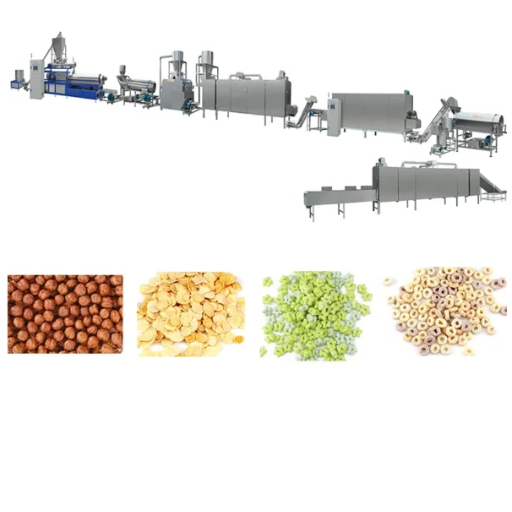
Breakfast cereal splits into two families. Hot cereals, such as oatmeal and farina, still need cooking at home. Ready-to-eat cereals are fully cooked in the plant and eaten from the box, and this article covers that route.
Ready-to-eat cereals are grouped by form rather than by grain. The same corn can become a flake, a puff or an extruded shape, and each route uses a different set of machines.
| Cereal form | Defining step | Common examples |
|---|---|---|
| Flaked | Cooked grits are dried, tempered and pressed between rolls | Corn flakes, wheat flakes, rice flakes |
| Extruded flake | Dough is extruded into pellets, then flaked and toasted | Extruded wheat or multigrain flakes |
| Gun-puffed whole grain | Cooked whole grain is released from high pressure | Puffed rice, puffed wheat |
| Extruded gun-puffed | Extruded shapes are dried and then gun-puffed | Puffed corn shapes |
| Oven-puffed | Rice or corn is bumped, dried and expanded in a very hot oven | Oven-puffed rice, crisped rice |
| Shredded | Cooked wheat is shredded into layers and baked | Shredded wheat biscuits |
| Extruded expanded | Dough expands at the die and is cut to shape | Rings, balls, stars, cocoa shapes |
| Granola | Oats and inclusions are mixed, baked and broken into clusters | Granola, clusters, muesli bases |
If you are still deciding which product to make, our overview of types of breakfast cereals covers the consumer side. The rest of this guide follows the process in the order the material moves.
Grain Preparation: Cleaning, Milling and Conditioning
Every cereal production process starts with grain that has to be made uniform. Receiving separators remove stalks, stones, dust and damaged kernels. Magnets and metal detectors catch tramp metal. The grain is then binned by size and quality, because a cooker batch that mixes coarse and fine grits will cook unevenly.
Corn for flakes is dry-milled to remove germ and bran, leaving chunks of endosperm at roughly one-half to one-third kernel size. Each flake usually represents one grit, so grit size sets flake footprint and packed bulk density.
Wheat takes a different preparation. The bran coat blocks water and flavour, so whole kernels are lightly steamed and passed through rolls to crack them open. This is called bumping. Over-crushing creates flour and fines that make the cook soft, gluey and hard to dry.
Rice is milled to head rice or second heads. Broken second heads are preferred for flakes on cost grounds, while whole grains are used for oven-puffed rice.
Oats follow a separate route. Groats are hulled, kilned and steamed before rolling; the US EPA description gives the target of 8-10% to 10-12% moisture, which lets the rolls produce a sound flake.
Grain preparation decides two commercial numbers: bulk density, which sets how much cereal fits in a carton, and fines, which set yield.
Cooking: Gelatinisation and Flavour Development
Cooking does two jobs. It gelatinises the starch so the grain can be formed and digested, and it drives the flavour solution into the kernel. Both depend on moisture, temperature and time acting together.
Most flaked-cereal plants use a rotating batch cooker with direct steam injection. Grits and a flavour syrup of sugar, malt, salt and water are loaded, capped and rotated while steam raises the pressure.
The windows differ by grain:
| Grain | Steam pressure | Cooking time | Moisture after cooking |
|---|---|---|---|
| Corn grits | 15-18 psi (1.0-1.25 bar) | About 2 hours | Not more than 32% |
| Wheat | 15 psi (1.0 bar) | 30-35 minutes | 28-30% |
| Rice | 15-18 psi (1.0-1.25 bar) | About 60 minutes | About 28% |
| Shredded wheat (atmospheric) | Atmospheric | 30-35 minutes | 45-50% |
A properly cooked corn grit changes from hard and chalky white to soft, translucent and golden brown. It feels rubbery but firm, with no raw starch at the centre. Undercooked starch survives the rest of the process and shows up as white spots in the finished flake. Overcooked grain is worse in a different way: it turns sticky and mushy, blocks the delumper and generates fines that cannot be recovered economically.
A wheat flake line ran 10 minutes long on the cooker because a new shift waited for a pressure gauge to settle. The batch looked cooked. At the lump breaker it formed balls the size of a fist, and the flakes came out with dark edges. The cause was a time window, not a machine fault. Illustrative example of the cooking window, not a customer case study.
After cooking, pressure is released, the cooker is vented and the product is dumped onto a conveyor. Delumping and cooling follow quickly, because the grain keeps cooking while hot, and cooling skins the surface so particles do not stick before drying.
Forming the Piece: Flaking, Extrusion, Puffing and Shredding
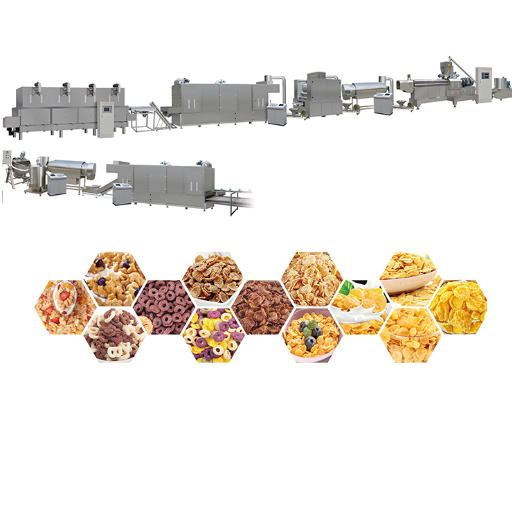
The cereal production process splits into four forming routes here, and the equipment downstream is often shared.
Flaking
Flaked cereals are dried to a precise moisture before rolling. Corn grits are dried below 120°C to 10-14% moisture. Wheat grits leave the dryer at 16-18%, and rice at about 17%. Wheat and rice flakes do not blister like corn, so their windows are set by handling strength rather than expansion.
The dried grits are cooled and tempered. Tempering holds the product in bins so moisture equilibrates from the centre of each grit to its surface. With controlled-humidity dryers, it takes hours rather than the 24 hours once needed.
The flaking mill presses the tempered grits between two large chilled rolls. Three numbers matter:
- Roll surface temperature should be 43-46°C. Above 50°C, product sticks and roll wear increases.
- A normal 50 × 75 cm roll pair applies about 40 tons of closing pressure.
- A modern roll produces roughly 180-550 kg/h of flakes, depending on roll size, speed and product.
The flakes are then toasted. Corn flakes run through air at 275-330°C for about 90 seconds; finished moisture is 1.5-3% for corn and 1-3% for wheat and rice.
When a flake sticks to the roll, the operator reaches for the knife first. The more common cause is moisture. Grits above the window are too sticky; grits below it shatter into small flakes and fines. Check dryer discharge moisture before touching the roll gap.
Flaking is also the line’s usual bottleneck. If you’re sizing a corn flake line, the published corn flake line equipment shows how roll capacity and dryer length scale together.
Extrusion
Extruded cereals skip the cooker. Flour, meal, sugar, salt, malt and water are mixed and fed into a cooking extruder, where shear and steam gelatinise the starch in seconds rather than hours. The dough leaves through a die and a rotating knife cuts it into pellets.
For extruded flakes, the pellets are about 0.6 cm in diameter and 1 cm long at 22-24% moisture. They are dried, tempered, flaked and toasted on the same equipment used for traditional flakes. The extruder replaces the cooker and delumper, not the rest of the line.
For extruded expanded cereals, the die shapes the piece and the moisture flash at the die exit expands it. Rings, balls and stars are formed this way, then dried, coated and packed. Our guide to the covers the mechanism.
The trade-off is product character: traditional cooking gives a layered, blistered flake, while extrusion gives a uniform crisp piece with more shape freedom.
Puffing
Puffing uses a sudden pressure drop to expand cooked grain. Gun puffing loads cooked, tempered grain into a vessel, raises the pressure to about 200 psi (14 bar) with steam and releases it. The steam inside the grain expands and the kernel puffs.
Puffed grain leaves the gun at 5-7% moisture, too high for a crisp product. It is screened and dried to 1-3%.
Oven puffing works differently. Medium-grain rice is cooked to about 28% moisture, dried to about 17%, tempered for 4-8 hours, bumped between rolls, then dried again to 9-11%. The final expansion happens in an oven at 290-340°C for about 90 seconds. Rice and corn puff this way; wheat and oats do not.
Shredding
Shredded wheat starts with whole wheat cooked in excess water at atmospheric pressure for 30-35 minutes to 45-50% moisture. It is cooled, then tempered for up to 24 hours; starch retrogradation firms the kernel enough for a clean shred.
The shredding rolls are a pair: one smooth, one grooved. A comb picks the shreds from the grooves and lays them on a conveyor. A large biscuit needs 10-20 layers. The web is cut with dull edges that crimp the shreds together, then baked at 200-315°C, taking moisture from about 45% to about 4%.
Drying, Tempering and Toasting: Where Quality Is Decided
Drying removes bulk moisture without damaging the surface. The EPA description puts most cereal drying below 121°C with controlled humidity, because a dry surface can case-harden and trap moisture inside the grit.
Tempering follows drying. It’s a diffusion step, not a rest period: moisture moves from particle centre to surface until the piece is uniform enough to flake or shred without shattering.
Toasting is the opposite kind of heat: short, hot and mostly surface-driven. It sets colour and flavour through browning reactions, blisters the flake and brings moisture down to the final 1-3%. The table below gathers the main windows.
| Stage | Target moisture | Typical condition | Defect if missed |
|---|---|---|---|
| Cooking (corn) | ≤32% | 15-18 psi, about 2 h | White starch spots or sticky mash |
| Drying (corn) | 10-14% | Below 120°C, controlled humidity | Case hardening, uneven flaking |
| Drying (wheat) | 16-18% | Below 120°C | Shattered grits or sticky rolls |
| Flaking | 10-14% (corn) | Rolls at 43-46°C, about 40 t | Torn flakes, roll sticking, fines |
| Toasting (corn flakes) | 1.5-3% | 275-330°C, about 90 s | Pale or scorched flakes, soft centre |
| Gun puffing | 5-7% out, then 1-3% | About 200 psi | Unpuffed kernels, hard centres |
| Oven puffing | 9-11% before oven | 290-340°C, about 90 s | Flinty texture, poor expansion |
| Shredded wheat baking | About 45% in, about 4% out | 200-315°C | Pale, soft or cracked biscuits |
| Granola baking | About 3% | 150-220°C | Chewy clusters or scorched oats |
Coating, Fortification and Cooling
Coating adds sugar, flavour, colour or a chocolate layer, and it is usually done in a rotating drum with a sprayed syrup or slurry. The coating adds weight, so a line rated at 500 kg/h of uncoated flakes doesn’t deliver 500 kg/h of a coated product. Output should always be quoted at a defined point: dryer discharge, after coating, or after packing.
Fortification is added at the same stage. Heat-sensitive vitamins are best added after toasting, because the cooker and toaster destroy a meaningful share of some vitamins, including thiamine.
Cooling comes before packaging. Product that is still warm when it enters the bag will condense moisture inside the film, and that moisture softens the cereal and shortens shelf life. Cooling conveyors bring the product close to ambient before the weigher.
Coating is also the main allergen changeover point in a cereal plant. A line that runs a milk or nut-containing coating needs a validated cleaning sequence before it returns to a plain product.
Quality Control and Food Safety Through the Process
Quality control in a cereal plant is mostly a set of measurements taken at stage boundaries, not a final inspection. Each stage has one or two parameters that predict the next stage’s behaviour.
- Incoming grain: foreign matter, mould, moisture and mycotoxins. Mould in raw grain cannot be eliminated completely, so the control is rejection and sanitation.
- Cooking: starch gelatinisation, moisture and the absence of chalky centres.
- Forming: flake thickness, bulk density and colour. Bulk density is the commercial check because it sets fill weight.
- Toasting: final moisture, colour and texture.
- Coating: weight gain, distribution and recontamination risk from additives and transfers.
- Packing: seal integrity, fill weight and metal detection.
These measurements become critical control points. The heat steps control microbial load, but coating ingredients, transfer points, conveyor surfaces and packaging sit downstream of the kill step. Hygienic design and validated cleaning matter as much as the temperature setpoints.
How the Cereal Production Process Changes With Scale and Product Mix
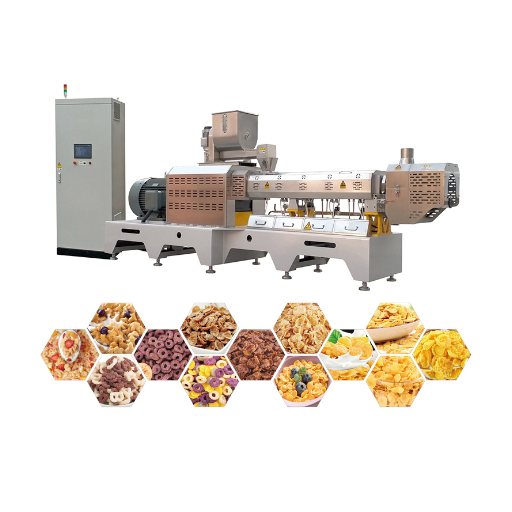
Small plants usually cook in batches and dry continuously. A batch cooker is simpler to run and change over, while a continuous dryer is more efficient. The cost is buffer capacity: a 2-hour cook followed by a 7-minute dump has to be spread into a steady flow between cooker and dryer.
Larger plants move toward continuous cooking extrusion, which removes the batch buffer but narrows the product window. Extrusion is less tolerant of recipe changes and requires more instrumentation to hold quality.
Capacity is set by the slowest stage, and in flaked cereals that is usually the flaking mill. A single modern roll stand at 180-550 kg/h can feed a dryer that is capable of more. Adding a second stand is often the cheapest way to raise output, provided the dryer and toaster have headroom.
A plant running corn flakes wanted to add a ring-shaped extruded product. The first proposal priced a second complete line. The cheaper option was a second extruder feeding the existing dryer, coater and packing line, because the downstream stages were already wider than the flaking section. Shared stages are where expansion is cheapest. Illustrative configuration study, not a quoted project.
If you are weighing a flaked line against an extruded one, or planning an expansion, sets out the configurations, capacity bands and utilities. For a corn-specific comparison, see .
Frequently Asked Questions
How is cereal made step by step?
The cereal production process runs in seven steps: clean and mill the grain, cook it with sugar, malt, salt and water, form the cooked mass, dry and temper it, toast or expand it, coat and fortify it, then cool and pack it. Windows differ by grain and product form.
What is the difference between flaked and extruded cereal?
Flaked cereal is cooked as grain or grits, dried, tempered and pressed between rolls. Extruded cereal is cooked inside an extruder, shaped at a die and cut into pieces. Flaked products have a layered, blistered texture; extruded products hold more complex shapes and a uniform crisp.
At what moisture is cereal toasted?
Most finished cereal leaves the toaster at 1-3% moisture. Corn flakes are typically 1.5-3%, and wheat and rice flakes 1-3%. The toaster also sets colour and flavour, so moisture and temperature must be controlled together.
Why is cereal cooked before it is flaked?
Cooking gelatinises the starch and softens the grain so it can be flattened without shattering. It also drives the sugar, malt and salt solution into the kernel. Without full gelatinisation, raw starch remains and shows as white spots in the finished flake.
How long does the cereal production process take?
Cooking takes about 2 hours for corn and 30-35 minutes for wheat. Drying, tempering and toasting add several hours, and shredded wheat needs up to 24 hours of tempering. A batch can reach a packed box in a day, but tempering and drying set the pace.
Is breakfast cereal ultra-processed?
Many ready-to-eat cereals are classified as ultra-processed because they contain added sugars, flavours and fortificants and pass through several industrial stages. The classification is about formulation and processing level, not a single step such as extrusion.
The Cereal Production Process in Five Points
The cereal production process is a sequence of moisture and heat windows, and every product form uses them differently. Grain is cleaned, milled, cooked under pressure, then formed by rolls, an extruder, a puffing gun or a shredding roll. It is dried, tempered and toasted to 1-3%, then coated, fortified, cooled and packed.
The numbers in this cereal production process guide are industry windows from the Cereals & Grains reference and the EPA process description, not a fixed recipe. Your grain, your product shape and your coating will move them, and the line has to be commissioned around your product rather than around a generic table.
If you want those windows checked against a specific product and output, and include the cereal type, the target capacity and the packing format. We will review the process and the equipment configuration together.