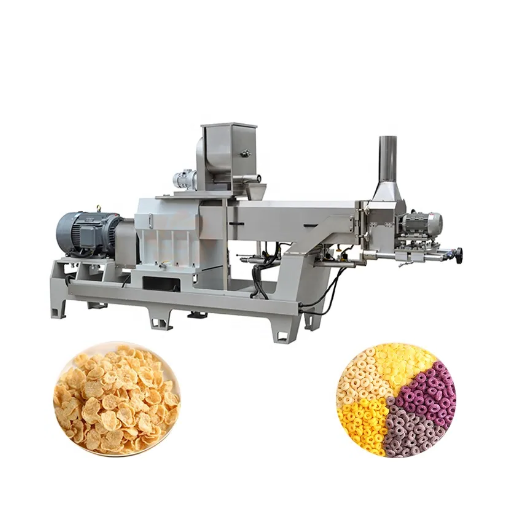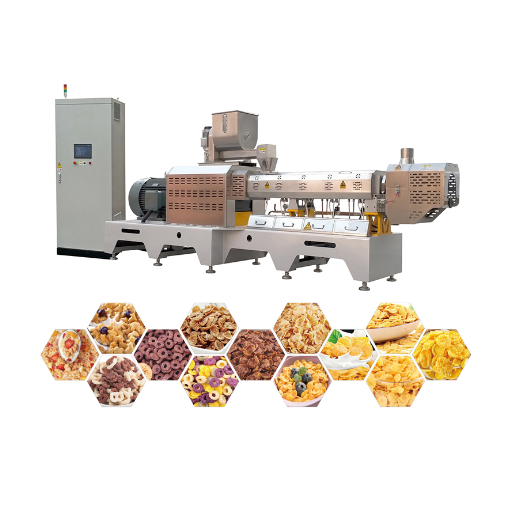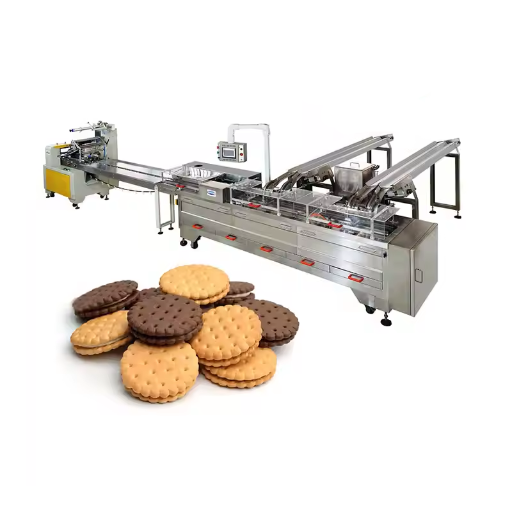
Cereal manufacturing equipment is the set of machines that turns grain into a finished, shelf-stable breakfast cereal. It runs from intake and cooking through flaking, drying, toasting, coating and packaging. A complete line usually includes a cleaner, a mixer, a cooker or extruder, a flaking mill, a dryer, a toaster, a coater, a cooler and packaging machinery. The exact configuration depends on the cereal type you intend to make.
Most buyers start with one number: output in kilograms per hour. That number is necessary, but it hides the decisions that determine whether the line actually runs at that rate. Steam capacity, flaking roll condition, dryer length and coating weight all move the real output.
This guide covers the decisions behind cereal manufacturing equipment selection. You will see what each stage does and which configuration suits each cereal type. We also cover capacity tables, utilities, floor space, cost drivers and the questions to ask a supplier before you sign.
If you already have a product and a target output, . If you are still mapping the process, read on.
Key Takeaways
- Cereal manufacturing equipment is configured around the product type first and the capacity second; a flaked line and an extruded line share packaging equipment but need different core machines.
- The configurations published on this page run from 120–150 kg/h at 140 kW installed to 800–1,000 kg/h at 240 kW installed, with line lengths from 39 m to 65 m.
- Installed power, steam demand, compressed air, water and ceiling height belong in the quotation, not in a later conversation.
- The six cost drivers are capacity, product type, automation level, materials and hygienic design, utilities and heat recovery, and packaging.
- A useful supplier questionnaire has ten questions; a supplier who cannot answer all ten in writing has not engineered your line yet.
What Cereal Manufacturing Equipment Includes
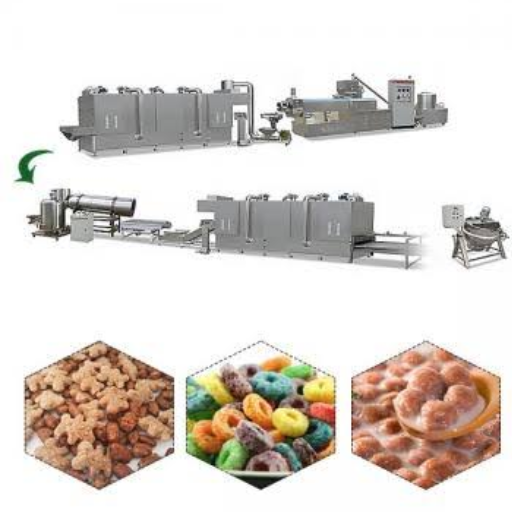
The full set of cereal manufacturing equipment follows a fixed sequence of unit operations, but not every product uses every stage. The table below shows the usual stage, the machine that performs it, and whether the stage is optional.
| Stage | Machine | Purpose | Optional? |
|---|---|---|---|
| 1. Intake and cleaning | Receiving hopper, sieve, destoner, magnet | Remove stalks, stones and metal before processing | No |
| 2. Mixing and blending | Ribbon blender or batch mixer | Combine grain, flour, sugar, salt, malt and water evenly | No |
| 3. Cooking | Rotary steam cooker or preconditioner | Gelatinise starch and hydrate the grain | No, but method varies |
| 4. Extrusion | Single or twin-screw extruder | Cook, shape and expand in one step | Only for extruded products |
| 5. Flaking | Flaking mill with chilled rolls | Press cooked grain into thin flakes | Only for flaked products |
| 6. Drying | Multi-pass belt dryer | Bring moisture down to the toasting window | No |
| 7. Toasting | Toaster with zoned burners or electric heaters | Expand, brown and set the flake | Flaked and puffed products |
| 8. Coating | Coating drum with syrup or slurry spray | Add sugar, flavour, vitamins or chocolate | Optional |
| 9. Cooling and packaging | Cooling conveyor, multihead weigher, bagger, cartoner | Stabilise the product and pack it | No |
The sequence is simple to describe and hard to balance. Each stage has a throughput ceiling, and the line runs at the slowest one. A 500 kg/h dryer behind a 300 kg/h flaking mill gives you a 300 kg/h line with an oversized dryer.
The full stage-by-stage explanation, with operating windows and quality checks, is in our guide to .
This is why a good quotation lists the capacity of each machine, not just the capacity of the line. Ask for that breakdown. It is also the fastest way to spot a configuration that was copied from another project.
Priya’s team in Pune learned that lesson while comparing three quotes for a 300 kg/h corn flake line. All three promised the same output. Only one listed steam demand, drying length and installed power. The cheapest quote needed a larger boiler, which erased the saving before the line was even installed. They chose the supplier who had shown the utility schedule first.
The difference between cooking and extrusion
Traditional flaked cereals cook the grain in a rotary vessel with steam, then dry and temper it before flaking. Extruded cereals cook, shape and expand inside the extruder itself, so they need no separate cooker and no flaking mill.
Both routes are mature. The choice depends on the product, not on which technology sounds newer. Corn flakes, oat flakes and multigrain flakes are flaked products. Rings, balls, stars and cocoa puffs are extruded.
Some plants run both routes and share the dryer, coater and packaging line.
If you want the mechanics of the extrusion step, our guide to the food extrusion process covers screw geometry, shear and expansion in detail.
Cereal Machinery by Product Type: Flaked, Extruded, Puffed, Shredded and Granola
Product type is the first specification, because it decides which core machines you need. The industry reference Breakfast Cereals and How They Are Made groups ready-to-eat cereals into roughly a dozen categories, including flaked, gun-puffed whole grain, extruded gun-puffed, shredded, oven-puffed, granola, extruded expanded and muesli-type products.
Those categories collapse into five practical line configurations. If you are still deciding what to make, our overview of covers the consumer side; the sections below cover the equipment side.
Flaked cereals: corn flakes, oat flakes and multigrain flakes
A flaked line needs a cooker, a flaking mill, a dryer and a toaster. The grain is cooked to a soft, hydrated state, dried to a firm consistency, then passed between two chilled rolls set close together. The flake thickness comes from the roll gap, usually around 0.1 mm for a standard corn flake.
Two details decide quality more than any other. The first is tempering: grain that is too wet tears at the rolls, and grain that is too dry cracks. The second is roll condition: a worn or uneven roll produces flakes of different thickness, which toast at different rates and give you a bag with dark and pale pieces.
A flaked line is the most equipment-heavy configuration per tonne of output, because it carries both a cooker and a flaking mill. It is also the most sensitive to product changeover, since flake thickness, cooking time and toasting profile all move together.
For corn specifically, our page goes deeper on flaking mill settings, toaster zones and capacity options.
Extruded and direct-expanded cereals: rings, balls and stars
An extruded line replaces the cooker and flaking mill with a preconditioner, an extruder, a die and a cutter. The extruder cooks the mix under pressure and shear, the die sets the cross-section, and the cutter sets the length. Expansion happens as the product leaves the die and the pressure drops.
The equipment decision here is die and cutter design, not line length. A die with too little open area limits output; a cutter with the wrong speed gives ragged edges. Product shape changes are usually a die and cutter change, which is faster than a flaking line changeover.
Extruded lines are shorter than flaked lines for the same output, and they use less steam because the extruder supplies most of the cooking energy. They use more electrical power per tonne, because the extruder motor is the dominant load.
Gun-puffed and oven-puffed whole grains
Gun puffing cooks whole grains, dries them to a low moisture, then heats them in a sealed rotating vessel and releases the pressure. The sudden drop makes the grain puff from the inside. The equipment is compact but needs careful pressure and temperature control, plus a dryer and usually a coater.
Oven puffing uses a different mechanism and a different machine set. It is less common than gun puffing and extrusion, and it is usually specified for a narrow product range.
Shredded cereals
Shredded products pass cooked, tempered whole grain through grooved shredding rolls, then bake the resulting strands in an oven. The line looks different from a flaked line: shredding rolls, a layering conveyor and a baking oven replace the flaking mill and toaster.
Shredded lines are specialised. They are worth specifying only when the product is central to your range, because the rolls and oven are not easily repurposed.
Granola, muesli and clustered cereals
Granola is mixed, baked or roasted, then cooled and packed. There is no extrusion and no flaking. The core equipment is a mixer, an oven or roaster, a cooling conveyor and a packaging line. Muesli is even simpler: blend dry ingredients, then pack.
Granola lines are often the lowest-capital entry point into cereal manufacturing, but they are also the least flexible if you later want flakes or puffs. A granola line cannot be upgraded into a flaked line without adding most of the flaked line’s core equipment.
What the configurations share
Every configuration shares intake, drying in some form, cooling, conveying and packaging. That shared tail is where a plant can save money by buying one packaging line and running it across products. The saving only holds if changeover and allergen controls are designed in from the start.
| Product type | Core machines | Shared downstream | Typical bottleneck |
|---|---|---|---|
| Flaked | Cooker, flaking mill, toaster | Dryer, coater, cooler, packaging | Flaking mill throughput |
| Extruded | Preconditioner, extruder, die, cutter | Dryer, coater, cooler, packaging | Extruder motor and die area |
| Gun-puffed | Puffing vessel, dryer | Coater, cooler, packaging | Batch cycle time |
| Shredded | Shredding rolls, baking oven | Cooler, packaging | Oven capacity |
| Granola / muesli | Mixer, oven or roaster | Cooler, packaging | Oven batch size |
Cereal Manufacturing Equipment Capacity and Specifications
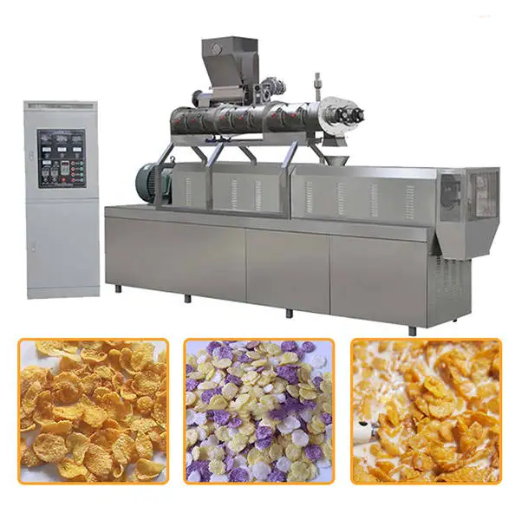
Cereal manufacturing equipment capacity is usually quoted as finished product per hour. That sounds unambiguous until you compare two quotes and find that one figures output at the end of the dryer and the other at the end of packaging, after coating weight and rejects.
Ask every supplier to state the basis: product, moisture at the point of measurement, coating level, and whether the number is raw-material input or finished output. A line quoted at 500 kg/h on uncoated flakes does not deliver 500 kg/h of a 15% coated product.
Published line configurations
The table below shows the configurations published for our corn flake process lines. It is a useful reference for how output, installed power and line length scale together. Final configuration is confirmed per project, because product type, coating and packaging change the numbers.
| Model | Installed power | Running power | Output | Line size (L×W×H) |
|---|---|---|---|---|
| LY65 corn flake process line | 140 kW | 90 kW | 120–150 kg/h | 39,000×1,200×2,200 mm |
| LY70 corn flake process line | 160 kW | 120 kW | 180–220 kg/h | 41,000×1,500×2,200 mm |
| KING75 corn flake process line | 190 kW | 140 kW | 300–500 kg/h | 43,000×3,500×4,300 mm |
| KING95 corn flake process line | 240 kW | 190 kW | 800–1,000 kg/h | 65,000×5,000×4,300 mm |
What changes between 120 kg/h and 1,000 kg/h
The smallest cereal manufacturing equipment configuration runs one lane through the dryer and a narrower toaster. The large line runs multiple lanes, a wider band and a longer cooling section. That widening is why the line grows from 1.2 m to 5 m in width and from 39 m to 65 m in length.
The pattern repeats across configurations: capacity scales through width and lane count more than through speed. Running a belt faster is limited by drying time and toasting time, which are set by the product. Running it wider is limited by floor space and by how evenly you can distribute product across the band.
This is also where layouts fail. A buyer plans for a 300 kg/h line, then discovers that the 1,000 kg/h version needs a building 65 m long with a 4.3 m ceiling and a wider packaging hall. The equipment price is only part of the project.
Why installed power is not running power
The published table shows both. The gap between them is not inefficiency; it is diversity. Not every motor runs at full load at the same moment, and heaters cycle. A toaster may draw full power during preheat and less during steady production.
For utility planning, use installed power for the electrical supply and running power for the energy estimate. For the transformer and cable sizing, the installed figure is the one that matters. For the operating budget, the running figure is the better starting point, adjusted for your actual load profile.
If you want a configuration checked against your product and target output, and include the product, the coating level and the packing format.
Cereal Production Equipment: Utilities, Footprint and Layout
Utilities are where thin quotations for cereal manufacturing equipment hide. A quote that lists machines and prices but not steam, air, water and drainage leaves you to discover the gap after the building is designed.
Power
Plan the electrical supply around installed power, plus margin for the packaging line and building services. Ask for the motor list with kW ratings, the control panel location, and whether the line needs a separate MCC room. A line with variable-frequency drives on the extruder, dryer fans and conveyors will have a different harmonic profile from a line with direct-on-line starting.
Steam
Steam drives cooking, drying and toasting, and it is usually the largest thermal load on a flaked line. Ask for steam pressure, steam consumption per hour at rated output, and condensate return requirements. If the site has an existing boiler, confirm that its capacity and pressure match the line before you commit.
Compressed air, water and drainage
Compressed air runs valves, cylinders and some conveying systems. Water is used for cleaning and, in some designs, for cooling. Drainage matters more than buyers expect. Cleaning a cereal line produces water and fines, so floor drains and washdown points need to be planned with the layout, not added later.
Footprint and ceiling height
The published line sizes give a starting point: 39 m for the smallest configuration, 65 m for the largest, with heights of 2.2 m and 4.3 m. Those heights are the equipment envelope, not the building. Add clearance for maintenance access, ductwork and the dryer and toaster stacks.
A buyer in Lagos planned a 500 kg/h line inside a hall designed for a 40 m run. The machines fitted. The toaster’s maintenance access and exhaust duct did not. The line ran with one burner bank removed and never reached its rated output, and the fix was a new roof section rather than a new machine.
Plan for material flow as well as floor area. Raw material should enter at one end, packaging should leave at the other, and finished goods should not cross the raw-material path. If the building forces a U-shape, confirm that conveyors and transfer points can handle the turns without breaking product.
Expansion allowance
Leave room to add a flaking mill, a second coater or a second packaging line. The most common regret in cereal projects is not buying too small a line; it is buying a line with no physical room to grow. A 20% to 30% allowance in the production hall is cheaper than a new building.
For a complete plant view, including how the cereal line fits with other lines, see .
What Drives the Cost of Cereal Manufacturing Equipment
There is no single price for cereal manufacturing equipment, and any supplier who quotes one without asking about your product is guessing. The quotation moves with six drivers.
1. Capacity. Output drives machine size, belt width, dryer length, motor ratings and packaging speed. Doubling output does not double cost, because some components scale faster than others, but it always increases it.
2. Product type. A flaked line carries a cooker, a flaking mill and a toaster. An extruded line carries an extruder, a die set and a cutter. A granola line carries a mixer and an oven.
The machine set changes the price more than the capacity does.
3. Automation level. Manual start-up, recipe management, remote monitoring and data logging all add cost. They also change the operator count and the consistency of the product. Decide which level you need before you compare quotes, or you will compare different lines.
4. Materials and hygienic design. Food-contact surfaces, washdown protection, stainless grade, frame design and enclosure IP ratings all affect price. A line built for dry cleaning and a line built for wet washdown are not the same product.
5. Utilities and heat recovery. Steam pressure, burner type, heat recovery on the dryer and toaster exhaust, and the electrical supply all change the project cost. Heat recovery can reduce running cost, but it adds capital cost and complexity.
6. Packaging. A line that fills bags at 30 bags per minute and a line that fills, seals and cartons at 120 packs per minute are different projects. Packaging is often quoted separately, and it should be, because it is the easiest part to scale independently.
A good quotation itemises these drivers, states what is included and what is excluded, and separates equipment from installation, commissioning, freight and spares. If you want to understand how machine-level pricing works before you ask for a full line quote, our guide to what drives extruder cost explains the same logic at the single-machine level.
What a quote should itemise
- Every machine, with model, capacity and installed power
- Steam, air, water and power demand at rated output
- Scope of supply: ex-works, FOB, CIF or delivered
- Installation, commissioning and training, or a clear exclusion
- Spare parts list and recommended first-order spares
- Drawings, manuals and control documentation
- Warranty terms and the conditions attached to them
If a quote omits the utility schedule or the scope boundary, ask for it in writing before you compare prices. Two quotes with different scope boundaries are not comparable, even when the totals look close.
Installation, Commissioning and Acceptance
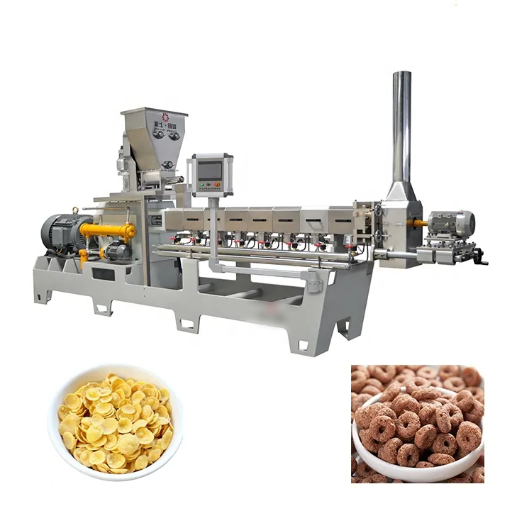
A cereal manufacturing equipment project is not finished when the machines arrive. It is finished when the line runs at the contracted output, at the contracted quality, with your operators running it.
Factory acceptance test (FAT). Before shipping, the main machines should be assembled and run at the factory where practical. The FAT confirms rotation, controls, safety interlocks and basic function. Ask for the FAT checklist and the test record.
Installation. Foundations, floor levelling, utility connections and conveyor alignment are project work. Confirm who is responsible for each item and who supplies the connection materials.
Site acceptance test (SAT). After installation, the line runs with your raw materials. The SAT should confirm output, product moisture, flake thickness or shape, coating weight and packing rate against the agreed specification.
Ramp-up. Most lines do not reach full rated output on day one. Product is adjusted, operators learn the controls, and small issues are corrected. A realistic ramp-up plan sets weekly targets and names who is responsible for each one.
A team in Guadalajara ran a 150 kg/h flaked line for two years before demand outgrew it. They added a second flaking mill and a wider packaging line, and kept the existing dryer and toaster because both still had headroom. Output rose by about half without a second drying stage, because the original line had been specified with the bottleneck in mind.
Training and documentation. Operators need training on start-up, shutdown, changeover, cleaning and fault response. Maintenance staff need drawings, a spare-parts list and recommended service intervals. Ask for the documentation package as a deliverable, not as a favour after commissioning.
What “turnkey” should mean. In a useful contract, turnkey means one party is responsible for the process design, the equipment, the installation and the performance test. In a weak contract, it means the equipment is delivered and the rest is your problem. Read the scope table, not the word.
How to Choose a Cereal Manufacturing Equipment Supplier
The fastest way to separate a real cereal manufacturing equipment supplier from a catalogue is to send the same ten questions to every vendor and compare the answers in writing.
- Which cereal types has this exact configuration run, and can you share the operating parameters?
- What output is guaranteed, for which product, at what moisture and coating level?
- What are the installed and running power, steam, air and water demands at rated output?
- What is the line footprint and the minimum ceiling height, including maintenance access?
- What is the expected yield at each stage, and where does product loss occur?
- Which components are manufactured in-house and which are bought in?
- What control system is used, and what data does it log?
- What is included in FAT, SAT, installation and operator training?
- What spare parts should be stocked, and what are their lead times?
- What is the commercial scope and the payment schedule?
A supplier who answers all ten in writing has engineered your project. A supplier who answers three and offers a call has sent you a brochure with a price attached.
Cereal Manufacturing Equipment FAQ
How much does cereal manufacturing equipment cost?
It depends on capacity, product type, automation, materials, utilities and packaging. A granola line and a flaked line at the same output are different projects. Ask for an itemised quotation that separates equipment, installation, commissioning, freight and spares, so you can compare scope rather than totals.
What is the smallest capacity available?
The configurations published on this page start at 120–150 kg/h. Smaller lines exist, but the configuration changes: shared equipment, smaller dryers and manual packing. Below roughly 100 kg/h, the labour and changeover cost per tonne rises quickly, so confirm the operating model before choosing a small line.
How much space does a cereal line need?
Published line lengths run from 39 m to 65 m, with equipment heights from 2.2 m to 4.3 m. Add maintenance access, ductwork, raw-material storage and finished-goods space. A 20% to 30% expansion allowance in the production hall is worth planning for from the start.
What is the lead time?
Lead time for cereal manufacturing equipment depends on the configuration, the number of custom machines, the control system and the destination. It is a commercial term, not a catalogue number, so ask for it in the quotation with the scope and the shipping terms attached.
What is the difference between a corn flake line and an extruded cereal line?
A corn flake line cooks the grain, flakes it between rolls, dries it and toasts it. An extruded line cooks, shapes and expands the product inside the extruder, then dries and coats it. The flaked line needs a flaking mill and a toaster; the extruded line needs a die and a cutter.
Should I buy used cereal manufacturing equipment?
Used equipment can reduce capital cost, but inspect the flaking rolls, dryer bands, burner condition and control system first. Confirm that spare parts are still available and that the machine can meet current food-safety and electrical requirements in your market. A used line with an obsolete control system can cost more to run than a new line with a modern one.
Conclusion
Cereal manufacturing equipment is a system, not a shopping list. The product type sets the core machines, the capacity sets the size, and the utilities and layout set whether the line can actually run at the number on the quotation.
Start with four specifications: the cereal type, the target output in finished product per hour, the coating and packing format, and the available building envelope. Then ask every supplier for the same itemised scope, the utility schedule and the acceptance test plan.
If you send us those four specifications, we will review the configuration and come back with the machine set, the published capacity data and the questions we still need answered. and we will take it from there.