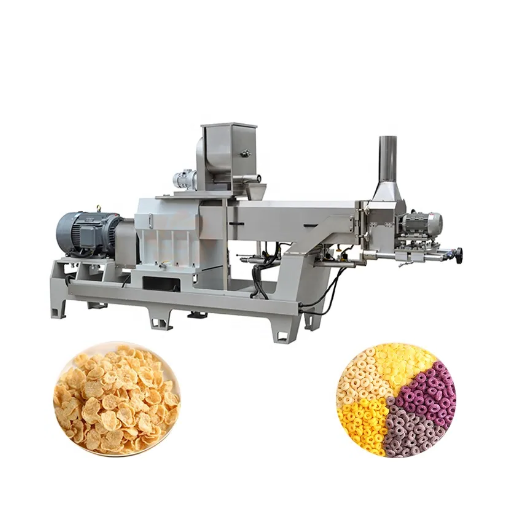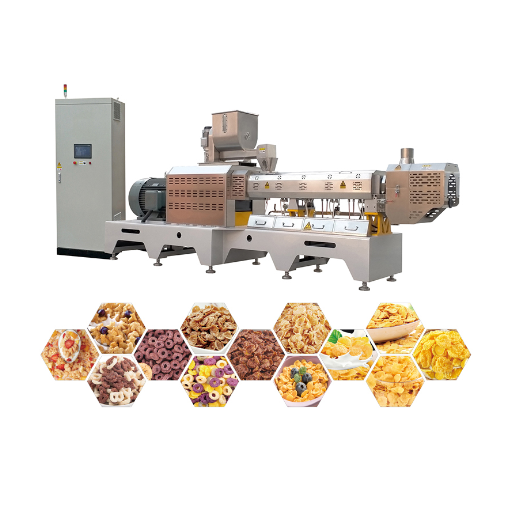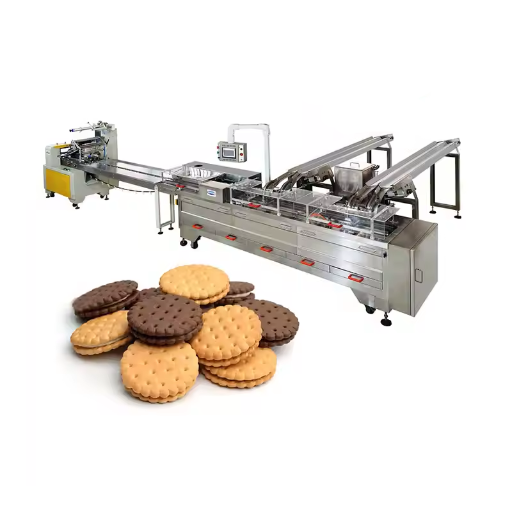
A complete breakfast cereal production line costs roughly $25,000 to $70,000 at 100 to 200 kg/h, $35,000 to $170,000 at 300 to 500 kg/h, and $55,000 to $250,000 at 800 to 1,000 kg/h in 2026, for China-origin equipment only. Add the building, utilities and working capital, and the plant costs two to three times the line.
Two quotes for the same 500 kg/h line can land at $40,000 and $170,000. Neither supplier is lying. One includes a wider dryer, a second toaster zone, automatic packing, installation and spares. The other includes the core machines.
This guide separates three numbers the market keeps mixing: equipment cost, plant cost, and cost per kilogram to run the line. It covers price bands, the drivers behind them, an operating model, and the questions that expose a thin quote. page shows the published models.
Key Takeaways
- Equipment-only observations in 2026 run from about $25,000 at 100 to 200 kg/h to $250,000 at 800 to 1,000 kg/h, China-origin and FOB; the same capacity can be quoted 10 times apart because scope differs.
- A plant costs more than a line: in a published 1 TPD Indian project, land, building and working capital were larger than the plant and machinery.
- Raw materials are 70 to 80% of operating cost and utilities 10 to 15%, so the machine price is not where the monthly budget goes.
- Cost per kilogram is a formula built from your own yield, tariffs and wages, not a vendor benchmark.
- A quote is comparable only when it states output basis, utility demand, scope boundary and exclusions.
How Much Does a Breakfast Cereal Production Line Cost?
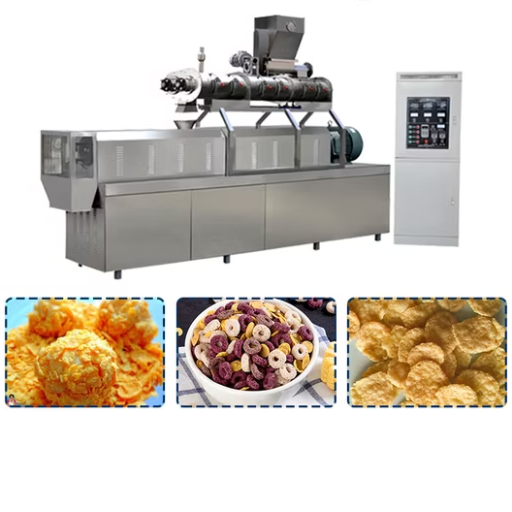
The table compiles published listings and reports from 2026: China-origin, FOB, equipment only. A planning reference, not a quote.
| Capacity band | Observed equipment range | What it usually includes | What it often excludes |
|---|---|---|---|
| 100 to 200 kg/h | $25,000 to $70,000 | Mixer, cooker or extruder, flaking mill, dryer, basic coater, packing | Boiler, installation, freight, duty, spares |
| 300 to 500 kg/h | $35,000 to $170,000 | Wider dryer and toaster, better controls, optional automatic packing | Civil works, utility connections, commissioning |
| 800 to 1,000 kg/h | $55,000 to $250,000 | Multi-lane drying, larger toaster, higher-grade controls | Building, working capital, spare-parts inventory |
| Plant with building and utilities | Project-specific | Line plus land, building, boiler, electrical, working capital | Nothing; this is the full project scope |
A complete line runs nine stages: intake and cleaning, mixing, cooking or extrusion, flaking, drying, toasting, coating, cooling and packaging. Each stage has a throughput ceiling, and the line runs at the slowest one. A quote that omits the dryer, toaster or packaging is a partial line. See how breakfast cereal is processed for detail.
Listings span from about $7,000 for a bare line to $600,000 for a premium configuration. A $7,000 listing is not a complete line; a $600,000 listing is not the same product as a $60,000 one. The number only means something with the scope attached.
Line cost vs plant cost
The line is the equipment. Cereal manufacturing plant cost adds land, building, boiler, electrical supply, drainage, warehousing, working capital and start-up costs.
A published Indian project for a 1 tonne per day corn flakes unit shows the split: land and building for 1,200 square meters ₹1.05 crore, plant and machinery ₹67.91 lakh, and three months of working capital ₹52.10 lakh. Total capital investment was ₹2.18 crore, at a stated 22% return (EIRI).
Building and working capital together were larger than the machines. Budgeting only for the line covers less than half the project.
Why published ranges differ by 10 to 20 times
- Scope. Dryer length, toaster zones, coating, automatic packing, installation, spares and training are optional.
- Capacity basis. Nameplate kg/h is not output at your product, moisture, coating level and OEE. A 500 kg/h line on uncoated flakes does not deliver 500 kg/h of coated product.
- Origin and terms. China, India, Turkey and Europe carry different cost structures; FOB, CIF and delivered duty paid are different numbers.
- Date. A 2023 price list is not a 2026 price list.
A project team in Nairobi compared two 500 kg/h quotes at $41,000 and $168,000. The lower quote ended at the dryer discharge: no toaster, coating drum or packing line. Once the missing stages were priced, the gap fell to about 20%. The sticker had been answering a different question. Illustrative composite.
What Determines Breakfast Cereal Production Line Price?
Capacity and line width
Output drives machine size, belt width, dryer length, motor ratings and packaging speed. On our published corn flake process line range, output runs from 120 to 150 kg/h at 140 kW installed to 800 to 1,000 kg/h at 240 kW installed, and line length grows from 39 m to 65 m.
Capacity scales through width and lane count, not belt speed. Drying and toasting times are set by the product, so a faster belt does not double output. A wider belt does, but needs floor space and a wider building.
Product type and configuration
A flaked line needs a cooker, a flaking mill, a dryer and a toaster. An extruded line needs a preconditioner, an extruder, a die set and a cutter, and no flaking mill.
A gun-puffed line needs a puffing vessel. A granola line needs a mixer and an oven. The machine set changes the price more than the capacity does.
Dryer and toaster
Drying and toasting are the thermal core of a flaked line, the largest utility load, and a major share of the equipment budget. Ask for dryer length, band width, zone count, burner type, steam or gas consumption, and heat-recovery options.
On our page, published steam consumption runs from 120 kg/h on the 100 kg/h model to 800 kg/h on the 1,000 kg/h model. That range is a better utility-planning input than the motor rating.
Automation, controls and materials
PLC controls, recipe management, remote monitoring, data logging and safety interlocks are priced individually. So are stainless grade, food-contact materials, washdown protection and frame design. Define which machines are linked and which checks still need an operator.
Origin, Incoterm and scope boundary
China-origin equipment usually carries lower capital cost. European equipment usually carries higher capital cost and often stronger documentation, energy performance and service reach.
Neither is automatically cheaper over ten years. Compare landed cost per tonne of annual capacity, not the FOB number. A quote that excludes the boiler or installation is not comparable.
Packaging
Packaging is the most under-specified line item. A line that fills 30 bags per minute and one that fills, seals and cartons 120 packs per minute are different projects. Film cost per pack belongs in the operating model.
Breakfast Cereal Production Line Cost Breakdown by Machine
These shares are a planning estimate from line structure, not a published market statistic. Use them to sanity-check a quote, not to negotiate a machine. For single-machine pricing, see .
| Section | Share of equipment budget | What it does | What it costs to get wrong |
|---|---|---|---|
| Intake, cleaning, conveying | 5 to 8% | Remove stones, stalks and metal | Contamination, downtime, rejects |
| Mixing and cooking | 12 to 18% | Hydrate and gelatinise starch | Inconsistent flake texture |
| Extrusion or flaking | 15 to 22% | Shape and expand, or press into flakes | Capacity bottleneck, poor flake thickness |
| Drying | 18 to 25% | Bring moisture into the toasting window | Cracking, uneven color, energy waste |
| Toasting | 10 to 15% | Expand, brown and set the product | Dark and pale pieces in one bag |
| Coating | 5 to 8% | Sugar, flavour, vitamins, chocolate | Giveaway, allergen changeover time |
| Cooling and conveying | 5 to 8% | Stabilize before packing | Condensation, breakage, jams |
| Packaging | 10 to 15% | Weigh, fill, seal, carton | Film waste, speed mismatch, giveaway |
| Controls and electrical | 6 to 10% | Coordinate stages, recipes, safety | Startup delays, operator error |
Thermal equipment, meaning dryer and toaster, takes the largest share of a flaked line’s budget. The extruder and its drive take the largest share of an extruded line. Heat, airflow and control matter more than steel.
Operating Cost: What It Costs to Run a Cereal Line
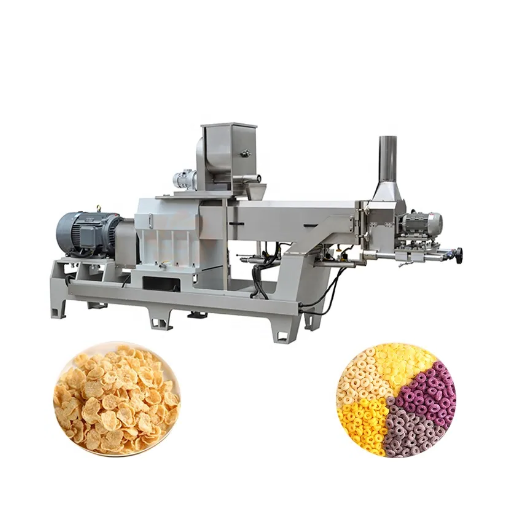
Equipment is one-time. Raw materials, energy, labor, maintenance and packaging repeat every month, and decide whether the line makes money. Published analysis for corn flakes plants puts raw materials at 70 to 80% of operating expenses and utilities at 10 to 15% (IMARC).
Energy: the controllable part
Use running power, not installed power, for the energy estimate. On our KING75 model, installed power is 190 kW and running power is 140 kW at 300 to 500 kg/h. At $0.10 per kWh, that is about $14 per hour, or $0.028 to $0.047 per kg before steam.
Steam is the larger thermal cost. At 400 kg/h of steam for a 500 kg/h product, with industrial steam at roughly $25 per tonne, steam adds about $0.02 per kg. Boiler efficiency and fuel price will move that number more than the machine will.
Labor, maintenance and cost per kg
The cost per kg of breakfast cereal depends on automation and shift pattern. Maintenance is usually budgeted as a percentage of equipment cost per year, plus spare parts. Both are planning rules.
Use your own numbers in this formula:
Cost per kg = (raw materials + packaging + energy + labor + maintenance + waste + overhead) ÷ good output in kg
A generic supplier figure uses someone else’s ingredients, tariffs, wages and yield. The formula forces your numbers into the model. Our guide uses the same capex, opex and payback structure.
Capex, Payback and the Hidden Costs
Payback is a model, not a promise. Utilization, contribution margin and yield move the answer more than the equipment price does.
| Assumption | Value | Note |
|---|---|---|
| Line capacity | 500 kg/h | Example |
| Operating hours | 6,000 h/year | 300 days at 20 h |
| OEE | 85% | Example |
| Annual output | 2,550 t | 500 × 6,000 × 0.85 |
| Equipment capex | $120,000 | Mid-band planning figure |
| Variable cost | $0.78/kg | Raw materials $0.55, packaging $0.08, energy $0.06, labor $0.05, maintenance $0.01, waste and other $0.03 |
| Wholesale price | $1.30/kg | Replace with your market price |
| Contribution | $0.52/kg | Price minus variable cost |
| Annual contribution | about $1.33 million | 2,550 t × $0.52/kg |
At those assumptions, contribution covers the equipment in months. That is arithmetic, not a forecast: it assumes you sell every tonne at the stated price. Demand, distribution and working capital decide the outcome, not the machine price.
Hidden costs and landed cost
The equipment quote is not the project cost. Planning rules of thumb:
| Item | Typical allowance | Note |
|---|---|---|
| Freight and insurance | 3 to 8% of equipment | Depends on Incoterm and distance |
| Import duty and clearance | Varies by country and HS code | Confirm the classification before you budget |
| Installation and commissioning | 5 to 15% of equipment | Higher for a first-time project |
| Civil works and utility connections | Project-specific | Foundations, drains, boiler, electrical |
| Spare parts and first consumables | 2 to 5% of equipment | Belts, bearings, burner parts, screens |
| Working capital | Months of raw material and payroll | In the 1 TPD example, 24% of total capital |
| Compliance and testing | Project-specific | Food safety, electrical, emissions |
| Ramp-up losses | Weeks to months of reduced output | Plan for it in the cash flow |
A family-owned plant in Gujarat budgeted ₹2.2 crore for a 1 TPD project. The machinery quote was ₹68 lakh. The rest went to land, building, the boiler, the electrical connection and working capital. The budget matched the plant, not the line. Illustrative composite from the published EIRI breakdown.
Second shift before a bigger line
A 500 kg/h line on one shift for 300 days produces about 1,200 tonnes. Two shifts produce about 2,400 tonnes with no additional capital. Labor and energy rise; the equipment does not. A second shift usually beats a bigger line until demand outgrows two shifts.
How to Compare Breakfast Cereal Production Line Quotes
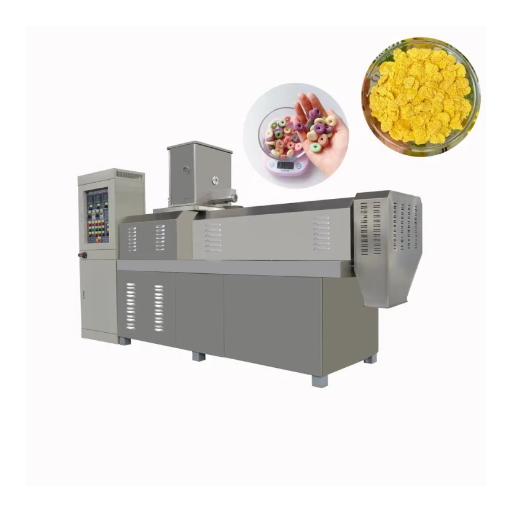
Compare breakfast cereal production line cost by sending the same seven questions to every supplier and requiring written answers.
- What output is guaranteed, for which product, at what moisture and coating level?
- What are the installed and running power, steam, air and water demands at rated output?
- What is the line footprint and minimum ceiling height, including maintenance access?
- Which machines are included, and which are excluded from the scope?
- What is included in the factory test, site test, installation and operator training?
- What spare parts should be stocked, and what do they cost?
- What are the payment terms, Incoterm and delivery milestone dates?
A quote that cannot answer the first two questions has not been engineered yet.
Red flags
- A price without a model number or capacity basis
- No utility schedule
- “Turnkey” with no scope table
- A capacity claim that ignores coating weight and packing losses
- A dryer or toaster sized independently of the rest of the line
China versus Europe: compare landed cost
European equipment usually costs more at FOB but may use less energy, need fewer operators and offer stronger documentation and service. Those differences can close the gap over five to ten years.
Build the comparison on landed cost, energy and labor per tonne, and downtime cost. If you cannot quantify the last two, you are comparing stickers.
If you have a product and target output, with the packing format and building envelope. We will review the configuration against the published capacity data.
Frequently Asked Questions
How much does a breakfast cereal production line cost?
A complete China-origin line is roughly $25,000 to $70,000 at 100 to 200 kg/h, $35,000 to $170,000 at 300 to 500 kg/h, and $55,000 to $250,000 at 800 to 1,000 kg/h, equipment only and FOB. A plant with building, utilities and working capital costs two to three times the line. Planning bands, not quotations.
How much does a corn flakes manufacturing plant cost?
It depends on scale and location. A published Indian project for a 1 tonne per day unit had a total capital investment of ₹2.18 crore, including land, building, machinery and working capital. Large plants run from 20,000 to 100,000 tonnes a year and are priced as projects.
Why do quotes for the same capacity differ so much?
Capacity is only one variable. Scope, dryer length, toaster zones, automation, packaging, origin and Incoterm all move the price. Two quotes are comparable only when they use the same output definition and scope boundary.
How much does it cost to run a cereal line per kilogram?
Use your own numbers: raw materials plus packaging plus energy plus labor plus maintenance plus waste plus overhead, divided by good output. Published plant analysis puts raw materials at 70 to 80% of operating cost and utilities at 10 to 15%, so ingredient and packaging prices dominate.
How long does a cereal line take to pay for itself?
The equipment can be covered quickly at high utilization and a healthy margin, but payback depends on demand, distribution, working capital and ramp-up. Model it with your own price and utilization. Treat any supplier figure as an assumption.
Conclusion
The breakfast cereal production line cost is three numbers, not one. Equipment is roughly $25,000 to $250,000 depending on capacity and scope. The plant is two to three times that once building, utilities and working capital are included. Cost per kilogram depends on ingredients, packaging and utilization.
To turn the breakfast cereal production line cost into a budget, start with four specifications: cereal type, output in finished product per hour, coating and packing format, and building envelope. Then ask every supplier for the same itemised scope, utility schedule and test plan.
Send those specifications and we will review the machine set, capacity data and utility demand. and we will tell you what the next decision is.