A cream biscuit production line is a biscuit line plus a sandwiching module. The bases are baked as usual, cream is deposited, a second biscuit is registered on top, and the assembled sandwich gets its own cooling pass before packing.
That is the whole difference on paper. In practice it is the difference between a project that runs at the rate you planned and one that runs at the rate the module allows, because the module, the second cooling tunnel and the floor space for both are decided late and budgeted never.
This guide covers the decisions that set your real output: base biscuit choice, cream temperature, lane count, registration and cooling. By the end you will know what to ask a supplier and what to put in the RFQ, whether you are adding a sandwich SKU to a line you already run or buying a new one.
Key Takeaways
- A cream biscuit production line is a biscuit line plus a sandwiching module, and the module sets output, rejects and floor space.
- Output is base positions per minute multiplied by lanes. A quoted “sandwiches per minute” means nothing until you know which piece it counts and at what cream weight.
- Cream temperature is an equipment decision, not a recipe note. It needs a controlled hopper and a jacketed path to the nozzle.
- Sandwiching adds a cooling pass before depositing and another after capping, and both consume line length and floor space.
- Retrofitting a module works only when the oven and the first cooling stage already have capacity to spare.
What Is a Cream Biscuit Production Line?
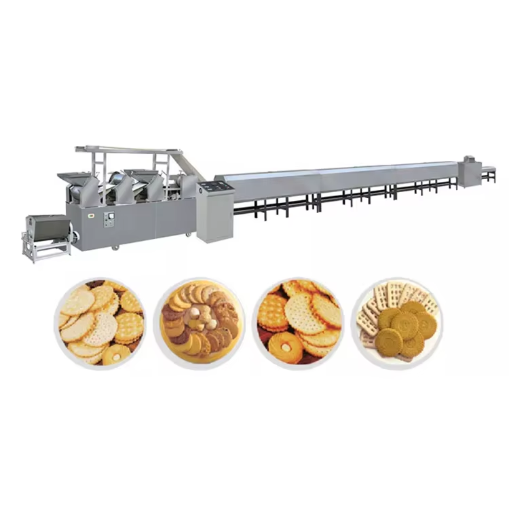
A cream biscuit production line is an automated biscuit line with a sandwiching station added after cooling. It bakes the base biscuits, deposits a measured layer of cream, places a second biscuit on top, and cools the assembled sandwich before wrapping. The biscuit line does the baking. The sandwiching module does the assembly.
The module itself has five stations: base feed and orientation, cream deposit, cap placement and registration, second cooling, and transfer to packing. Everything upstream, from mixing and forming to baking and the first cooling stage, belongs to the biscuit line you already know. Our covers that side; this page covers what the module adds.
If you already know you need a module rather than a full line, and we will tell you which lane count fits it.
“Cream biscuit” does not mean the same thing in every market. In India and much of South Asia it describes a cream-filled sandwich biscuit, the kind sold as Bourbon or as an Oreo-style sandwich. In the United States, a biscuit is a buttermilk quick bread, and the same product is sold as a sandwich cookie. Buyers who search for a sandwich biscuit production line mean the same equipment.
Buyers in the UK say sandwich biscuit. The machine is identical; only the vocabulary moves. Put the market’s own word in the RFQ so the quotation comes back for the product you actually intend to make.
The Sandwiching Module on a Cream Biscuit Production Line
Buyers ask for “a cream biscuit line” when what they need is a module. That distinction drives price, space and schedule.
A standalone module arrives with its own frame, drives and controls, and bolts onto the end of an existing line. A new integrated line includes mixing, forming, baking and cooling sized around the sandwich product from the start. The module is the cheaper entry point. It is also where a retrofit can go wrong.
Integration is not a cable. The module has to align its base infeed with the oven discharge, match speed to the oven band, transfer assembled sandwiches to packing without losing registration, and handshake with the line’s PLC. Miss any of those and you own a machine that runs at its own rate rather than at yours.
Retrofitting is viable when the oven and first cooling already have capacity to spare. If the oven is at its limit, the sandwich line runs at the module’s rate, not the oven’s, and the extra cooling sits in a hall that was never laid out for it. Ask for those two capacity numbers before you ask for a price.
Our covers cream depositing as a process stage, including the cooling targets either side of it. This page stays on the equipment decision.
Choose the Base Biscuit First
Sandwiching does not fix a base that is wrong for it.
Hard sweet bases such as Marie-style and glucose biscuits are sheeted, cut and baked to low moisture. They stay flat and strong, which makes them the easier sandwich base and the one most cream sandwich products use. The trade-off is shape flexibility: a new product usually means a new cutter. More detail sits in our guide to .
Soft and short dough bases are rotary moulded or wire-cut, with higher fat and sugar and a shorter bake. They are more fragile, and thickness varies more across the band. A soft base can carry cream well, but the module has to handle gentler transfers. Our guide covers dough handling for that route.
Three dimensions matter more for a sandwich than for a standalone biscuit: flatness, diameter consistency and thickness consistency. A single biscuit tolerates spread variation. A sandwich does not, because every cap must register on its base and every stack must pack to the same height.
A retrofit review in 2025 ran into exactly that. A plant added a two-lane module to a line running a soft rotary-moulded base, and the module hit its rated rate on the trial. Two weeks into production, caps started landing 3 mm off centre. Thickness varied by 1.5 mm across the band, and the transfer amplified it. The fix was not the module. The base spec and the transfer were changed, and the misregistration went away.
One more distinction: a sandwich base is baked for the sandwich. It is paler, because it will not be eaten alone, and its moisture target is set by how the cream behaves in the pack, not by how the biscuit snaps.
Cream Formulation and Temperature Control
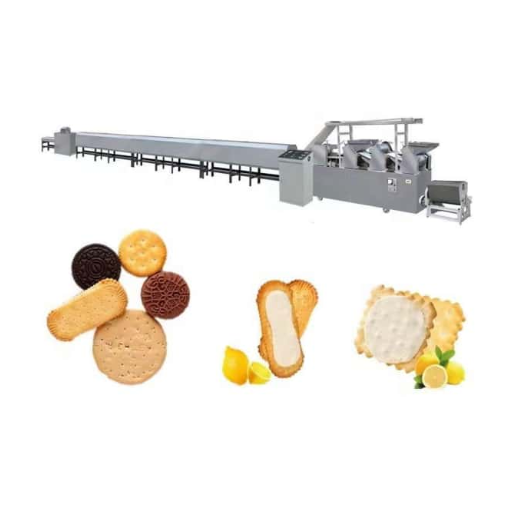
Cream is where a sandwich line fails quietly. Three variables decide whether it works: the fat and its melting point, the deposit temperature, and the viscosity at the nozzle.
The melting point of the filling fat decides whether the cream holds at warehouse temperature and survives a container in a hot season. Ask the filling supplier for the melting point and the temperature they recommend for depositing, then confirm the module’s hopper can hold that band. A hopper without temperature control turns a formulation problem into a machine problem.
Warm cream flows; cold cream does not. Run too warm and you get squeeze-out, bleed into the wrapper, and seals that fail later. Run too cool and the cream strings, tails at the cut-off, and sits on the base without adhering. The working band is narrow, which is why a controlled hopper and a jacketed path from hopper to nozzle belong in the specification, not in the options list.
Depositor type matters too. Stencil, roller and manifold depositors each give a different range of cream weights and shapes, and each has its own changeover routine. If you plan to run three cream weights across two product shapes, describe that in the RFQ, because the answer changes the depositor you should buy.
Cream is also a cleaning problem. It is high in fat and sugar and sets as it cools, so washdown and changeover design decide how many SKUs you can run in a day. EHEDG hygienic design principles are the reference most European buyers will ask about, and a food safety plan under FSMA preventive controls is the equivalent question for the US market.
Registration, Lane Count and Throughput
Registration is the alignment of the cap biscuit on the cream-covered base. It is the number that quietly sets your reject rate.
Cap alignment tolerance is quoted in millimetres. Ask what it is, how it is measured, and what biscuit diameter it applies to. A cap sitting two millimetres off centre looks acceptable on a slow trial and becomes a packing reject once the line speeds up. Misregistration costs twice: you lose the sandwich, and you may jam the transfer.
Lane count sets output and multiplies risk. A single-lane module suits lower volume and frequent changeovers. Two lanes double output without doubling floor width, which is why most mid-size projects land there. Four lanes are production scale, and every extra lane adds alignment points that have to be set and checked.
The output arithmetic is worth doing before any quotation arrives. Start with what the oven actually delivers: base positions per minute. Multiply by lanes to get sandwiches per minute. Then convert cream:
sandwiches per minute × cream weight in grams × 60 ÷ 1000 = cream consumption in kg/h
A two-lane module running 40 base positions per minute makes 80 sandwiches per minute. At 3 g of cream per sandwich, that is 14.4 kg/h of cream and 160 biscuits per minute once bases and caps are counted together.
This is where most quotes mislead. Suppliers quote “pieces per minute” without saying which piece. A base rate, a sandwich rate and a biscuit consumption rate differ by a factor of two. One vendor figure for top-end equipment is 4,800 sandwiches per minute; treat that as a claim to test at your cream weight, not a number to design around.
Write the acceptance test into the order. Run your base and your cream for an agreed period, then measure sandwiches per minute, cream weight per sandwich and reject rate. A module that hits its rate on the vendor’s test biscuit and misses on yours has not met the specification, and the only way to prove that is to have written the test down.
Cooling: The Station Buyers Underestimate
A sandwich line cools twice. The first pass brings the base down before depositing, because cream placed on a warm base migrates and loses its shape. The second pass sets the assembled sandwich before it reaches the wrapper.
Each pass costs tunnel length, floor space and energy. Sandwich products also run slower per metre than plain biscuits, because the assembled product is taller and the cooling is constrained by the cream, not only by the biscuit. A line that fits a plain biscuit product in your hall may not fit the sandwich version of the same product.
This is the cost that appears after the purchase order. Two cooling tunnels, the transfers between them and the space to service both add metres that were never in the layout drawing. Work the line length and the hall dimensions before you fix the module, not after. Our guide picks up at the point the sandwich leaves the second cooling stage.
A cream sandwich that leaves the second tunnel at 30°C instead of 22°C looks fine on the line. It bleeds into the wrapper overnight, and the complaint arrives from the retailer three weeks later. Shorten the tunnel to save floor space and that is the failure you buy. The temperature at the wrapper is a specification item, so measure it at the wrapper.
Common Defects and Fixes
Most sandwiching faults fall into eight patterns. The table below is a starting point for a line trial, not a diagnosis for a specific machine.
| Defect | Likely cause | First check | Fix |
|---|---|---|---|
| Cream squeeze-out | Cream too warm or too soft | Deposit temperature and fat melting point | Cool the hopper; reformulate the cream |
| Cap misalignment | Registration drift or base position error | Cap placement sensor and base infeed | Re-set registration; check base orientation |
| Cream bleed into wrapper | Sandwich packed too warm | Sandwich temperature at the wrapper | Extend the second cooling pass |
| Caps separating in the pack | Poor adhesion or low cream moisture | Cream temperature at deposit and adhesion | Adjust deposit temperature; check cream recipe |
| Cracked or broken base | Base too fragile or transfer too aggressive | Base thickness and transfer drop height | Change base spec; soften the transfer |
| Cream weight drift | Pump wear, hopper temperature swing or nozzle clog | Weight checks across the shift | Service the pump; stabilise hopper temperature |
| Tails and stringing | Cream too cool or cut-off timing wrong | Nozzle temperature and cut-off setting | Raise cream temperature; adjust cut-off |
| Wrapper seal failure | Warm product or contaminated seal area | Seal temperature and product temperature | Cool before packing; check seal jaws |
The pattern behind the table: defects that appear at depositing are temperature and registration problems, while defects that appear in the pack are cooling problems. That is why a line trial has to run long enough for the second cooling stage to settle.
Cream Biscuit Line Configurations and What Drives Cost
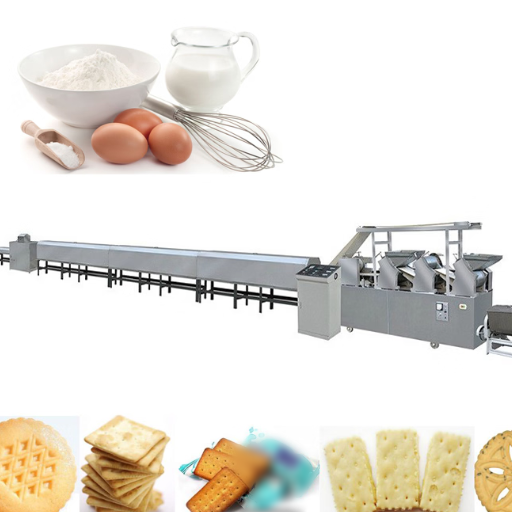
Sandwich configuration comes first. A single sandwich uses one cream layer and two biscuits. Double and triple configurations add cream layers and biscuits, and each layer adds depositing stations, registration points and cooling load.
Around that decision sit the module choices: one, two or four lanes; semi-automatic or fully automatic capping; with or without integrated packing. A semi-automatic module relies on an operator for loading or capping and costs less, but the labour sits in the unit cost for the life of the line.
The cost drivers are the ones the RFQ should name: lane count, temperature control on the hopper and path, the registration system and its tolerance, the length of the second cooling stage, packing integration and the automation level of the controls. Two quotations for “a cream biscuit production line” can differ by a factor of two and still both be honest, because they describe different amounts of those six things.
We do not publish price bands for sandwiching modules, because a band without the configuration behind it misleads. Send the base dimensions, the cream weight and the required output, and the quotation can be specific. and we will price the module against your product.
How to Specify a Sandwiching Module
An RFQ that gets comparable quotations answers nine questions:
- Base biscuit dimensions, weight and thickness tolerance.
- Target cream weight per sandwich and the acceptable range.
- Required sandwiches per minute at that cream weight, not at a vendor test weight.
- Lane count and the changeover time between products.
- Cream type, melting point and deposit temperature.
- Registration tolerance and how it will be measured.
- Second cooling length, and the sandwich temperature required at the wrapper.
- Packing format and the transfer height into it.
- Acceptance test conditions, including the base and cream you will supply.
Three questions separate an OEM from a trading company. Who builds the depositor, and can you visit the workshop where it is built? What is the registration mechanism, mechanically or by vision? What happens at changeover, in minutes, and who trains the operators?
A supplier who cannot answer those three in specific terms is selling a catalogue page.
Frequently Asked Questions
What is a cream biscuit production line? It is a biscuit line with a sandwiching module added after cooling. The line bakes the bases, the module deposits cream and caps each sandwich, and a second cooling stage sets the cream before packing.
Is a cream biscuit the same as a sandwich biscuit? Yes, in most markets. India and South Asia say cream biscuit, the UK says sandwich biscuit, and the US calls the same product a sandwich cookie. Only the vocabulary changes; the equipment is the same.
Can I add a sandwiching module to my existing biscuit line? Often, yes. It works when your oven and first cooling stage have spare capacity and your hall has room for a second cooling tunnel. Check both numbers before ordering the module.
How many lanes does a biscuit sandwiching machine need? It depends on volume and changeover frequency. One lane suits lower volume and frequent product changes; two lanes are the usual choice for mid-size production; four lanes are for high-volume, single-product runs.
What cream temperature should the depositor run at? Use the temperature your filling supplier recommends for that fat, and hold it within a narrow band. The module needs a controlled hopper and a jacketed path to the nozzle to hold that band through a shift.
Why does cream squeeze out of the sandwich? Usually the cream is too warm, too soft, or the sandwich is packed before the filling sets. Check deposit temperature and fat melting point first, then confirm the second cooling stage is long enough.
How much does a cream biscuit production line cost? It depends on lane count, temperature control, registration, cooling length, packing integration and automation. Send your base dimensions, cream weight and required output, and we will quote against that specification.
Conclusion
A cream biscuit production line succeeds or fails on the module, not on the biscuit line. The bases you already know how to bake. The module decides how many sandwiches leave the line, how many are rejected, and how much floor space the project really needs.
Four decisions carry most of the outcome: the base biscuit’s flatness and consistency, the cream’s fat and deposit temperature, the lane count against your oven’s real rate, and the second cooling length. Settle those before you compare prices, and two quotations stop looking like different products.
If you are planning a cream biscuit line or adding a sandwich SKU to an existing one, , the cream weight and the output you need. Our engineering team will review the configuration and come back with a module specification you can quote against.