The total cost of ownership (TCO) for food processing equipment is a summation of all costs required to buy, operate and own the machine within its lifetime. In this case, food processing machines from purchase and installation to energy, maintenance, cost of operation, and eventually disposal, all make up food processing equipment TCO. For the majority of food processing industries, the cost of buying the machine itself is less than 30% of the whole cost after 10 years. The remaining cost is due to utility and repair expenditure, waiting time, and billing for regulatory purposes among others that are not mentioned in the system.
You should note that the cost of machinery is an upfront investment cost that is very much significant and will need a lot of finances and the resources of the company. One of the aspects you are likely to miss in the understanding of this situation is that the cheapest price on the market is sometimes going to be the most costly costs you ever resort to. A funny free market tendency is a fact that the majority of customers assess equipment exclusively on sticker price and then slowly witness their profits vanishing and yet the hidden costs have been escalating sloughing off year in and year out.
In this guide, we will cover all the necessary aspects of food processing equipment TCO calculation for one’s business operations. It opines systematically about every cost-sharing segment. Demonstrates that economic models of larger scales have smaller lifespan costs. Explains in detail what ‘premium’ equipment is and how it differs from the cheaper analogues with practical examples. In addition five powerful ways are shown to help reduce the level of ownership costs. In conclusion, a ready to use guideline will be available.
Key Takeaways
- The purchase price of food processing machinery is only 20% to 30% of true lifetime cost; energy, maintenance, and downtime dominate the rest.
- A mid-sized plant loses 5,000to5,000to10,000 per hour during unplanned downtime, and the true cost is 2.4 times the visible losses when you factor in scrapped product and idle labor.
- Small-scale lines (100 to 300 kg/hour) typically achieve ROI within 18 to 36 months, while premium energy-efficient equipment can cut utility costs by 30% to 40%.
- Turnkey production lines reduce hidden integration and commissioning costs that piecemeal assemblies often create.
- Preventive maintenance programs reduce equipment breakdowns by 25% or more, directly lowering your food processing equipment TCO.
What Is Food Processing Equipment TCO?
Food processing equipment TCO tracks every dollar you spend on machinery from order to retirement. It covers the purchase, shipping, installation, and commissioning. It also includes daily operation, maintenance, repairs, energy, compliance, and eventual disposal or resale.
Industry research consistently shows that the upfront purchase price accounts for only 20% to 30% of total cost over a ten-year lifecycle for general food processing machinery. For thermal processing systems like fryers or dryers, that figure can drop to as low as 10% to 20%. This means your food processing equipment TCO commitment begins after the machinery arrives at your facility.
The standard formula for calculating TCO is straightforward:
TCO = Initial Cost + (Annual Operating Costs x Expected Asset Life) + Disposal Costs – Residual Value
When Priya Sharma opened her snack factory in Mumbai in 2023, she focused entirely on the purchase price of her first extrusion line. She chose a 120,000systemthatlookedidenticaltoa120,000systemthatlookedidenticaltoa180,000 option from another supplier. Within eighteen months, her energy bills had exceeded the 60,000pricedifference,andthreeunplannedbreakdownscosthernearly60,000pricedifference,andthreeunplannedbreakdownscosthernearly40,000 in lost production. Her food processing equipment TCO told a very different story than her initial invoice.
The Hidden Cost Breakdown: Where Your Money Really Goes
Understanding where costs actually accumulate is the first step toward controlling them. Here is a complete breakdown of every category that feeds into your food processing equipment TCO.
Initial Investment Costs (Beyond the Invoice)
The price of the equipment is only one of the determinants. The shipment bore some costs from the supplier to the country for the most part and perhaps when within the country as well. The workers who are well trained in this area of work are necessary for operations such as installation and commissioning of equipment and their labor costs could be borne within10,000to50,000 or bore part16 depending on the line expanse. More money is also needed in initial training of operators, stocking of spare parts, and sometimes modifying of structures.
These projections are mainly kept in mind by customers interested in getting a ready to install food production system. When one chooses not to buy the system as a unit, the different components that make it are usually procured from different suppliers who in turn sell the system without a problem. Coordination problems, problems with dimensions, apportioning of responsibility amongst other problems are undesirable and will however be encountered. These problems commonly known as hidden costs for preparation can realistically increase the initial cost by 15% to 25%.
Operating Costs: The Silent Majority
Energy dominates the operating cost picture. For motor-driven food processing equipment, energy bills can consume up to 45% of lifetime costs. Water, compressed air, steam, and raw material waste add further pressure. Over a five-year period, cumulative operating expenses typically reach 145% to 165% of the initial equipment investment.
Energy-efficient drying and frying systems can reduce these utility costs by 30% to 40%, with payback periods of 24 to 36 months. When you evaluate a snack food machinery investment, the efficiency rating matters as much as the throughput specification.
Maintenance and Repairs: Planned vs Panic
It is commonly known that the cost of planned maintenance is equal to approximately 3% – 6% of the cost of the equipment per year. Emergency repair costs are up to three or five times as much as the cost of routine maintenance. You incur the costs of after hour labor charges, faster delivery charges as well as loss of production. Proper preventive maintenance programs can reduce breakdowns by over 25%.
The existing norm is simple – one should get rid of the equipment if the annual expenditure on repairs reaches 50 % of the value of the replacement. Many smaller managers try to prolong their use of worn-out equipment, assuming that savings on purchases exceed repairs; in fact, they contribute to the increase of food processing equipment TCO.
Downtime: The Fastest Profit Killer
A single hour of unplanned downtime in a mid-sized food plant costs 5,000to5,000to10,000 in lost output alone. The true cost is approximately 2.4 times the visible losses. That includes scrapped product, idle labor, schedule disruption, and customer penalties. For high-volume operations running corn puff snack production lines, a four-hour breakdown can erase an entire day of profit.
Seventy-four percent of food manufacturing downtime is preventable. Equipment with real-time diagnostics, remote monitoring capability, and accessible spare parts inventory dramatically reduces these losses.
Compliance and Certification
Food safety regulations do not stand still. CE marking, ongoing food safety audits, and regulatory updates add 5,000to5,000to10,000 annually for many operations. Equipment that arrives CE-certified and built to international hygiene standards reduces both the initial compliance burden and the ongoing audit risk.
End-of-Life and Residual Value
No machine lasts forever. Decommissioning, removal, and disposal carry costs, but trade-in or resale value can offset them. Movable mechanical equipment typically retains roughly 20% of its original cost at end of life. Equipment built with durable, food-grade stainless steel construction commands higher residual value because buyers trust its longevity.
TCO by Production Scale: Small, Medium, and Large Lines
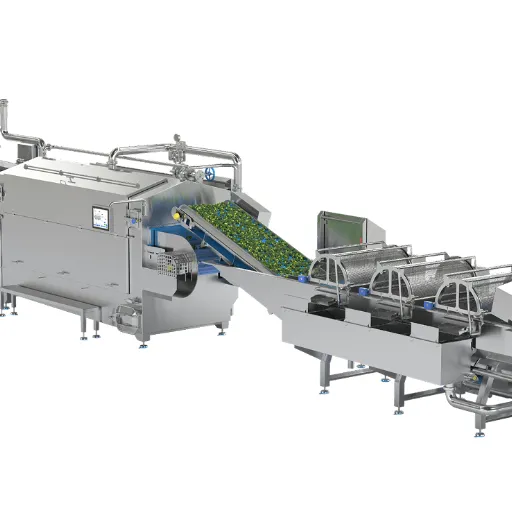
Scale changes everything. A large line spreads fixed costs across far more kilograms of output, but the absolute investment and risk increase proportionally. Here is how food processing equipment TCO breaks down across typical production capacities.
| Scale | Capacity | Initial Investment | 5-Year TCO Range | Typical ROI | Cost per kg |
|---|---|---|---|---|---|
| Small | 100-300 kg/h | 150K−150K−450K | 218K−218K−743K | 18-36 months | 1.20−1.20−1.80 |
| Medium | 300-1,000 kg/h | 450K−450K−1.5M | 653K−653K−2.48M | 24-48 months | 0.75−0.75−1.10 |
| Large | 1,000+ kg/h | 1.5M−1.5M−5M+ | 2.18M−2.18M−8.25M+ | 36-72 months | 0.45−0.45−0.75 |
Small manufacturers often worry that they cannot compete on unit cost with large factories. The data shows they face higher per-kilogram expenses, but they also achieve faster ROI because their capital commitment is lower and their operational flexibility is higher. The key is right-sizing your line to actual demand rather than overbuilding for growth you have not yet achieved.
For a medium-scale operation, the 5-year food processing equipment TCO typically allocates as follows:
| Cost Component | 5-Year Total | % of TCO |
|---|---|---|
| Equipment Purchase | 450K−450K−1.5M | 60-70% |
| Operating Costs | 110K−110K−250K | 15-20% |
| Energy Consumption | 75K−75K−150K | 8-12% |
| Maintenance and Repairs | 45K−45K−90K | 5-8% |
| Certification/Compliance | 30K−30K−70K | 4-6% |
| Installation/Commissioning | 20K−20K−50K | 3-5% |
Budget vs Premium: A TCO Comparison That Changes Everything
Marcus Chen had to make a very hard choice at the start of 2024. His snack factory in Vietnam required the purchase of a new extrusion line. A low-cost manufacturer proposed a full line for 150,000. Shandong stated that for 200,000, it was ready to provide a customized highly-energy efficient full system.
The most difficult part was the 50,000. The gap triggered Marcus to seek more contrast.
Marcus considered an eight-year horizon to predict the TCO. The equipment from the budget supplier was equipped with more power-consuming motors, regular 304 grade steel, and supplied in pieces. The equipment of the higher price range included a control system made from one manufacturer driven by energy-efficient motor drives and the equipment was in 316 grade for better corrosion resistance.
Over the course of eight years, the energy expenditure of the budget line reached eighteen thousand dollars per annum. It also needed two unforeseen repairs, each costing amounts between fifty-three to seventy thousands. Due to the differences between their control solutions from different suppliers, there was a longer commissioning period, and that accounted for $22,000 of wasted potential profit in the startup phase. After the sixth year, the replacement parts became more difficult to obtain, increasing repair duration.
The premium line was operational and with only prepared servicing performed. The cost of the saved energy over 8 years was 144 thousand dollars. Troubleshooting was an easier process and the system start time was reduced due to one control system.
The 316 stainless steel structure still had preservation of 25 percent of its value, at the end of 8th year. By comparison, the value of the budget frame had reduced to a mere 15%.
As Marcus did his calculations, the food processing equipment TCO was actually reduced by almost $90,000 by the “more expensive” machine, over its entire life cycle. On the very first day that decision seemed costly but it turned out as the best money-related decision he took that year.
Want a side-by-side TCO analysis for your production goals? Contact our engineers for a customized proposal that models your true lifetime costs.
5 Proven Strategies to Reduce Your Food Processing Equipment TCO
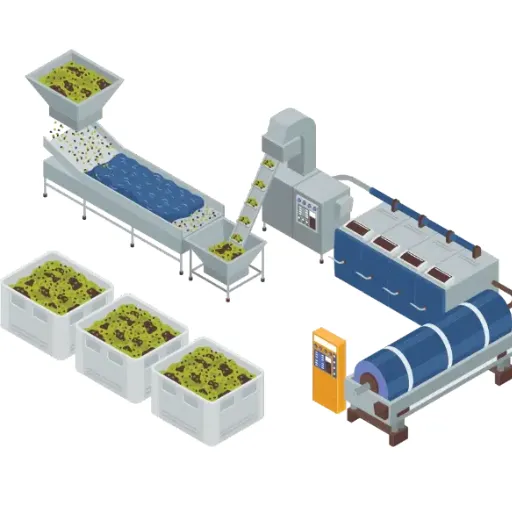
Smart buyers do not just calculate TCO. They actively manage it. Here are five strategies our engineering team recommends based on over ten years of global project experience.
1. Right-Size Your Line to Actual Demand
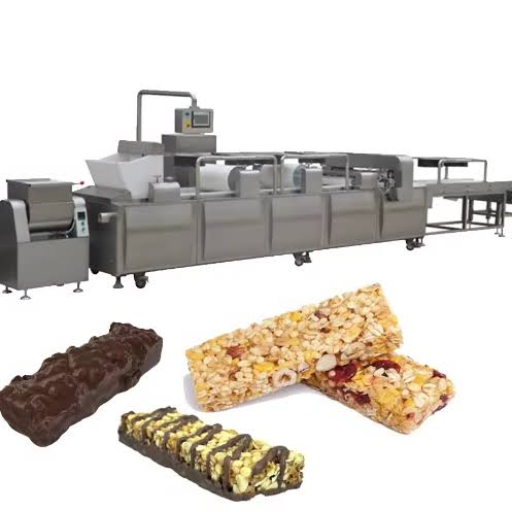
Overcapacity wastes capital, floor space, and energy. Undercapacity forces your equipment to run beyond its optimal range, accelerating wear and increasing failure risk. Match your line capacity to your current demand plus 15% to 20% headroom for growth. A protein bar production line designed for 400 kg/hour performs far more efficiently than a 1,000 kg/hour line running at 40% capacity.
2. Invest in Energy-Efficient Systems Upfront
Energy is a recurring cost that compounds over time. Energy-efficient frying systems and modern extruder drives can cut utility costs by 30% to 40%. The upfront premium typically pays for itself within 24 to 36 months, and every month after that is pure margin improvement.
3. Implement a Preventive Maintenance Program
Waiting for something to break is the most expensive maintenance strategy. Create a schedule for lubrication, seal inspection, calibration, and wear-part replacement. Stock critical spare parts on-site.
Document every service event. Facilities that follow structured preventive maintenance report 25% fewer breakdowns. They also extend equipment life by two to four years.
4. Choose Turnkey Over Piecemeal Assembly
Buying equipment from multiple suppliers creates integration risk. Control systems may not communicate. Mechanical interfaces may need custom fabrication. Commissioning takes longer because no single vendor owns the full system performance.
A turnkey production line eliminates these compatibility costs. It also gives you one point of accountability for support, spare parts, and performance guarantees.
5. Factor in Customization for Recipe Flexibility
Adaptable extrusion systems reduce changeover downtime and raw material loss when you switch between recipes. Standardized machines force compromises that increase waste and extend cleaning time. Customizable solutions tailored to your specific product range pay for themselves through higher yield and faster batch transitions.
Conclusion
It must be understood primarily that the price paid for the purchase of food processing machinery is the payment of an initial fee. The expenditure in this regard shall appear in further years in terms of energy charges, service checks, occurrence of breakdowns, availability of spare parts and compliance with regulations. What smart shoppers think when offered a food processing equipment TCO is the price, and not a quote, because sometimes, the most expensive machine on the ground, turns out to be the cheapest one on paper.
So now you are complete to look at everything calculated and managed from the standpoint of total cost of ownership. You know how scale can scale-down unit cost. You have beheld how the factors of energy efficiency and maintenance lead. And you have appreciated why handling a project to experienced manufacturers on a turnkey basis which is highly tailored does not increase the cost of the project and enhances the margins.
Ready to invest in food processing equipment with transparent lifetime costs? Partner with Shandong Loyal Industrial for a detailed TCO projection and a turnkey production line designed around your budget, your recipes, and your growth plans. Tell us your production goals, and we will design a solution that delivers reliable performance and a clear path to ROI.
Sources: