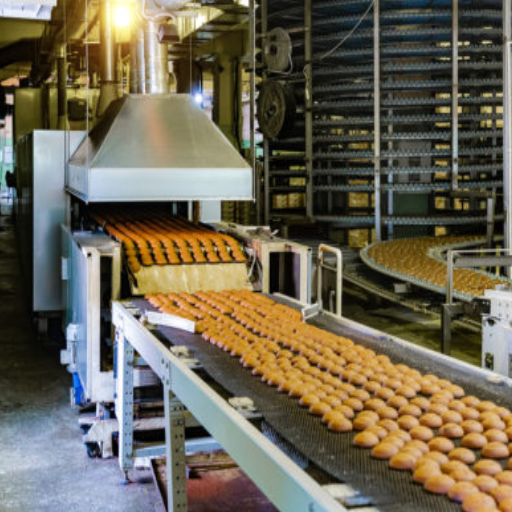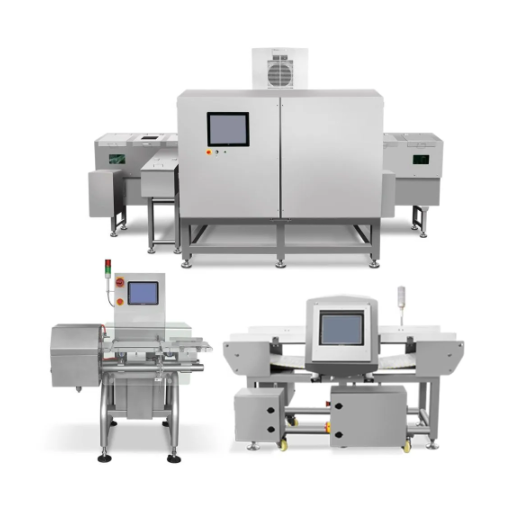
A pet food dryer and coating system is the critical post-extrusion equipment that reduces kibble moisture to safe levels and applies fats, flavors, and nutrients that pets actually want to eat. With the global pet food processing market projected to reach $6.43 billion by 2026, manufacturers who get these two steps right are capturing the premium pet food boom. Those who don’t are leaving profit on the table, or worse, producing kibble that pets simply refuse.
If you’re evaluating equipment for a new production line or upgrading an existing one, this guide covers everything you need to know about choosing the right dryer and coating system for your facility. We’ll walk through every dryer type, every coating technology, and the decision factors that separate a good investment from a costly mistake.
After manufacturing pet food production lines for over a decade, we’ve learned one truth: the extruder gets the attention, but the dryer and coater make the product.
Key Takeaways
- A pet food dryer and coating system must work as an integrated unit; mismatched capacities create bottlenecks that waste energy and reduce output quality.
- Vacuum coating can achieve fat inclusions of up to 35-40%, compared to just 8-10% for traditional drum coating, making it essential for premium pet food.
- Kibble moisture must drop to approximately 10% before coating to prevent oxidation, rancidity, salmonella, and microbial growth.
- The correct production sequence is always: Extrusion, Drying, Coating, Cooling, Packaging; coating before drying ruins product quality.
- Energy efficiency, CE certification, and PLC automation are no longer optional; they’re baseline requirements for competitive pet food manufacturing in 2026.
What Is a Pet Food Dryer and Coating System?
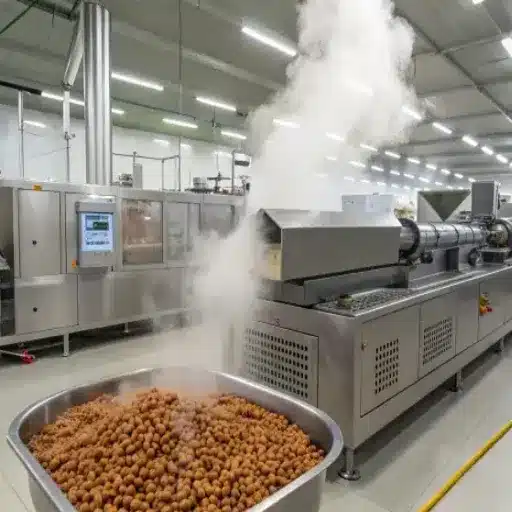
A pet food dryer and coating system is a pair of integrated machines that handle the two most critical post-extrusion steps in kibble production. The dryer removes moisture from freshly extruded kibble, reducing it from 23-28% down to 8-12%, which is essential for shelf stability and microbial safety. The coating system then applies liquid fats, digest flavors, vitamins, and dry powders that give pet food its palatability and nutritional profile.
These two pieces of equipment are always linked in a production line because they depend on each other. You cannot coat wet kibble; the moisture prevents fat absorption and causes uneven coating. You also cannot skip coating; uncoated kibble lacks the flavor and nutrition that pet owners demand. Together, a properly matched dryer and coating system forms the backbone of any pet food manufacturing operation.
The equipment typically processes kibble at capacities ranging from 100 kg/h for pilot lines up to 5,000+ kg/h for industrial operations. Modern systems use PLC controls to maintain precise temperature, moisture, and flow rates, ensuring consistent product quality batch after batch.
The Complete Production Flow: Where Dryer and Coater Fit
Understanding where the dryer and coater fit in the production sequence helps explain why choosing the right equipment matters so much. Here’s the standard flow for dry pet food:
- Raw Material Reception and Storage — Ingredients arrive in bulk and are stored in silos or bins.
- Grinding — Hammer mills reduce particle size to 60-100 mesh for uniform extrusion.
- Batching and Mixing — Ribbon or paddle mixers blend ingredients to a coefficient of variation of 5% or less.
- Pre-Conditioning — Steam and water injection at 60-80 degrees C raises throughput by 10-15%.
- Extrusion — Twin-screw extruders cook the mix at 110-180 degrees C under 3-15 MPa pressure. For a detailed technical breakdown of extrusion parameters, screw configurations, and troubleshooting, see our complete guide to the pet food extrusion process.
- Drying — Multi-stage belt or drum dryers reduce moisture from 23-28% to 8-12%.
- Coating — Drum or vacuum coaters apply fats, flavors, and nutrients.
- Cooling, Sieving, and Packaging — Counter-flow coolers, vibratory sifters, and multi-head weighers complete the line.
The sequence matters. Coating before drying means the fat sits on wet surfaces instead of absorbing into the kibble structure. Cooling after coating allows the applied fats to set properly. Skipping either step or reversing the order leads to product rejection, spoilage, or customer complaints.
When Marcus, a plant manager in Brazil, ordered his first production line in 2024, he tried to save money by purchasing a dryer and coater from two different suppliers. The dryer output 1,200 kg/h, but the coater was rated for only 800 kg/h. He spent six months dealing with kibble piling up between stations, inconsistent fat application, and a 30% throughput loss before he finally replaced the coater with a matched unit. The mismatch cost him over $40,000 in lost production.
Ready to avoid costly equipment mismatches? Contact Shandong Loyal for a matched dryer-coater proposal tailored to your production capacity.
Types of Pet Food Dryers: Which One Is Right for You?
Choosing the right pet food drying equipment depends on your production capacity, product type, energy budget, and facility layout. Here are the four main dryer types used in pet food manufacturing:
Continuous Belt/Mesh Dryers
Belt dryers are the most common choice for pet food production lines. Kibble sits on a perforated stainless steel belt while hot air passes through from below. Multi-stage designs (3-5 zones) allow precise temperature control across the drying curve.
Advantages:
- Gentle handling with minimal kibble breakage
- Uniform drying across the belt surface
- Easy to clean and maintain
- Scalable from 200 kg/h to 10+ t/h
Best for: Standard kibble production, medium to large capacity lines
Rotary Drum Dryers
Drum dryers tumble kibble inside a rotating cylinder while hot air flows through. The tumbling action provides good mixing but can cause more breakage than belt dryers.
Advantages:
- Compact footprint
- Good heat transfer through direct contact
- Lower capital cost than belt dryers
Best for: Smaller facilities with space constraints, budget-conscious startups
Fluidized Bed Dryers
These dryers suspend kibble in a stream of hot air, creating a fluid-like bed. They offer excellent heat transfer and uniform drying but require careful airflow calibration.
Advantages:
- Very uniform moisture distribution
- Fast drying times
- Good for small, uniform kibble shapes
Best for: Premium kibble with strict moisture consistency requirements
Microwave Dryers
Microwave dryers heat kibble from the inside out using electromagnetic energy. They’re faster than conventional dryers and can preserve more nutrients, but they come with higher energy costs and capital investment.
Advantages:
- Faster drying (minutes vs. 15-25 minutes)
- Better nutrient preservation
- Reduced surface case hardening
Best for: Premium and functional pet food lines where nutrient retention is a priority
Dryer Comparison Table
| Feature | Belt Dryer | Rotary Drum | Fluidized Bed | Microwave |
|---|---|---|---|---|
| Capacity Range | 200 kg/h – 10+ t/h | 100 kg/h – 3 t/h | 200 kg/h – 5 t/h | 100 kg/h – 2 t/h |
| Kibble Breakage | Low | Medium | Low | Very Low |
| Energy Efficiency | Medium | Medium | High | Low-Medium |
| Footprint | Large | Compact | Medium | Small |
| Capital Cost | Medium-High | Low-Medium | Medium | High |
| Nutrient Preservation | Good | Good | Good | Excellent |
| Best For | Standard lines | Budget setups | Premium kibble | Functional foods |
Need help choosing the right dryer? Explore our drying equipment solutions or request a free consultation.
Types of Pet Food Coating Equipment
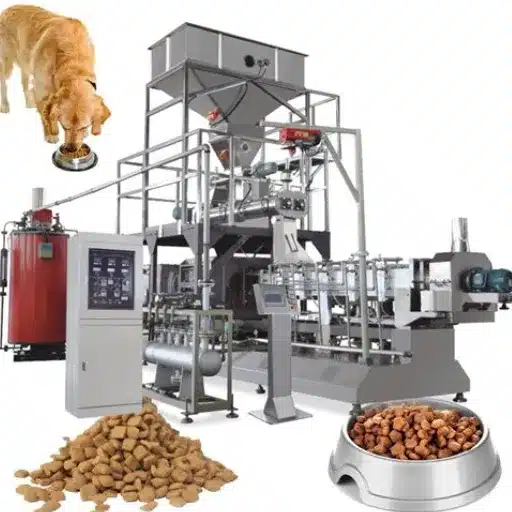
A pet food coating machine is what transforms bland, dry kibble into food that pets actually want to eat. The right coating system applies fats, liquid digest, vitamins, and dry powders evenly and efficiently. Here are the main types:
Atmospheric Drum Coaters
Drum coaters are the workhorse of pet food coating. Kibble tumbles inside a rotating drum while liquid fat and flavoring are sprayed through nozzles. Dry powder can be added in a separate stage.
Advantages:
- Simple, reliable design
- Low capital cost
- Easy to operate and maintain
- Handles most standard kibble well
Limitations:
- Maximum fat application of 8-10%
- Surface-only coating; no deep penetration
- Less uniform on irregularly shaped kibble
Best for: Standard dog and cat food, budget-conscious operations
Vacuum Coaters
Vacuum coaters remove air from the kibble pores under vacuum, then release the vacuum while the kibble is submerged in liquid coating. The pressure differential forces fat and nutrients deep into the kibble structure.
Advantages:
- Fat inclusion up to 35-40%
- Deep penetration protects sensitive nutrients
- More uniform coating distribution
- Better shelf life for high-fat products
Limitations:
- Higher capital cost (2-3x atmospheric drum)
- More complex operation and maintenance
- Requires precise vacuum control
Best for: Premium pet food, high-fat recipes, functional ingredient enrichment
Spray/Mist Coating Systems
Spray systems apply liquid coatings as a fine mist while kibble moves on a belt or through a drum. They’re often used as a supplement to drum or vacuum coating for applying thin surface layers of flavoring or vitamins.
Advantages:
- Precise application rates
- Good for thin, uniform surface coatings
- Can be integrated into existing lines
Best for: Surface flavor application, vitamin spray coating, supplementary coating stages. This type of pet food flavor coating equipment is often used as a secondary stage after primary fat application.
Powder Coating Systems
Powder systems apply dry digest, vitamins, or other powdered ingredients to coated kibble. They typically use a drum or belt with powder dispensing equipment.
Advantages:
- Adds dry nutrients without additional moisture
- Improves palatability with digest powder
- Simple integration with liquid coating stages
Best for: Dog food digest coating (1.0-1.5%), cat food powder coating (2-3%). Liquid digest and dry powder coatings work together to create the flavor profile that pets prefer.
Coating Comparison Table
| Feature | Atmospheric Drum | Vacuum Coater | Spray System | Powder System |
|---|---|---|---|---|
| Fat Inclusion | 8-10% max | Up to 35-40% | 2-5% | N/A |
| Nutrient Penetration | Surface only | Deep | Surface | Surface |
| Capital Cost | Low | High | Medium | Low |
| Complexity | Low | High | Medium | Low |
| Best For | Standard kibble | Premium/functional | Thin coatings | Dry digest |
Vacuum Coating vs. Traditional Coating: What Manufacturers Need to Know
The choice between vacuum and traditional coating is one of the most important decisions you’ll make. Here’s what you need to know:
Traditional (Atmospheric) Coating works by spraying liquid fat and flavoring onto kibble as it tumbles in a drum. The fat coats the surface but doesn’t penetrate deeply. This works fine for standard kibble with moderate fat content (8-10%), but it has clear limits.
Vacuum Coating changes the physics. First, a vacuum pump removes air from the kibble’s porous structure. Then, while the kibble is under vacuum, liquid coating is introduced. When the vacuum is released, atmospheric pressure forces the liquid deep into the kibble pores. The result is fat inclusion levels of 35-40% and much more uniform nutrient distribution. Vacuum coating for pet food applications has become the gold standard for premium and functional products.
When Sarah launched her premium cat food brand in Australia in 2025, she started with a traditional drum coater. Her target was 15% fat content for a salmon-flavored recipe. The drum coater could only achieve 9% before the kibble started clumping and the coating became uneven. After switching to a vacuum coater, she hit 18% fat content with perfect uniformity. Her palatability scores jumped 40%, and her repeat purchase rate doubled within three months.
When to choose traditional coating:
- Standard dog or cat food with 8-10% fat
- Budget-constrained operations
- Simple recipes without functional ingredients
When to choose vacuum coating:
- Premium or super-premium pet food
- High-fat recipes (above 10%)
- Functional ingredient enrichment (omega-3, probiotics, vitamins)
- Products targeting the fast-growing premium segment (8.2% CAGR)
The investment difference is significant, vacuum coaters cost 2-3x more than atmospheric drums, but for premium products, the ROI is clear. Higher palatability means higher repeat purchases, and the ability to deliver functional ingredients through coating opens product categories that competitors using traditional equipment simply cannot match.
How to Choose the Right Pet Food Dryer and Coating System for Your Facility
Selecting the right equipment requires balancing six key factors. Here’s a framework for making the decision:
Production Capacity (kg/h or t/h)
Your industrial pet food dryer and coater must be matched to each other and to your extruder output. A 1,000 kg/h extruder paired with a 600 kg/h dryer creates a bottleneck. Pair it with a 1,500 kg/h dryer and you’re paying for capacity you don’t use.
Rule of thumb: Size your dryer and coater at 110-120% of your extruder’s rated capacity. This provides headroom for peak production and recipe variations. If you are planning a complete facility rather than upgrading a single station, our turnkey pet food manufacturing guide covers full-line equipment matching, installation, and commissioning.
Product Type
Dog food, cat food, fish food, and treats all have different drying and coating requirements:
- Standard dog kibble: Belt dryer + drum coater handles most recipes
- Cat food: Often requires higher palatability; consider vacuum coating
- Premium/functional: Vacuum coater is almost always necessary
- Treats and snacks: May need specialized drying (lower temperature, longer time)
Fat/Coating Load Requirements
If your recipes call for 8-10% fat, a traditional drum coater works. If you need 15-35% fat, vacuum coating is the only option. Plan for your highest-fat recipe, not your average one.
Energy Efficiency Goals
Drying is the most energy-intensive step in pet food production. Investing in an energy efficient pet food dryer with heat recovery systems can reduce energy consumption by 15-25% compared to single-pass designs. In 2026, with energy costs rising globally, this matters more than ever.
Budget and ROI Considerations
Here’s a rough investment guide for dryer-coater systems:
| Capacity | Belt Dryer + Drum Coater | Belt Dryer + Vacuum Coater |
|---|---|---|
| 200-500 kg/h | 25,000−25,000−50,000 | 45,000−45,000−80,000 |
| 500-1,200 kg/h | 50,000−50,000−120,000 | 80,000−80,000−180,000 |
| 1,500-3,500 kg/h | 120,000−120,000−250,000 | 180,000−180,000−400,000 |
| 4,000+ kg/h | 250,000−250,000−500,000+ | 400,000−400,000−800,000+ |
Chinese manufacturers like Shandong Loyal Industrial typically offer CE-certified equipment at 40-60% of European pricing, with comparable quality and full installation support.
Hygiene and Compliance Requirements
For export markets, your equipment must meet specific standards:
- CE Marking — Required for EU exports; covers machinery safety and EMC
- HACCP Compatibility — Equipment design must support critical control point monitoring
- Food-Grade Stainless Steel — All product-contact surfaces must be SS304 or SS316
- CIP (Clean-in-Place) — Automated cleaning systems reduce downtime and contamination risk
Key Features to Look for in Quality Equipment
Beyond the basic dryer and coater types, certain features separate good equipment from great equipment:
Food-Grade Stainless Steel Construction. All product-contact surfaces should be 304 or 316 stainless steel. This isn’t just about hygiene; it’s about durability. Carbon steel corrodes, contaminates product, and fails inspections.
Precise Temperature and Moisture Control. Modern dryers use multi-zone temperature control with in-line moisture sensors. This ensures consistent product quality regardless of ambient conditions or recipe variations.
Automated Control Systems (PLC). A PLC with HMI touchscreen allows operators to store recipes, monitor parameters in real-time, and adjust settings without manual intervention. This reduces operator error and ensures repeatability.
Easy Cleanability and CIP Compatibility. Look for smooth welds, sloped surfaces for drainage, and quick-disconnect fittings. CIP systems automate cleaning and reduce the risk of cross-contamination between batches.
CE Certification and International Standards. If you’re exporting, CE certification is non-negotiable. It covers machinery safety, electromagnetic compatibility, and hygiene standards required by the EU and many other markets. For a detailed breakdown of which EU directives apply, how to verify supplier certificates, and what documentation to demand, see our guide to CE certified pet food equipment requirements.
Modular Design for Future Expansion. Choose equipment that can be expanded or reconfigured as your business grows. A modular dryer with capacity for additional zones or a coater with upgrade potential saves you from replacing equipment when demand increases.
Common Mistakes When Integrating Dryers and Coaters
After working with hundreds of pet food manufacturers worldwide, we’ve seen the same mistakes repeated. Here’s how to avoid them:
Coating before adequate drying. This is the most common and most expensive mistake. Kibble with moisture above 12% cannot absorb fat properly. The fat sits on the surface, causes clumping, and accelerates rancidity. Always verify moisture content before coating.
Wrong cooler choice for fat-coated products. After coating, kibble needs gentle cooling to allow fat to set. Counter-flow coolers work best for coated products. Cross-flow coolers can cause fat migration and uneven product temperature.
Inadequate spacing between dryer and coater. If the dryer and coater are too far apart, kibble cools between stations and requires re-heating before coating. Too close, and there’s no buffer for capacity fluctuations. Plan for 2-3 meters of conveyor between units.
Ignoring energy efficiency. Drying accounts for 60-70% of total energy consumption in a pet food line. A dryer with heat recovery costs more upfront but saves tens of thousands of dollars annually in energy costs.
Overlooking hygiene design. Rough welds, dead corners, and hard-to-clean surfaces become breeding grounds for bacteria. Every cleaning cycle takes longer, and contamination risk increases. Insist on hygienic design from the start.
Market Trends Shaping Dryer and Coating Technology in 2026
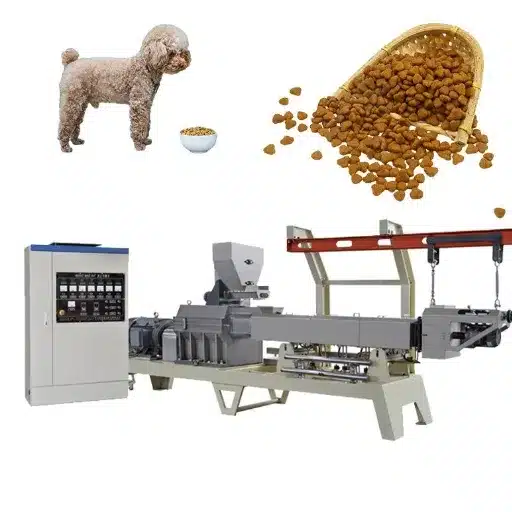
The pet food industry is evolving rapidly, and dryer-coater technology is evolving with it:
Functional and Premium Pet Food Boom. The treats and snacks segment alone is growing at 8.2% CAGR, creating massive demand for specialized coating and drying lines. Pet owners increasingly want functional ingredients like omega-3 fatty acids, probiotics, and joint supplements delivered through coating.
Energy Efficiency Mandates. With energy costs rising globally, manufacturers are demanding dryers with heat recovery, insulation, and smart controls that optimize energy use. Belt dryers with recirculating hot air can reduce energy consumption by 15-25%.
Industry 4.0 and Smart Controls. Modern dryer-coater systems feature IoT sensors, remote monitoring, and predictive maintenance alerts. Operators can monitor parameters from a smartphone, and the system can predict component failures before they cause downtime.
Low-Temperature Drying for Nutrient Preservation. Premium pet food brands are pushing for lower drying temperatures (80-100 degrees C instead of 120-130 degrees C) to preserve heat-sensitive nutrients. This requires longer drying times but produces a superior product.
Multi-Layer Coating for Functional Ingredients. Advanced coaters can apply multiple coating layers in sequence: first a base fat layer, then a nutrient layer, then a flavor layer, then a dry powder finish. This allows manufacturers to deliver complex nutritional profiles in a single kibble.
Why Shandong Loyal Industrial Co., Ltd.?
Choosing equipment is only half the equation. Choosing the right manufacturer determines whether your investment delivers results for 2 years or 20 years.
Shandong Loyal Industrial has manufactured pet food processing equipment for over a decade, serving clients in 50+ countries. Here’s what sets us apart:
Integrated System Design. Unlike competitors who sell dryers and coaters as separate products, we design them as an integrated system. The dryer output matches the coater input. The controls communicate. The conveyor connects seamlessly. No mismatches, no bottlenecks, no finger-pointing between suppliers.
Customization for Every Scale. From 100 kg/h pilot lines for startups to 5,000+ kg/h industrial operations for established brands, we configure equipment to your specific product, facility, and budget. No two production lines are identical because no two businesses are identical.
CE-Certified, Export-Ready. All equipment meets CE standards with full documentation. We’ve shipped lines to Europe, South America, Southeast Asia, Africa, and the Middle East. We understand export logistics, customs requirements, and local regulations.
Competitive Pricing Without Compromising Quality. Chinese manufacturing offers a 40-60% cost advantage over European brands while maintaining comparable quality. Our equipment uses the same stainless steel, the same PLC systems, and the same engineering principles, at a fraction of the price.
Comprehensive Support. From initial consultation and factory layout design through installation, commissioning, operator training, and ongoing spare parts supply, we support your turnkey production line from start to finish and beyond.
The team at a mid-sized pet food brand in Mexico invested $85,000 in a Shandong Loyal belt dryer and vacuum coater system in 2025. Within six months, they were producing 1,200 kg/h of premium dog food with 20% fat content and perfect coating uniformity. Their previous equipment, sourced from a local supplier, could only handle 600 kg/h with inconsistent results. The upgrade paid for itself in under eight months through increased output and reduced waste.
Ready to upgrade your pet food drying and coating capabilities? Request a customized proposal from Shandong Loyal Industrial. We’ll design a matched dryer-coater system for your specific production goals.
Frequently Asked Questions
What is the difference between a pet food dryer and a coating system?
A pet food dryer removes moisture from freshly extruded kibble, reducing it from 23-28% to 8-12% for shelf stability. A coating system applies fats, flavors, vitamins, and dry powders to the dried kibble. They work in sequence; drying first, then coating.
How much fat can be added with a pet food coating system?
Traditional atmospheric drum coaters can add up to 8-10% fat. Vacuum coaters can achieve 35-40% fat inclusion by using pressure differentials to force liquid deep into the kibble structure. The choice depends on your product requirements and budget.
What temperature should a pet food dryer operate at?
Most pet food dryers operate between 90-130 degrees C across multiple zones. Lower temperatures (80-100 degrees C) preserve more nutrients but require longer drying times. Higher temperatures (120-130 degrees C) are faster but may degrade heat-sensitive vitamins.
How do I choose between a belt dryer and a drum dryer for pet food?
Belt dryers are better for medium to large production lines (500+ kg/h) because they offer gentle handling, uniform drying, and easy maintenance. Drum dryers are more compact and lower cost, making them suitable for smaller facilities or startups with space constraints.
What certifications should pet food processing equipment have?
For export markets, look for CE marking (EU), HACCP compatibility, and ISO 22000 food safety management. All product-contact surfaces should be food-grade stainless steel (SS304 or SS316). Some markets also require specific national certifications.
Can I integrate a new dryer and coater into an existing production line?
Yes, but careful planning is required. The new equipment must match your extruder output capacity, fit your available floor space, and connect to your existing conveyor and control systems. A professional layout assessment is recommended before purchasing.
Conclusion
Choosing the right pet food dryer and coating system is one of the most consequential equipment decisions you’ll make. The dryer determines your product’s shelf stability and safety. The coater determines its palatability, nutrition, and market positioning. Together, they determine whether your pet food business thrives or struggles.
The key factors are clear: match your dryer and coater capacities to your extruder, choose coating technology based on your fat and nutrient requirements, prioritize energy efficiency and hygiene design, and work with a manufacturer who understands integrated system design for your pet food production line.
Whether you’re launching a new pet food brand or upgrading an existing production line, the right equipment investment pays for itself through higher output, better product quality, and reduced waste.
Ready to discuss your pet food production goals? Contact Shandong Loyal Industrial for a customized dryer and coating system proposal. Our engineers will design a solution tailored to your capacity, product type, and budget.