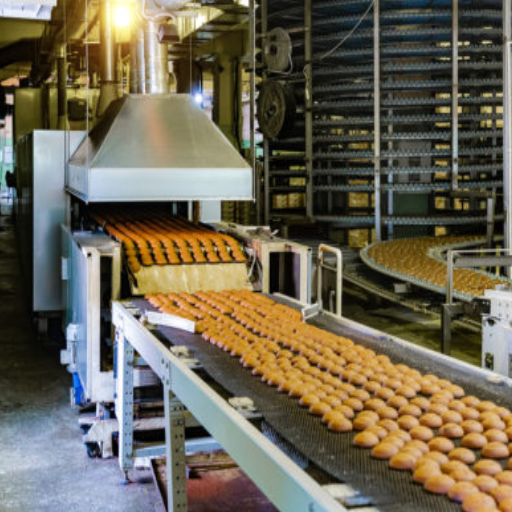
Turnkey pet food manufacturing is a complete, ready-to-operate production system delivered by a single provider, including equipment, installation, commissioning, operator training, and ongoing support. It allows entrepreneurs and established brands to launch or scale in-house pet food production without assembling equipment from multiple vendors or managing complex integration themselves.
When Elena Morales founded her boutique pet food brand in Barcelona, she spent eight months juggling quotes from seven different equipment suppliers. The extruder arrived from one factory, the dryer from another, and the packaging line from a third. None of the control systems communicated. Commissioning stretched to fourteen weeks. By the time her first batch ran, she had burned through her first-year marketing budget just fixing integration issues.
Her competitor, a Lisbon-based startup, chose a turnkey pet food manufacturing solution from a single provider. They went from contract signing to first commercial batch in twenty-two weeks. Same capacity. Same product quality. Half the stress.
That difference is what this guide is about. Whether you are validating a startup idea, expanding an existing brand, or moving production in-house from a co-manufacturer, understanding turnkey pet food manufacturing helps you make the right investment at the right time. We will cover what turnkey solutions include, when they make business sense, what investment to expect, and how to choose a partner who delivers more than just machines.
Key Takeaways
- Turnkey pet food manufacturing combines equipment, installation, commissioning, training, and support from a single provider, cutting setup time by 30-40% compared to piecemeal procurement.
- In-house turnkey production typically becomes more economical than co-manufacturing at volumes above 500 tons annually, capturing 15-25% more margin.
- Complete turnkey investments range from 50,000forpilotlinesto50,000forpilotlinesto3,000,000+ for multi-line industrial facilities, with payback periods of 18-36 months at commercial scale.
- The turnkey journey spans 5-9 months from contract to first batch: engineering, manufacturing, shipping, installation, commissioning, and handover.
- Choosing the right partner requires verifying pet food track record, in-house manufacturing capability, FAT protocols, and after-sales infrastructure.
What Is Turnkey Pet Food Manufacturing?
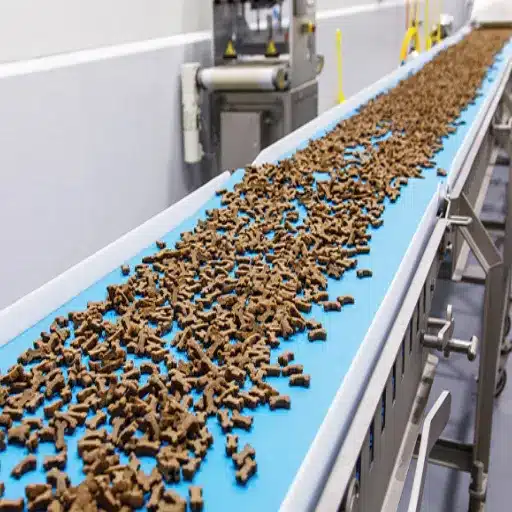
A turnkey pet food manufacturing solution is more than a box of equipment. It is a complete production system designed, built, installed, and commissioned by a single provider so that you can begin commercial production with minimal operational risk.
The Full Scope of a Turnkey Solution
The term “turnkey” means you receive a production-ready facility where the provider handles virtually every technical detail. The scope typically includes:
- Equipment supply: Grinders, mixers, preconditioners, extruders, dryers, coaters, coolers, packaging lines, and quality control systems
- Factory layout design: Process flow optimization, utility planning, and biosecurity zoning
- Installation supervision: On-site assembly, electrical connection, and utility hookup
- Commissioning: Cold checks, hot trials with your recipes, and performance validation
- Operator training: Machine operation, recipe changes, cleaning protocols, and basic maintenance
- Documentation: Operation manuals, maintenance guides, spare parts lists, and electrical drawings
- Certification support: CE marking documentation, HACCP alignment guidance, and material certificates
- After-sales support: Warranty coverage, remote diagnostics, and spare parts logistics
The “turn the key” moment happens when your team produces the first commercial batch under supervised conditions, with all systems performing to specification.
Turnkey Manufacturing vs. Co-Manufacturing vs. Piecemeal Buying
Understanding the three main approaches helps you choose the right path for your business stage:
| Approach | Capital Required | Control Level | Timeline | Best For |
|---|---|---|---|---|
| Turnkey manufacturing | Medium to high | Full | 5-9 months | Brands ready to own production and capture margins |
| Co-manufacturing | Low to none | Limited | 2-4 months to launch | Startups validating market demand |
| Piecemeal buying | Medium | Full | 9-18 months | Buyers with strong engineering teams |
Turnkey manufacturing sits in the sweet spot for brands that have validated demand and want full control without the integration headaches of piecemeal procurement. Co-manufacturing works well for early-stage validation but typically costs 25-40% of retail price in production fees, eroding margins as volume grows.
When Does Turnkey Pet Food Manufacturing Make Business Sense?
Not every pet food brand should invest in turnkey manufacturing on day one. The decision depends on your business stage, volume projections, and strategic priorities.
The Buy-vs-Outsource Decision Framework
The fundamental question is simple: at what volume does owning production become cheaper than outsourcing it?
Co-manufacturers typically charge production fees representing 25-40% of your retail price. For a brand selling at 4.00perpound,thatmeans4.00perpound,thatmeans1.00-1.60perpoundgoestotheco−manufacturer.In−houseproductioncosts,includingequipmentdepreciation,labor,energy,andmaintenance,typicallyrun1.60perpoundgoestotheco−manufacturer.In−houseproductioncosts,includingequipmentdepreciation,labor,energy,andmaintenance,typicallyrun0.60-$0.90 per pound at medium scale.
The crossover point usually occurs between 400 and 600 tons of annual production. Below that threshold, the fixed costs of equipment and facility outweigh the variable savings. Above it, margin capture accelerates rapidly.
For example, a regional brand producing 800 tons annually might pay 1.2millioninco−manufacturingfees.Aturnkeylinewith1.2millioninco−manufacturingfees.Aturnkeylinewith300,000 in annual operating costs saves 900,000peryear.Againsta900,000peryear.Againsta500,000 turnkey investment, that is a twenty-month payback.
Business Stages and the Right Approach
Stage 1 – Validation (0−0−500K revenue): Co-manufacturing or private label is the smartest path. You test recipes, pricing, and channel fit without locking up capital in equipment. Focus your budget on marketing and customer acquisition.
Stage 2 – Growth (500K−500K−2M revenue): A turnkey pilot line (100-300 kg/h capacity) makes sense for your core SKUs. You gain production control, protect recipe confidentiality, and start capturing margin. This is where turnkey pet food manufacturing delivers its highest strategic value.
Stage 3 – Scale ($2M+ revenue): Full commercial turnkey facilities (500+ kg/h) with multi-format capability support national distribution and export ambitions. At this stage, production flexibility and throughput reliability matter more than minimizing initial investment.
Product Format Considerations
Your product choices directly affect turnkey scope and cost:
- Dry kibble turnkey: Most common, fastest ROI, and broadest equipment availability. A complete line runs from raw intake through packaging with extrusion as the core process.
- Wet or canned turnkey: Requires entirely different equipment (cookers, fillers, retorts) and higher investment. Often warrants a dedicated facility due to regulatory complexity.
- Treats and chews turnkey: Frequently overlaps with kibble equipment, especially for extruded treats. Dental chews may need cold extrusion or molding presses.
- Premium formats (freeze-dried, baked, air-dried): Specialized equipment with longer payback periods. Best suited for brands with premium positioning and higher price points.
Most turnkey pet food manufacturing projects start with dry kibble as the core line, then add treat or wet capabilities as modular expansions.
What a Turnkey Pet Food Manufacturing Solution Includes
Understanding exactly what is included helps you compare quotes accurately and avoid scope gaps that derail projects.
Equipment Package
A complete dry kibble turnkey line integrates these machine groups into a unified system:
Raw material handling: Silos or bulk bag stations, hammer mills for grinding to 60-100 mesh, and pneumatic or mechanical conveyors feeding the mixing station.
Mixing and preconditioning: Ribbon or paddle blenders achieving a coefficient of variation below 5%. Jacketed preconditioners inject steam and water, raising moisture to 20-30% and beginning starch gelatinization before extrusion. This single upgrade typically boosts extruder throughput by 10-15%.
Extrusion system: The heart of the line. Twin-screw extruders handle high-meat recipes (20-40% fresh meat content) with self-wiping action and superior heat distribution. Single-screw extruders suit simpler formulations at lower capital cost. Barrel temperatures reach 110-180°C at pressures of 3-15 MPa.
Drying and cooling: Multi-pass belt dryers reduce moisture from 20-30% to 8-12% over 15-25 minutes at 80-130°C. Counter-flow coolers bring kibble temperature below 30°C before coating to prevent fat oxidation.
Coating and flavoring: Drum coaters apply fat and palatants for basic SKUs. Vacuum coaters pull fat into kibble pores for premium products, improving nutrient retention and shelf stability.
Packaging: Multi-head weighers, vertical form-fill-seal baggers, and nitrogen flushing systems extend shelf life to 12-18 months.
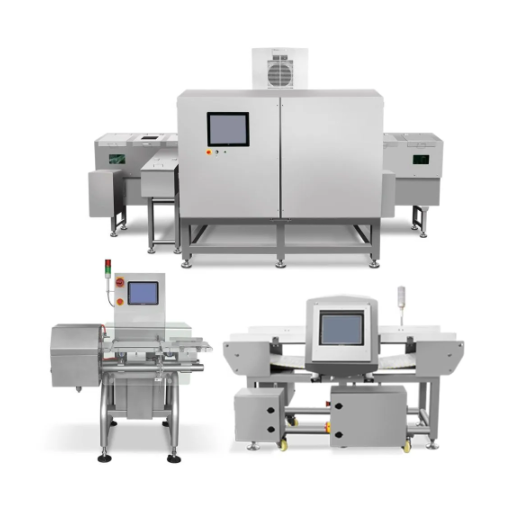
Quality control: Metal detectors, checkweighers, and moisture analyzers form critical control points throughout the line.
Automation: PLC-controlled systems with HMI interfaces enable recipe storage, batch logging, and alarm management.
Engineering and Design Services
Before any metal is cut, a competent turnkey provider delivers detailed engineering:
- Factory layout and process flow design: One-way flow from raw receiving through finished goods, with clear separation of raw and processed zones
- Utility requirements: Electrical load (150-600 kW depending on capacity), steam demand (200-800 kg/h), compressed air (0.6-1.2 MPa), and water for processing and clean-in-place systems
- HVAC and dust control: Exhaust systems for grinding areas and climate control for packaging zones
- Biosecurity zoning: Physical separation of raw material, processing, and finished product areas to prevent cross-contamination
Installation and Commissioning
Installation separates competent turnkey providers from equipment resellers. The process includes:
- On-site installation supervision: Experienced technicians guide local contractors through assembly and utility connection
- Cold commissioning: Mechanical verification of all systems without product, checking alignment, electrical safety, and control logic
- Hot commissioning: Production trials using your actual recipes, adjusting parameters for optimal throughput, yield, and quality
- Performance acceptance: Documented validation that capacity, yield, and quality targets are met before handover
Training and Documentation
A turnkey solution is only as good as your team’s ability to operate it. Expect:
- Operator training: 3-5 days of hands-on instruction covering startup, shutdown, recipe changes, cleaning protocols, and emergency procedures
- Maintenance training: Preventive schedules, lubrication points, wear part inspection, and common repairs
- Documentation package: Operation manuals, maintenance guides, electrical drawings, pneumatic diagrams, and a complete spare parts list with part numbers
After-Sales Support
The relationship continues long after handover. Verify your provider offers:
- Warranty terms: Typically 12 months on equipment, with options for extended coverage
- Remote diagnostic capability: PLC systems with internet connectivity enable technicians to troubleshoot issues without traveling
- Spare parts availability: Critical wear parts (screws, dies, bearings, seals) available within 2-4 weeks
- Technical support response: Phone and video support with response time commitments
Investment Tiers and ROI for Turnkey Pet Food Manufacturing
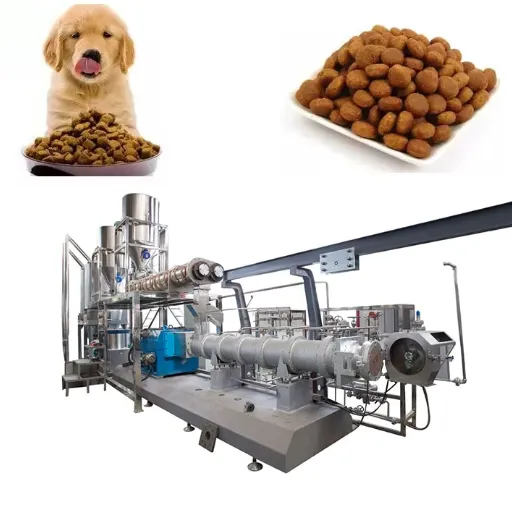
Honest investment data helps you plan realistically. The tables below reflect industry benchmarks for Chinese-built, CE-certified turnkey lines.
Capacity and Investment Matrix
| Tier | Capacity | Equipment Investment | Total Turnkey Investment | Floor Area | Typical Buyer |
|---|---|---|---|---|---|
| Pilot / R&D | 100-200 kg/h | 30,000−30,000−60,000 | 50,000−50,000−100,000 | 200-400 m2 | Startups, recipe development |
| Small Commercial | 300-500 kg/h | 80,000−80,000−150,000 | 120,000−120,000−250,000 | 500-800 m2 | Boutique brands, regional markets |
| Medium Commercial | 500-1,200 kg/h | 150,000−150,000−350,000 | 250,000−250,000−500,000 | 800-1,500 m2 | Growing brands, private label |
| Large Industrial | 1,500-3,500 kg/h | 350,000−350,000−800,000 | 600,000−600,000−1,200,000 | 1,500-3,000 m2 | National brands, exporters |
| Multi-Line Facility | 4,000+ kg/h | $800,000+ | 1,500,000−1,500,000−3,000,000+ | 3,000+ m2 | Multinational, diversified formats |
Total turnkey investment includes equipment, shipping, installation supervision, commissioning, training, and an initial spare parts package. It does not include building construction, land, or working capital.
When Raj Patel evaluated his expansion options in Mumbai, he compared a 180,000mediumcommercialturnkeylineagainstcontinuingwithhisco−manufacturer.Athisprojectedvolumeof600tonsannually,theco−manufacturercharged180,000mediumcommercialturnkeylineagainstcontinuingwithhisco−manufacturer.Athisprojectedvolumeof600tonsannually,theco−manufacturercharged960 per ton. In-house production cost 420pertonincludingdepreciation.The420pertonincludingdepreciation.The540 per ton savings paid back his turnkey investment in twenty months. After that, the margin improvement funded his marketing expansion into Southeast Asia.
Operating Cost Benchmarks
Understanding ongoing costs helps you model profitability accurately:
- Raw materials: 50-65% of production cost. Meat meals, grains, fats, and vitamin premixes dominate.
- Labor: 10-20%, varying with automation level. A semi-automatic line needs 4-6 operators per shift. A fully automated line needs 2-3.
- Energy: 8-15%. Extrusion and drying are the largest consumers. Variable frequency drives on motors reduce energy consumption by 15-25%.
- Packaging: 5-10%. Film, labels, and cartons scale with output.
- Maintenance and spare parts: 3-5% of equipment value annually. Dies, screws, bearings, and seals are the main consumables.
ROI and Payback Timeline
Payback periods vary by scale and utilization:
- Pilot lines: Often not ROI-positive on their own. Their value lies in recipe development and market validation.
- Small commercial (300-500 kg/h): 24-36 months at 60% utilization.
- Medium commercial (500-1,200 kg/h): 18-30 months at 70% utilization.
- Large industrial (1,500+ kg/h): 18-24 months at 75% utilization.
The key variable is utilization. A line running one shift at 50% capacity takes twice as long to pay back as the same line running two shifts at 80% capacity. Plan your capacity to match near-term demand with room for growth.
Facility Requirements for Turnkey Pet Food Manufacturing
Your facility is as important as your equipment. Poor layout or inadequate utilities undermine even the best machinery.
Floor Space and Layout Principles
Effective pet food facilities follow one-way process flow:
Raw receiving → raw storage → grinding → mixing → extrusion → drying → coating → cooling → packaging → finished storage
Critical layout principles include:
- Raw and finished product segregation: Never allow backflow of materials. Separate personnel and equipment for raw and finished zones.
- Allergen control: Dedicated lines or thorough cleaning protocols for products containing common allergens.
- Expansion stubs: Pre-planned utility connections and floor space for adding a second extruder or treat line later.
A typical 1,000 m2 facility for a 500-800 kg/h line allocates roughly:
- 200 m2 for raw receiving and storage
- 150 m2 for grinding and mixing
- 200 m2 for extrusion, drying, and cooling
- 100 m2 for coating and flavoring
- 150 m2 for packaging and finished goods
- 200 m2 for offices, laboratories, and utilities
Utility Infrastructure
Underestimating utilities is a common and expensive mistake. Verify your facility can support:
- Electrical: 150-600 kW depending on line capacity, with three-phase power and adequate panel capacity
- Steam: 200-800 kg/h at 0.6-0.8 MPa for preconditioning and extrusion. Some lines use electrically heated alternatives.
- Compressed air: 0.6-1.2 MPa for pneumatic conveying, packaging, and control systems
- Water: Process water for conditioning and cleaning, plus potable water for operator facilities
- Exhaust and dust collection: Essential for grinding areas and dryer vents
Environmental and Regulatory Compliance
Before ordering equipment, confirm your facility can obtain:
- Local feed manufacturing licenses
- Environmental permits for emissions and wastewater
- Fire safety approvals
- Building code compliance for industrial equipment loads
International Standards and Certifications
Export-ready turnkey lines require documentation that satisfies regulators in your target markets.
CE Marking for European Markets
CE marking under the Machinery Directive 2006/42/EC is mandatory for equipment sold in the European Economic Area. A complete turnkey line requires:
- Machinery safety compliance for all integrated equipment
- Electromagnetic compatibility (EMC) certification
- Electrical safety per Low Voltage Directive standards
- Unified technical file covering the complete line, not just individual machines
Verify that your provider supplies a Declaration of Conformity for the integrated system, not just component certificates.
Food Safety Standards
Pet food manufacturing must align with established safety frameworks:
- HACCP: Hazard Analysis Critical Control Points implementation with defined CCPs at extrusion (kill step), metal detection, and moisture validation
- ISO 22000: Food safety management system certification for the production facility
- Regional regulations: EU Regulation (EC) 767/2009 for Europe, FDA FSMA for the United States, and AAFCO guidelines for nutritional adequacy claims
Material and Hygiene Standards
All food-contact surfaces should use:
- 304 stainless steel as the minimum standard
- 316L stainless steel for high-salt or acidic recipe environments
- Surface finishes of Ra less than or equal to 0.8 micrometers for cleanability
- Clean-in-place compatibility for mixing, extrusion, and coating equipment
How to Choose a Turnkey Pet Food Manufacturing Partner
The partner you choose determines your production success for the next decade. Equipment lifespan typically reaches 10-15 years with proper maintenance.
Seven Essential Evaluation Criteria
1. Proven pet food track record: Ask for the number of complete pet food lines delivered, operational client references, and video documentation of running installations. A provider with fifty snack lines but only two pet food lines may lack recipe-specific expertise.
2. In-house manufacturing capability: Does the provider build core equipment (especially extruders) or only integrate third-party machines? In-house manufacturing means direct engineering access for customization and faster spare parts availability.
3. Recipe flexibility: Can the line handle your specific formulations? High-meat recipes, grain-free diets, and functional additives place different demands on extruder configuration, dryer capacity, and coating systems.
4. Certification documentation: Request valid CE certificates, material mill certificates for stainless steel, and test reports. Verify certificate authenticity with the issuing body if uncertain.
5. Commissioning protocol: A professional provider conducts Factory Acceptance Testing (FAT) before shipment, either on-site or via detailed video documentation. On-site hot commissioning with your recipes should be part of the standard scope.
6. Training quality: Operator and maintenance training should span multiple days with hands-on practice, not just a few hours of observation. Documentation should be complete and professionally translated into your team’s working language.
7. After-sales infrastructure: Confirm spare parts lead times, remote diagnostic capability, and warranty terms in writing. Ask specifically about technical support response times and whether they have service presence or partners in your region.
Red Flags to Avoid
Watch for these warning signs during evaluation:
- Vague scope definitions or “turnkey” used without a written deliverables list
- No FAT protocol or refusal to demonstrate equipment running before shipment
- Missing unified line warranty (only individual machine warranties offered)
- Pressure for 100% upfront payment without milestone-based terms
- Inability to provide three or more pet food client references with operational lines
- No CE marking for European buyers
- Single-screw extruder recommended for high-meat recipes without technical justification
- Poorly translated documentation or operation manuals
The Turnkey Journey: From Consultation to First Batch
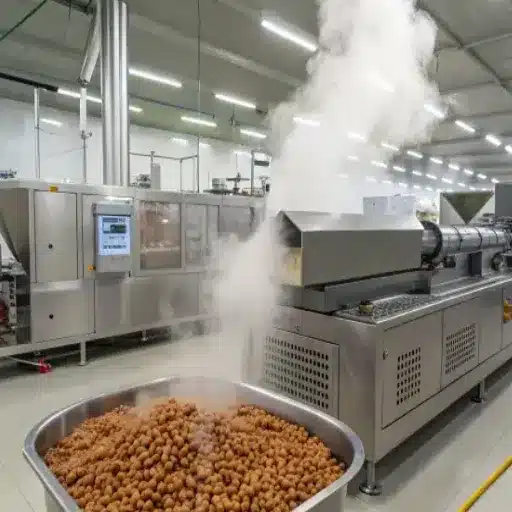
Understanding the timeline helps you plan cash flow, marketing launches, and staffing.
Phase 1 – Consultation and Feasibility (2-4 weeks)
The provider reviews your product specifications, target capacity, budget, and facility constraints. You receive a preliminary layout, equipment list, and quotation. This is also when you discuss recipe flexibility, expansion options, and certification requirements.
Phase 2 – Engineering and Design (4-6 weeks)
After contract signing and deposit, detailed engineering begins. The provider finalizes factory layout drawings, utility specifications, equipment designs, and control system architecture. You review and approve drawings before manufacturing starts.
Phase 3 – Manufacturing (8-16 weeks)
Equipment is fabricated, assembled, and tested at the provider’s facility. Factory Acceptance Testing verifies mechanical function, electrical safety, and control logic. For international buyers, video-FAT has become standard practice, reducing travel costs while maintaining quality assurance.
Phase 4 – Shipping and Customs (2-6 weeks)
Equipment is packed for export, documented for customs, and shipped. A competent provider supplies complete customs documentation and can advise on import procedures for your country.
Phase 5 – Installation and Commissioning (3-6 weeks)
Technicians supervise on-site assembly, utility connection, and system integration. Cold commissioning verifies mechanics and electrics. Hot commissioning runs production trials with your recipes, adjusting parameters for optimal output and quality.
Phase 6 – Handover and Support (ongoing)
Performance acceptance is documented. Warranty activates. Operator training concludes. The provider transitions to ongoing technical support.
Total typical timeline: 5-9 months from contract to first commercial batch.
Turnkey Trends Shaping Pet Food Manufacturing in 2026
The turnkey landscape is evolving rapidly. Three trends deserve attention in your planning.
Modular and Scalable Design
The smartest investment today is a line designed for tomorrow. Modular turnkey systems let you start with core kibble capacity and add treat modules, wet processing, or packaging upgrades without replacing the entire line. This approach costs 10-15% more upfront but protects against premature obsolescence.
For growing brands, modularity means expanding capacity in increments that match demand rather than over-investing early or facing bottlenecks later.
Smart Automation and IoT
Modern turnkey lines integrate PLC systems with cloud dashboards for remote monitoring, recipe management, and predictive maintenance. Real-time OEE tracking identifies bottlenecks before they constrain output. Predictive maintenance alerts reduce unplanned downtime by up to 30%.
These capabilities matter most for facilities operating multiple shifts or in regions where on-site technical support is limited.
Sustainability and Energy Efficiency
Energy costs represent 8-15% of operating budgets. New turnkey designs incorporate heat recovery from dryers, variable frequency drives on motors, and water reclamation systems. Some installations report 15-25% energy reductions compared to lines designed five years ago.
For brands marketing sustainability credentials, efficient manufacturing supports brand positioning while reducing costs.
Turnkey pet food manufacturing represents a strategic inflection point for growing brands. It offers control over quality, protection of recipe intellectual property, and margin capture that compounds as volume grows. But it is not a decision to rush.
Validate your market first. Know your volume trajectory. Understand your product formats. Then choose a turnkey partner with proven pet food expertise, in-house manufacturing capability, and a commitment to long-term support.
The right turnkey pet food manufacturing solution does not just deliver equipment. It delivers a production capability that becomes a competitive advantage for the next decade.
At Shandong Loyal Industrial, we have spent over ten years designing, building, and commissioning complete pet food production lines for clients in more than fifty countries. Our turnkey solutions include everything from initial feasibility assessment through commissioning, training, and ongoing support. Every line is engineered for your specific recipes, capacity targets, and growth plans.
Ready to explore turnkey pet food manufacturing for your brand? Contact our engineering team for a customized feasibility assessment, preliminary layout, and investment proposal tailored to your production goals.