Last updated:
Food grade lubricants NSF H1 are registered for machinery applications where incidental food contact may occur. Selecting one still requires a match between the exact product, its permitted use and the machine manufacturer’s requirements. A registration mark answers only part of that decision. NSF registration program
Your maintenance team needs a usable answer at the lubrication point. Which container belongs here? What amount and interval does the manual specify? What happens when the supplier offers a substitute?
This guide connects those questions to a product verification record, a machine-point register and a controlled change procedure.
For a proposed installation, review the food production lines relevant to your project and include the lubrication schedule in your equipment-document request.
Key Takeaways
- Classify the possible contact pathway before approving a lubricant.
- Match the delivered container to the exact registration and use documentation.
- Check machine suitability separately, including compatibility with the existing fill.
- Link storage, tools, work orders and change control to the approved product.
What NSF H1 means for food-grade lubricants
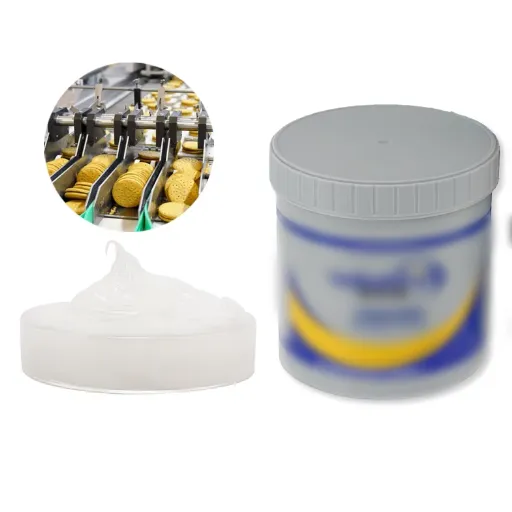
H1 identifies lubricants registered for applications involving possible incidental food contact. The registration process evaluates formulation and labelling. Plant teams then need to control where and how that product is used. Keep the product’s registration letter, technical data sheet and safety data sheet together so technicians can find both use restrictions and handling information. NSF registration program
Read the category as an intended use
The letters and numbers distinguish different applications. Start with the required application, then confirm the exact product’s use letter. A general food-grade label gives too little information to approve a container for a particular task.
| Category | Intended application | Point to verify |
|---|---|---|
| H1 | Lubrication where incidental food contact may occur | Product identity, use restrictions and machine suitability |
| H2 | Lubrication where food contact is excluded | The assessed contact pathway and controls |
| H3 | Soluble oils, including specified rust-prevention uses | Application and removal instructions in the use letter |
| 3H | Release agents for specified direct-contact applications | The release-agent use and its restrictions |
| HT1 | Heat-transfer fluids where incidental food contact may occur | Fluid category and suitability for the heat-transfer system |
Use the category descriptions and product search in the NSF White Book when checking these distinctions. H3 and 3H have separate purposes. A rust-prevention product needs its own application instructions before equipment returns to food use.
Interpret limits in their actual context
For US applications, 21 CFR 178.3570 contains ingredient and use conditions for incidental-contact lubricants. It requires the minimum amount needed for the technical effect and applies constituent-specific limitations. Its mineral-oil entry specifies a 10-parts-per-million limit for addition to food.
Apply each constituent’s conditions when assessing the formulation and use. A plant cannot use the mineral-oil figure alone to authorize intentional addition or release an affected food batch. 21 CFR 178.3570
Map leakage, spray drift, maintenance access and contaminated tools as possible routes. A drive’s position below a conveyor alone cannot settle the assessment. Ask how oil could move during operation, cleaning or repair, then record the controls. The broader hygienic equipment design guide provides related equipment-design context.
Verify registration, ISO 21469 and MOAH-Free claims
A useful verification record lets another person repeat your check. Record the company, full product name, registration number, category, check date and document reference. Keep the checked evidence with the approval record, rather than relying on a remembered logo or a purchasing description such as food-safe grease.
Match the delivered container to the listing
Search the White Book using the supplier’s registration number and product details. Compare the result with the container and registration letter. Confirm the precise product designation, including any grade or suffix. Ask the supplier to explain a mismatch before authorizing that product for use. NSF White Book
Illustrative scenario
A purchase order names an approved grease, but the delivered tub has an extra suffix. The receiving technician asks purchasing for the matching registration letter and technical sheet. The decision remains open until the supplier establishes the delivered product’s identity and engineering confirms the application. This example describes a decision process and claims no customer result.
Also check the container’s batch identification and condition. Link receipt information to the product record. For decanted oil, retain a traceable connection to the original labelled container. Treat an unlabelled grease gun as an unresolved identity problem during the site check.
Separate the evidence each program supplies
NSF’s program describes H1 registration as formulation and label review. ISO 21469 addresses hygiene requirements for formulation, manufacture and use of lubricants that may contact food during processing. Review the certification’s actual product and manufacturing scope against the supplier’s claim. The NSF ISO 21469 program and certified listings provide the verification routes.
On September 23, 2026, NSF announced its first NSF 538 MOAH-Free certification. MOAH means mineral oil aromatic hydrocarbons. The announcement describes a separate certification involving formulation review and laboratory analysis against the guideline’s requirements. When a supplier makes this claim, request evidence for the exact supplied product and examine the certification scope. NSF 538 announcement
Keep these documents in separate fields in the register. Record H1 status, ISO 21469 evidence and any MOAH-Free claim individually. That makes a missing document visible without letting one mark stand in for another. Carry the relevant references into the equipment documentation handover checklist.
Match the lubricant to each machinery point
Two H1-labelled products can have different operating properties and compatibility requirements. Start with the OEM’s manual and lubrication schedule. OEM means original equipment manufacturer.
Ask the machine maker to resolve an unclear specification before choosing a product from a general application chart. Supplier guidance on food-industry lubricant applications reinforces the need to consider the operating environment.
Build the selection record from the machine
Identify each lubrication point by asset and location. Record the existing product and the operating conditions relevant to selection. Useful inputs include load, speed, operating temperature, water exposure, cleaning chemicals, seals and the lubrication delivery system. Use the actual machine documentation for the required viscosity or grease consistency.
| Machinery point | Questions for the OEM or lubricant supplier | Record before approval |
|---|---|---|
| Conveyor chain | What are the chain temperature, application method and cleaning conditions? | Specified oil, application point and dose/interval source |
| Enclosed gearbox | What oil specification, seal compatibility and fill level apply? | Approved specification, product and change procedure |
| Bearing or linear guide | What consistency, base-oil properties and delivery requirements apply? | Grease specification, access point and quantity source |
| Hydraulic system | Which fluid properties and pump/seal requirements apply? | System specification and supplier suitability evidence |
| Designated mixer or extruder point | Which external points require lubrication under the manual? | Point diagram and exact instructions for each location |
For a corn puff snacks production line, map the extruder drive and downstream handling equipment separately. For a pasta and macaroni production line, identify the mixer’s designated lubrication points from its manual. These are survey prompts, with the final schedule determined by the installed equipment.
Resolve compatibility before a substitution
An H1 category match alone cannot establish that the proposed product can mix with the existing fill. Greases can differ in thickener and base oil even when their consistency grades match.
NLGI is the grease-consistency grading system. A matching grade alone leaves the compatibility question open. Give the supplier both product names and ask for written compatibility and transition guidance. The lubrication-system supplier’s switching FAQ identifies miscibility as a changeover consideration.
Illustrative scenario
A contractor offers an H1 grease with the same NLGI consistency as the approved product. The work order has no comparison of thickener or base oil. The supervisor records the proposed substitution and requests the supplier’s compatibility assessment. The team can then approve a documented transition or retain the existing approved product.
Where an automatic system serves multiple points, ask how the proposed lubricant will work with its pumps, lines and metering components. Include the system supplier in the decision. Document any unresolved condition so a purchase approval cannot be mistaken for engineering approval to fill the equipment.
Before equipment handover, request a point-by-point schedule for the food production line you are assessing. Ask which instructions establish the product, quantity, interval and transition procedure.
Build hygienic handling and maintenance records

EHEDG announced the fourth edition of Guideline 23 Part 1 on May 18, 2026. Its public summary covers lubricant handling, risk assessment, monitoring, contamination prevention and corrective actions. Use these subjects to structure your plant review and consult the guideline for its full recommendations. EHEDG lubrication guidance announcement
Give storage and tools a defined owner
Keep containers closed and identified. Assign storage locations and dispensing tools to approved products. If your site uses colours, document what each colour means and support it with legible product labels. Contractors need the same point-specific instructions and access to approved materials as permanent staff.
At the work area, compare the asset ID, point and container label with the work order. Check that the applicator belongs to the correct product and is clean. After the task, record what was used and any abnormal condition. Build these checks into plant maintenance planning so they appear in the technician’s normal workflow.
Make the register useful at the point of work
Separate the approved-product record from the maintenance event log. The first explains what may be used and why. The second records what actually happened. The following template uses placeholders for a plant to complete from its own records.
| Record field | Example entry format | Evidence to attach |
|---|---|---|
| Asset and point | [asset ID] / [bearing or chain point] | Point photograph or drawing reference |
| Approved lubricant | [full product name and grade] | OEM specification and supplier confirmation |
| Registration check | [number], H1, [check date] | Dated listing and registration letter |
| Application instruction | [quantity] / [interval] | Manual page or approved work instruction |
| Application tool | [identified grease gun or dispenser] | Tool-to-product assignment |
| Work event | [date/time], [technician], [quantity used] | Completed work order |
| Follow-up | [observation], [owner], [due date] | Investigation and closure record |
Give each work event a link to the lubricant batch or lot used. For a shared dispenser, record the source container and replenishment history so the site can trace the material used at the point. Keep the full product designation on both the approval record and the event log.
For example, a completed work order can reference [asset/point], [approved product record], [container batch], [quantity] and [technician]. These are fields to complete from actual work. If a record is missing, assign someone to resolve the gap instead of reconstructing an assumed application.
Keep the latest approval accessible, and retain the superseded version so the maintenance history remains understandable. Where customers require additional declarations, list those requirements separately and obtain the relevant supplier document.
Define leakage and review triggers
Agree what operators should report, such as visible drips, unexpected consumption, damaged seals or an unlabelled applicator. Assign investigation to responsible maintenance and food-safety personnel. If food may be affected, use the plant’s incident and product-disposition process and document the assessment. The H1 designation alone cannot establish whether a particular affected batch can be released.
Set review timing through the site’s risk assessment and management system. Include triggers for a changed supplier or formulation, new equipment, a revised cleaning method and a leakage incident. Record the reason for a review and the resulting action. This makes the schedule traceable to the plant’s actual operating conditions.
Control changeovers and restart checks

A lubricant change connects purchasing, engineering, maintenance and food safety. Plan the transition before the replacement reaches the machine. Use the following sequence as a work-order framework, supported by the OEM and lubricant supplier’s written instructions.
- Identify the existing fill. Record the asset, point, current product and available service history. Resolve an unknown fill with the responsible engineering team.
- Verify the proposed replacement. Match its registration, use documents and technical properties to the assessed application. Close identity discrepancies with the supplier.
- Agree the transition method. Obtain product-specific compatibility advice and the OEM’s procedure. Define any required draining, cleaning, replacement parts or other preparation in that approved procedure.
- Prepare the maintenance task. Assign trained personnel, approved tools and the site’s isolation and contamination controls. Make the current work instruction available at the job.
- Carry out and document the change. Record the product, batch, amount, technician and completed preparation. Log deviations and obtain the required decision before continuing.
- Check and authorize restart. Complete the specified checks, record the decision and update the point’s product record and work orders.
The transition procedure should specify whether flushing is appropriate and how it is performed. The changeover decision depends on the equipment and the actual products involved. Ask for a written resolution if the two suppliers’ instructions conflict. Lubricant switching guidance
Illustrative scenario
A handover pack lists the gearbox model but omits its lubricant schedule. The maintenance planner opens a documentation action and requests the correct manual. The action stays open until the specified fill and service instructions are confirmed. A generic H1 recommendation cannot fill that information gap.
Use the handover documentation checklist to track the missing item, its owner and its closure evidence. Review early operation against the approved restart instructions, including any specified leakage or delivery-system checks. Name the person authorized to close the maintenance action. Record which checks were completed and which evidence supports that decision.
If the change follows a leak or suspected food exposure, keep the maintenance restart record linked to the incident record. The responsible food-safety team still needs to resolve the affected-food question through the site process. A repaired seal and a completed fill record answer the equipment task, while the incident record documents the food assessment.
For ongoing review, compare observed conditions with the approved instructions. Assign an owner when a point keeps leaking, consumes an unexplained amount or needs an undocumented top-up. Revisit the point assessment and work instruction when the investigation identifies a changed condition.
Compare purchasing options on an approved basis
Begin a comparison with products that meet the documented application requirements. Ask suppliers to identify the exact product, pack size, price basis and evidence included in the quotation. Record the unit used for price comparisons so a smaller container or a different grade cannot distort the decision.
Keep the assessment practical. Compare the OEM acceptance, registration evidence, technical data, transition work, storage needs and support included. Where a supplier proposes a longer service interval, request application-specific evidence and the machine maker’s acceptance before changing the work order. Separate the quoted purchase price from any unverified estimate of operating savings.
For a protein bar production line, assess the mixing, forming, cutting and handling points individually before considering consolidation. A shared product may be an option where each point’s requirements are satisfied and the transition is controlled. Keep separate approvals where requirements differ.
Use a sheet like this for each candidate. Leave a field open until the relevant document or quotation arrives.
| Comparison item | Candidate A | Candidate B | Decision evidence |
|---|---|---|---|
| Exact product and grade | [supplier entry] | [supplier entry] | Matching container and product documents |
| Application acceptance | [reference] | [reference] | OEM requirement and suitability confirmation |
| Registration and other claims | [references] | [references] | Exact listing and relevant certificate scope |
| Quoted quantity and price basis | [dated quote] | [dated quote] | Same unit, pack and delivery basis |
| Transition work | [approved procedure] | [approved procedure] | Written compatibility and change instructions |
| Technical support scope | [included work] | [included work] | Supplier commitment in the offer |
Discuss open technical fields with the responsible maintenance engineer before accepting a substitution. A cheaper pack has limited decision value if its application acceptance remains unresolved. Where both products are approved, compare the actual quoted supply and transition costs on the same basis. Keep any proposed operating benefit separate until its evidence is available.
Ask who will provide missing documents and by when. Include those commitments in the purchase or handover action list. The completed sheet should explain why the plant selected the product and what conditions apply to its use.
Questions plant teams should resolve
Does H1 mean a lubricant is edible?
H1 covers incidental-contact lubrication applications. Follow the product’s conditions of use and control lubricant migration. Direct-contact release-agent applications have their own category and instructions. Review the required application before selecting from a supplier’s food-grade range. NSF White Book
What should we do if the listing and container differ?
Keep approval open and ask the supplier to identify the exact delivered product. Save the response, matching letter and technical sheet with the receipt record. Check any proposed substitute against the machine specification before releasing it to maintenance.
Does a lubricant’s certification cover our whole machine?
Check the named product and scope on the registration or certificate. Equipment suitability still requires the machine’s instructions and application assessment. Keep lubricant certification evidence separate from the machinery handover documents and the plant’s own operating controls.
Can one H1 product serve the entire plant?
Review every intended point before consolidating. Required viscosity, grease consistency, compatibility and delivery-system conditions can differ. A product family can also contain separate grades with separate applications. Maintain a clear product-to-point record for the approved combinations.
What does a MOAH-Free claim establish?
For an NSF 538 claim, request the exact certification evidence and examine its scope. The named guideline defines the claim and its criteria. H1 registration, machine suitability and the plant’s food-safety decisions require their own supporting records. NSF 538 announcement
For your next equipment review, bring the asset list, planned cleaning method and outstanding lubrication-document questions. Discuss maintenance documentation for your proposed Loyal line so the enquiry can address your actual project and handover needs.