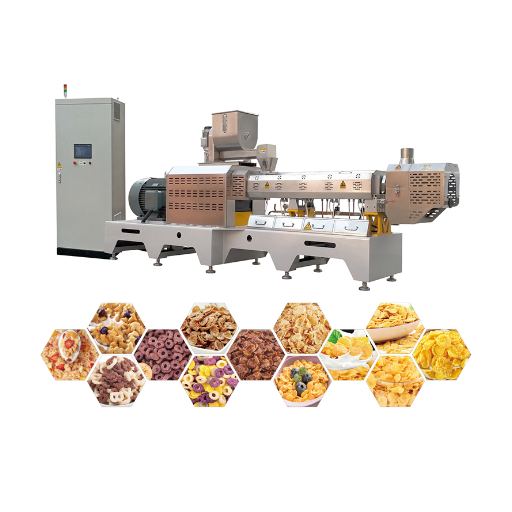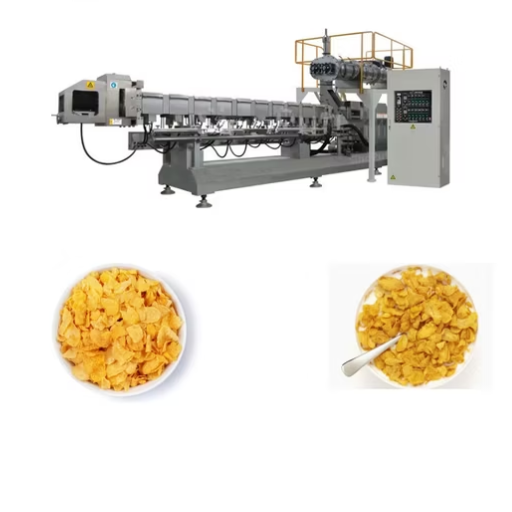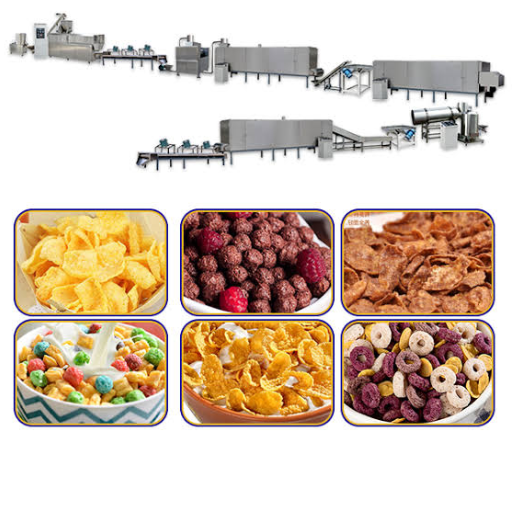
Cereal production line quality control is a set of measurements taken at fixed points along the line, each with a target, a method, a frequency and a written reaction when the result drifts. The measurements that decide the finished product are moisture and water activity, bulk density and flake thickness, colour and toast level, coating pickup, foreign material and pack weight.
Most plants get the order wrong. They buy the line, then build QC around whichever instruments the supplier fitted, so the first real measurement happens at the packing line, after the product is in the bag.
We’ll call her Ana. Ana ran a 500 kg/h flaked line and checked moisture once an hour, at the dryer exit, with a hand meter.
A steam valve drifted on a Friday afternoon. Forty minutes of product left the dryer out of spec, about 330 kg, and most of it was packed before anyone opened the sample bag. The fix was not a new dryer: a second sample port, a shorter interval and one line telling the operator to slow the line.
This guide covers what to measure at each stage, how often to sample, which limits the literature supports, and what a record needs before an audit. If you’d rather see the line first, the cereal manufacturing equipment page lists the published configurations.
Key Takeaways
- Cereal QC is defined by control points, not by how much testing happens at the end. On a flaked line, the dryer exit is the most valuable measurement point you have.
- Moisture targets change by grain and stage: cooked mass at or below 32%, corn grits 10-14% after drying, wheat grits 16-18%, finished corn flakes 1.5-3%.
- Sampling frequency follows time, not tonnage. A 30-minute interval covers 0.2% of shift output at 500 kg/h and 0.1% at 1,000 kg/h.
- Foreign-material inspection is often the line’s only true critical control point, and its sensitivity depends on aperture, product effect and validated speed.
- A QC program survives an audit on records: who measured, with what, against what limit, and what happened when it failed.
What cereal production line quality control measures
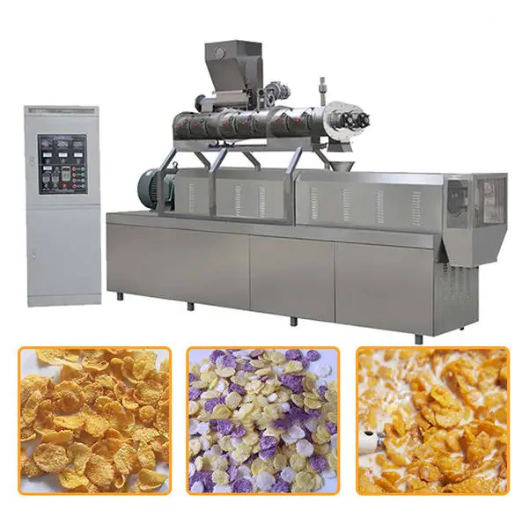
Five families of measurement cover almost everything that cereal production line quality control has to answer.
Moisture and water activity. Moisture sets texture, flake strength and toasting behaviour. Water activity sets shelf life.
Physical structure. Bulk density, flake thickness, breakage and fines tell you whether the rolls and dryer are doing what the specification says. Bulk density also decides how much product fits a carton.
Appearance. Colour and toast level are what customers notice first and complain about loudest, and the fastest way to see a dryer drifting.
Coating. Pickup percentage, coverage and allergen segregation. A coating line sharing a room with an uncoated line is a labelling risk before it is a quality risk.
Foreign material and pack integrity. Metal detection, X-ray where fitted, seals, net weight and code legibility.
The full proximate panel is missing on purpose. Protein, fat, fibre and ash belong to the supplier certificate of analysis, not the hourly control sheet. Cereals are bought on texture and bowl life, which moisture and structure decide.
Quality control happens at the line, every hour. Quality assurance is the system around it. This article is about the first.
The control points, stage by stage
A control point is a place where a measurement can still change the outcome. Once the flakes are in the bag, your options are rework, downgrade and complaint handling. Treat the targets below as published references; your product specification governs.
| Stage | What is measured | Reference target or limit | Instrument | Action if out |
|---|---|---|---|---|
| Raw grain intake | Moisture, foreign matter, insect damage, test weight, supplier COA | Against your approved specification | Sieve, moisture meter, visual check | Hold the load before unloading |
| Mixing and premix | Batch weight, water addition, ingredient lot | Recipe, within scale tolerance | Scales, flow meter | Stop and verify the batch record |
| Cooking (flaked lines) | Cooked mass moisture, kernel appearance | No more than 32%; translucent, no chalky centre | Moisture meter, squeeze test | Extend or shorten the cook |
| Extrusion | Barrel temperatures, die pressure, product temperature | Set points from the product trial | PLC sensors | Correct before the die |
| Forming and flaking | Roll gap, flake thickness, flake moisture | Thickness per spec; moisture by grain (below) | Feeler gauge, moisture meter | Reset the rolls |
| Drying | Exit moisture, bed temperature | Corn 10-14%, wheat 16-18%, rice about 17% | In-line NIR or bench meter | Adjust temperature and residence |
| Coating | Pickup percentage, slurry solids, allergen changeover | Per product spec | Weight delta, refractometer | Hold and rework or divert |
| Toasting | Oven temperature, residence, colour | About 275-330 C, roughly 90 seconds for corn | Pyrometer, colour meter | Adjust before colour drift becomes a lot |
| Cooling | Product temperature before packing | Below the packing limit | Probe | Slow the line or extend the cooler |
Those windows aren’t ours, and they aren’t arbitrary. The Cereals & Grains Association chapter on breakfast cereal processing puts cooked mass at no more than 32% moisture and finished corn flakes at 1.5-3%. In between, corn grits leave drying and tempering at 10-14%, wheat grits leave the dryer at 16-18%, and rice grits run about 17% at flaking.
Each window exists because the grains behave differently at the rolls. Wheat grits at 12-13% shatter during flaking and bulk density climbs; at 19-20% they gum the rolls. Corn flakes tolerate a drier flake because they blister during toasting.
The most common mistake on mixed-product lines is one moisture target posted at the dryer, three grains running through it.
We’ll call him Daniel. Daniel’s plant ran corn, wheat and rice on one line and used 12% for all three, because that was the corn target and corn was the volume product. Wheat shattered into fines, bulk density rose, and the packing line started under-filling. The fix was two laminated cards on the dryer door, one per grain, and a changeover check signed before the first flake passed the rolls.
Packing checks test the product rather than the process.
| Check | Method | Reference | When |
|---|---|---|---|
| Net weight | Gravimetric check against the declared quantity | NIST Handbook 133 | Start of run, hourly, end of run |
| Seal integrity | Visual and manual pull, or leak test where specified | Customer specification | Hourly and after any sealing adjustment |
| Metal detection | Test piece through the aperture at production speed | Customer or retailer standard | Start of shift, after changeover, after repair |
| Checkweigher | Known weight above and below target | Calibration schedule | Daily and after adjustment |
| Lot and date code | Legibility and correctness | Internal procedure | Each code change |
Net weight is the check most often done badly. It isn’t about whether the bag looks full. NIST Handbook 133 sets out the gravimetric procedure, and a checkweigher that has never been checked against a static weight isn’t evidence of anything.
The sequence itself is set out in our breakfast cereal production process guide.
Sampling and statistical control
Sampling frequency is usually written as a time interval, which is a mistake on a line whose output changes.
Take a 500 kg/h line. An eight-hour shift produces 4,000 kg. Sampling every 30 minutes gives 16 samples, and a 500 g composite gives 8 kg against 4,000 kg, which is 0.2%.
Run the same line at 1,000 kg/h and keep the interval. You still take 8 kg, but against 8,000 kg, so coverage falls to 0.1%.
That is planning arithmetic, not a specification, but the conclusion holds: if line speed doubles and the interval doesn’t halve, the control halves with it.
Composite and grab samples answer different questions. A composite gives the average across the interval, which a release decision needs. A grab gives the worst moment, which troubleshooting needs. A composite that hides a 40-minute excursion is worse than no sample.
Finished-goods sampling is attribute sampling. You count defectives (burnt flakes, uncoated pieces, double seals, underweight bags) against an acceptance number, and both the sample size and the number are written before the run. Choosing them afterwards isn’t sampling, it’s negotiation. The release structure we use is set out in our sampling plans for finished product guide.
Sample handling matters too. A flake left open in a humid packing room gains moisture before it reaches the meter, so the reading describes the room. Seal, cool, test inside a defined window, and write the window on the sheet.
Statistical process control
A single result inside specification says almost nothing about the next hour. A trend says where the line is going, and a chart makes the trend visible.
For moisture and bulk density, an X-bar and R chart is the standard pair. For defect proportions such as burnt flakes per hundred, a p-chart. With one sample an hour and no subgroup, an individual and moving range chart does the same job with less data.
Capability is easy to get wrong.
Take a moisture specification of 2.5% to 3.5%, a mean of 3.0% and a standard deviation of 0.15%. The process is centred, so Cp and Cpk are both 0.5 divided by three times 0.15, which is 1.11. Move the mean to 3.2% and Cpk falls to 0.67, even though every recent result was inside specification. Centring matters as much as spread.
The reaction plan turns a chart into a control. Three tiers work for most cereal lines.
- Trend rule. Seven consecutive points on one side of the mean, or two of three beyond two standard deviations. The operator checks steam pressure, feed rate, humidity and any raw material lot change.
- Single out-of-specification result. Hold the lot, retest with a second sample, record both results. Do not average them into compliance.
- Two consecutive failures, or a confirmed assignable cause. Stop, correct, record, and release only after a verification sample passes.
The plan belongs on the wall beside the instrument, not in a folder. If the operator has to find a supervisor to learn what to do, the plan is documentation rather than control.
Foreign material: metal detection, X-ray and the 7 mm line
Foreign material is the one part of cereal QC where a regulation, rather than a customer preference, sets the target.
The FDA’s compliance policy guide on hard or sharp foreign objects records that objects under 7 mm rarely cause trauma or serious injury, except in special-risk groups such as infants, surgery patients and the elderly. An object of 7 mm to 25 mm in a ready-to-eat food is treated as adulterated. Cereal is ready to eat, so the 7 mm line is the number that matters. The full policy guide is short and worth reading.
Prevention first. Screens and sieves at intake, magnets on dry ingredient lines, covers on conveyors, hygienic design at every transfer. Detection catches what prevention missed; it is a poor substitute for a missing screen.
Detection second. A metal detector is standard. X-ray is added where the contaminant of concern is glass, stone, bone or dense plastic, or where the product’s density makes metal detection unreliable.
Rejection and confirmation third. A detector that alarms into a bin nobody checks is an alarm, not a control. Every reject must be verified as removed, and the reject path checked at the start of each shift.
Sensitivity depends on aperture, product effect, line speed and the test piece: a detector validated at 20 m/min then run at 40 m/min isn’t validated. Test at production speed, at the start of the shift, after every changeover and after any repair.
Test-piece sizes come from the customer or retailer standard, not the equipment supplier, and they differ between standards. There is no universal schedule, so ask which standard applies before you specify the aperture.
The wider inspection stack, including X-ray, checkweighing and vision, is covered in our food inspection systems guide.
Moisture, water activity and shelf life
Moisture is the process variable; water activity is the shelf-life variable. They move together but answer different questions.
Water activity measures the water available for chemical and microbial activity, not the water present by weight. The FDA uses 0.85 as the definitional line for water-activity-controlled foods, below which a product falls outside the low-acid canned food regulations. The FDA’s water activity page covers the measurement and the rule.
Breakfast cereals sit far below 0.85, which matters for how you describe the control. Water activity on a cereal line is a texture and shelf-life measurement, not a pathogen control. What it tells you is whether the flake stays crisp in six months and whether a coating will migrate into the base flake. It is the number behind a bowl-life claim, and the one to trend against complaint data.
Packaging is part of the measurement. The EPA’s emission inventory for breakfast cereal processing notes that puffed cereals are highly porous and absorb moisture readily, so they need moisture-barrier packaging. A barrier liner holds the water activity you reached at the dryer; a poor seal loses it in a warehouse. When water activity rises, check the seal and the liner before touching the dryer.
Records, holds and traceability
A defensible cereal production line quality control record has seven fields: lot code, time, stage, instrument and calibration status, result, limit, operator and the action taken. If the sheet has fourteen columns and three are blank on every page, the sheet is a formality.
Under the preventive controls rule in 21 CFR Part 117, every preventive control has to be monitored, corrected when it fails, verified and recorded. The QC sheet is the evidence that monitoring happened. It isn’t evidence of the control itself.
Lot coding is the hinge. Without it a hold can’t be scoped and a recall becomes a guess. Define the lot by production run and by raw material lot, and make sure the carton code matches the sheet. Hold and release then needs a named person with authority to say no; a hold with no release authority is a suggestion, and an auditor reads it as an uncontrolled process.
The FDA’s Food Traceability Rule under FSMA 204 applies to foods on the Food Traceability List, with a compliance date of 20 January 2026 and a proposed extension to 20 July 2028. Whether your SKUs are covered is a question for the rule and its list, not an assumption.
Where records go next is the line’s data system. Trend history, alarm logs and batch reports are covered in our guide to automated controls for food processing.
How cereal production line quality control fits the line you buy
The cheapest time to design QC into a cereal line is before the purchase order, and it is almost never done then.
Specify the sampling points, not just the equipment. A sample port at the dryer exit, a flaking roll you can gauge without dismantling the guard, a weigh point after coating, a checkweigher before the case packer. A port added after commissioning costs a shutdown.
Specify what the line records. Ask how long the PLC keeps trend history, whether the alarm log exports, and which fields appear in the batch report. A line keeping 24 hours of trend data can’t support a 30-day capability study, and that study is what proves the process can hold a customer specification.
Know where the supplier’s scope ends. A supplier can fit sensors, ports and connections. The specification, the limits and the reaction plan belong to the buyer and should exist before the factory acceptance test.
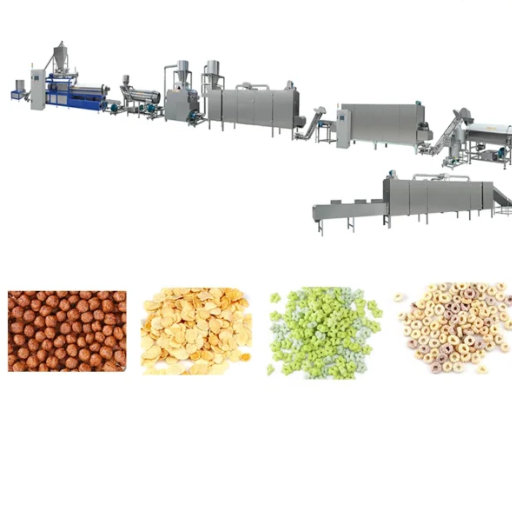
The published output bands are the starting point, because sampling rate, instrument range and record volume scale with throughput. Our published breakfast cereal line specifications list the configurations, from 120-150 kg/h to 800-1,000 kg/h.
Frequently asked questions
What should be checked at each stage of cereal production?
Raw grain moisture and foreign matter at intake, batch weights at mixing, cooked mass moisture at cooking, barrel temperatures and die pressure at extrusion, roll gap at flaking, exit moisture at drying, pickup at coating, colour at toasting, and net weight, seals and metal detection at packing.
What moisture content should breakfast cereal have?
It depends on the grain and the stage. Published figures put cooked mass at no more than 32%, corn grits at 10-14% after drying, wheat grits at 16-18% from the dryer, rice at about 17% at flaking, and finished corn flakes at 1.5-3%. Your product specification governs.
Is drying a critical control point in cereal production?
Usually not. On most cereal lines drying is a quality control point for moisture and texture, because water activity sits far below 0.85. Which steps are critical control points comes from your hazard analysis, and on a cereal line the foreign-material inspection is more often the critical one.
How often should a cereal line be sampled?
Often enough that the interval still covers output at the line’s fastest speed. A 30-minute interval covers 0.2% of an eight-hour shift at 500 kg/h and 0.1% at 1,000 kg/h. Most plants set the interval for their slowest product and never revisit it.
What metal detector sensitivity does a cereal line need?
There is no universal answer. Sensitivity depends on aperture, product effect and line speed, and test-piece sizes come from the customer or retailer standard. Specify the standard first, then size the aperture and confirm the detector reaches the test pieces at production speed.
The line makes the product. QC decides whether you know it
Four decisions define cereal production line quality control, and all four are made before the first batch: which stages get a control point, what limit applies at each, how often you sample, and who acts when a result fails.
We’ll call her Mei. Mei inherited a fourteen-column QC sheet completed on perhaps one shift in five. She replaced it with four columns tied to the reaction plan: result, limit, action, signature. Completion went to daily within a month, not because the operators became more diligent, but because the sheet finally asked for decisions instead of data entry.
If you are specifying a line and want the control points designed in rather than bolted on, tell us which stages you already control and we will work from there.