Biscuit forming equipment is selected by dough type first, and by capacity or price second. Short doughs run on a rotary moulder, developed doughs run through a sheeter, gauge rolls and a rotary cutter, layered crackers add a laminator, and cookies with inclusions go through a wire-cut machine.
Amir, a project engineer, signed off a rotary moulder for a Marie-style biscuit in early 2025. The die looked right on the drawing. On the first production run the pockets filled unevenly, and the biscuits spread into ovals in the oven.
The machine was not faulty. The dough was developed, not short. A moulder presses short dough into engraved pockets. It can’t handle the elastic, sheeted dough that a Marie-style biscuit needs.
That mistake is common because equipment is sold by machine type and bought by product. The quotation lists a moulder or a cutter. Your specification lists a shape, a weight and an output. The two don’t always meet.
This guide compares five forming methods on dough behaviour, scrap, capacity and changeover, and ends with the specification list that makes quotations comparable.
If you are still mapping the whole line, our guide to the shows where the forming station sits between mixing and baking.
Key Takeaways
- Forming method follows dough rheology: rotary moulder for short dough, sheeter and cutter for developed dough, wire-cut for inclusions, depositor for batter.
- A rotary moulder produces no scrap net. A rotary cutter returns a scrap net that must be managed, and scrap uniformity affects bake spread.
- A laminator is optional for Marie-style biscuits and mandatory for laminated crackers. It adds roughly 5 m of line length.
- Forming width must match oven band width, and capacity is pieces per minute times rows times piece weight, not one kg/h figure.
- Die roll cost and changeover time decide whether one forming station can run many shapes economically.
What Is Biscuit Forming Equipment?
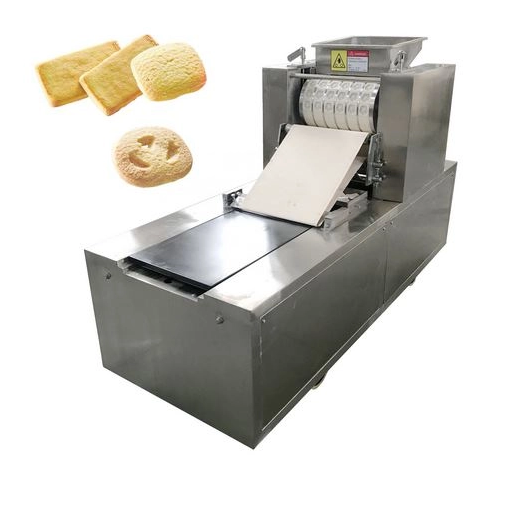
Biscuit forming equipment turns mixed, rested dough into individual pieces of a fixed shape, weight and thickness before baking. The main types are the rotary moulder, the sheeter with gauge rolls and rotary cutter, the laminator, the wire-cut machine and the depositor.
The forming station sits after mixing and rest, before the oven. Everything downstream assumes it got the piece right. A moulder that fills pockets unevenly sends variable weights into the oven, and no oven setting corrects that.
Each machine does one thing to the dough:
- A rotary moulder presses dough into engraved pockets on a roll and lifts the pieces onto a web.
- A sheeter forms a continuous sheet, and gauge rolls reduce it in steps.
- A laminator folds and layers the sheet before gauging.
- A rotary cutter embosses and cuts pieces out of the sheet.
- A wire-cut machine extrudes a column of dough and slices it with a wire.
- A depositor drops soft dough or batter through nozzles.
Why forming decides your product range
You can size an oven up or down. You can’t teach a moulder to make a laminated cracker, and you can’t run very short dough through a sheeter without trouble.
The forming choice also fixes the scrap profile, changeover time and die inventory, which decide how many products a line can run at a profit.
Which Forming Method Matches Your Dough?
Start with the dough, then confirm the product. The table below is the decision most buyers need before they compare quotations.
| Dough and product | Forming method | Typical products | Scrap net | Changeover |
|---|---|---|---|---|
| Short dough, high fat and sugar | Rotary moulder | Butter cookies, shortbread, glucose biscuits, sandwich biscuit shells | None | Swap die roll |
| Developed hard dough | 3-roll sheeter, gauge rolls, rotary cutter | Marie, Rich Tea, Petit Beurre, hard sweet biscuits | Yes, returned to sheeter | Cutter roll and gauge setting |
| Laminated cracker dough | Sheeter, laminator, gauge rolls, cutter | Soda, saltine and cream crackers | Yes | Lamination count and cutter |
| Cookie dough with inclusions | Wire-cut | Chocolate chip, oatmeal, nut cookies | Minimal | Die and wire setting |
| Soft dough or batter | Depositor | Drop cookies, soft-baked cookies | None | Nozzle set |
Read the table left to right. Fat and sugar make dough short and crumbly, so it needs a moulder. Gluten development makes it elastic, so it needs a sheet and cutter. Inclusions break a sheet, so the dough needs a wire.
“Hard biscuit” isn’t a specification
A buyer who asks for a hard biscuit line can mean three different machines. Marie, Rich Tea and Petit Beurre are usually sheeted and cut without lamination. Soda and cream crackers are fermented, laminated and cut. Crisp glucose biscuits sold across South Asia are short dough, rotary moulded, and need no sheeter at all.
The word “hard” describes the finished bite, not the process. Our guide to the walks through the three configurations and the product signs that tell them apart.
The laminator question
A laminator folds and layers the sheet, sometimes with a dusting between layers. The layers trap air and give a lighter, crisper bite. Lamination is mandatory for crackers and optional for Marie-style biscuits. Adding it where it isn’t needed increases line length by roughly 5 m and changes nothing about the product.
Rotary Moulder: How It Works and What It Cannot Do
A rotary moulder is the simplest forming machine on a biscuit line, and the most misunderstood. It makes a defined shape with no scrap net, which is why it dominates short-dough production.
How a rotary moulder forms a biscuit
Dough sits in a hopper above two rolls. A forcing roll presses dough into the pockets of an engraved moulding roll. A scraper knife clears the roll surface, and an extraction web lifts the formed pieces out of the pockets and carries them toward the oven.
The mould defines the complete biscuit. There’s no sheet and no web of dough between pieces, so there is no scrap to return, as the standard 那样产生 describes. The excess dough that the pockets don’t accept stays on the forcing roll and goes back to the hopper.
Die rolls are engraved bronze or brass, or steel with plastic inserts. Changing the roll changes the shape, the embossing and often the piece weight, so the die is the real product-change part, not the machine.
Published moulder ranges run from about 200 to 3,600 kg/h with working widths of 0.6 to 1.5 m, according to Reading Bakery Systems. Independent drives for the forcing roll, moulding roll and web let a line run up to about 40 m/min on the Coperion and Baker Perkins TruClean series.
Treat those as vendor ranges. Capacity depends on piece weight, pocket count, dough and the downstream oven.
What a moulder can’t do
A moulder can’t laminate, so it can’t make a cracker with layered texture. It can’t handle coarse inclusions, because a chocolate chip or a nut won’t press cleanly into a pocket.
It also struggles with extensible dough. The scraper drags the dough instead of cutting it, pockets fill incompletely, and you get tails or torn pieces. Short dough isn’t a preference here. It’s a requirement.
If your product is a soft or short-dough biscuit, the dough handling matters as much as the machine. Our guide to covers mixing, rest and temperature control before the moulder.
Sheeter, Gauge Rolls and Laminator
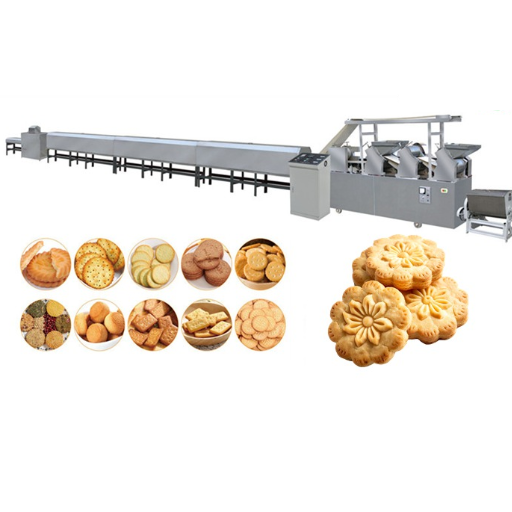
Hard dough needs a different sequence. The goal is a sheet of even thickness, with the gluten relaxed enough to cut cleanly and hold its shape in the oven.
From dough mass to a consistent sheet
A three-roll sheeter takes dough from the hopper and forms the first continuous sheet. Gauge rolls then reduce thickness in steps, and one equipment maker describes a reduction of roughly 2:1 per pass. Baker Perkins lists gauge roll diameters of 300 mm standard and 400 mm heavy-duty.
Reduction has to be gradual, step by step. Too much at one stage tears the sheet or builds tension that shows up later as distortion. The sheet also needs a short rest before cutting, so the gluten relaxes and the pieces stop springing back.
When you need a laminator
The laminator folds the sheet back on itself in layers. A miter turn lets dough bypass the laminator and go straight to the first gauge roll, which is why combination sheeting and laminating lines are common.
Laminator widths are commonly 1.0, 1.2 and 1.5 m, matching cutter and oven band widths. A laminating section adds roughly 5 m to the line, and it adds a machine that has to be set correctly for every product.
For a Marie-style biscuit, skip it. For a cream cracker, the layered structure is the product, and there is no substitute.
Rotary Cutter and Scrap Return
A rotary cutter embosses the surface and cuts the piece out of the sheet. The cutter roll carries the shape, the logo and often the docking holes that let steam escape during baking.
Cutter rolls are product-specific. The design compensates for dough shrinkage and elasticity, so a cutter that works on one recipe may produce an oval on another. A new shape often means a new roll, not a new setting.
Cutting produces a scrap net. The sheet between the pieces is lifted on a scrap conveyor and returned to the sheeter, a difference in scrap handling that Golden Bake describes in its forming overview. On hard-dough lines the returned scrap is often quoted at around 30% of the sheet, though the figure depends on shape, spacing and product. Ask for the number on your own layout.
Scrap quality matters as much as scrap quantity. Returned scrap is denser and warmer than fresh dough, and uneven inclusion changes how a piece spreads. Manley’s Technology of Biscuits, Crackers and Cookies notes that variable scrap causes spread variation, which is why some plants add a separate sheeter to meter scrap back into the dough.
Docking happens on the cutter. A cracker without clean docking blisters or checks, and blocked or misaligned pins show up as an oven fault, sending operators to the wrong machine.
Wire-Cut and Depositing for Cookies
Wire-cut machines handle doughs that can’t be moulded or cut cleanly. Dough is extruded through a die as a column and sliced by a taut wire, so chocolate chips, oats and nuts pass through without tearing a sheet.
Cutting rates are commonly quoted around 100 cuts per minute. The wire, die and suck-back setting control piece weight and shape. Wire-cut cookies have a softer, more irregular edge than a moulded biscuit, which is part of their appeal.
Depositors work differently. A row of nozzles on a rising and falling head drops soft dough or batter onto the band, at roughly 20 to 25 strokes per minute on smaller machines. They suit drop cookies and soft-baked products, not a biscuit that needs a defined embossed face.
Neither machine replaces a moulder or a cutter on a classic biscuit line. They extend the product range at the cookie end. Our guide to the cookie production line covers the product and supplier decisions around them.
How to Specify Biscuit Forming Equipment
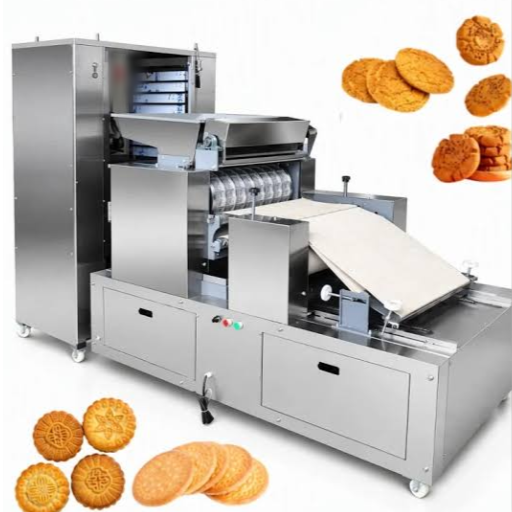
A forming quotation is only useful if it states its capacity basis, the scrap it expects and the changeover it assumes. Most state one number and leave the rest to the meeting.
Match capacity to the oven, not the brochure
Capacity is pieces per minute times rows times piece weight. A moulder running 60 strokes a minute with four rows makes 240 pieces a minute. At 5 g per piece, that is 72 kg/h of dough pieces.
Baked weight is lower because the pieces lose moisture. A quotation that mixes dough weight, baked weight and oven output will look better than the line can deliver.
Width matters too. A 1.5 m forming width needs at least a 1.5 m oven band, and the oven then sets the ceiling for the whole line. Our guide to the explains how band width and length scale with capacity.
Ask every supplier to state three things in writing:
- The capacity basis: dough weight, baked weight or oven rating.
- The piece weight range the machine is set for.
- The oven width the forming station feeds.
Die and mould economics
A forming station is cheap to buy once and expensive to run across many shapes. Each die roll or cutter roll costs money, takes time to make, and needs storage and handling.
A small standalone moulder is listed from about $2,000 to $4,000, while tray-type and custom-width units run from about $18,500 to $60,000. A low-end die roll can cost around $165, and an Indian supplier lists a moulder die at about ₹2 lakh. Those are marketplace listings, not quotations, and they rarely include the oven or installation.
The real question isn’t the price of one die. It’s how many dies you need, how often you change them, and what the line does while the change happens. Ask for the changeover time between your two most different products, not two similar ones.
RFQ checklist
Send this list with your product samples and target output:
- Product type, shape, piece weight and target moisture.
- Dough type: short, developed, laminated, cookie with inclusions, or batter.
- Required output in kg/h, and whether that is dough or baked weight.
- Oven band width and forming width you expect.
- Number of SKUs and changeovers per week.
- Die roll quantity, material, lead time and price per roll.
- Expected scrap rate and how scrap returns to the line.
- Contact materials, cleanability and guarding requirements.
- Spare parts list, wear parts and recommended spares.
- Factory acceptance test criteria and training scope.
If you send us your product, capacity and SKU list, we’ll tell you which forming method fits and where a cheaper configuration would do the same job. .
Faults that trace back to forming
| Symptom | Usual cause | Where to check |
|---|---|---|
| Tails or incomplete fill on moulded pieces | Dough too stiff or cold, worn die, scraper setting | Dough temperature, die condition, scraper pressure |
| Weight drift across a run | Dough density change, hopper level, roll speed | Dough feed, hopper control, drive settings |
| Oval or distorted cut pieces | Sheet not relaxed, excessive reduction, cutter timing | Rest time, gauge settings, cutter alignment |
| Spread variation after baking | Uneven scrap inclusion, dough temperature | Scrap return, scrap sheeter, dough rest |
| Sheet tearing at the sheeter | Reduction too aggressive, dry dough | Gauge steps, water addition, dough rest |
| Pieces sticking to the extraction web | Dough too warm or too fatty, web tension | Dough temperature, web condition, release |
| Docking marks missing or blocked | Blocked pins, misaligned cutter roll | Cutter roll cleaning and alignment |
| Pattern loss or shallow emboss | Worn die, insufficient pressure | Die wear, roll pressure, dough hardness |
Biscuit Forming Equipment FAQs
What is the difference between a rotary moulder and a rotary cutter?
A rotary moulder presses short dough into engraved pockets and produces pieces with no scrap net. A rotary cutter cuts pieces out of a continuous sheet, leaving a scrap net that returns to the sheeter. The moulder suits short dough, the cutter suits developed and laminated dough.
Do I need a laminator for my biscuit line?
Only if you make laminated products such as soda or cream crackers. Marie and most semi-sweet biscuits are sheeted and cut without lamination. A laminator adds roughly 5 m of line and a machine to maintain, so justify it by the product.
How is biscuit forming capacity measured?
Capacity is pieces per minute times rows times piece weight. That gives kg/h of dough pieces, higher than baked output because moisture is lost in the oven. Ask whether a quoted kg/h refers to dough, baked product or oven rating.
How much does a biscuit forming machine cost?
Marketplace listings run from about $2,000 to $4,000 for a small moulder and $18,500 to $60,000 for tray-type units. Cutter lines cost more, and dies are priced separately. Treat listings as a starting point, not a quotation.
Can one forming line make both hard and soft biscuits?
Yes, with a dual-forming station that combines a moulder with a sheeter and cutter. It adds length, cost and changeover steps, so it makes sense only when both families carry real volume.
Why are my moulded biscuits leaving tails or filling incompletely?
Usually the dough is too stiff, too cold or too extensible, or the die and scraper are worn. Check dough temperature and rest first, then die condition and scraper pressure. If the dough is developed rather than short, the machine is wrong.
Conclusion
Biscuit forming equipment is where a line commits to a product range. Choose the method from the dough, size the machine from the oven, then cost the dies and changeovers before comparing prices.
Three checks prevent most expensive mistakes:
- Confirm the dough type with a sample, not a description.
- Confirm whether the quoted capacity is dough or baked weight.
- Confirm how many dies you need and what each changeover costs in time.
A moulder, a sheeter and a cutter aren’t interchangeable. The right one makes biscuits; the wrong one makes scrap.
Send us your product, target output and SKU list. We’ll recommend the forming configuration, including the cases where the simpler machine is the better buy. .