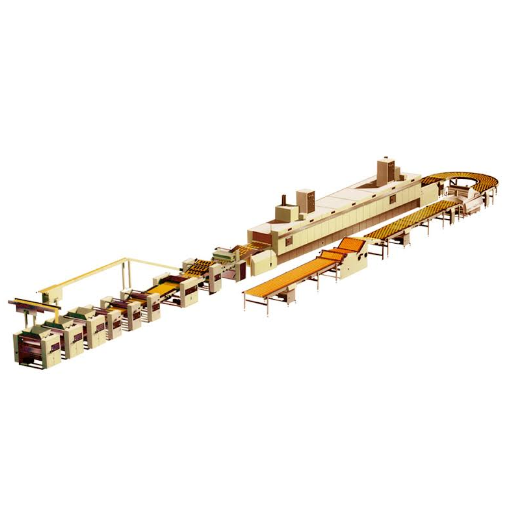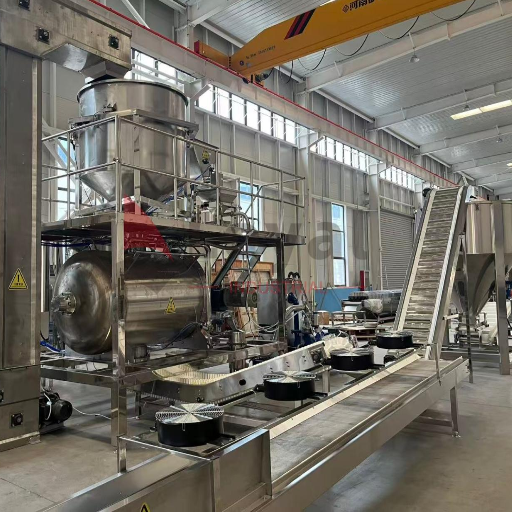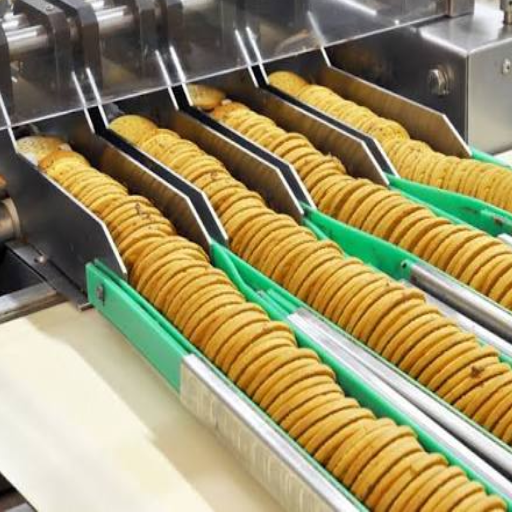
A hard biscuit production line is not one machine. It’s one of three configurations, and the choice decides which products your line can make.
Semi-sweet biscuits such as Marie and Rich Tea are usually sheeted and cut without lamination. Soda and cream crackers are fermented, laminated and docked. Crisp glucose biscuits are rotary moulded from a short dough.
That’s why “hard biscuit” is a poor specification. It describes a texture, not a process.
Most buyers compare quotes in kilograms per hour and price per machine. But two quotes at the same output can describe two different factories.
One line can make crackers. The other cannot.
This guide separates the three families and gives you ten numbers to put in your RFQ. Send your specification and target output to our engineering team for a line-configuration review.
Key Takeaways
- “Hard biscuit” covers three line types: semi-sweet sheeted, fermented laminated cracker, and rotary-moulded short dough.
- Marie and Rich Tea are usually sheeted without lamination; soda and cream crackers are laminated into 7 or 8 layers.
- Semi-sweet biscuits bake to 1.5 to 3.0% moisture; crackers to 1.5 to 2.5%.
- Specify output at your piece weight, not the nameplate kilograms per hour.
What Is a Hard Biscuit Production Line?
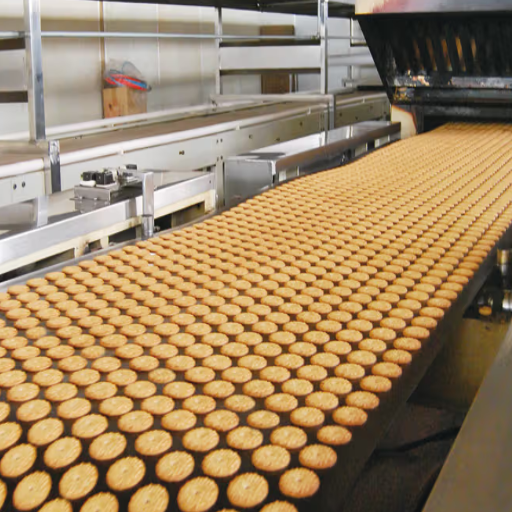
A hard biscuit production line mixes, sheets, gauges, cuts, bakes, cools and packs low-moisture biscuits made from hard dough. The same line cannot make every hard biscuit well: semi-sweet products are usually sheeted and cut without lamination, while crackers are fermented, laminated and docked before baking.
Semi-sweet hard biscuits
This is the family most people mean by “hard biscuit” in Europe and much of Asia. It includes Marie, Rich Tea, Petit Beurre, Arrowroot and Morning Coffee. In the trade, this family is also called the hard sweet biscuit group.
The dough has strong, developed gluten, low sugar and fat, and water content around 12%. It’s sheeted and cut. Doughs made with sodium metabisulphite (SMS) are usually sheeted without lamination, so the snap comes from the gluten network and the bake, not from folded layers.
Marie is a useful reference. It is made with flour that should not exceed 9.0% protein, mixed in a horizontal mixer to a dough temperature of 40 to 42°C for 20 to 25 minutes, then sheeted and cut. It is traditionally baked on a steel band. The target final moisture is 1.5 to 3.0%.
Crackers
Crackers include soda, saltine, cream cracker and water biscuit. They are leaner, often fermented, and always laminated. The dough has a higher water content, typically 15 to 25%. One market estimate puts global cracker sales at USD 33.57 billion in 2025, rising to USD 39.01 billion by 2030 (Knowledge Sourcing).
A soda cracker sponge, made from 60 to 70% of the flour, ferments for 16 to 19 hours at 25 to 29°C while the pH falls from about 6 to about 4. The remaining ingredients are mixed in, sodium bicarbonate raises the pH to 7 to 8, and a second fermentation of 3 to 6 hours follows.
The dough is then sheeted and laminated into 7 or 8 layers, about 2 mm thick in total. It is docked to bind the layers and prevent large blisters, then baked at 230 to 315°C for 2.5 to 6 minutes. Final moisture is 1.5 to 2.5%.
Rotary-moulded crisp biscuits
In India, Pakistan and parts of Africa, a “hard biscuit” often means a crisp glucose biscuit. That product is not made from hard dough.
Glucose biscuits are short-dough products with more fat and sugar and less water. They are formed on a rotary moulder, which presses dough into engraved cavities. There is no sheeter, no laminator and no scrap-return loop. If you ask for a hard biscuit production line and receive a sheeting-line quote, you may be buying the wrong machine.
| Family | Dough | Forming route | Lamination | Final moisture | Examples |
|---|---|---|---|---|---|
| Semi-sweet hard biscuit | Hard dough, strong gluten, low sugar and fat, about 12% water | Sheeted and cut | Usually none | 1.5 to 3.0% | Marie, Rich Tea, Petit Beurre, Arrowroot, Morning Coffee |
| Cracker | Fermented or leavened hard dough, 15 to 25% water | Sheeted, laminated, docked, cut | 7 to 8 layers typical | 1.5 to 2.5% | Soda, saltine, cream cracker, water biscuit |
| Rotary-moulded crisp biscuit | Short dough, higher fat and sugar, low water | Rotary moulder | None | Product-specific | Glucose biscuits, malted milk, Tiger |
This distinction is not academic. Consider a buyer we will call Ravi, who runs a biscuit operation in Mumbai. His best-selling product is a crisp glucose biscuit, so he asked three suppliers for a hard biscuit production line.
Two sent sheeting-line quotations with laminators he did not need. The third asked what product he was making and quoted a rotary-moulding line. The terminology almost cost him a six-figure mistake.
Semi-Sweet vs Cracker: The Decision That Sets the Line
Once you know you need a sheeted hard-dough line, the next decision is whether it must laminate. That choice changes the machine list, layout and oven profile.
Semi-sweet: sheet and cut, usually without lamination
A semi-sweet biscuit production line is built around consistent thickness and minimal dough stress. The dough is mixed to a controlled temperature, sheeted, gauged and cut.
Because the dough is elastic, the sheet needs a relaxation conveyor. Without it, biscuits shrink after cutting and piece weight drifts across the band.
The oven is gentler. Humidity at the entry drives volume and surface sheen. Marie is traditionally baked on a steel band; most other semi-sweet products run on wire mesh.
Cracker: ferment, laminate, dock and bake hot
A soda cracker production line adds three things: fermentation, lamination and docking.
Fermentation develops flavour and an extensible dough that can be sheeted thin. Lamination builds the layers that separate when you bite a cream cracker. Docking punches holes so steam escapes and the layers stay together.
The oven runs hotter and faster. Crackers need a strong spring in the first zones, good humidity and enough heat to reach 1.5 to 2.5% moisture.
What this means for your quote
A laminator is optional for Marie and mandatory for soda or cream crackers. It’s the most common omission in a comparison.
Ask each supplier three questions:
- Which named products has this exact line configuration run?
- Does the quoted scope include a laminator, a relaxation conveyor and a scrap-return system?
- Can the line run both semi-sweet and cracker products, and what changes between them?
A cracker line can sometimes run semi-sweet products by bypassing the laminator. A semi-sweet line without one cannot make crackers. If crackers are in your five-year plan, buy the capability now or plan a second line later.
| Decision | Semi-sweet (Marie, Rich Tea) | Cracker (soda, cream) |
|---|---|---|
| Dough water | About 12% | 15 to 25% |
| Flour protein | 9.0% or lower for Marie | 8 to 9% for snack crackers |
| Mixing | Horizontal, 20 to 25 minutes, dough 40 to 42°C | Fermentation-led; sponge 16 to 19 hours at 25 to 29°C |
| Rest or fermentation | Dough rest; SMS doughs | Sponge plus second fermentation, pH 6 to 4 to 7 to 8 |
| Lamination | Usually none | 7 to 8 layers, about 2 mm |
| Docking | Light emboss or docker pins | Docking essential to bind layers |
| Baking band | Wire mesh; Marie traditionally steel | Wire-mesh band |
| Baking temperature | Lower, commonly 180 to 240°C | 230 to 315°C |
| Bake time | Longer at lower temperature | 2.5 to 6 minutes |
| Final moisture | 1.5 to 3.0% | 1.5 to 2.5% |
The Stations on a Hard Biscuit Production Line
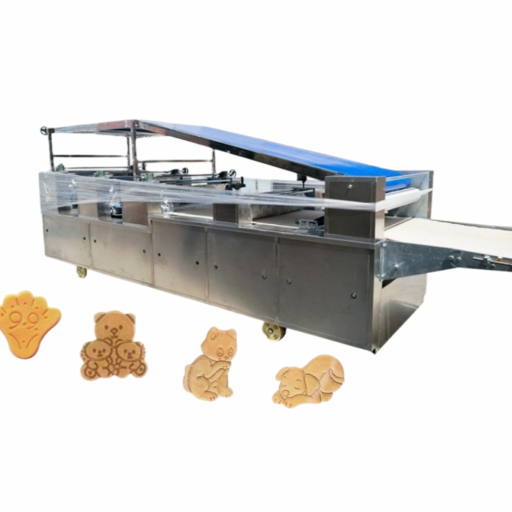
The station list is similar across configurations. What changes is the equipment inside each station. For a broader walk-through of the whole process, see our guide to the biscuit manufacturing process.
Mixing and dough feed
Semi-sweet doughs are usually mixed in a horizontal high-speed mixer. Cracker doughs need fermentation vessels or troughs before the final mix. The feed system must match the dough.
Sheeting, gauging and relaxation
A three-roll sheeter turns the dough into a continuous sheet. Gauge rolls then reduce it in steps, commonly around a 2:1 ratio per pass. The sheet is typically 0.89 to 1.65 mm thick before cutting.
The relaxation conveyor matters. It lets the gluten recover after sheeting, which limits shrinkage and keeps piece weights stable.
Laminating, cutting, docking and scrap return
On a cracker line, the laminator folds the sheet into layers before final gauging. The rotary cutter then embosses and cuts the shapes. Docker pins create the holes that let steam escape.
Cutting produces trim. That trim is returned to the dough, but the recycle ratio depends on the shape and die layout. A high scrap ratio is not just a yield problem. It also limits how often you can change products, because the returned dough changes the batch you are running.
If your product is a cookie or a rotary-moulded biscuit, a rotary moulder is the better forming route.
Baking, Cooling and Moisture
The oven does three jobs in sequence. The first half builds structure and texture. The middle removes moisture. The final third develops colour.
That sequence explains most baking problems. If the entry zones are too cool, the biscuit does not set and later collapses. If the middle zones are too weak, moisture stays in the centre and the biscuit checks after packing. If the final zones are too hot, the colour arrives before the moisture is gone.
Band type and humidity
Most hard biscuits bake on a wire-mesh band. Marie is the traditional exception and is often baked on a steel band. The band affects heat transfer and the mark on the biscuit base, so it belongs in the specification.
Humidity at the entry matters for volume and sheen. Crackers need a strong spring in the first zones; semi-sweet biscuits need enough humidity to open the structure without blistering.
Oven types
Direct gas fired, indirect radiant, convection and hybrid ovens can all make good hard biscuits. The choice depends on the product, fuel availability and flexibility. Our guide to biscuit tunnel oven zones and fuel choice covers the trade-offs in detail.
Cooling and checking
Cooling is part of the process, not an add-on. The cooling-to-baking time should be at least 1.5:1. If the biscuit cools too fast, the moisture gradient between the centre and the surface causes checking: fine cracks that appear after packing.
Aim to pack below roughly 30°C, and confirm the final moisture against your product specification. For semi-sweet biscuits the target is 1.5 to 3.0%; for crackers, 1.5 to 2.5%. These ranges come from standard biscuit technology teaching material; CUTM’s notes summarise them clearly.
Capacity and Line Length on a Hard Biscuit Production Line
Capacity is not a single number. It’s a function of band width, line speed, piece weight and uptime.
A wider band carries more rows. A faster band moves them through sooner. A heavier piece uses more dough. And every line stops for cleaning, die changes and maintenance.
A quoted 1,000 kg/h can therefore mean very different things. Ask for output at your piece weight, with the uptime assumption stated.
| Band width | Typical output | Line length | Oven length |
|---|---|---|---|
| 600 mm | 150 to 250 kg/h | 60 to 80 m | 40 to 50 m |
| 1,000 mm | 450 to 600 kg/h | 80 to 100 m | 45 to 55 m |
| 1,200 mm | 800 to 1,200 kg/h | 100 to 120 m | 50 to 60 m |
| 1,500 mm | 1,500 to 2,000 kg/h | 120 to 150 m | 55 to 60 m |
These are typical ranges, not guarantees. A longer oven can run faster at the same bake time.
Consider a buyer we will call Mei, who compared two lines quoted at 1,000 kg/h. Her product weighed 5 g. One supplier’s figure assumed a 4 g biscuit and a wider band. The other assumed 24 hours of uninterrupted running.
At her piece weight and a realistic 85% uptime, both lines landed closer to 750 to 800 kg/h. The quote with the lower price per kilogram was not the cheaper line per tonne.
What to Specify Before You Request a Quote
Most wrong-line purchases start with a vague RFQ. A supplier cannot quote against “a hard biscuit line, about one tonne per hour.” Give them these ten points.
- Product family and named references. “Marie-type, 5 g, 44 mm” is a specification. “Hard biscuit” is not.
- Dough type and recipe constraints. Flour protein, water, sugar and fat, SMS or fermentation.
- Target output at your piece weight. Kilograms per hour at the actual product, not nameplate.
- Piece weight, size, thickness, docking and embossing. These set the die and cutter selection.
- Forming route. Sheet-and-cut or laminated; layer count; scrap-return arrangement.
- Oven. Type, zones, band type, fuel, temperature profile and humidity at entry.
- Cooling. Conveyor length, cooling-to-baking ratio and target temperature at packing.
- Packaging. Flow-wrap, pillow-pack or slug pack; nitrogen flushing; case packing.
- Utilities and footprint. Power, gas, water, compressed air, drainage, ceiling height and floor loading.
- Documentation and acceptance. CE Declaration of Conformity, FAT protocol with pass/fail criteria, spare-parts list, commissioning and training scope.
Two documents make the comparison fair: a factory acceptance test checklist and a supplier evaluation framework. Our guide to how to choose a biscuit production line manufacturer explains what to verify in the quote, the factory and the reference list.
Send those ten points to our engineering team and we will tell you which configuration fits, including the cases where a different line type is the better answer.
Common Faults on a Hard Biscuit Production Line
Most faults trace back to dough condition, sheet thickness, oven profile or cooling. Use this table as a starting point for the conversation with your supplier.
| Defect | Likely cause | What to check or adjust |
|---|---|---|
| Uneven thickness or piece weight | Gauge-roll setting, dough stress, insufficient relaxation | Reduce in 2:1 steps; use the relaxation conveyor; check dough temperature |
| Blistering | Steam trapped under the surface; insufficient docking | Check docker pins; adjust entry-zone humidity and heat |
| Insufficient lift or flat cracker | Low heat or humidity at oven entry; weak fermentation | Raise entry-zone heat and steam; verify sponge pH and fermentation time |
| Checking (cracks after packing) | Moisture gradient; insufficient cooling | Extend cooling; target at least 1.5:1 cooling to baking; verify final moisture |
| Colour variation across the band | Burner or zone imbalance; uneven band loading | Calibrate zones; check band speed and loading pattern |
| Layer separation | Insufficient docking; wrong lamination count or roll pressure | Check the dock pattern; verify laminator layer count and pressure |
| High breakage | Over-baking; excessive scrap return; rough stacking | Check moisture and bake; review scrap ratio; inspect the stacker |
These are typical causes, not universal diagnoses. A line trial with your own dough is the only way to confirm which one applies.
Hard Biscuit vs Soft Biscuit: Don’t Buy the Wrong Line
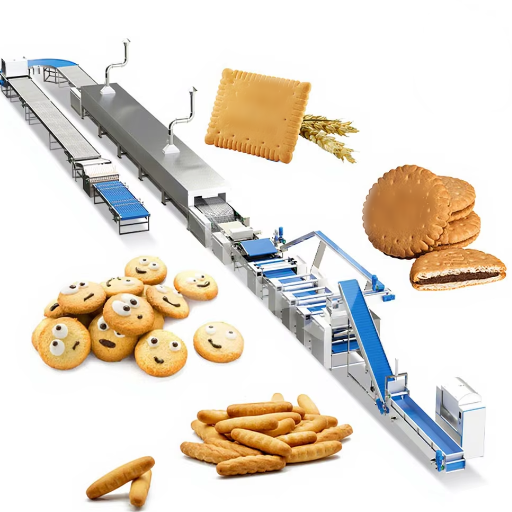
Hard dough and soft dough are not interchangeable, and neither are the machines that form them.
Hard dough is strong, elastic and low in fat and sugar. It is sheeted, gauged and cut. Soft or short dough is higher in fat and sugar, lower in water and much less elastic. It is formed on a rotary moulder.
A rotary moulder cannot make a laminated cracker. A sheeting line cannot make a good short-dough cookie without wasting capacity. If your range spans both, you need two forming routes or a hybrid line. Our guide to the soft biscuit production line covers the soft-dough side in detail.
Frequently Asked Questions
What is a hard biscuit production line?
A hard biscuit production line mixes, sheets, gauges, cuts, bakes, cools and packs low-moisture biscuits from hard dough. It may include a laminator for crackers. It isn’t a rotary-moulding line for short-dough glucose or malted-milk biscuits.
Is a Marie biscuit a hard biscuit?
Yes. Marie is a semi-sweet hard biscuit. It is made from hard dough, sheeted and cut, and usually baked without lamination. It is traditionally baked on a steel band to 1.5 to 3.0% moisture.
What is the difference between a hard biscuit and a cracker?
A cracker is a leaner, often fermented hard-dough product that is laminated and docked. A semi-sweet biscuit such as Marie or Rich Tea is usually sheeted without lamination. Crackers bake hotter and finish at 1.5 to 2.5% moisture.
Are hard biscuits laminated?
Not usually. Semi-sweet biscuits made with SMS are normally sheeted and cut without lamination. Crackers are the laminated branch, typically with 7 or 8 layers. The laminator is the clearest equipment difference.
What moisture content should a hard biscuit have?
Semi-sweet hard biscuits are typically baked to 1.5 to 3.0% moisture. Crackers are typically baked to 1.5 to 2.5%. The exact target depends on the product and packaging, so confirm it in the specification.
Can one line make both Marie biscuits and soda crackers?
Sometimes, but not without compromise. A cracker line with a laminator can often run semi-sweet products by bypassing it. A semi-sweet line without one cannot make crackers. Ask which named products the quoted configuration has run, and request a trial on your dough.
Conclusion
Hard biscuits are not one product, and a hard biscuit production line is not one specification. The three families use different doughs, different forming routes and different oven profiles.
Semi-sweet biscuits such as Marie and Rich Tea are usually sheeted without lamination. Crackers are fermented, laminated and docked.
Decide which family you are making before you compare quotes. Then specify output at your piece weight, the forming route, the oven and band type, the cooling ratio and the documents you expect. Ten clear points will save more money than a tenth supplier quotation.
If you are planning a hard biscuit production line, send your product specification and target output to our engineering team. We will review the configuration, flag the constraints, and tell you honestly whether a hard-dough line is right for you.