The right biscuit production line manufacturers are the ones that can prove, in writing and in a factory test, that their line will make your product at your target output. The cheapest quote is rarely the cheapest line.
Most biscuit production line manufacturers send a quote in the same format: a capacity in kg/h, a total price and a delivery date. That format hides the differences that matter. Two suppliers can both quote 1,000 kg/h and still be selling different machines, different documentation and different levels of support.
This guide gives you seven questions that separate an OEM from a trading company, the documents to request, and a shortlist method you can score.
We build biscuit lines, so we are one of the suppliers you should evaluate. Use this framework to reject us if we cannot answer the questions.
The global biscuit market was worth about 134billionin2025andisforecasttoreach134billionin2025andisforecasttoreach141 billion in 2026, growing at roughly 5.4% a year, according to The Business Research Company. Demand is not the constraint. Choosing a line that can serve it is.
Key Takeaways
- A biscuit line is specified by product, forming method and oven, not a single kg/h figure.
- Seven questions separate an OEM from a trading company; ask them before you compare price.
- Request the CE Declaration of Conformity, ISO 9001 scope, FAT protocol and a priced spare-parts list.
- Test the line with your own recipe at your target speed; nameplate capacity is not output.
- Score suppliers on evidence, not brochures, and make FAT a condition of balance payment.
Already comparing quotes? Send us the scope and we will mark the gaps before you sign. No obligation.
What a Biscuit Production Line Manufacturer Actually Does
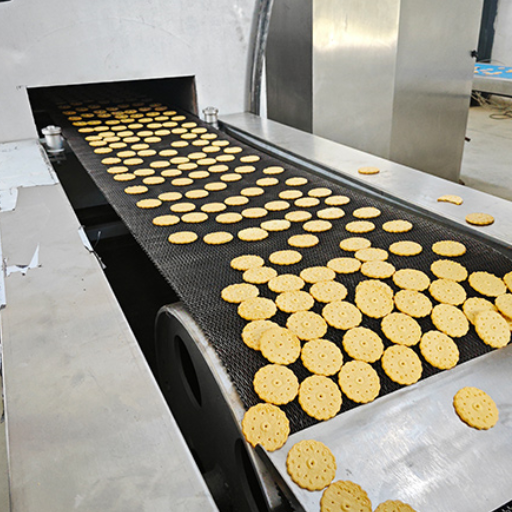
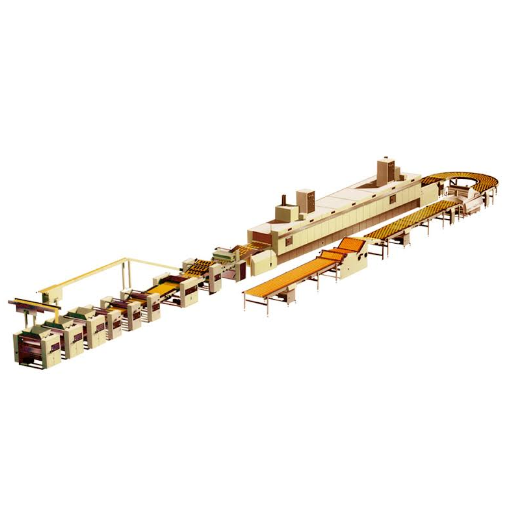
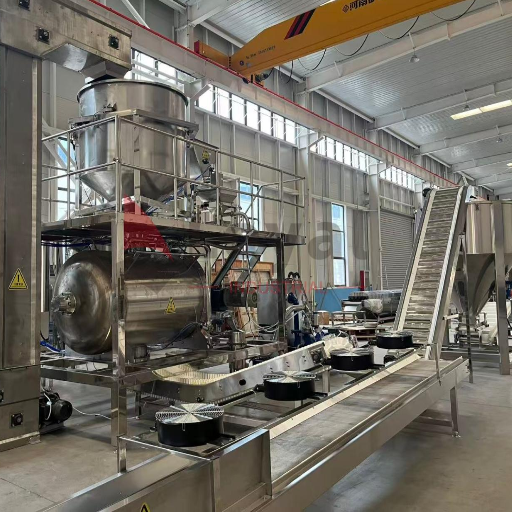
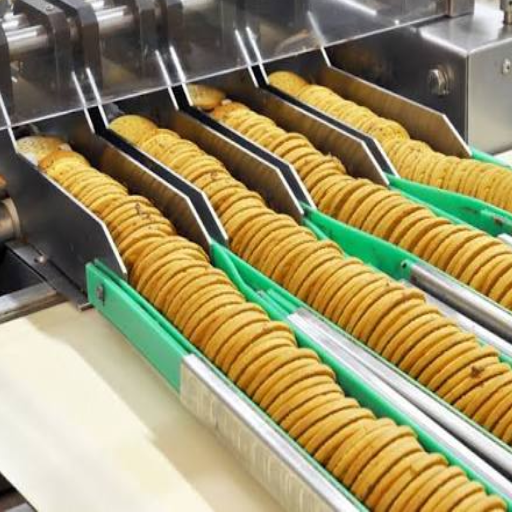
A biscuit production line manufacturer designs, builds, integrates and commissions the equipment that turns dough into packaged biscuits: mixing, forming, baking, cooling, sandwiching, packaging, case packing and palletising. The job is to make those stations work as one line at your product and output. Some buyers want a turnkey biscuit production line; others want to integrate a few stations into an existing plant.
Forming and the oven are the hardest decisions to reverse. Forming fixes the product range and dough type; the oven fixes the energy bill for the life of the line.
Biscuit production line manufacturers differ in how much of that chain they control.
| Supplier type | What they control | What they often outsource | What to verify |
|---|---|---|---|
| OEM | Design, fabrication, assembly, commissioning | PLCs, burners, bearings, packaging machines | Factory tour, in-house engineering, FAT protocol, spare-parts list |
| Trading company | Sales, project coordination, supplier management | Design and manufacturing | Who builds the line, component brands, who holds the warranty |
| Integrator | Line design and station integration | Most fabrication | Interface responsibility, single-point warranty, commissioning scope |
A trading company is not automatically a bad choice; some are excellent project managers. The risk is paying OEM prices for a trading-company scope.
A bakery owner we will call Daniel sent the same specification to five suppliers and got quotes from 85,000to85,000to240,000. He almost signed the cheapest until his engineer asked for the spare-parts list with part numbers. Three suppliers went quiet. The lowest quote came from a trading company that had never built the oven it was selling. Daniel did not need a cheaper machine. He needed a supplier who could answer.
For the full line configuration, see our complete biscuit production line guide.
Seven Questions for Biscuit Production Line Manufacturers
Ask every supplier the same seven questions. A real OEM answers with names, documents and dates. A trading company answers with adjectives. That tells you who will support the line in year seven.
1. Who designs the line, and can I meet the engineer?
A good answer names the engineer who will own your project and shows a line layout, utility schedule and PLC architecture for your product. It includes a trial plan before you commit. A red flag is when every technical answer comes from sales and the engineer appears only after the deposit.
2. Which stations do you build in-house, and which do you buy in?
No supplier builds every component. An honest answer names the make of the mixer, oven burner, PLC, servo and packaging machine, and separates in-house build from integration or rebranding. A red flag is “we make everything” without a factory walkthrough or component list.
3. What does your FAT protocol prove?
A factory acceptance test should run your recipe, at your target speed, for a defined period, and record weight, thickness, moisture, colour, breakage and output against pass or fail criteria signed before the test. A red flag is “you can watch it run.” That is a demonstration, not a FAT.
4. What is on your spare-parts list, and what is the lead time?
Ask for a priced list with part numbers, wear-item intervals, lead times and a first-year kit. Ask which parts are proprietary. A red flag is no list before the purchase order. “We can send parts anytime” is not a policy without part numbers or lead times.
5. Who commissions, trains and supports the line after delivery?
A good answer names the commissioning engineer, training days, language, response time and warranty terms. It says who pays for travel and gives a reference in your region and product type. A red flag is support that ends at the factory gate, or a warranty that quietly excludes wear parts and travel.
6. What is the real output on my product, not the nameplate?
Nameplate capacity is measured on a reference product under ideal conditions. Ask for output at your product weight, size and recipe, including changeover, rejects and uptime. One supplier’s published note claims a 1,000 kg/h nameplate often delivers under 800 kg/h after downtime and trim. Treat that as a vendor illustration, not a rule, but ask the question. A single kg/h number with no product or uptime assumption is a red flag.
7. What happens when my SKU mix changes?
Ask for changeover time, tooling cost, recipe storage and the station that limits flexibility. A rotary moulder with fixed dies is cheap per biscuit but expensive per new shape. A wire-cut line handles inclusions but has different throughput and spread control. A red flag is “you just change the mould” without a time, a price or a trial.
Match the Manufacturer to Your Biscuit Type
The forming method is the first irreversible decision. It fixes the product range, the dough type and much of the downstream equipment. Ask each supplier which method they would recommend, and why the others would be worse.
Hard sweet biscuits and crackers
Hard sweet biscuits and crackers usually run on a sheeting and cutting line with lamination and gauging. The dough is tougher, the bake longer and the fat lower. Ask for references on your product, not just “biscuits.” See the hard biscuit and cracker line guide.
Soft and short dough biscuits
Soft and short dough biscuits usually run on a rotary moulder. The dough is higher in fat and sugar, the bake is shorter, and moisture retention matters more than lift. Ask for shelf-life data and a trial with your recipe. The soft biscuit production line guide explains the dough handling.
Cookies and wire-cut products
Cookies and wire-cut products need a wire-cut or depositing line, especially with inclusions such as chocolate chips or nuts. Ask how the supplier controls spread, piece weight and throughput when you add inclusions.
Cream and sandwich biscuits
A cream sandwich line is a biscuit line plus a sandwiching module. The extra decisions are cream depositing accuracy, biscuit registration and sandwich count. Ask for a sandwich line reference and a trial with your cream recipe.
The full biscuit manufacturing process explains how these choices change mixing, forming, baking and cooling.
What to Verify Before You Sign
A quote is a promise. Verification is how you find out whether it is real. Three checks matter: a factory acceptance test, the documents behind the certifications, and the utilities the line will need.
Run a factory acceptance test with your own recipe
A FAT should use your flour, your fat and your recipe. It should run at your target speed for a defined period and record weight, thickness, moisture, colour, breakage and output. The pass or fail criteria should be signed before the test starts. Make the balance payment conditional on the FAT.
Priya, a project engineer in Pune, ran a FAT with her own flour and cream recipe. The line hit nameplate speed, but the packing machine could not keep up and biscuits broke at the transfer. The supplier fixed it in two days. Without the test, Priya would have found the bottleneck after installation.
Use a written factory acceptance test checklist so the test covers the whole line, not just the oven.
Ask for the documents, not the badges
A CE logo on a brochure is not evidence. A certificate you cannot verify is not evidence either. Ask for the documents and check the details.
| Document | What it proves | What to check |
|---|---|---|
| CE Declaration of Conformity | The manufacturer’s declaration that the machine meets EU law | Model and serial number, directives cited, signatory |
| ISO 9001 certificate | The quality management system, not product safety | Scope, certification body, expiry; verify on the body’s register |
| HACCP and hygienic design | Cleanability and contamination control | Food-contact materials, drainability, EHEDG references |
| Material certificates | Food-contact stainless steel grade | Actual 304 or 316 grades, not the brochure claim |
| Electrical drawings and PLC I/O list | Control architecture and maintainability | PLC brand, spare availability, network architecture |
| Utility schedule | Power, gas, water, compressed air and drainage needs | Match against your building and supply capacity |
| Spare-parts list | Supportability | Part numbers, wear intervals, lead times, first-year kit |
| FAT protocol and warranty terms | Acceptance and after-sales responsibility | Your recipe, target speed, pass or fail; exclusions and response time |
CE marking is not a quality certificate. For most machinery, the manufacturer self-declares conformity and issues a Declaration of Conformity under its own responsibility; a Notified Body is required only for Annex IV high-risk machinery. The EU Machinery Regulation sets the framework, though the older Machinery Directive still applies in many markets. ISO 9001 certifies the quality management system, not the product: it shows a repeatable process, not that the line will make your biscuit. See the CE certified food machinery guide for the certificate’s role, and the EHEDG guidelines for hygienic design.
Check the utilities and the footprint
A line that does not fit your building is not a bargain. Confirm power, gas, water, compressed air, drainage, ceiling height, floor loading and washdown before you sign. Ask for a utility schedule in writing; without one, your building engineer cannot plan the installation.
What Biscuit Production Line Manufacturers’ Quotes Tell You
What price tiers actually tell you
Public marketplace listings in November 2026 show entry lines at roughly 27,000to27,000to80,000, mid-range lines at 150,000to150,000to300,000, and industrial biscuit production lines at 300,000to300,000to1.2 million or more. These are listed prices, not transaction prices, and they are not our pricing. Use them as a sanity check, not a quote.
Biscuit production line manufacturers price on scope: band width, oven length and zone count, forming method, automation, packaging, sandwiching, materials, certification and installation. A quote that is three times higher is usually three times more scope, not three times more margin. A quote that is three times lower is usually missing something.
Ask each supplier to itemise the same scope. Then compare total cost of ownership: energy, changeover labour, waste, spare parts and downtime. The lowest purchase price is rarely the lowest cost per tonne.
Western vs Chinese manufacturers: an honest tradeoff
Western OEMs often bring longer process heritage, deeper documentation and local service. They cost more and deliver slower. Chinese OEMs often offer a broader capacity range, faster delivery and lower prices, though documentation and service depth vary widely.
The right question is not where the line is made. It is who will answer the phone at 2 a.m. in year seven. Ask the same seven questions of every supplier, whatever the country. The answers tell you more than the country of origin.
Want a second opinion on the line configuration? Send your product specification and target output. We will tell you which stations we would change, and why.
Red Flags and How to Build a Supplier Shortlist
Red flags in a biscuit line quote
- No itemised scope, only a total price.
- No utility schedule for power, gas, water, air and drainage.
- No FAT protocol, or a FAT that uses the supplier’s recipe.
- No priced spare-parts list with part numbers and lead times.
- A single kg/h figure with no product, uptime or reject assumptions.
- “CE certified” with no Declaration of Conformity.
- No reference in your region or product type.
- A warranty that quietly excludes wear parts, labour and travel.
- A payment schedule that asks for most of the money before FAT.
Biscuit production line manufacturers that cannot answer these points may be small, new or focused on a different product. Know which before you sign.
How to build a shortlist you can defend
- Define the product and output. Write down biscuit type, piece weight, size, recipe, target kg/h and SKU plan.
- Send the same RFQ to four to six biscuit production line suppliers. Include the product specification, utility limits, site constraints and required documents.
- Score the responses against weighted criteria. Do not score the brochure. Score the evidence.
- Run a FAT before balance payment. Test with your recipe at your target speed.
- Call references in your region and product type. Ask what broke, how fast the supplier responded and how the spare-parts experience went.
- Put spares, commissioning and training in the contract. A verbal promise is not a scope item.
| Criterion | Weight | What to score |
|---|---|---|
| Product fit and trial result | 25% | Makes your product at target weight and texture |
| Engineering and documentation | 20% | Named engineer, drawings, utility schedule, CE DoC |
| Real output and uptime evidence | 15% | Output at your product, rejects, uptime |
| After-sales and spares | 15% | Response time, part numbers, lead times, regional reference |
| Total cost of ownership | 15% | Energy, changeover, waste, spares and downtime |
| Lead time and project plan | 10% | Realistic schedule, installation plan, commissioning scope |
Marco runs a family biscuit business in northern Italy. He chose the second-cheapest quote because the supplier’s engineer walked him through the changeover from a 40 g shortbread to a 25 g sandwich biscuit, priced the tooling and wrote the changeover time into the contract. Two years later, that clause won him a private-label order without a second line.
Frequently Asked Questions
What is a biscuit production line manufacturer?
A biscuit production line manufacturer designs, builds and commissions the biscuit manufacturing equipment that makes biscuits, from mixing to packaging. Some build the whole line; others integrate machines from several suppliers.
How do I choose among biscuit production line manufacturers?
Start with your product and target output, not the price. Ask the seven questions above, request the documents behind the certifications, then score the answers and test the line with your own recipe.
What is the difference between an OEM and a trading company?
An OEM designs and builds the line, or a substantial part of it, and holds the engineering responsibility. A trading company coordinates suppliers and may not build anything. The risk is paying OEM prices for a trading-company scope.
What should a biscuit line quote include?
A complete quote should itemise every station, the forming method, oven type and length, band width, automation, packaging, utilities, installation, commissioning, training, warranty and a priced spare-parts list, plus the capacity basis.
What is a factory acceptance test?
A factory acceptance test is a structured run of the line at the supplier’s factory before shipment. It should use your recipe, run at your target speed and record weight, thickness, moisture, colour, breakage and output against written pass or fail criteria.
How long does installation and commissioning take?
Public listings often quote 20 to 45 working days for delivery and about a week for installation. The real schedule depends on line length, oven size, utilities and site readiness. Ask for a project plan with dates.
What certifications should a biscuit line have?
At minimum, ask for a CE Declaration of Conformity, an ISO 9001 certificate with a verifiable scope, and a HACCP or hygienic design statement for food-contact parts. Verify each certificate with the issuing body.
How much does a biscuit production line cost?
Public listings in November 2026 range from roughly 27,000forasmallentrylineto27,000forasmallentrylineto1.2 million or more for a large industrial line. The price depends on band width, oven length, forming method, automation, packaging and installation. Compare itemised scope, not headline price.
Conclusion
A biscuit line is bought on a quote, but it is owned for twenty years. The best biscuit production line manufacturers make the documents easy to check. The weakest ones make the brochure easy to read.
Five points to keep:
- Specify by product, forming method and oven, not by a single kg/h figure.
- Ask the seven questions and score the answers.
- Request the documents behind the certifications.
- Test with your own recipe before balance payment.
- Put spares, commissioning and training in the contract.
Send your product specification and target output to our engineering team for a line configuration review. We will answer with a configuration, a FAT plan and a spare-parts list, not a brochure.