When evaluating cold press vs extruded pet food, neither method is universally better. The right choice depends on your target market, ingredient strategy, production scale, and budget. Extrusion dominates 80% of the global pet food market because it delivers high throughput, long shelf life, and low cost per kilogram. Cold pressing captures the premium segment with superior nutrient retention and growing consumer demand at 7-8% CAGR.
Here is what most manufacturers miss. The decision is not about picking a winner. It is about matching your production method to your business model. A cost-focused operation serving mass-market retailers needs a completely different setup than a premium brand targeting health-conscious pet owners in Europe.
You already know the pet food industry is massive. The global market reached 132.4billionin2025,anditisclimbingtoward132.4billionin2025,anditisclimbingtoward263.8 billion by 2036. What you may not know is how the production method you choose today will shape your margins, your product positioning, and your ability to compete five years from now. This guide breaks down both methods from a manufacturing perspective, backed by peer-reviewed research and real market data, so you can make a decision grounded in science rather than marketing hype.
Key Takeaways
- Extrusion uses 120-150°C+ heat and high pressure to cook and expand ingredients into kibble, offering the lowest cost per kilogram and fastest production speeds.
- Cold pressing forms pellets at 40-80°C using mechanical pressure, preserving more heat-sensitive nutrients and capturing the $9.5 billion (and growing) premium pet food segment.
- Research from Wageningen University found that cold-pressed foods can actually contain higher Maillard reaction products than extruded foods, proving that processing temperature alone does not determine nutritional quality.
- The cold pressed pet food market is projected to reach $19.8 billion by 2033, driven by pet humanization and consumer backlash against ultra-processed foods.
- Your ideal setup depends on four factors: target market (mass vs. premium), ingredient strategy (starch-heavy vs. high-meat), production scale, and capital budget.
What Is Extruded Pet Food?
Extruded pet food is dry kibble produced by cooking ingredients under high heat (120-150°C) and pressure inside an extrusion system, then forcing the mixture through a die to expand and shape it into familiar crunchy pellets. It is the dominant pet food production method, accounting for over 80% of all dry pet food worldwide. Among all pet food production methods, extrusion offers the highest throughput and lowest cost per kilogram.
The Extrusion Process Step-by-Step
Extruded pet food is the industry standard. Roughly four out of five dry pet food products on shelves worldwide are made this way. The process transforms raw ingredients into the familiar crunchy kibble that most consumers recognize.
First, raw materials are ground into a fine meal. Meat meals, grains, starches, fats, and vitamins are blended into a uniform dough. This mixture then enters a preconditioner where steam and water raise moisture content to 20-30% and begin partial cooking.
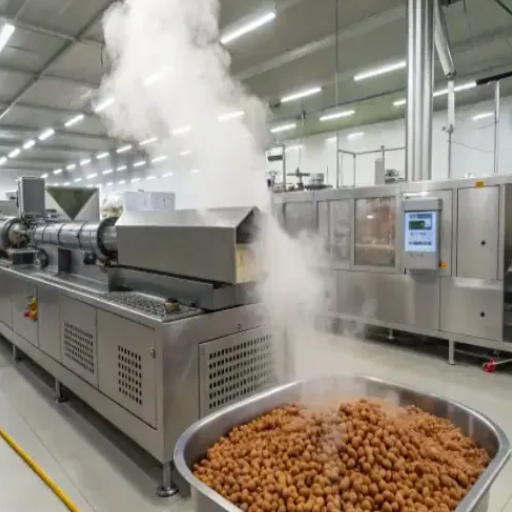
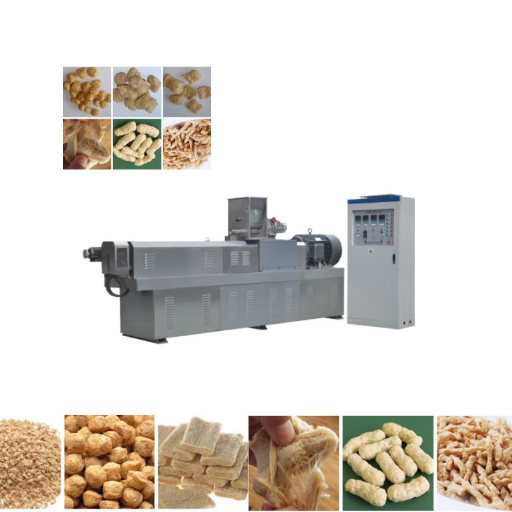
The conditioned dough feeds into an extrusion system. A rotating screw inside a heated barrel compresses the mixture under extreme pressure. Temperatures climb to 120-150°C or higher. The combination of heat, pressure, and mechanical shear cooks the ingredients rapidly. This pet food extrusion process transforms raw ingredients as the cooked dough exits through a die plate. The sudden pressure drop causes it to expand and puff. Rotary knives cut the extruded stream into uniform pellets.
After extrusion, the kibble passes through a dryer to reduce moisture to 2-12%. A cooling stage follows. Finally, fats, oils, flavor enhancers, and sometimes synthetic vitamins are sprayed onto the surface. This coating step is critical because high-heat cooking degrades heat-sensitive nutrients during extrusion.
Key Processing Parameters
| Parameter | Typical Range |
|---|---|
| Temperature | 120-150°C+ (up to 200°C for some grains) |
| Pressure | 20-60 bar |
| Screw speed | 200-500 rpm |
| Moisture content (in) | 20-30% |
| Moisture content (out) | 2-12% |
| Preconditioning | Steam injection, 2-4 minutes |
Twin-screw extrusion systems offer more precise control than single-screw units. They handle a wider range of ingredients, including high-meat formulations that challenge traditional single-screw designs. The intermeshing screws create self-wiping action, which reduces residue buildup and improves hygiene. For manufacturers producing diverse product lines, twin-screw technology provides the flexibility to switch between recipes with minimal downtime.
Nutritional Impact of High-Heat Processing
The high temperatures in extrusion trigger several chemical and physical changes. Starch gelatinization improves digestibility and provides the structural matrix that holds kibble together. Protein denaturation can increase bioavailability for some ingredients. Anti-nutritional factors like phytic acid and trypsin inhibitors are reduced.
However, the heat also degrades heat-sensitive vitamins, particularly B vitamins and vitamin C. Essential amino acids like lysine can become bound through the Maillard reaction, reducing their bioavailability. Natural enzymes are destroyed. Fatty acids, especially omega-3s, oxidize under high heat.
This is why extruded pet food is almost always fortified. Synthetic vitamins and minerals are sprayed on after cooking to replace what was lost. The final product is nutritionally complete, but much of that nutrition comes from post-processing additives rather than the original ingredients.
What Is Cold Pressed Pet Food?
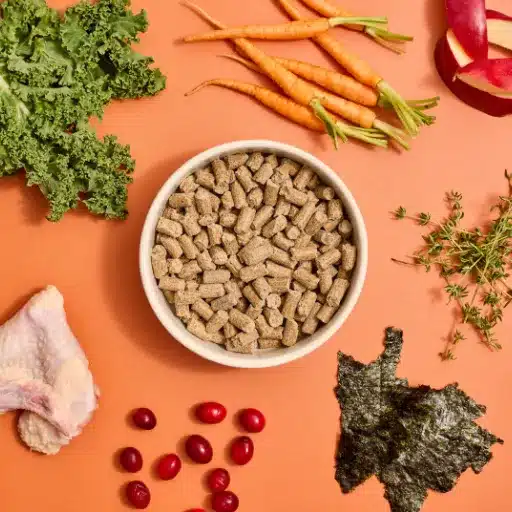
Cold pressed pet food is dry kibble produced by grinding fresh ingredients and forming them into dense pellets using extreme mechanical pressure at low temperatures (40-80°C), without the high heat used in extrusion. This minimally processed pet food preserves more natural nutrients and appeals to health-conscious consumers seeking cleaner labels.
The Cold Pressing Process Step-by-Step
Cold pressed pet food occupies a different position in the market. It is not raw. It is not extruded. It sits in the middle as a minimally processed alternative that appeals to consumers seeking cleaner labels and higher meat content.
The cold pressed pet food manufacturing process begins with grinding fresh or frozen ingredients into a fine meal. Fresh meats, vegetables, fruits, and grains are mixed at room temperature with minimal added moisture. The dough-like mixture then enters a cold press forming machine.
Instead of high heat, extreme mechanical pressure shapes the ingredients into dense pellets. Temperatures remain carefully controlled, typically between 40°C and 80°C. Most manufacturers aim for the lower end of this range, around 40-65°C. The friction from pressing generates some heat, but cooling systems prevent temperatures from climbing into the nutrient-destruction zone.
The formed pellets then pass through a low-temperature drying or baking stage. This removes excess moisture slowly without exposing the product to high heat. Because natural flavors and oils are preserved during pressing, cold pressed kibble typically does not require sprayed-on flavor coatings.
Key Processing Parameters
| Parameter | Typical Range |
|---|---|
| Temperature | 40-80°C (typically 40-65°C) |
| Pressure | High mechanical pressure (hydraulic or screw-driven) |
| Moisture content (in) | 15-25% |
| Moisture content (out) | 8-12% |
| Drying temperature | 40-70°C (slow dehydration) |
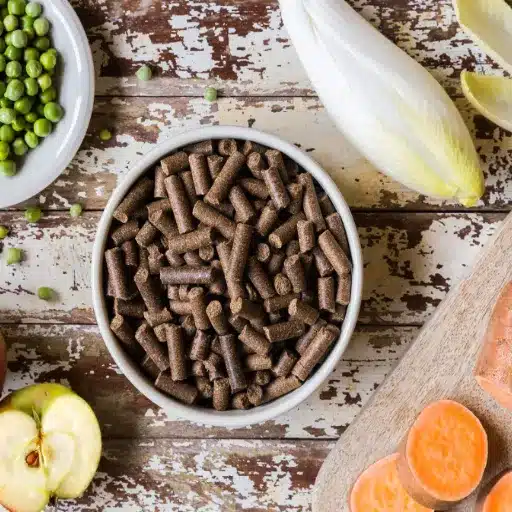
Cold press equipment uses different mechanics than extruders. Forming machines rely on hydraulic pressure or slow-rotating screws to compress ingredients. Die plates shape the pellets, but there is no expansion or puffing. The resulting kibble is dense, compact, and heavier than extruded equivalents of the same volume.
Nutritional Benefits of Low-Heat Processing
The central claim for cold pressed pet food is nutrient preservation. At temperatures below 80°C, heat-sensitive vitamins remain largely intact. Natural enzymes survive the process. Fatty acids, including omega-3 and omega-6, maintain their structure. Amino acids avoid the Maillard reaction that binds them to sugars at higher temperatures.
Because cold pressing does not require starch gelatinization to hold the pellet together, formulations can include higher meat content and lower carbohydrate levels. Natural oils and moisture from fresh ingredients provide binding instead of relying on cooked starches.
The trade-off is safety. Without high-heat sterilization, manufacturers must rely on strict raw material quality control. Some ingredients, particularly animal by-products, may require pre-cooking or thermal treatment before entering the cold press to ensure pathogen control.
Head-to-Head Comparison: 8 Key Factors
When Chen Li evaluated equipment for his new pet food facility in Jiangsu Province, he faced the same question thousands of manufacturers face every year. Should he invest in a high-capacity extrusion line to serve the mass market, or position his brand as a premium cold pressed alternative? He needed numbers, not marketing claims.
Here is how these two pet food production methods compare across the factors that matter most to manufacturers.
| Factor | Extruded Pet Food | Cold Pressed Pet Food |
|---|---|---|
| Processing temperature | 120-150°C+ | 40-80°C |
| Primary force | Heat + pressure | Mechanical pressure only |
| Texture | Light, airy, puffy | Dense, compact, heavy |
| Starch requirement | High (needed for expansion) | Low (natural oils bind) |
| Nutrient retention | Lower (post-cooking fortification) | Higher (natural vitamins preserved) |
| Production speed | 500-3,000 kg/hour | 100-800 kg/hour |
| Energy consumption | Higher (heating + drying) | Lower (minimal heat) |
| Equipment cost | $8,000-50,000+ | $5,000-40,000+ |
| Shelf life | 12-18 months | 6-12 months |
| Pathogen control | Excellent (heat kills bacteria) | Requires strict raw material QC |
Processing Temperature and Heat Exposure
Temperature is the most obvious difference. Extrusion cooks at 120-150°C or higher. Cold pressing stays below 80°C. This temperature gap drives nearly every other difference between the two methods.
High heat in extrusion gelatinizes starches, denatures proteins, and kills pathogens. It also degrades vitamins, damages fatty acids, and triggers the Maillard reaction. Cold pressing avoids most of these heat-driven changes but sacrifices the safety benefits of thermal sterilization.
Nutrient Retention
Cold pressing preserves more natural nutrients. Vitamins B, C, and E survive better. Omega fatty acids remain intact. Amino acid bioavailability is higher because the Maillard reaction is minimized.
However, the scientific picture is more nuanced than marketing suggests. A 2014 study from Wageningen University found that commercially available cold-pressed dog foods actually contained higher average levels of certain Maillard reaction products than extruded alternatives. The researchers concluded that processing temperature alone is not the only determining factor. Ingredient composition, drying time, and storage conditions also play major roles.
Digestibility and Bioavailability
Both methods claim superior digestibility, but through different mechanisms. Extrusion improves starch digestibility through gelatinization and can increase protein bioavailability through denaturation. Heat also reduces anti-nutritional factors like trypsin inhibitors.
Cold pressing preserves the natural structure of ingredients. Some manufacturers claim this leads to more efficient nutrient absorption. Research from Wageningen University in 1996 found higher apparent protein digestibility in pressed diets using gelatinized corn starch. But a 2017 study from Kafkas University showed the opposite when native grains were used. Extruded diets demonstrated better digestibility because the cooking step is essential for breaking down uncooked starches.
The key insight for manufacturers is this. Digestibility depends on your ingredient mix, not just your processing method.
Ingredient Flexibility
Extrusion structurally requires carbohydrates and starches to act as binders. The dough must expand and hold its shape. This is why many extruded kibbles rely on grains, potatoes, or legumes as base ingredients. High-meat formulations are possible with advanced preconditioning and twin-screw systems, but they add complexity and cost.
Cold pressing does not require a starch matrix. Formulations can include higher meat content, up to 70-90% in some recipes. Natural oils and moisture bind the pellet together. This flexibility allows manufacturers to create grain-free, limited-ingredient, and high-protein products that appeal to the premium segment.
Production Speed and Throughput
Extrusion wins on speed. A twin-screw extrusion system can produce 500 to 3,000 kilograms per hour depending on configuration. Cold press forming machines typically operate at 100 to 800 kilograms per hour. For manufacturers targeting high-volume, low-margin markets, extrusion is the only economically viable option.
Energy Consumption and Operating Costs
Extrusion requires significant energy input for heating, steam generation, and high-temperature drying. Cold pressing uses less energy overall because minimal heat is applied. The lower energy requirement can improve margins for premium products where price per kilogram is already higher.
Food Safety and Pathogen Control
This is where extrusion has a clear advantage. The high-temperature, high-pressure environment effectively kills Salmonella, mold, and other pathogens. The resulting product is very dry and shelf-stable.
Cold pressed products do not undergo thermal sterilization. Manufacturers must implement rigorous HACCP protocols, source ingredients from verified suppliers, and maintain strict hygiene standards throughout production. Some cold pressed manufacturers use high-pressure processing (HPP) or pasteurization steps to improve safety without high-heat cooking.
Shelf Life and Storage
Extruded kibble typically lasts 12 to 18 months in sealed packaging. The low moisture content and heat-treated ingredients create a stable product. Cold pressed food has a shorter shelf life, usually 6 to 12 months, because residual natural enzymes and higher moisture levels can lead to faster degradation.
The Science Behind the Methods: What Research Actually Shows
Marketing claims about cold pressed superiority often outpace the scientific evidence. As a manufacturer, you need to understand what peer-reviewed research actually says about these processing methods.
Wageningen University Studies (1996, 2014)
Wageningen University and Research in the Netherlands has published some of the most influential studies on pet food processing. Their 1996 study in the Journal of the Science of Food and Agriculture examined apparent total tract digestibility of protein in pressed versus extruded diets. They found that pressed diets showed higher apparent protein digestibility when formulated with gelatinized corn starch.
The more surprising finding came in a 2014 study published in Nutrition Research Reviews. Researchers measured fructoselysine and carboxymethyllysine, two markers of Maillard reaction products, in commercially available dog foods. Cold-pressed products showed higher average levels of these compounds than extruded alternatives. This directly contradicted the assumption that lower processing temperatures automatically produce healthier food. The researchers emphasized that ingredient composition and drying conditions matter at least as much as processing temperature.
Kafkas University Findings (2017)
A 2017 study from Kafkas University in Turkey, published in the Journal of the Faculty of Veterinary Medicine, added another layer of complexity. When native (uncooked) grains were used in formulations, extruded diets demonstrated better digestibility than pressed alternatives. The extrusion cooking step was essential for breaking down the starches in raw grains. This finding suggests that extrusion may actually be the better choice for manufacturers using traditional grain-based recipes.
Azabu University Acrylamide Research (2021)
Researchers at Azabu University in Japan studied acrylamide levels in extruded versus retorted dog food. Acrylamide is a potentially harmful compound formed during high-heat cooking. Their 2021 study in Fundamental Toxicological Sciences found that extruded dog food contained higher acrylamide levels than retorted alternatives. They estimated that daily acrylamide intake from dog food could be four times higher than from human food, given typical feeding quantities.
The Human UPF Parallel (Harvard/BMJ, 2024)
The backlash against ultra-processed foods (UPF) in human nutrition is increasingly influencing pet food consumer behavior. A 2024 study published in the British Medical Journal tracked over 100,000 participants for 34 years. The highest UPF consumption quartile showed 4% higher all-cause mortality and 9% higher mortality from causes other than cancer or cardiovascular disease.
However, the study also found that the association weakened significantly when researchers controlled for overall diet quality. This suggests that the nutritional composition of food matters more than the processing label itself. For pet food manufacturers, the lesson is clear. The quality of your ingredients and formulation matters more than whether you choose extrusion or cold pressing.
The Bottom Line on Science
No processing method is universally superior. Extrusion offers safety, speed, and cost advantages. Cold pressing offers nutrient preservation and premium positioning. The peer-reviewed research consistently shows that ingredient quality, formulation expertise, and process control are more important than the processing method alone.
Market Demand: What Pet Food Manufacturers Need to Know
Understanding consumer trends is critical when choosing production equipment. You are not just buying a machine. You are betting on where the market will be in five to ten years.
Global Market Size and Growth
The global pet food market reached 132.4billionin2025,accordingtoFutureMarketInsights.Theindustryisprojectedtogrowat6.5132.4billionin2025,accordingtoFutureMarketInsights.Theindustryisprojectedtogrowat6.5263.8 billion by 2036. Dry pet food, which includes both extruded and cold pressed products, remains the largest category at roughly $67.7 billion.
The cold pressed segment is growing faster than the overall market. Market Data Forecast valued the cold pressed pet food market at 9.5billionin2023,projectingittoreach9.5billionin2023,projectingittoreach19.8 billion by 2033 at 7.6% CAGR. IMARC Group offered a similar estimate of 9.9billionin2023growingto9.9billionin2023growingto19.8 billion by 2033. Research and Markets forecast even faster growth, with the market reaching $15.1 billion by 2027 at a 12.8% CAGR.
Consumer Trends Driving Demand
Three major trends are reshaping the pet food landscape. Pet humanization continues to accelerate, with approximately 95% of pet owners viewing their animals as family members. This drives willingness to pay premium prices for perceived higher-quality nutrition.
The backlash against ultra-processed foods is crossing from human to pet nutrition. Mintel data shows that 48% of UK pet owners find manufactured pet food less appealing due to UPF concerns. Air-dried, freeze-dried, and cold-pressed pet food launches doubled from 3% to 8% of new product launches between November 2020 and October 2025, according to GlobalPETS industry analysis.
Clean label demand is also rising. Consumers want fewer artificial additives, transparent ingredient sourcing, and recognizable ingredients. Cold pressed products align naturally with these preferences because they require fewer post-processing additives. This shift positions cold pressed offerings as a compelling minimally processed pet food alternative to conventional extruded kibble.
Regional Variations
Europe leads the cold pressed market, with strong manufacturing bases in the UK, Germany, and Scandinavia. Brands like Forthglade, Guru Pet Food, and Lily’s Kitchen have built significant market share on cold pressed positioning.
North America is the second-largest market, with U.S. sales growing at approximately 7.8% CAGR. The Asia-Pacific region is the fastest-growing market overall, driven by rising pet ownership in China, India, and Southeast Asia.
For manufacturers, these regional differences matter. A production line optimized for European export markets might prioritize cold pressing capabilities. A line serving Southeast Asian mass markets would likely focus on high-volume extrusion.
How to Choose: A Decision Framework for Manufacturers
When Nordic Pet Nutrition launched in Denmark three years ago, they faced the exact decision you are facing now. Their leadership team spent six months analyzing market data before committing to a cold press production line. Today they supply premium retailers across Northern Europe with a product line that commands 40% higher shelf prices than mass-market kibble. Their bet on the premium segment paid off because they matched their production method to their market position.
Use this framework to make your own decision.
Choose Extrusion
- Your target market is cost-conscious mainstream consumers
- You need production capacity above 500 kg per hour
- Your formulations rely on grains, starches, or vegetable proteins as primary ingredients
- Shelf stability of 12+ months is essential for your distribution model
- You are entering markets with limited cold chain infrastructure
- Your budget requires the lowest possible cost per kilogram of finished product
Choose Cold Press
- Your target market is premium or health-conscious pet owners
- You want to position your brand as minimally processed or natural
- Your formulations feature high meat content (50%+)
- You are targeting European markets where cold pressed awareness is highest
- Your business model supports higher price points and lower production volumes
- You want to differentiate from the 80% of competitors using extrusion
The Hybrid Approach
Some manufacturers operate both extrusion and cold press lines. This strategy lets you serve multiple market segments from a single facility. Mass-market extruded products generate volume and cash flow. Premium cold pressed products deliver higher margins and brand differentiation.
The capital requirement is higher, but the risk diversification is significant. If consumer preferences shift further toward minimally processed foods, you are positioned to capitalize. If economic pressures push consumers toward lower-priced options, your extrusion line maintains revenue.
Budget and Scale Considerations
| Factor | Extrusion Line | Cold Press Line |
|---|---|---|
| Entry-level investment | $8,000-15,000 | $5,000-12,000 |
| Mid-range turnkey system | $15,000-30,000 | $12,000-25,000 |
| High-capacity industrial line | $30,000-50,000+ | $25,000-40,000+ |
| Operating cost per kg | Lower | Higher |
| Labor requirements | Moderate (automated) | Moderate |
| Floor space | Larger | Smaller |
Ready to explore equipment options for your specific production goals? Contact our engineering team for a customized quotation based on your target capacity, ingredient mix, and budget.
Equipment Considerations: What to Look For
Whether you choose extrusion, cold pressing, or both, the quality of your pet food processing equipment determines the quality of your product. Here is what experienced manufacturers prioritize when evaluating production lines.
Extrusion Line Components
A complete extrusion system includes several integrated stages. Raw material processing starts with grinders and mixers that create a uniform dough. The preconditioner adds steam and water to begin cooking. The extruder barrel and screw assembly apply heat, pressure, and shear. A die plate shapes the product. Rotary or pneumatic cutters trim pellets to uniform length. Dryers remove moisture using hot air. Coolers bring the product to ambient temperature. Finally, coating drums apply fats, flavors, and post-cooking nutrients.
For pet food applications, twin-screw extrusion systems offer significant advantages over single-screw designs. The intermeshing screws provide better mixing, more precise temperature control, and greater flexibility for high-meat or alternative protein formulations. Self-cleaning screw profiles reduce downtime and improve food safety.
Cold Press Line Components
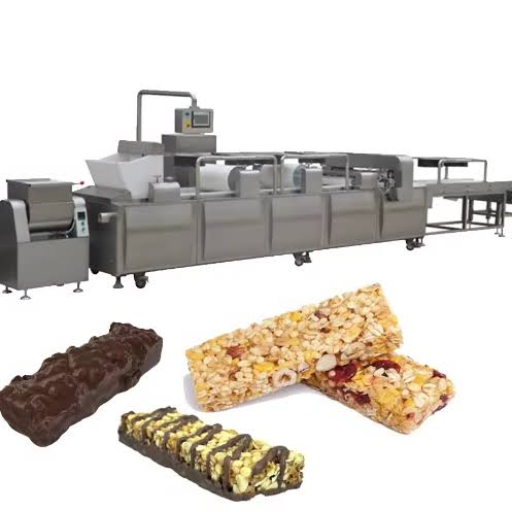
A cold press production line follows a different flow. Grinding and mixing equipment prepares the raw materials at room temperature. The cold press forming machine applies high mechanical pressure to shape pellets without heat. Low-temperature dryers or dehydration ovens remove moisture gently. Cooling systems bring products to packaging temperature. Quality control sensors monitor pellet consistency, weight, and moisture levels throughout the process.
Key specifications to evaluate include maximum pressing pressure, temperature control precision (look for ±3°C accuracy), die interchangeability for different shapes, and throughput capacity per hour. Stainless steel construction using food-grade 304 or 316L materials is essential for food safety compliance.
Automation and Quality Control
Modern production lines should include programmable logic controller (PLC) systems with touch-screen interfaces. Real-time monitoring of temperature, pressure, moisture, and motor load helps maintain consistent product quality. Automated alarm systems flag deviations before they become costly problems.
For cold press lines, moisture monitoring is particularly critical. Because the product does not undergo high-heat sterilization, precise moisture control affects both shelf stability and pathogen risk.
Turnkey Solutions vs. Piecemeal Equipment
Buying individual machines from different suppliers often creates integration headaches. Motors may not match. Control systems may not communicate. Hygiene standards may vary. Turnkey production lines from a single manufacturer eliminate these problems.
A turnkey food production line includes integrated mixing, processing, drying, cooling, and packaging systems designed to work together. Installation support, operator training, and ongoing technical service ensure your line performs at specification from day one.
Our extrusion expertise extends beyond pet food into snack food machinery, giving us deep experience with the twin-screw technology that drives both industries. This cross-sector knowledge helps us optimize equipment configurations for diverse ingredient matrices.
For manufacturers specifically interested in premium pet food production, our cold pressed pet food making machine delivers low-temperature processing with the capacity and reliability commercial operations require.
Frequently Asked Questions
Is cold pressed pet food better than extruded?
Neither method is universally better. Cold pressing preserves more heat-sensitive nutrients and appeals to premium consumers. Extrusion offers lower cost, higher throughput, and superior pathogen control. The best choice depends on your target market and business model.
What temperature is pet food extrusion?
Pet food extrusion typically operates at 120-150°C, with some grain-heavy formulations reaching up to 200°C during the cooking phase inside the extruder barrel.
Can cold pressed pet food be nutritionally complete?
Yes. Cold pressed pet food can meet FEDIAF (European Pet Food Federation) and AAFCO (Association of American Feed Control Officials) nutritional standards when properly formulated. The lower processing temperatures preserve more natural nutrients, reducing the need for extensive post-processing fortification.
Which production method has lower equipment costs?
Entry-level cold press equipment typically costs slightly less than entry-level extrusion systems. However, high-capacity industrial lines for both methods fall in similar price ranges of $25,000-50,000+. Operating costs per kilogram are lower for extrusion due to higher throughput.
Does extruded pet food cause bloat in dogs?
No conclusive scientific evidence links extruded kibble to bloat. The expansion of kibble in the stomach is not the cause of bloat. Gas from fermentation is the primary factor. Claims that cold pressed food reduces bloat are not supported by peer-reviewed research.
Conclusion
The debate between cold press vs extruded pet food is not about choosing a winner. It is about choosing the right tool for your specific business. Extrusion delivers the scale, efficiency, and cost structure that built the $132 billion global pet food industry. Cold pressing captures the fastest-growing premium segment, driven by consumers who treat their pets as family and scrutinize processing methods.
The scientific evidence supports a nuanced view. Processing temperature matters, but ingredient quality and formulation expertise matter more. A well-formulated extruded food with premium ingredients can outperform a poorly formulated cold pressed alternative, and vice versa.
For manufacturers, the decision comes down to four factors. Who is your customer? What ingredients will you use? How much do you need to produce? What is your capital budget? Answer these questions honestly, and the right production method becomes obvious.
With over 10 years of experience in food processing machinery, we have helped manufacturers across 50+ countries choose, install, and optimize production lines for both extruded and cold pressed pet food. Our CE-certified turnkey production lines are designed to meet your unique production goals, whether you are entering the mass market or building a premium brand.
Tell us your production targets, and we will design a solution tailored to your needs. Get in touch today for a detailed consultation and quotation.