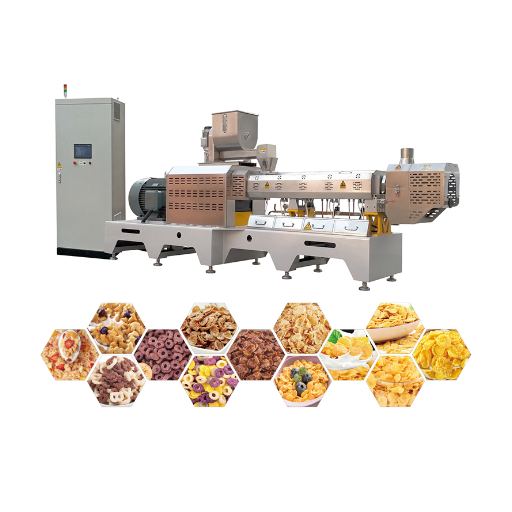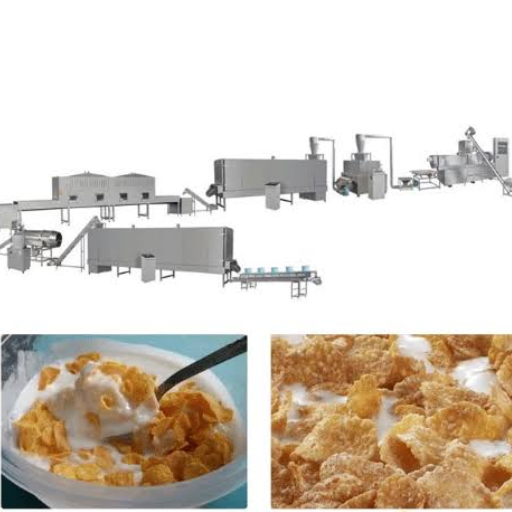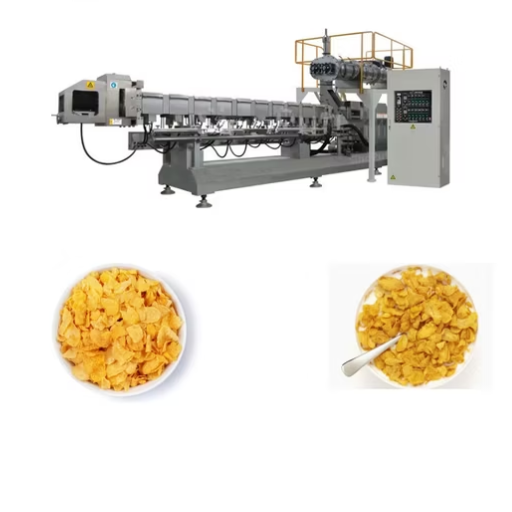
An extruded cereal production line turns cereal flour or meal into a finished ready-to-eat cereal in one continuous pass. The extruder cooks and plasticises the mix under pressure. The die sets the cross-section, and a knife at the die face cuts each piece to length.
That much is agreed on. What most equipment pages skip is that four different cereals come off four different versions of that line. The divergence starts at the extruder, not at the packaging end.
A direct-expanded ring puffs as it leaves the die. An extruded flake leaves the die as a dense pellet and stays that way until a pair of rolls flattens it. A gun-puffed cereal is shaped cold and puffed later, in a separate pressure vessel.
If you’re specifying a line, that route decision comes before any machine decision. Get it wrong and you buy a flaking mill you never use, or a dryer sized for the wrong mass flow.
This guide covers what the extruder does in each route, why only one of them needs a flaking mill, and how die and cutter choice set shape and bulk density. It also maps which equipment every route shares. For the machine list behind that sequence, see our overview.
Key Takeaways
- An extruded cereal line is one extruder plus a route-specific tail: direct-expanded needs a dryer, extruded flakes need rolls and a toaster, gun-puffed needs a puffing gun.
- Raw cereal grain enters at roughly 48 lb/ft³ and finished cereal leaves at 4-10 lb/ft³ (0.6-1.6 kg per 100 cm³). That expansion is created at the die; drying only removes the water that carried it.
- Extruded flake pellets leave the die at 22-24% moisture, about 0.6 cm across and 1 cm long, with 17-18% as the working target for the tempered pellet. The last barrel zone is cooled so they do not flash-expand.
- Gun-puffed cereals are formed below 70°C (160°F) at 20-24% moisture, tempered down to 9-12%, then puffed at 10-14 bar (150-200 psi) and dried to 1-3%.
- Extruder output is not packed-product output. Drying removes water and coating adds solids, so ask for finished kilograms per shift, not extruder kilograms per hour.
What an Extruded Cereal Production Line Actually Is
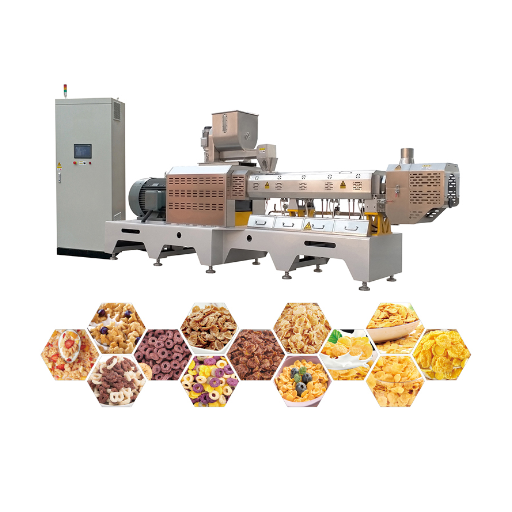
An extruded cereal production line is a sequence of unit operations that never fully stops: mixing and conditioning, extrusion, forming at the die, cutting, drying, coating or toasting, cooling, and packing. Some routes insert a flaking mill, some insert a puffing gun, and some run a second extruder for a filled centre. Extrusion is the stage every route shares. For at each of those stages, our stage-by-stage guide covers the detail.
The extruder is best understood as a short bioreactor, which is how the Institute of Food Technologists describes it. Energy arrives from three places: mechanical work from the screws, heat through the barrel jackets, and the chemical energy released as starch gelatinises. Screw geometry, barrel temperature profile and residence time decide how much of each the material receives.
Cereal extrusion applies that physics to a narrow set of raw materials. Ready-to-eat cereals are made mainly from corn, wheat, oats and rice, in about that order of quantity produced, so most extruded cereal manufacturing is built around corn and wheat recipes with oats and rice as the variation.
The visible result is a change in density. Raw cereal grain arrives at roughly 48 lb/ft³. Finished cereal leaves at 4-10 lb/ft³, or about 0.6-1.6 kg per 100 cm³. Nothing downstream creates that structure; it happens in the barrel and is fixed at the die.
These figures come from Breakfast Cereals and How They Are Made, the Cereals & Grains Association reference behind most of the process data in this article.
Two words get used interchangeably by buyers and should not be. Extruded means formed by pushing material through a die. Flaked means rolled flat between mill rolls. A corn flake is flaked, while an extruded flake is both, in that order, which is why their equipment lists diverge after the extruder.
If you want the mechanism in more depth, our guide to how food extrusion works covers barrel zones, screw elements and shear.
The Four Routes Through an Extruded Cereal Line
Every extruded cereal starts as flour, meal or grits. What changes is what the extruder is asked to do with it, and the answer determines the rest of the plant. Most extruded grain products also share the same front end: batching, mixing and preconditioning.
| Route | What the extruder does | Moisture at forming | Texture comes from | Added equipment |
|---|---|---|---|---|
| Direct-expanded | Cooks the meal and lets it expand as it leaves the die | Set by recipe and die | The pressure drop at the die face | Dryer, coater |
| Extruded flake | Forms a dense pellet and holds it back from expanding | 22-24% at the die, 17-18% target | Rolling the tempered pellet flat, then toasting | Flaking rolls, toaster |
| Extruded gun-puffed | Shapes the piece cold, without puffing it | 20-24%, then tempered to 9-12% | A separate puffing gun at 10-14 bar | Dryer, tempering bins, puffing gun, final dryer |
| Co-extruded | Runs a shell and a filling through one die | Recipe dependent | Crimping and sealing at the die | Second extruder, crimper, dryer |
Direct-Expanded Cereals
Flour or meal goes in and the die holes set the shape.
The knife runs on the outer face of the die and cuts the strand as it emerges. Expansion happens in the same instant, driven by steam and by the pressure drop across the die, so the piece is close to its final cross-section before it reaches the dryer. Rings, balls, stars and cocoa shapes come off this route.
Extruded Flake Production Line: Pellets, Rolls and Toaster
The extruder’s job changes completely. Instead of allowing expansion, it forms a dense pellet and holds it back: about 0.6 cm in diameter and 1 cm long, leaving the die at 22-24% moisture.
The final barrel section is cooled so the pellet does not flash-expand. Rolls flatten the tempered pellet, then a toaster sets colour and crunch. An extruded flake production line is therefore the same extruder base plus rolls and a toaster; the traditional adds grits cooking and drying ahead of the rolls.
<!– IMAGE 3: pellet versus flake comparison. alt: “Extruded cereal pellet before flaking and finished flake after toasting” –>
Extruded Gun-Puffed Cereals
Here the extruder only shapes: it runs below 160°F (70°C), so the starch is formed but not expanded, and pieces leave at 20-24% moisture. They are dried and tempered to 9-12%, then released in a puffing gun at 150-200 psi, about 10-14 bar. A final dry brings them to 1-3%.
Co-Extruded Cereals
Two streams, a shell and a filling, meet in one die and are crimped shut. The filled cereal patent literature describes this arrangement in detail. The added equipment is a second extruder and a crimper, not a different drying strategy.
If you are still deciding which of these products to make, our overview of types of breakfast cereals covers the consumer side of that choice.
Which Extruded Cereals Need a Flaking Mill
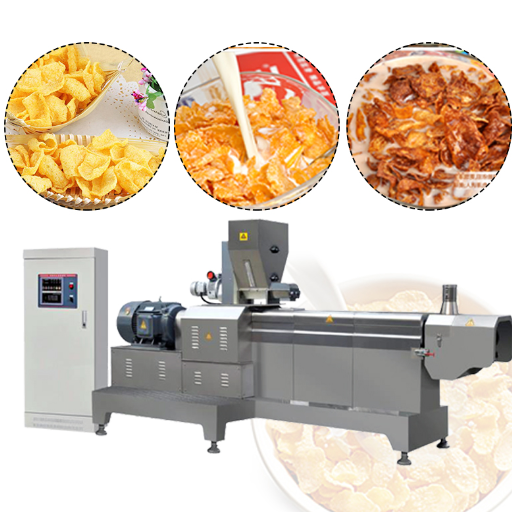
A traditional corn flake cannot be made without a mill. Grits are cooked, dried, tempered, cooled below 110°F (43°C), and then rolled flat. The rolls are the texture step, and they are unforgiving: at 12-13% moisture the grits shatter, at 19-20% they gum the rolls.
An extruded flake doesn’t skip that step. It moves it. The extruder makes the pellet, the rolls flake it, and the toaster finishes it. What extrusion adds is control: pellet density and moisture can be dialled far more precisely than a cooked grit can.
Direct-expanded and gun-puffed cereals skip the mill entirely. Their texture is set at the die or in the gun, and fixed in the dryer.
That difference has three practical consequences. Footprint shrinks, because rolls and their conditioning bins are long and heavy. Changeover becomes a die change rather than a recipe rebuild. And labour shifts from a cooking and milling crew to an extrusion operator who reads pressure and torque instead.
Our product page covers the flake route in more depth, including .
Die, Cutter and Process Variables
Shape, size and bulk density are decided in three places: the die, the knife, and the process settings. Buyers tend to specify the first and ignore the other two until commissioning.
The Die Sets Shape and Resistance
Die hole cross-section sets the profile: ring, ball, star, curl or flake pellet. But shape alone is not the specification. Land length and taper along each hole set how much resistance the melt meets, and resistance sets expansion, and expansion sets bulk density. A die cut for one recipe will often run badly on another, which is why dies are cut for a product family rather than a single product.
The Knife Sets Length and Cut Quality
The knife runs on the outer die face. Blade count and rotation speed set piece length. Stand-off from the die face decides how cleanly the piece separates: too far and the strand tears, too close and blades wear fast. On a filled or coated product, cut quality is also a seal quality, and a poor cut shows up later as leakage in the dryer.
Three Variable Groups
The IFT framework reduces the settings to three groups: formulation, thermomechanical input, and die. The practical discipline is to change one and hold the other two, then read the product. In most plants that means moisture, barrel temperature profile, and screw speed.
The expansion mechanism behind most extruded cereals is steam-induced. Water in the matrix flashes to steam at the pressure drop across the die and expands the structure. That is why IFT classifies breakfast cereals among steam-induced expansion products rather than among dry thermal processes.
Shear leaves marks too. High shear dulls colour, which matters on a product sold on brightness. Conditioning before the die produces curled flakes, while a drier, shorter path produces the flat “poker chip” flake some markets prefer.
| Shape | Die form | Cutter | Usual route |
|---|---|---|---|
| Ring | Annular hole with a central mandrel | Rotating face knife | Direct-expanded |
| Ball | Round hole, short land | Rotating face knife | Direct-expanded |
| Star | Multi-lobed hole | Rotating face knife | Direct-expanded |
| Curl or shell | Curved slot | Rotating face knife | Direct-expanded |
| Filled pillow | Twin-port die with crimp shoulder | Crimper rolls | Co-extruded |
| Flake pellet | Round hole, dense output | Face knife, then rolls | Extruded flake |
After the Extruder: Shared Equipment and What to Specify
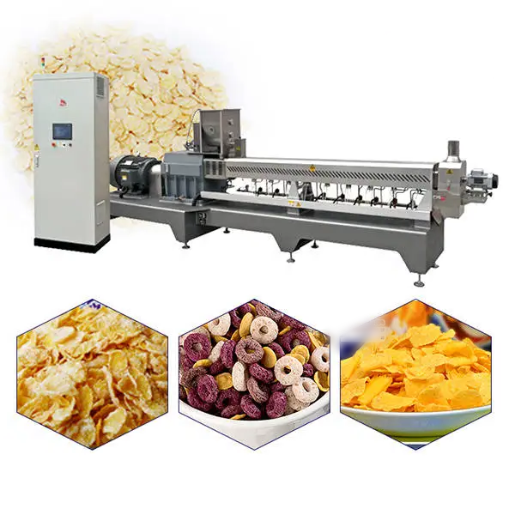
Route-Specific Equipment
Direct-expanded lines need a dryer and a coater and little else, while extruded flake lines need flaking rolls and a toaster. Gun-puffed lines need tempering bins, a puffing gun and a second dryer. Co-extruded lines need a second extruder and a crimper. That list is what makes one extruded cereal line cost different from another.
Equipment Shared Across Extruded Cereal Products
Extruded cereal products differ in shape, density and coating, but the back end of the plant barely changes. Belt dryers, sugar or vitamin coating, cooling conveyors, and weighing and packing are common to all four routes. So is the front end: a preconditioner that hydrates and partially cooks the meal before it reaches the barrel, which is where much of the moisture variation enters the process.
Six Questions That Decide the Quote
| Question | Why it changes the quote |
|---|---|
| Which route, and which shapes? | Fixes the die set and the tail of the line |
| What finished throughput, in packed kilograms per shift? | Extruder output is a different, larger number |
| How much recipe flexibility? | Multi-grain and high-fibre recipes push the choice from single-screw toward twin-screw |
| What utilities are available? | Steam, water, compressed air and power capacity all constrain the configuration |
| What certification target applies? | Hygienic design can be specified to EHEDG principles, and a line can be configured to meet certifications such as CE |
| What is the building? | Dryer length usually drives footprint and ceiling height more than the extruder does |
Extruder throughput deserves its own warning. Drying removes water, which is a large mass fraction on a flake line, and coating adds solids back. The two numbers can differ by a wide margin, and a quote written against extruder output will under-deliver at the packing machine.
Extruded Cereal Production Line FAQ
What is the difference between an extruded cereal and a flaked cereal?
A flaked cereal is rolled flat between mill rolls, and the rolls create the flake. An extruded cereal is formed through a die. Extruded flakes are both: the extruder makes a pellet, then rolls flatten it.
Do extruded cereals need a flaking mill?
Only the extruded flake route does, and there the mill sits downstream of the extruder rather than replacing it. Direct-expanded and gun-puffed cereals need no mill at all.
What shapes can an extruded cereal line make?
Rings, balls, stars, curls, pillows and flake pellets are the common families. Shape is set by the die, so a new shape is a new die rather than a new extruder.
How is bulk density controlled?
Mainly by die resistance, moisture and screw speed, acting together. Land length and taper change expansion, and expansion changes how much cereal fits in a carton.
What is the difference between extruded-expanded and gun-puffed cereal?
Extruded-expanded cereal puffs at the die as it leaves the extruder. Gun-puffed cereal is shaped cold, dried and tempered, then puffed later in a separate pressure vessel at 10-14 bar.
Choosing the Route Before the Machine
An extruded cereal production line is decided by the product, not by the extruder catalogue. The route fixes the equipment list, the moisture window, the drying load and the labour profile. Choose the route first and the machine specification mostly writes itself.
Three things are worth doing before you request a quote. Write down the target shapes and the finished bulk density. Measure what your building can actually take in dryer length and ceiling height. And decide whether you’re buying a single-product line or a platform you’ll add SKUs to, because that answer changes the die inventory and the screw configuration.
If you have those three answers, and our engineers will map them onto a configuration. If you’re earlier in the process, work backwards from the product you want in the box and let the shape decide the route.