
Today, the art of biscuit making has advanced notably and automation is now the main factor in changing the industry. The automatic biscuit production line has become a game changer by merging innovation with precision in the production of both hard and soft biscuits. But what are the characteristics of these systems that make them so powerful and how do they meet the high standards of quality, efficiency, and versatility needed in biscuit production? This article reveals the very heart of automatic biscuit production lines, bringing out their importance, their characteristics and also the amazing ways they are changing the bakery sector. If you are a professional manufacturer or someone who is just interested in knowing the technology behind your favorite snacks, then this is the place where the old ways and the new technology come together.
Introduction to Biscuit Production Lines
The Importance of Efficient Biscuit Making
To the global market, quality, consistency, and affordability are the three important criteria that the consumers are more and more demanding, which is why the demand for biscuit production that is very efficient is becoming more and more important. The process that the producers are using is so advanced and efficient that they are able to supply the market with a large and constant volume of biscuits without permission given on the texture, shape, and taste. The manufacturers do this for the sake of the consumers so that they become satisfied and also for the sake of the brand loyalty by constantly delivering products that meet or exceed the consumers’ expectations.
Key Benefits of Automation
- Cost Reduction: Eliminates extra expenses through streamlined processes
- Speed Enhancement: Significantly faster production cycles
- Labor Efficiency: Reduces dependency on manual workforce
- Error Minimization: Lower error rates through precision technology
Furthermore, the cutting-edge biscuit manufacturing lines are a plus for the nature. They optimize the use of energy and reduce waste simultaneously. They are also the ones that the companies are able to use when they are implementing such sustainable measures as the recycling of materials and the limiting of emissions as their practices which is totally in line with the industry’s growing concern for the environment. By being focused on efficiency, biscuit manufacturers will not only make a profit but also be part of the sustainable development process and, at the same time, be able to satisfy the market with their products.
Overview of the Automatic Biscuit Production Line
An automatic biscuit production line is a highly effective system that is manufactured to the maximum biscuit manufacturing process. It combines the different stages of production—mixing, molding, baking, and packaging—into a single continuous and automated workflow. This kind of production line not only eliminates the need for manual labor but also increases production and at the same time gives the final products the same quality and taste.
Production Stages Integration
- Automated Mixing Units: Ensure precise ingredient proportions
- Molding Machines: Create dough with perfect dimensions
- High-Capacity Ovens: Maintain consistent temperature for texture and flavor
- Packaging Robots: Reduce material wastage and extend shelf life
The adoption of an automatic biscuit production line brings about substantial gains for the manufacturers. The production process becomes very smooth with human errors being reduced to almost zero, speed is intensified, and the facility has the ability to run at full capacity. Furthermore, a lot of contemporary systems are very energy-efficient, hence they cut down both the costs of operation and the pollution they cause. In addition, these systems which can handle the high consumer demand without sacrificing quality have grown to be a necessity in the biscuit production industry.
Key Trends in Biscuit Manufacturing
The biscuit making industry is adapting to changing consumer habits and market demands. Among the changes, the biggest one is the heightened attention on health products. Manufacturers are using whole grains, natural sweeteners, and plant-based substitutes as ingredients in their products to attract those customers who want to have healthier snacks. To support this, the variety of biscuits produced now includes gluten-free, vegan, and high-protein, which correspond to the dietary changes taking place in the market.
| Trend Category | Description | Impact |
|---|---|---|
| Health Products | Whole grains, natural sweeteners, plant-based ingredients | Attracts health-conscious consumers |
| Smart Production | AI, robotics, and automation integration | Maximum efficiency and quality |
| Sustainability | Recyclable packaging, reduced carbon footprint | Environmental responsibility |
Reducing the environmental impact is a main focus among the biscuit manufacturers. Companies are insisting on using recyclable materials for packaging, cutting down on plastic usage, and sourcing of ingredients that are friendly to the environment to counteract their negative impact. Moreover, many large-scale manufacturers are implementing or considering initiatives like carbon neutrality as well as zero-waste to landfill across their supply chain. All these steps are being taken and, thus, the food industry is getting more challenging, but all of them are reflecting the loyalty to the customers’ needs. The combination of these trends is steering the dairy of biscuit manufacturing into the direction of more innovative, sustainable, and consumer-friendly systems.
Benefits of Automatic Biscuit Production Lines
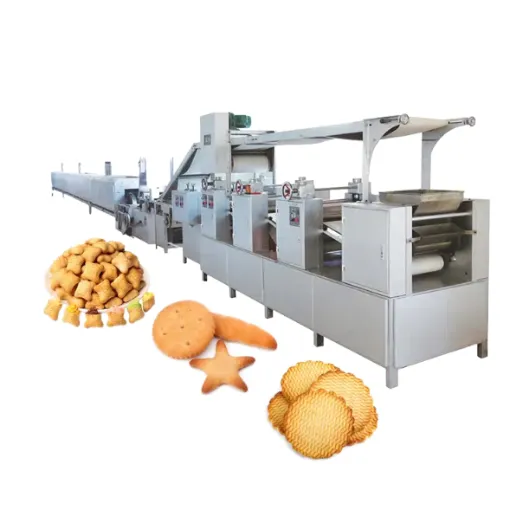
Reducing Labor Costs with Fully Automatic Systems
Completely automatic biscuit production lines reduce extensively manual labor costs as they operate all the stages of the manufacturing process. Minimal human involvement is needed for these systems ranging from dough preparation and shaping to baking and packaging. Such labor reduction does not go against the manufacturing industries’ main aim which is that of optimizing costs while keeping the efficiency of production. To illustrate; the automated lines can sometimes run non-stop for the entire week with very little down time thus producing higher amount of biscuits without the need for a big group of workers; therefore reducing one of the most important areas of production – the labor cost that is the operating expense.
💡 Advantages of System Reliability
- Programmed for consistent results every time
- Precision in cutting and placing dough reduces raw material loss
- AI-powered monitoring enables effective production line oversight
- Identifies potential slowdowns and maintenance needs automatically
Moreover, the constantly increasing labor costs in different parts of the world particularly in countries where labor laws are strict and wages highly regulated have made the switching to fully integrated systems more economically feasible. It is true that the initial expenditure can be quite high but the savings in the long run sometimes outweigh the initial costs. In addition, automation can eliminate problems related to the workforce such as the shortage of labor or the rate of turnover, thus ensuring continuous production. When combined with the economic advantages, these systems enable companies to hold their ground in a price-sensitive market by both maintaining their profitability and high production standards.
Increased Efficiency and Consistency in Biscuit Making
The deployment of mechanization in biscuit making has completely changed the sector due to its ability to increase productivity and at the same time maintain uniformity in taste across different batches. Present-day robotized systems take control of the full production line, right from the mixing of the dough to the packing, cleaning the way for human errors and the like. The advanced machines have been equipped with both sensors and precision controls, which guarantee that every biscuit is made to the same high standards in terms of shape, size, and texture, thus producing high-quality goods that are right in line with what the consumers expect.
🔍 AI-Based Quality Assurance Systems
Detection Capabilities:
- Wrong baking temperatures
- Unequal dough distribution
- Improper packaging
Benefits: Real-time identification enables quick adjustments, preventing costly product rejections and delays while increasing processing time significantly.
The use of machines in the production of biscuits also opens the door to new product development. The installation of specialized software gives the producers the opportunity to try out different mixtures, ingredients or even decorations while keeping accuracy and efficiency intact. Moreover, the data analysis done by automated systems serves to give the manufacturers a clear picture of the prevailing trends in the market as well as the tastes of the customers, thereby guiding them in making the right decisions. Together with less reliance on manpower and the use of energy-efficient technology, automation is not only enhancing productivity but is also in line with sustainability practices, thus creating a more competitive and eco-friendly future for the biscuit industry.
Customizable Solutions for Different Biscuit Types
The biscuit industry is very different and varied. It sells to different customers and different regions with different tastes. The company acknowledges the need for variety and consequently, will be able to use automation systems that are very much tailored to suit the different biscuit types. For example, the processing solutions for cream-filled cookies may demand the application of very thin layers of cream one over the other, while the production of digestive biscuits would need the implementation of a baking system that is very efficient and at the same time, preserves their coarse texture and unique flavor profile.
| Biscuit Type | Production Requirements | Automation Solution |
|---|---|---|
| Cream-Filled Cookies | Thin layer application | Precision layering systems |
| Digestive Biscuits | Preserve texture and flavor | Efficient baking systems |
| Gluten-Free/Vegan | Special recipe handling | Customized modifications |
The most advanced automation technology is very flexible and goes hand in hand with the changing production setups, which in turn, allows the manufacturers to creater switch between different biscuit recipes without much downtime at all. The top-notch programming options and modular designs make quick changes possible in the parameters including dough preparation, shaping, and baking. This flexibility keeps the manufacturers on their toes and within reach of the changing market trends, seasonal demands, or regional tastes.
Features of Modern Biscuit Making Machines
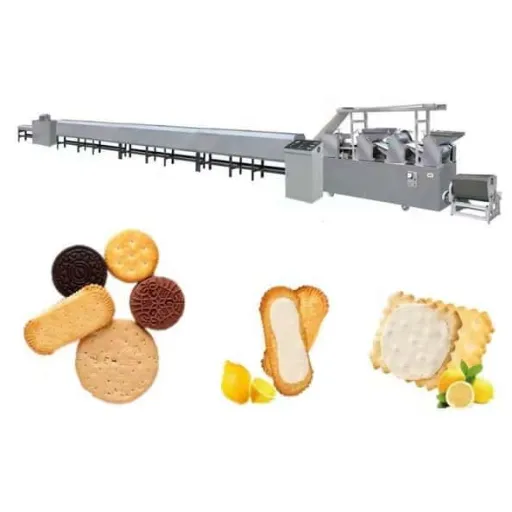
Overview of Fully Automatic Biscuit Machines
The fully automatic biscuit machines are the best in terms of efficiency and innovation in the baking industry. The machines are responsible for the entire biscuit manufacture process by preparing the dough, molding it, baking and cooling it, all of which are done non-stop and in an organized manner. High-level automation is fitted into the machines, which assures that the biscuit quality is always the same and the production capacity is high. Also, the human intervention is very little.
⚙️ Advanced Machine Features
- PLC and HMI Technologies: Unprecedented control over timing, temperature, and volume
- Modular Design: Adjustable production lines for different shapes and sizes
- Energy-Efficient Mechanisms: Reduced operational costs
- Waste Reduction Systems: Minimized material loss
- Quick Recipe Changes: Easy adaptation to market demands
Technological Advancements in Biscuit Manufacturing
With the introduction of technology, the biscuit making process has changed drastically over the years as the main aim was to increase efficiency, consistency, and sustainability. One such technological advantage is the use of automated systems and robotics that have revolutionized the entire manufacturing process of biscuits by eliminating human mistakes. Operations like dough mixing, shaping, baking, and packaging have become faster and more accurate through the use of these systems; thus, the manufacturers not only meet the increasing market demand but also produce a consistent quality over time.
🤖 AI and IoT Integration
Predictive Maintenance Benefits:
- Continuous data collection and analysis
- Prediction of equipment malfunction before occurrence
- Reduced maintenance costs and downtime
- Longer equipment lifespan
- Uninterrupted production schedules
In addition, sustainability has gradually taken center stage in the industry and this has been a push factor for the development of green manufacturing processes and even machines. The modern-day biscuit-making machines have come a long way from using conventional ovens that consumed a lot of energy and were also hard to regulate. Nowadays, there are state-of-the-art production lines with energy-saving ovens and waste-reducing systems in place for reducing the negative impact on the environment. Even some of the manufacturers are choosing to generate the power for their plants from renewable energy sources which are a big step forward on the path to sustainability.
Importance of Forming Machines in Biscuit Production
In the process that leads to biscuit production, the shaping machines hold the most important position since they are the ones that determine the quality and shape of the biscuits, their size, and the final texture. The primary function of the machines is to provide uniformity throughout the large quantity of products, which is a very important factor in consumer satisfaction, product quality assurance, and meeting consumer expectations. The advanced forming methods applied by the manufacturers give them the flexibility to produce every kind of biscuit, they could be simple circular cookies or even the most elaborate shapes with the most intricate designs.
✨ Smart Technology Integration
IoT Systems Capabilities:
- Continuous monitoring and real-time data analysis
- Detection of production bottlenecks
- Estimation of maintenance timing
- High-quality product assurance
- Waste reduction and cost savings
Types of Biscuits Produced Using Automatic Lines
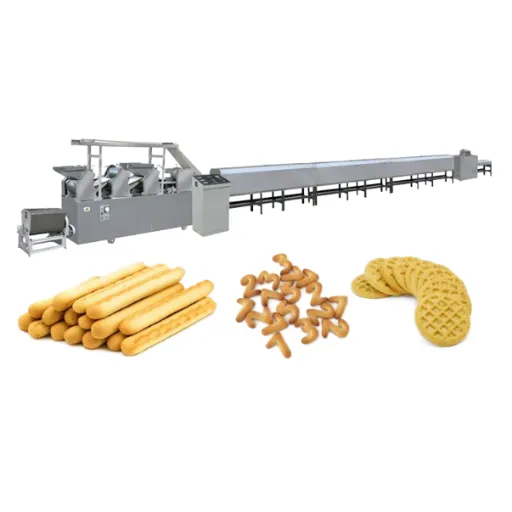
Hard Biscuits: Characteristics and Production Techniques
Hard biscuits, which are usually characterized by a crisp texture and slight sweetness, are minimally processed and are the main coming in biscuit production. This kind of biscuit normally contains low amounts of fat and sugar, which is the main reason why it is favored by health-conscious people. The firmness of the biscuit is a direct result of the proper balancing of the dough constituents, one of which is fat that is certainly less than that of the soft biscuits. The consequence of this is a compact structure that yields the “snap” when the biscuit is broken.
| Production Stage | Process | Key Consideration |
|---|---|---|
| Mixing & Kneading | Dough consistency achieved | Uniformity throughout |
| Rolling & Sheeting | Desired thickness obtained | Determines final texture and firmness |
| Shaping | Precision cutters used | Uniform dimensions |
| Baking | Temperature-controlled ovens | Proper crispness and finish |
Hard biscuits possess not only the ability to be consumed in a variety of manners but also a great number of their different tastes and uses. They can be either unflavored, flavored very mildly, or even enriched with extra grains so as to appeal to a big market group, all this while still having the long shelf-life that they are known for. The technological improvements in automatic machinery have resulted in a further increase of the ability to mass-produce these biscuits without losing quality, which in turn has led to manufacturers being able to meet the rising consumer demands in a fast and eco-friendly manner.
Soft Biscuits: Unique Requirements and Processes
Soft biscuits are different from the hard ones in texture, moisture, and formulation. The distinguishing feature of soft biscuits is their tender and cake-like texture which is the result of a skilled combination of ingredients. The ingredients responsible for the soft biscuit are flour, sugar, fat, and leavening agents. These ingredients together produce a dough that has just the right amount of moisture left after baking. The fats, which can be butter, shortening, or oils, are the main factors giving the softness and flavor to the final product.
🎯 Maintaining Softness: Key Challenges
- Humidity Control: Critical factor in preserving freshness
- Storage Conditions: Proper environment maintenance
- Packaging Solutions: Multi-layered films and resealable packs
- Emulsifiers: Natural or synthetic options to control moisture content
The making of soft biscuits also involves the use of special machinery and the careful regulation of every process. Not only mixing the dough and baking but also every process has to be controlled precisely to avoid over-baking, which may ruin the soft texture. The cutting and tunnel ovens are the modern biscuit production lines that are using these technologies in a very effective way. When a company uses automation and data-based quality control systems, they can produce product with a high level of uniformity, meaning that, for instance, every group of soft biscuits would have the same texture, taste, and look as per the requirements. Using the combination of ingredient science, high-tech machinery, and creative packaging, it is possible to produce soft biscuits with all the indulgent qualities that are expected of them.
Crackers: Specialized Production Methods
The production of crackers entails very skilled processes in order to reach the crispiness and the taste that are their major traits. The process generally starts with the careful mixing of distinct ingredients, namely, flour, water, fats, and in some cases, leavening agents, to produce a dough that has the proper consistency. After that, the dough is rolled out and laminated, which is the critical process that results in the flaky texture which is similar to that of the crackers. These layers are finely adjusted to receive the same thickness and also to hold the structure during baking.
🔧 Modern Cracker Production Equipment
- Rotary Cutters: Precise shape formation
- Docking Rollers: Perforate crackers to prevent bubbles and maintain flat appearance
- High-Efficiency Ovens: Accurately controlled temperatures for even moisture extraction
- Quality Control Systems: Real-time monitoring of size, shape, and color
The cutting-edge innovations in cracker production have today brought about the combination of automated quality control systems that monitor size, shape, and color in real-time. This kind of technology not only reduces waste but also guarantees the uniformity of the product. Moreover, manufacturers are increasingly meeting consumer demands for health-conscious products by the use of whole grains, salt reduction, and plant-based ingredients coming into cracker formulations. The careful blending of traditional processes and modern advancements is still the driving force behind the production of crackers and it is also catering to the various needs of the consumers.
Applications of Automatic Biscuit Production Lines
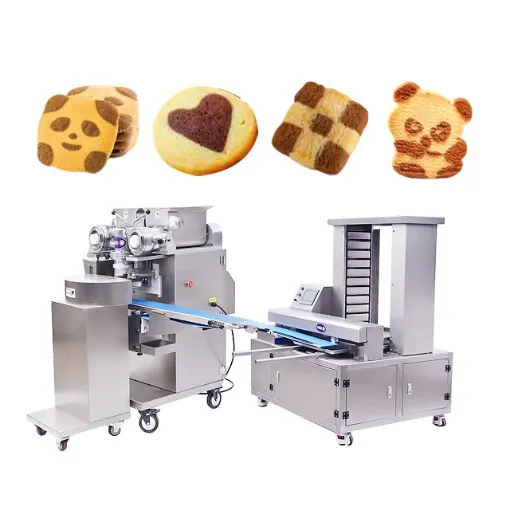
Industrial Bakeries: Scaling Up Production
The integration of automatic biscuit making machines has changed the game regarding the scaling potential of industrial bakeries. The new technique serves the baking process in a very advanced manner and thus, the producers can now easily supply the consumers’ wishes for the product in the same quality and quantity. Automation technology application in industrial bakeries reduces the manual labor drastically, increases the production speeds, and also, of course, the quality is uniform in every batch of crackers or biscuits. All these advantages together are very important for the supply of the packaged snack products which are in demand all over the world and the demand is going up due to the changing lifestyles and preferences of the consumers.
| Automated Process | Function | Benefit |
|---|---|---|
| Dough Mixing | Ingredient blending | Consistent quality |
| Cutting & Forming | Shape creation | Uniform dimensions |
| Baking | Temperature-controlled cooking | Food safety compliance |
| Cooling & Packaging | Final preparation | Extended shelf life |
📊 Data-Driven Production Advantages
- Predictive Maintenance: Minimizes downtime and extends equipment lifespan
- Operational Efficiency: Optimizes production processes
- Demand Forecasting: Better planning capabilities
- Ingredient Management: Efficient usage tracking
- Sustainability: Energy-efficient ovens and material recycling
Commercial Use in Retail and Foodservice
The application of automated baking systems has completely changed the scene of the commercial baking at both retail and foodservice sectors. The retail bakeries are able to do a lot with these new technologies. They will be able to make even fresher, more uniform products that will appeal to the consumers who are in constant demand and of high quality. Automation gives the manufacturers the ability to control the baking very closely so that every product coming out is the same regardless of whether it is bread, pastry, or cake, which is a very vital factor when it comes to the reputation and loyalty of the customers.
🍽️ Foodservice Sector Benefits
- Quick Menu Creation: Meet diverse customer needs efficiently
- Quality Maintenance: Consistent products without overwhelming kitchen staff
- Programmable Machines: Multiple recipes and bulk production
- Waste Reduction: Decreased preparation time and material loss
- Dietary Adaptability: Quick accommodation of gluten-free and vegan options
In addition to all of these, the use of modern technology is in sync with market trends like the increasing focus on food safety and sustainability. The automated machines not only take care of the cleanliness aspect of the product by reducing the human involvement in the process but also adopt practices such as using less energy and controlling the portions of the products to lessen the amount of waste produced. This combination of concerns for food safety and sustainability actually increases the appeal of the businesses that take the lead in this direction, as they can easily market themselves as being modern and environmentally-conscious. The combined use of automated baking in retail and foodservice has proven that the food industry is still on the way to becoming more efficient, innovative, and responsible.
Frequently Asked Questions (FAQ)
❓ What is an automatic biscuit production line and how does it differ from manual biscuit making?
Automatic biscuit production line refers to a complete set of equipment consisting of biscuit making machines and powered by full automation to make the production processing of biscuits from mixing the dough to baking and packing totally automatic. In contrast to manual biscuit making, an automatic biscuit line uses machines for forming, rotary molding, baking in a tunnel, conveyors and PLC control to produce biscuit types like hard biscuit, soft biscuit, crackers, soda biscuit and sandwich biscuit with increased production capacity, uniform quality and reduced cost of labor.
❓ What biscuit types can a fully automatic biscuit production line produce?
An automatically operated biscuit production line can make a variety of biscuit types like thin biscuit, soda crackers, shortbread, biscotti, soft and hard biscuits, sandwich biscuit, laminated biscuits and different shapes done with different forming molds if it is set up properly. The machine can produce different biscuits by altering forming mold plates and modifying machine settings according to diverse production requirements and market demand.
❓ What are the main components and the line features of the industrial biscuit machinery?
The principal mechanical devices of a biscuit production line comprise of dough mixers for blending wheat flour and other substances, rolling and laminate units to process the dough, forming machines or rotary molding machines featuring different forming molds, tunnel ovens for baking, oil spraying or spraying systems, cooling conveyors and packaging units. PLC control, stainless steel food-grade materials, and quick-change molds are standard line features that prove to be safe, efficient, and easy to operate.
❓ How do biscuit making machines improve production efficiency and reduce production costs?
Biscuit making machines cuts down the labor requirements and at the same time, it improves the output of high-quality biscuits and also it reduces the costs of labor. The efficient production process also requires less energy and helps the manufacturers to produce in a way that is suitable for large-scale biscuit production or different production needs.
❓ Can an automatic biscuit production line be customized to produce sandwich biscuits or specialty items?
Suppliers and manufacturers of machinery provide a wide range of customizable biscuit production lines that can create a sandwich biscuit, filled cookie, or any specialty biscuit by including depositing units, cream dispensers, laminating stations, and custom molds. Advanced manufacturers’ equipment allows rapid changes in molds and flexible programming so that the biscuit maker machine can manufacture various products in line with specific market demand.
❓ What should biscuit manufacturers consider when choosing a biscuit production line or machine manufacturer?
Manufacturers ought to assess production capacity, production costs, production efficiency, types of biscuit the machine can make (capabilities), build quality (what is made of – stainless steel, food-grade materials), availability of biscuit equipment modules (rotary, forming machine, tunnel oven), after-sales service, spare parts availability, and customization options. Selecting professional equipment and experienced machine manufacturers will guarantee reliable performance for high-volume biscuit production and long-term automated production requirements.
❓ How does the biscuit production process handle dough preparation and forming for soft and hard biscuits?
Dough preparation is done by first batching and then mixing wheat flour, leaven, fats, and other ingredients in industrial mixers. The line for soft and hard biscuits utilizes different rolling, laminating, and forming stages: soft biscuit lines might opt for sheeting and depositing, whereas hard biscuit and cracker lines might choose rotary molding or stamping with forming molds. Careful management of dough’s moisture level, forming pressure, and baking in a tunnel oven ensures similar texture across all opened biscuit kinds.
❓ What maintenance, safety, and operational aspects are important for long-term operation of an automatic biscuit making machine?
Cleaning of the conveyors, inspection of forming molds, lubrication of moving parts, checking of PLC and electrical systems, and calibration of the tunnel oven are some of the activities that come under regular maintenance. Processing safety and food compliance involve the use of food-grade materials, stainless steel construction, proper guarding and hygiene procedures. The provision of efficient and timely after-sales service and spare parts support from the machine manufacturer helps to maintain production, minimize downtime and maintain the line that is capable of producing high-quality biscuits while managing production costs.
📌 Key Takeaways
- Automatic biscuit production lines integrate all stages from mixing to packaging in one continuous workflow
- Automation significantly reduces labor costs while improving consistency and quality
- Modern systems incorporate AI, IoT, and predictive maintenance for optimal performance
- Production lines can be customized for various biscuit types including hard, soft, and crackers
- Sustainability features like energy-efficient ovens and waste reduction are becoming standard
- Both industrial bakeries and commercial foodservice benefit from automated biscuit production technology