The best means of ensuring the efficient running of food apparatus is to carry out daily checkups, replace components as stipulated, and also ensure safety and hygiene of the equipment. To a maintenance culture of an extrusion system or a turnkey project that fosters the life span of equipment, wear of the equipment assembly is reduced by a quarter or over a comparably long period.
That worn-out screw of the extruder machine which you set the replacement budget at fifty thousand dollars? It might serve you for 5 more years without replacing it, if you have a plan and schedule for machine maintenance and do not forget about it.
Food maintenance is ideally a concept understood by the majority of food manufacturers. However, many are still trapped in the culture of being reactive rather than understanding it as an investment. Premature damage to the components, loss of processing hours and contamination of food products are among the worst and most unnecessary yet common consequences.
By the end of this guide, you will have a practical food machinery maintenance framework tailored to food processing equipment, from twin-screw extruders to complete turnkey lines. We’ll cover the four types of maintenance, a detailed checklist, extruder-specific care, turnkey line strategies, and real cost benchmarks you can use immediately.
Key Takeaways
- Preventive maintenance costs 3-6% of equipment value annually but saves 3-5x that amount by avoiding unplanned repairs.
- Structured PM programs reduce equipment breakdowns by 25% or more, according to industry data.
- Extruder screws and barrels need annual wear measurement; replace when clearance exceeds 1-2% of barrel diameter.
- Turnkey production lines simplify maintenance through unified control systems and compatible components from a single manufacturer.
- Small-scale lines (100-300 kg/hour) need 3,000−8,000/yearinmaintenance;mediumlines(300−1,000kg/hour)need3,000−8,000/yearinmaintenance;mediumlines(300−1,000kg/hour)need8,000-20,000/year.
What Is Food Machinery Maintenance?
Food machinery maintenance is the systematic upkeep of food processing equipment to ensure safety, efficiency, and longevity. Unlike general industrial maintenance, it must integrate strict hygiene protocols, food-grade materials, and regulatory compliance at every step.
All maintenance operations in a food processing facility, by their very nature, harbor the risk of contamination in one form or another. Imagine a scenario where a bolt came off a mixer and got fixed incorrectly; such a case will immediately cause product recalls or failed audits that are extremely costly. As such, food machinery maintenance requires better controls than those maintained in other sectors to document, manage materials, and clean up after repairs.
Avoidance, however, comes at a price. At least one study conducted by Advanced Technology Services demonstrated that unforeseen breakdowns cost several times more than preventative maintenance and at least co occurs. In the context of an average-sized food processing plant, an hour of unscheduled outage results in $5k-10k of unrealized output. Where all these costs do not consider wastage of products labor and, schedule interruptions, the cost of these is 2.4 higher than the visible costs.
Marcus operates a snack extrusion equipment with capacity of 300 kg/hour in Lagos. He suspended his planned screw wear checks for three months as the performance of the production process was good. Output started to fall by 15%. Consistency deteriorated. When it came to getting a new screw, the barrel in use was also so scored that it had to be replaced. Instead of the planned $8,000 components change, the users ended up having to change the screw and the barrel for $35,000, and a two-week loss of production.
The 4 Types of Maintenance Every Food Manufacturer Should Know
Not all maintenance is equal. Understanding the four main approaches helps you allocate resources where they matter most.
Reactive Maintenance (Breakdown Maintenance)
Restorative maintenance, commonly referred to as reactive maintenance, is the practice of attending to repairs only after equipment has broken down. This type of maintenance does not need much planning and does not impose an effort to provide funds in work scheduling or buying systems to monitor. This concept nonetheless in light industry particularly in food processing is unsafe. A production line failure can not only result in all units being thrown away due to contamination, but might incur a HACCP breach and even halt production until the machine is fixed and the premises sanitized.
It is permissible to apply reactive maintenance only when the equipment is not essential, and in any case food protection cannot be compromised by its breakdown. It is unacceptable to rely on reactive maintenance on critical machinery as extruders, dryers or packing equipment.
Preventive Maintenance (PM)
Preventive maintenance is an essential component of every organized operation. Many such programs exist within food machinery maintenance but they all revolve around the same principle of controlled failure.
Breakdowns are reduced by 25% or more through strictly following all the steps of a PM program. In addition, these provide reasonable time windows for maintenance in relation to existing production periods, changeover operations, or even in the lean season. It offers more than a mixed blessing for there is a catch here. Purpose of a PM is sure to be rendered quite futile in case it fails to perform its maintenance role diligently or spray the right oil for lubrication.
Predictive Maintenance (PdM)
The technique is predictive maintenance whereby the harm is foreseen even before it occurs utilizing sensors and current data. Among the more widely used practices are vibration monitoring in different kinds of rotation equipment, thermal imagery in electrical systems, gear analysis monitored through oil and motors monitored via current.
One of them is the food machinery maintenance where it is stated in Oxmaint’s report that the approach of PdM reduces the number of unnecessary maintenance procedures and one could perform the required repairs when the production processes are naturally interrupted. As a result of this approach, production stops and corresponding delays can be decreased by as much as 40%. For consumption storing units including more than one assembly line, the costs of the predictive devices installed can be recouped in 12-18 months only.
Autonomous Maintenance
Autonomous maintenance consists of giving the machine operators responsibility for simple maintenance tasks without relying on the maintenance team for every little thing. These include basic daily cleaning and inspection tasks, checking of oil levels, and communicating anomalies noted within their workstations.
Such a strategy aids in releasing the maintenance staff to work on more structural repairs while at the same time enhancing the operators’ ownership of the machines. This system works optimally when proper guidelines are issued to the operators concerning the things they ought to examine, the method for raising defects, and the point at which it warrants line stopping.
Want to see how our turnkey lines are designed for easier maintenance from day one? Explore our turnkey food production lines to learn more.
Food Machinery Maintenance Best Practices
A strong maintenance program starts with clear, repeatable procedures. Here is a practical framework organized by frequency.
Daily Maintenance Checklist
Daily tasks are your first line of defense. They catch problems early and keep equipment in its optimal operating window.
- Conduct a visual inspection of all moving parts before startup.
- Check lubrication levels in gearboxes, bearings, and chains.
- Clean all food-contact surfaces after every production run.
- Monitor motor load, temperature, and pressure readings for abnormal spikes.
- Verify that guards, covers, and safety interlocks are in place.
- Listen for unusual noise or vibration from the extruder, mixer, or conveyor.
These tasks take 15-30 minutes per line. Skipping them to save time almost always costs more later.
Weekly and Monthly Tasks
Weekly and monthly tasks go deeper. They target components that degrade gradually and are not visible during a daily walkthrough.
- Inspect belts, chains, and pulleys for wear, tension, and alignment.
- Calibrate temperature sensors, pressure transducers, and weight systems.
- Deep clean extrusion dies, cutter blades, and forming rollers.
- Inspect seals, gaskets, and connections for leaks.
- Test emergency stops and safety systems.
- Review daily maintenance logs for recurring issues or trends.
Quarterly and Annual Overhauls
Quarterly and annual maintenance addresses the long-term health of your equipment. These tasks require more time and often involve partial disassembly.
- Measure screw outer diameter and barrel inner diameter with calipers and bore gauges.
- Change synthetic gear oil in the extruder gearbox every 4,000-5,000 operating hours, or at least annually.
- Inspect drained oil for metal particles, which indicate internal wear.
- Calibrate all electrical systems, including heater bands, thermocouples, and VFDs.
- Verify screw-to-barrel and gearbox coupling alignment.
- Replace worn bearings, seals, and gaskets before they fail.
Food Safety During Maintenance
Every maintenance task in a food plant must end with a clean, safe production environment.
- Use only food-grade lubricants and greases on all equipment.
- Cover work areas with tarps or plastic sheeting during dusty tasks like grinding or welding.
- Sanitize all food-contact surfaces after every repair, no matter how small.
- Enforce a strict temporary repair policy. Metal-detectable cable ties are acceptable in some non-contact zones if logged and dated. Wood, string, cardboard, and clear tape are never allowed.
- Document every maintenance activity for regulatory compliance and audit traceability.
Extrusion System Maintenance: A Deep Dive
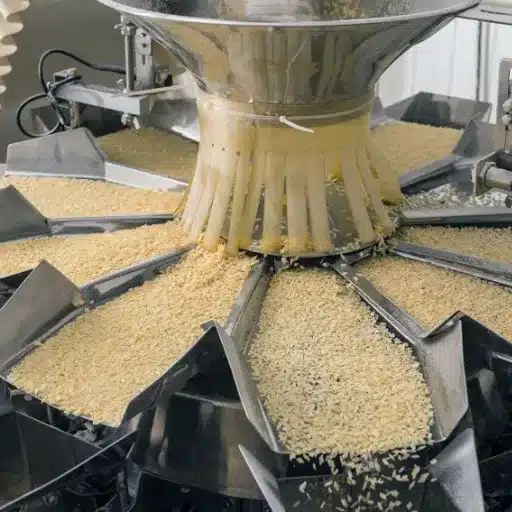
Extruders are the heart of most snack and cereal production lines. Their screws, barrels, and dies operate under extreme mechanical stress, temperature, and pressure. Proper extruder maintenance food processing requires attention to four critical areas.
Screw and Barrel Care
Both the screw and the barrel are wear parts. Hence, their respective clearance is very crucial as it interferes with processes such as output, mixing quality, and energy usage.
Carry out visual inspections on a daily basis to observe any scoring, residue build up or damage. Clean screws using brass or soft brush tools after use, also barrels. Avoid using steel scrapers or wire brushes. Do not use acethyne torch. These materials not only scratch surfaces but also keep bacteria which enhance wearing out of parts.
Cylindrical screw outer and barrel inner should be measured on an annual basis. Wanplas states that excessive clearance, which occurs when it is generally more than 1-2 % of the barrel diameter causes loss of output, reduces mixing efficiency and increases power consumption. These screws and barrels should be replaced before they reach the limits.
Die Plate Maintenance
This is what determines the final shape of your edible product. When the die is blocked or does not work properly, it will affect shape formation and consistency, and widen expansion leading to greater rejection rate.
While the die plates remain warm, proceed to clean them. Put them in appropriate approved solvent and aid cleaning using brushes or ultrasonic systems. Never insert a metal pick or drills inside die holes. These items make the holes wider and alter shapes of the items manufactured.
Every as end of the month conduct through check on die plates for crack, erosion or uneven surface wearing. Shift to new ones when the product loses quality.
Gearbox and Drive Train
The gear box transforms engine power into the needed force and speed to be applied to the extruder. Such inattentiveness is cost-intensive.
Synthetic gear oil should be replaced after 4,000 to 5,000 hours of use for a machine or if not for that time period in a year as and when applicable. Look at the used oil if there are metal particles in it as such particles are a sign of wear in the bearings inside of the gearbox or the gearbox’s own gears. Observe the intensity of shaking and level of sound made. When you hear strange noises from the gearbox it is a common sign perhaps of bearings not aligned well or worn out.
Contamination Prevention
Preventing contamination starts before material ever enters the barrel.
Install magnetic separators at feed hoppers to catch ferrous debris. Pre-screen raw materials to remove stones, metal fragments, and other hard impurities. Never run the extruder empty, or dry. This causes screw-to-barrel contact and scoring that ruins both components.
For producers running multiple recipes on the same line, such as switching from a corn puff snack production line to a protein bar production line, thorough purging between runs prevents cross-contamination and flavor transfer.
Video: Twin-screw extruder maintenance overview. Replace with your Shandong Loyal maintenance tutorial video.
Maintaining a Turnkey Production Line vs. Individual Machines
Buying machines from multiple suppliers and integrating them yourself creates a maintenance nightmare. Each manufacturer uses different control protocols, electrical standards, and spare part specifications. When a synchronization issue arises, no single supplier takes responsibility.
A turnkey food production line from a single manufacturer solves this problem. The extruder, dryer, flavoring drum, and packaging system share compatible controls, documentation, and spare parts. Maintenance teams learn one system instead of four.
In the latter stages of the project, some adjustments will be yet to be made. The conveyer belt between the extruder and the dryer must also remain fixed in one spot. The forming station and cutter should also be in perfect synchrony. The electrical control system fitted into each zone must work interlocked properly.
The process of aligning all aspects is, however, done once all components are in place, completion is only required for operational controlled start up. Even though it was not constrained in any way to work together the maintenance department receives fully functional equipment.
Elena runs the plant in Mexico City where the capacity of the corn puffs is five hundred kilograms per hour. Each of the abrasive wear units she uses; the extruder, the dryer, and the packaging system are from different suppliers. Three days passed until the systems were back in alignment and the problem with the electricity was resolved. A pasta manufacturer based in Italy, who makes use of a single line sourced from a single supplier, faced a similar problem which was attended to in four hours. Each piece of equipment was controlled by the same control system which had all the requisite manuals. One call, and one team resolved all problems.
Need maintenance guidance for your specific production line? Our engineers can provide a customized preventive maintenance schedule based on your equipment and production goals. Contact us for a consultation.
How to Build a Preventive Maintenance Schedule
A preventive maintenance schedule is not a generic checklist pulled from the internet. It must reflect your specific equipment, production intensity, and product mix.
Follow these five steps to build a schedule that works.
Step 1: Inventory all equipment and identify critical assets.
List every machine in your production line. Mark which ones would shut down the entire line if they failed. These are your critical assets. They get the most frequent and detailed attention.
Step 2: Define maintenance intervals based on manufacturer recommendations and production intensity.
Start with the manufacturer’s manual. Then adjust based on your actual operating hours, raw material abrasiveness, and ambient conditions. A line running 20 hours per day in a dusty environment needs more frequent attention than a line running 8 hours per day in a climate-controlled facility.
Step 3: Assign responsibilities to maintenance teams and operators.
Use autonomous maintenance for daily tasks. Reserve skilled technicians for quarterly overhauls, calibration, and complex repairs. Cross-train at least two people on every critical system. This prevents delays when your primary technician is unavailable.
Step 4: Document everything for regulatory compliance and trend analysis.
Record every inspection, repair, and replacement. Note the date, the technician, the parts used, and the reason for the work. These records support HACCP audits, warranty claims, and long-term trend analysis. If bearing failures spike every 18 months, your records will reveal the pattern.
Step 5: Maintain a critical spare parts inventory with minimum stock levels.
Identify the components that would halt production if they failed. Screws, barrels, die plates, bearings, and seals are common critical spares for extrusion lines. Set minimum stock levels and reorder points. For global operations, factor in shipping time from your supplier. A two-week ocean freight delay turns a minor repair into a major crisis.
| Frequency | Tasks | Estimated Time |
|---|---|---|
| Daily | Visual inspection, lubrication check, cleaning, motor load monitoring | 15-30 min |
| Weekly | Belt/chain inspection, sensor check, leak inspection | 30-60 min |
| Monthly | Deep cleaning, calibration verification, log review | 1-2 hours |
| Quarterly | Wear measurement, oil analysis, alignment check | 2-4 hours |
| Annually | Complete overhaul, electrical calibration, spare parts audit | 1-2 days |
Reducing Downtime Through Smart Maintenance
Even the best maintenance schedule fails if it conflicts with production demands. Smart maintenance aligns upkeep with your operational reality.
Schedule major overhauls during seasonal low-demand periods, holiday shutdowns, or planned batch changeovers. A fried snack production line that peaks in summer should complete its annual deep clean in winter.
Teach your team of technicians how to operate different kinds of equipment. A technician who has knowledge of both the extruder and the dryers solves problems associated with integration way faster than two experts who do not.
Monitor the Overall Equipment Effectiveness (OEE), Mean Time Between Repair (MTBF), and Mean Time to Repair (MTTR). That will give you an indication of whether your maintenance program is improving or deteriorating. Where the MTTR rises, there could be a problem with the number of spare parts in stock or the training levels of the technicians.
Use remote technical assistance to enhance the diagnosis time. Newer control systems, however, enable manufacturers to access the system remotely with the aid of a secure login and examine error codes as well as assist your personnel wherever needed. food machinery maintenance does not require air travel.
Maintenance Cost Benchmarks: What Should You Expect?

Retaining the usefulness of equipment is surely something that should be looked at as an asset worth investing in, not a liability. Benchmarks are useful in understanding what needs to be done and whether what you are currently doing, as well as the expenses incurred thereon, is appropriate or not.
For safety equipment, the preventive maintenance which is done on a regular basis incurs a total of 3-6% of the portion of the equipment on a yearly basis. Hence, talking about an assembly line machine costs around one hundred and fifty thousand (150,000), I would say it will cost about four thousand five hundred (4,500) to a maximum of nine thousand (9,000) a year for preventive maintenance. However, it must be noted that unscheduled repairs are three to five times more expensive than the scheduled ones. For example, the 4,500 spent on PM pays back against: prevents 13,500 to 22,500 of corrective, unplanned repairs whereas plant stands.
Insufficiently maintained systems are also more wasteful in terms of energy usage. For every abandoned screw, loosely hanging belts, and dirty filters, there is a cost for energy consumption that increases by 15-25%. In a case where the energy bills add up to 30,000 every year, that is, 4,500 to 7,500 is clean waste.