Textured vegetable protein (TVP) is made by extruding defatted protein flour under controlled heat, pressure, and shear until the proteins denature and align into a fibrous, meat-like structure. The same core process powers everything from dry soy crumbles to juicy high-moisture meat analogs.
Plant-based protein is no longer a niche category. In 2026, the global textured vegetable protein market sits between USD 1.9 and 2.1 billion, and food manufacturers across every continent are adding TVP capacity to meet demand. Yet many production teams still struggle to connect the science of texturization to the machinery that makes it happen at scale. This guide walks through the full textured vegetable protein manufacturing process, from raw material selection through drying, cutting, and packaging, with practical equipment guidance you can use to plan or upgrade a line.
Key Takeaways
- TVP is produced by thermoplastic extrusion: protein flour is heated, pressurized, and sheared, then forced through a die to create fibrous structures.
- Low-moisture TVP (15–30% moisture) is shelf-stable and rehydrated before use; high-moisture meat analogs (40–70% moisture) mimic whole-muscle meat and need refrigeration.
- A complete TVP production line includes mixing, extrusion, shaping/cutting, drying or cooling, and packaging, with the twin-screw extruder as the core unit.
- Twin-screw extruders dominate TVP production because they deliver better mixing, heat transfer, and recipe control than single-screw units.
- Process parameters (moisture, temperature, screw speed, die geometry) determine final texture, rehydration, and product consistency.
What Is Textured Vegetable Protein (TVP)?

Definition and key characteristics
Textured vegetable protein is an edible protein product that has been physically restructured to mimic the fibrous, chewy texture of cooked meat. The starting material is usually a protein-rich flour or concentrate. During extrusion, the proteins unfold, aggregate, and realign into layered or fibrous networks. The result is a porous, sponge-like product that absorbs water and carries flavors well.
TVP is valued because it is:
- High in protein, often 50% protein or more on a dry basis.
- Low in fat, made from defatted raw materials.
- Shelf-stable, when dried, low-moisture TVP stores for months.
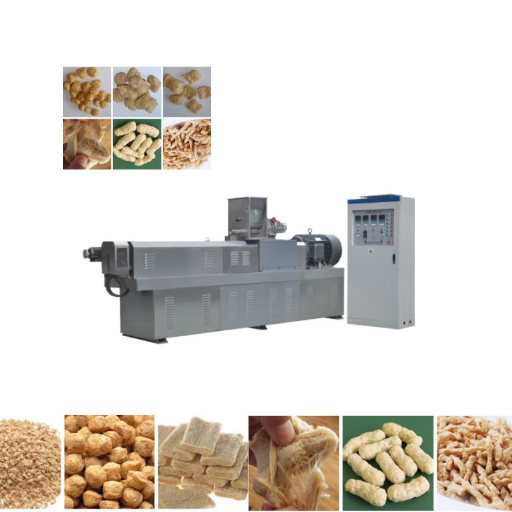
- Versatile, available as granules, chunks, strips, flakes, or nuggets.
- Cost-effective, generally less expensive than animal protein on a per-protein basis.
Common raw materials
Soy dominates the TVP market, accounting for roughly 45–50% of production. Defatted soy flour and soy protein concentrate are the most common starting points because they are abundant, affordable, and have strong gelling and fiber-forming properties. However, the raw material base is expanding quickly.
Other common protein sources include:
- Pea protein, popular for allergen-free and clean-label products.
- Wheat gluten, contributes elasticity and chewiness.
- Fava bean and lentil proteins, emerging options for sustainable, locally sourced analogs.
- Rice, corn, and peanut proteins, used in specialty or regional formulations.
Each raw material behaves differently in the extruder. Soy forms strong fibrous structures at moderate moisture, while pea protein often needs tighter temperature control and higher shear to develop a meat-like bite.
Forms and applications
TVP is sold in many forms, each suited to different end uses:
| Form | Typical use |
|---|---|
| Granules | Taco filling, chili, spaghetti sauce |
| Chunks | Stews, curries, ready meals |
| Strips | Stir-fry, fajitas, plant-based chicken |
| Flakes | Snacks, protein fortification |
| High-moisture fibrous cuts | Plant-based steaks, fillets, whole-muscle analogs |
Food products and meat alternatives represent approximately 70% of TVP demand. The remaining share goes into pet food, animal nutrition, and specialized ingredient applications.
The Core TVP Manufacturing Process: Step by Step
A commercial TVP production line follows a clear sequence. Each stage must be controlled precisely because small changes in moisture, temperature, or shear affect the final product.
Step 1, Raw material preparation and grinding
The process starts with protein-rich raw materials, usually defatted soy flour or soy protein concentrate. These materials arrive as powders with particle sizes that may be too coarse for consistent extrusion. A grinder or mill reduces the powder to a uniform particle size, typically between 60 and 100 mesh.
Uniform particle size matters. Coarse particles hydrate unevenly, leading to wet spots or dry pockets inside the extruder. This causes inconsistent texture and can clog the die. Manufacturers often sieve the flour after grinding and recycle oversize particles back into the grinder.
When Maria launched her plant-based food startup in São Paulo, she initially skipped the grinding step to save on equipment costs. Within three weeks, her line was producing batches with uneven hydration. Some nuggets were dense and rubbery; others crumbled during drying. Adding a pin mill upstream solved the problem and cut her rework rate by nearly 40%.
Step 2, Mixing and preconditioning
The ground protein powder moves into a mixer or preconditioner. Here, water and sometimes steam are added to raise the moisture content. For low-moisture TVP, the target is typically 15–30% moisture before extrusion. Preconditioning softens the protein, begins hydration, and helps distribute any additives such as color, flavor, or vitamins.
Preconditioning time usually ranges from 30 seconds to 3 minutes. Longer preconditioning improves hydration but can begin protein denaturation too early if temperatures rise too high. Most systems use a continuous paddle or ribbon mixer with controlled water and steam injection.
Step 3, Extrusion cooking and texturization
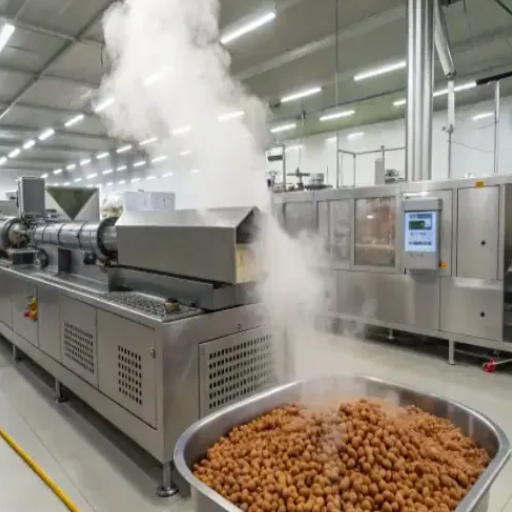
The preconditioned mixture enters the extruder, where the real transformation happens. Inside a heated barrel, one or two screws rotate at high speed, conveying the material forward while applying mechanical shear and compressing it against the die. Temperatures can exceed 120°C, and pressures may reach several megapascals.
The combination of heat, pressure, and moisture causes proteins to:
- Denature, unfold from their native structure.
- Aggregate, bond through disulfide bridges, hydrogen bonds, and hydrophobic interactions.
- Align, form layered or fibrous networks as the melt passes through the die.
This is a high-temperature, short-time (HTST) process. It deactivates anti-nutritional factors, reduces off-flavors, and sterilizes the product, all in under a minute of residence time.
Twin-screw extruders are preferred for TVP because the intermeshing screws provide superior mixing, heat transfer, and control over residence time. Single-screw extruders are simpler and cheaper but struggle with recipe flexibility and consistency.
Want to see how extrusion technology supports more than just TVP? Explore our snack food machinery to learn how the same extrusion platforms produce puffed snacks, cereals, and protein crisps.
Step 4, Shaping, cutting, and forming
As the hot protein melt exits the die, it expands and sets into the die’s shape. The die determines the product form: round holes produce granules, larger openings produce chunks or strips, and long slit dies create sheets or fibrous layers.
A rotating cutter at the die face slices the extrudate to the desired length. Cutter speed must match extrusion rate. Too slow, and pieces stick together; too fast, and pieces become dust or fines. For high-moisture meat analogs, a long cooling die is used instead of immediate cutting. The cooling die stretches and cools the protein melt slowly, aligning proteins into dense, meat-like fibers.
Step 5, Drying and cooling
Low-moisture TVP leaves the extruder with a moisture content that is still too high for shelf stability. A multi-layer dryer or oven reduces moisture to roughly 5–8%. Hot air temperatures typically range from 80°C to 120°C, and drying time depends on product size and initial moisture. Larger chunks need longer drying than granules.
After drying, the product passes through a cooling conveyor. Cooling stops the drying process, prevents condensation inside packaging, and brings the product to a safe handling temperature. Proper cooling is often overlooked, but it directly affects final crunch, color, and packaging integrity.
High-moisture meat analogs skip drying. Instead, they move directly to refrigeration or freezing to preserve their juicy texture. This difference has major implications for equipment layout, operating cost, and distribution strategy.
Step 6, Seasoning, packaging, and quality control
Some TVP products are sold unseasoned as a neutral ingredient. Others receive oil, flavor, salt, or color in a rotary drum coater before packaging. Seasoned products are popular in retail and foodservice because they reduce preparation steps for the end user.
Packaging options include:
- Bulk bags for ingredient sales to food manufacturers.
- Retail pouches with nitrogen flushing for shelf stability.
- Vacuum packs for high-moisture analogs.
Quality control tests typically measure moisture, protein content, water absorption index, texture, and microbial limits. Consistent testing at each batch ensures the product meets customer specifications and food safety standards.
Low-Moisture TVP vs High-Moisture Meat Analogs

The textured vegetable protein manufacturing process splits into two main branches: low-moisture extrusion and high-moisture extrusion (HME). Each route creates a different product with different equipment, storage, and market applications.
Low-moisture extrusion
Low-moisture TVP is the traditional form. It is produced at 15–30% moisture, expanded through a die, dried to a stable moisture level, and sold dry. Before cooking, the consumer or foodservice operator rehydrates it with water or broth.
Advantages of low-moisture TVP include:
- Long shelf life without refrigeration.
- Lower equipment investment.
- Lightweight, low-cost distribution.
- Versatility across ground-meat applications.
The texture is spongy and porous, which makes it ideal for absorbing sauces and seasonings.
High-moisture extrusion
High-moisture extrusion uses 40–70% moisture, often with a long cooling die that slowly chills the protein melt. The result is a dense, fibrous, juicy product that closely resembles whole-muscle meat. High-moisture meat analogs (HMMA) can be eaten directly or lightly processed into strips, patties, or steaks.
Advantages of HME include:
- Superior meat-like texture and mouthfeel.
- Direct use without rehydration.
- Strong appeal in premium plant-based products.
The trade-offs are higher equipment cost, more sophisticated process control, and the need for cold-chain distribution.
Process comparison
| Parameter | Low-moisture TVP | High-moisture meat analog |
|---|---|---|
| Moisture content | 15–30% | 40–70% |
| Die type | Expansion die | Long cooling die |
| Texture | Spongy, porous | Dense, fibrous, juicy |
| Drying required | Yes | No |
| Storage | Ambient, shelf-stable | Refrigerated or frozen |
| Common uses | Crumbles, extender, snacks | Steaks, fillets, whole cuts |
| Equipment cost | Lower | Higher |
Understanding this distinction is critical when selecting a TVP production line. A manufacturer focused on commodity crumbles needs a very different setup than one producing premium plant-based chicken breasts.
Equipment Needed for a TVP Production Line
A complete TVP production line integrates several unit operations. Each piece of equipment must be sized and configured for the target product, capacity, and raw material.
Mixer and preconditioner
The mixer blends protein powder with water, steam, and additives. Paddle, ribbon, or continuous twin-shaft mixers are common. The goal is uniform hydration without overworking the protein. Preconditioners may include jacketed barrels for temperature control.
Twin-screw extruder
The extruder is the heart of the line. A co-rotating twin-screw extruder provides the best control for TVP production. Key specifications to evaluate include:
- Screw diameter and L/D ratio, typically 12:1 to 20:1 for food extrusion.
- Motor power, ranging from ~20 kW for small lines to 200+ kW for industrial systems.
- Barrel heating/cooling zones, electric or oil heating with water cooling jackets.
- Modular screw design, allows recipe changeover by rearranging conveying, mixing, and kneading elements.
A well-configured extruder can process soy, pea, wheat gluten, and blends with only screw and die changes.
Cooling die or shaping die and cutter
For low-moisture TVP, a shaping die plus rotary cutter creates the desired shape and length. For high-moisture products, a long cooling die is essential. The cooling die length, cooling rate, and die geometry determine fiber orientation and final texture.
Dryer and cooling conveyor
Low-moisture TVP needs a multi-layer belt dryer or oven. Hot air circulates through the product bed until the target moisture is reached. A cooling conveyor then brings the product to room temperature before packaging.
Seasoning and packaging systems
Optional but common for retail products. A drum coater applies oil and flavor, and a vertical form-fill-seal machine packages the product in pouches or bags. Nitrogen flushing extends shelf life for dry TVP.
Typical line capacities and power requirements
Commercial TVP lines commonly range from 120–150 kg/h for entry-level systems up to 600–1,000 kg/h for large industrial lines. Some high-capacity models exceed 1,500 kg/h. Installed power ranges from roughly 75 kW for a small line to 250+ kW for a full industrial setup.
When Chen evaluated equipment for a co-manufacturing facility in Southeast Asia, he chose a modular 500 kg/h twin-screw line. The same platform could run TVP granules during the day and puffed protein snacks during a second shift by swapping screws and dies. That flexibility helped him win contracts from three different brands in his first year.
Ready to map out your own TVP line? Our TVP production line buyer’s guide breaks down capacities, pricing, and configuration options for commercial and industrial setups.
Key Process Parameters That Affect TVP Quality
Consistent TVP quality depends on controlling a handful of interrelated parameters. Changing one variable usually requires adjusting others.
Moisture content
Moisture is the most influential variable. Low moisture produces dense, hard products. Higher moisture creates lighter, more expanded structures. For high-moisture meat analogs, moisture must be high enough to create a juicy, fibrous matrix but not so high that the product loses structural integrity.
Barrel temperature and die temperature
Barrel temperatures typically range from 120°C to 180°C for low-moisture TVP. High-moisture extrusion uses lower die temperatures, often 20–80°C in the cooling die, to set the fibrous structure without collapse. Precise zone-by-zone temperature control is essential.
Screw speed and shear rate
Higher screw speed increases shear, which can improve protein alignment and texture but also raises product temperature and can damage sensitive proteins. Most TVP extruders operate at 200–600 rpm, with the exact speed tuned to the formulation.
Feed rate and residence time
Feed rate must match screw speed and barrel capacity. Too high a feed rate causes incomplete cooking. Too low a rate causes overheating and browning. Residence time in the extruder is usually 20–60 seconds.
Protein source and formulation
Different proteins require different settings. Soy protein concentrate generally processes at 45–65% moisture for HME and 20–30% for dry TVP. Pea protein often needs slightly higher moisture and more shear. Wheat gluten adds elasticity but can make the product tough if over-processed.
Quality Control and Common Defects
Quality control in TVP production focuses on texture, hydration, appearance, and safety.
Water absorption and rehydration targets
A good low-moisture TVP rehydrates quickly, absorbing 2–3 times its weight in water. Water absorption index (WAI) and water solubility index (WSI) are common lab tests. Low absorption usually indicates under-extrusion or insufficient protein denaturation.
Texture, color, and flavor consistency
Texture is evaluated by bite, chewiness, and fiber pull. Color should be uniform and appropriate for the raw material. Off-flavors often come from overheating, poor-quality raw materials, or inadequate preconditioning.
Common production issues and troubleshooting tips
| Problem | Likely cause | Solution |
|---|---|---|
| Hard, dense product | Too little moisture or too low temperature | Increase moisture or raise barrel temperature |
| Crumbly product | Too much shear or overheating | Reduce screw speed or lower temperature |
| Uneven hydration | Inconsistent particle size | Improve grinding and sieving |
| Dark color or burnt flavor | Overheating or long residence time | Lower temperature or increase feed rate |
| Poor fiber formation (HME) | Insufficient moisture or wrong die geometry | Adjust moisture and cooling die design |
Regular sampling and adjustment are normal parts of TVP production. Even small changes in ambient humidity or raw material lot can shift the optimal settings.
Applications and Market Opportunities

TVP’s versatility makes it attractive across multiple food and feed segments.
Meat alternatives and plant-based proteins
The largest application, accounting for roughly 70% of demand, is meat alternatives. TVP provides structure, protein, and a familiar chew at a lower cost than many other plant proteins. It appears in plant-based burgers, sausages, nuggets, and ground-meat substitutes.
Snack foods and protein fortification
Textured proteins are increasingly used in protein chips, puffed snacks, and extruded crisps. These products combine the nutrition of plant protein with the appeal of crunchy snacks. The same extrusion line can often pivot between TVP and snack products with minor changes.
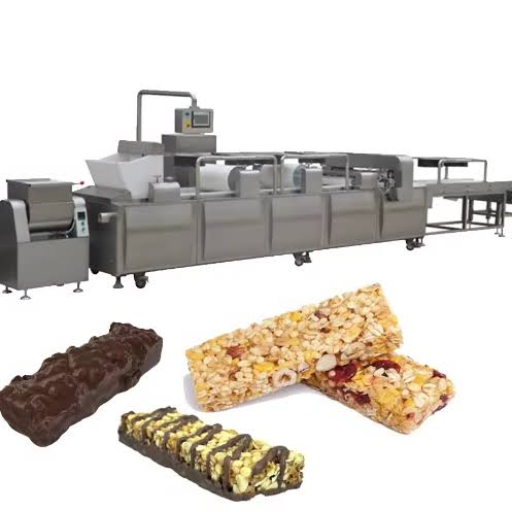
For brands already producing protein bars, textured proteins can also appear as inclusions. If you are exploring protein-fortified product lines, our protein bar production line page shows how to integrate extruded inclusions into bar manufacturing.
Pet food and animal nutrition
TVP is used in premium pet foods as a protein source and texturizer. It can also appear in animal feed formulations where palatability and digestibility matter.
Ready meals and foodservice
Pre-seasoned TVP crumbles and chunks are popular in frozen and shelf-stable ready meals. Foodservice buyers value the long shelf life, quick rehydration, and neutral flavor that carries sauces well.
Frequently Asked Questions
What raw material is best for TVP production?
Defatted soy flour and soy protein concentrate are the most common choices because they are affordable, widely available, and form strong fibrous textures. Pea protein is growing quickly for allergen-free and clean-label products. Wheat gluten adds chewiness but is often blended rather than used alone.
What is the difference between TVP and TSP?
TVP (textured vegetable protein) and TSP (textured soy protein) are often used interchangeably. Strictly speaking, TSP refers to textured soy protein specifically, while TVP can be made from soy, pea, wheat, or other plant sources.
How much does a TVP production line cost?
Small commercial TVP lines can start around USD 20,000–35,000. Industrial lines with full automation, higher capacities, and multiple processing stages typically range from USD 50,000 to USD 200,000 or more, depending on configuration and customization.
Can one extrusion line produce TVP and other products?
Yes. A modular twin-screw extrusion line can often produce TVP, puffed snacks, cereals, and protein crisps by changing screws, dies, and recipes. This flexibility is one reason extrusion is so popular in contract manufacturing.
What capacity should a new TVP manufacturer start with?
Entry-level lines at 120–300 kg/h are common for startups and pilot production. Established brands or co-manufacturers typically look at 500–1,000 kg/h lines or larger to achieve economies of scale.
How is high-moisture extrusion different from traditional TVP extrusion?
High-moisture extrusion uses 40–70% moisture and a long cooling die to create dense, fibrous, juicy products that resemble whole-muscle meat. Traditional low-moisture TVP uses 15–30% moisture, expands through a die, and is dried for shelf stability.
Conclusion
The textured vegetable protein manufacturing process is a powerful combination of food science and mechanical engineering. When raw material selection, preconditioning, extrusion, drying, and cutting are controlled precisely, the result is a versatile protein ingredient that serves markets from plant-based meat to snacks and pet food.
Low-moisture TVP remains the workhorse of the industry for its long shelf life and low equipment cost, while high-moisture extrusion is opening new premium markets with meat-like texture and juiciness. Both routes rely on the same foundational platform: a well-designed twin-screw extrusion line.
If you are planning a TVP production line or scaling an existing one, start by defining your target product and capacity. Then match the extruder, die, dryer, and support equipment to that goal. Small decisions at the process design stage have a large impact on product quality, operating cost, and flexibility for future recipes.
Ready to build or upgrade your TVP production line? Contact Shandong Loyal Industrial Co., Ltd. for a customized consultation. With over 10 years of experience in food processing machinery and turnkey food production lines, we can help you design a CE-certified, stainless-steel TVP line that meets your product goals and production targets.