FOB, CIF, and DDP are the three Incoterms most often quoted when buying food machinery from China. FOB gives the buyer the most control but requires arranging ocean freight and insurance. CIF lets the seller handle freight and minimum insurance, yet the buyer still bears transit risk from the origin port. DDP delivers goods all the way to the buyer’s door with customs and duties included, but it usually costs more and depends heavily on the seller’s import capability.
What looks like a simple price comparison is rarely simple. The same machine can arrive under three different contracts with three very different real costs, risks, and workloads.
When Elena, a snack producer in Poland, received quotes for a corn puff production line, the CIF option was only 4% higher than FOB. She chose CIF to keep things simple. Then the cargo arrived at Hamburg with water damage inside the control cabinet. The seller’s insurance covered only “total loss or fire,” not partial moisture damage. Because risk had transferred to Elena when the goods were loaded in Shanghai, she had to pay €8,400 for repairs before commissioning could begin. The “small” CIF premium suddenly looked expensive.
In this guide, you will learn how FOB vs CIF vs DDP work for food machinery imports, when each term makes sense, and why the cheapest headline price may not be the cheapest landed cost. We will also explain when FCA, CIP, or DAP may actually be the better choice for containerized equipment.
Key Takeaways
- FOB gives buyers maximum cost transparency and control, but they must arrange freight, insurance, and import clearance themselves.
- CIF includes freight and minimum insurance, yet risk transfers at the origin port just like FOB, leaving buyers exposed to the CIF risk gap.
- DDP is the simplest option because the seller handles duties and delivery, but it requires proven destination logistics and usually costs more.
- For containerized food machinery, FCA is often more accurate than FOB because risk transfers when the goods are handed to the carrier.
- Always name the exact port or place and add “Incoterms 2020” to the contract; Incoterms allocate responsibility but do not replace a detailed purchase agreement.
What Are FOB, CIF, and DDP?
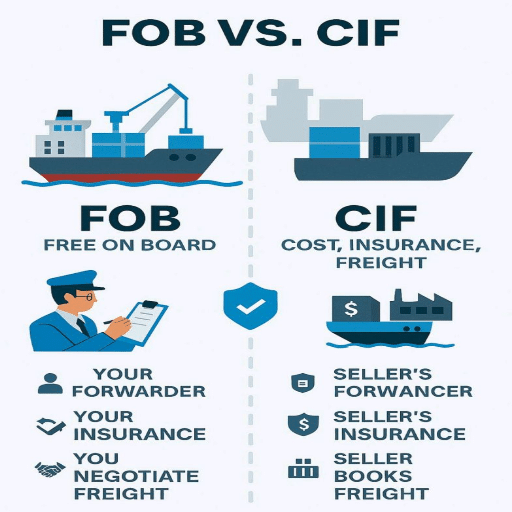
Incoterms are standardized trade terms published by the International Chamber of Commerce. The current edition, Incoterms 2020, contains 11 rules that define who pays for transport, insurance, export/import formalities, and where risk transfers from seller to buyer.
FOB, Free On Board
Under FOB, the seller delivers the goods to the named origin port and loads them onto the vessel. Once the cargo passes the ship’s rail or is placed on board, risk transfers to the buyer. The buyer pays ocean freight, cargo insurance, destination port charges, import customs, duties, and inland delivery.
FOB is strictly for sea or inland waterway transport. It works well for bulk or break-bulk cargo, but it can be awkward for containerized machinery because the container is often handed to a carrier before it reaches the vessel.
CIF, Cost, Insurance, and Freight
Under CIF, the seller pays for ocean freight and minimum insurance to the destination port. The buyer handles import customs, duties, and inland delivery from the port.
The trap is that risk still transfers when the goods are loaded on the vessel at the origin port, exactly the same point as FOB. The seller pays for the journey, but the buyer owns the risk during it. CIF insurance is also minimum cover only, which often excludes theft, partial damage, water ingress, and loading accidents.
DDP, Delivered Duty Paid
Under DDP, the seller is responsible for almost everything: pickup, export clearance, freight, insurance, import customs, duties, taxes, and delivery to the buyer’s named place. Risk transfers only when the goods arrive at that named place.
This is the simplest term for the buyer, but it is also the most demanding for the seller. Not every Chinese machinery manufacturer can reliably clear customs in every destination country.
FOB vs CIF vs DDP: Side-by-Side Comparison
| Responsibility | FOB | CIF | DDP |
|---|---|---|---|
| Export customs clearance | Seller | Seller | Seller |
| Inland transport to origin port | Seller | Seller | Seller |
| Ocean / main freight | Buyer | Seller | Seller |
| Cargo insurance | Buyer arranges | Seller arranges minimum cover | Seller arranges |
| Import customs clearance | Buyer | Buyer | Seller |
| Import duties and taxes | Buyer | Buyer | Seller |
| Inland delivery from destination | Buyer | Buyer | Seller |
| Risk transfer point | Goods loaded on vessel | Goods loaded on vessel | Named destination place |
| Cost transparency | High | Medium | Low |
| Best for | Experienced importers with forwarders | Buyers without a forwarder | Buyers wanting all-in pricing |
This table is the fastest way to compare the three terms, but the right choice still depends on the shipment. A complete food production line shipped in three containers may need a different term than a single urgent spare part sent by air.
The CIF Risk Gap: Why Buyers of Food Machinery Get Surprised

The biggest misunderstanding in machinery importing is the belief that CIF transfers transit risk to the seller. It does not.
Risk Transfers at Origin, Not Destination
Under both FOB and CIF, risk transfers when the goods are loaded onto the vessel at the origin port. If the vessel sinks, if a container is damaged by another cargo, or if moisture enters the crate during a storm, the buyer is the party at risk under CIF just as under FOB. The seller’s obligation is to arrange freight and minimum insurance, not to absorb transit loss.
Minimum Insurance Is Often Too Thin
CIF requires the seller to obtain insurance that meets at least Institute Cargo Clauses C or an equivalent minimum. Clause C covers major casualties such as fire, explosion, vessel sinking, or collision. It does not cover theft, water damage from humidity, rough handling, breakage, or partial loss.
For stainless-steel food machinery with sensitive control panels, sensors, and calibrated components, Clause C is frequently inadequate. Buyers should either negotiate Clause A “all risks” cover in the contract or purchase separate cargo insurance from their own broker.
When David in South Africa imported a biscuit production line under CIF, he assumed the seller’s insurance was comprehensive. A forklift punctured one crate at the destination terminal. Because the damage happened after the ocean leg and the policy was Clause C, the claim was denied. David paid for the replacement parts himself.
Hidden Destination Charges
CIF quotations often exclude destination terminal handling, storage, demurrage, detention, customs brokerage, and heavy haulage. A quote that looks only slightly higher than FOB can become significantly more expensive once the cargo reaches the port.
Want to avoid the CIF risk gap? Request a detailed quotation that states the Incoterm, named place, insurance clause, and exactly what is included in the shipping scope.
When FCA, CIP, or DAP May Be Better Than FOB, CIF, or DDP
Most food production lines today move in containers. That changes which Incoterm is technically correct.
FCA for Containerized or Multimodal Shipments
FCA, or Free Carrier, transfers risk when the seller hands the goods to the carrier at a named place. That place could be the seller’s factory, a container yard, or a terminal. This matches modern container logistics better than FOB, where risk transfer is tied to loading on the vessel.
If your snack production line is packed into three 40-foot containers at the factory and trucked to Qingdao port, FCA at the factory is often the more accurate rule. It also works for any transport mode, including road, rail, and air.
CIP for Better Insurance Coverage
CIP, or Carriage and Insurance Paid To, requires the seller to arrange all-risk insurance cover equivalent to Institute Cargo Clauses A under Incoterms 2020. That is a major upgrade from the minimum cover required under CIF. For high-value or sensitive food machinery, CIP is usually safer than CIF.
DAP When You Want to Control Customs
DAP, or Delivered at Place, means the seller delivers the goods to the named destination, but the buyer clears customs and pays duties. This gives the buyer control over the broker and tax treatment while still leaving freight and transit risk with the seller.
How Each Term Affects Food Machinery Shipments
FOB, Maximum Buyer Control
FOB is popular with experienced importers because it lets them choose their own freight forwarder, negotiate ocean rates, and select insurance that matches the real value and fragility of the equipment. It also makes destination cost components transparent.
The downside is workload. The buyer must coordinate origin loading, ocean freight, insurance, customs, and inland delivery. If the buyer has no forwarder at the origin port, FOB can create delays.
CIF, Convenient but Verify the Details
CIF appeals to first-time importers who do not have a freight forwarder. The seller handles the booking, and the buyer only needs to arrange customs and pickup at destination.
Before accepting CIF, verify four things:
- The exact named port of destination.
- The insurance clause and coverage limits.
- Whether destination terminal handling and storage are included.
- Which forwarder the seller is using and their destination charges.
DDP, Simplest if the Seller Can Perform
DDP is attractive because it gives a single, fixed price. For a buyer who wants budget certainty, that matters. However, the seller must be capable of acting as the importer of record, paying duties, and managing customs in the buyer’s country.
For heavy food machinery, DDP is less common than for small parcels or e-commerce. The risks of miscalculation on duties, cranes, rigging, and inland permits are high. Only choose DDP if the supplier has proven experience delivering to your country.
Cost Components Buyers Often Overlook
The supplier’s quoted price is only the starting point. A complete landed-cost estimate should include:
- Machinery price under the chosen Incoterm.
- Export packing, crating, and ISPM 15 wood treatment where required.
- Origin inland transport and terminal handling.
- Ocean or air freight and fuel/security surcharges.
- Cargo insurance premium and deductible.
- Destination terminal handling, storage, demurrage, and detention.
- Customs duties, VAT or GST, and brokerage fees.
- Inland heavy haulage, cranes, and rigging.
- Unloading, positioning, installation, and commissioning.
- Startup spares, tools, and operator training.
Under FOB, the buyer sees most of these line items. Under CIF, several are hidden until arrival. Under DDP, they are all rolled into one figure, which can make comparison harder.
Planning a full project budget? Our guide to importing machinery from China walks through supplier verification, HS codes, and payment terms in more detail.
Documents and Responsibilities by Incoterm
The documents required vary by term. Use this table as a checklist when reviewing a contract.
| Document | FOB | CIF | DDP |
|---|---|---|---|
| Commercial invoice | Seller | Seller | Seller |
| Detailed packing list | Seller | Seller | Seller |
| Bill of lading or transport document | Buyer arranges main carriage | Seller arranges | Seller arranges |
| Insurance certificate | Buyer | Seller, minimum cover | Seller |
| Certificate of origin | Seller if requested | Seller if requested | Seller if requested |
| Export clearance | Seller | Seller | Seller |
| Import clearance | Buyer | Buyer | Seller |
| Proof of delivery | On-board B/L | B/L + insurance certificate | Delivery receipt at named place |
For food machinery, you will also need technical documents such as CE declarations, manuals, electrical drawings, and spare-parts lists. These are separate from the Incoterm but should be written into the purchase contract.
Decision Matrix: Which Incoterm Should You Choose?
| If you are a buyer who… | Consider | Reason |
|---|---|---|
| Has an experienced freight forwarder | FOB or FCA | Control and transparency |
| Wants the seller to arrange shipping | CIF or CIP | Less coordination, but verify insurance |
| Needs a fixed landed price | DDP or DAP | Simplicity, but check seller capability |
| Is shipping containerized machinery | FCA | Risk transfers at carrier handover |
| Is buying high-value sensitive equipment | CIP or FCA + all-risk insurance | Better coverage |
| Wants to use your own customs broker | FOB, FCA, or DAP | Buyer controls clearance |
| Is using a letter of credit | FCA with on-board B/L option | Better document match |
This matrix is a starting point, not a rule. The final choice should reflect the specific route, equipment value, buyer experience, and seller logistics capability.
Common Mistakes to Avoid
- Comparing only the headline price. A low FOB price plus unmanaged destination costs can exceed a well-structured DDP price.
- Thinking CIF removes transit risk. Risk transfers at the origin port under CIF, exactly like FOB.
- Accepting minimum insurance for expensive equipment. Always confirm the insurance clause.
- Using FOB for containerized cargo. FCA is usually the technically correct term.
- Choosing DDP without confirming import capability. Not every seller can clear customs in your country.
- Forgetting the named place. “FOB China” is meaningless. Use “FOB Shanghai Incoterms 2020.”
- Mismatching the Incoterm with the letter of credit. Documents in the LC must match the chosen term.
- Assuming Incoterms cover everything. They do not cover title transfer, payment terms, warranty, or quality disputes.
How Shandong Loyal Industrial Supports Your Shipment

At Shandong Loyal Industrial, we have spent more than a decade exporting CE-certified food machinery to over 50 countries. We understand that choosing the right shipping term is as important as choosing the right machine.
We provide:
- Transparent quotations with a clear Incoterm, named place, and scope of supply.
- Export packing designed to protect stainless-steel finishes, control cabinets, and sensitive components.
- Loading plans and container photos for buyer review before departure.
- Document support including commercial invoices, packing lists, certificates of origin, and conformity documents.
- Coordination with buyer-nominated forwarders under FOB or FCA.
- Optional DDP or DAP arrangements where our logistics network supports reliable delivery.
- Factory Acceptance Testing, installation guidance, commissioning support, and operator training.
Whether you need a corn puff snack line, a pasta line, or a complete turnkey food production line, our team helps you plan the shipment as part of the project, not an afterthought.
Ready to compare Incoterms for your project? Contact us with your destination, machine type, preferred Incoterm, and target delivery date. We will prepare a detailed quotation and shipping scope.
Conclusion
Choosing between FOB, CIF, and DDP is not about finding the cheapest price. It is about matching responsibility, risk, and workload to your experience and your project.
FOB rewards buyers who have a freight forwarder and want full transparency. CIF looks convenient but opens the CIF risk gap unless insurance is upgraded. DDP offers simplicity, but only when the seller has proven logistics in the destination country. For most containerized food machinery, FCA or CIP may actually be the smarter choice.
When Amir in Dubai ordered a fortified-rice line, he started with a DDP quote because he wanted one fixed number. After reviewing the breakdown, he switched to FCA at the factory with his own forwarder and all-risk insurance. The total landed cost was 7% lower, and he had full visibility into every charge from factory gate to his plant.
Before you sign your next machinery contract, map out the full journey. Ask your supplier to name the exact port or place, state the Incoterm edition, and confirm what insurance, documents, and destination services are included. The right Incoterm will not just protect your cargo, it will protect your startup timeline and your budget.
Start your next shipment with clarity. Request a machinery quotation from Shandong Loyal Industrial and we will help you choose the Incoterm that fits your project.