The short answer: choose a twin-screw extruder when you need ingredient flexibility, wide moisture tolerance, or complex products like filled snacks. Choose a single-screw extruder when you make simple, direct-expanded snacks from granular ingredients at lower volumes and need to keep capital costs down.
Here’s the part most guides skip. The single screw vs twin screw extruder decision is not about which machine is “better.” It’s about which one matches your recipe, your output target, and your budget. Get that wrong, and you either overpay for capability you never use, or buy a machine that can’t make the product your next customer asks for.
When Priya launched her corn puff brand in Ahmedabad in 2024, her first machine decision came down to one question: one screw or two? Her recipe was simple (maize grits, salt, a little oil) and her budget was tight.
She bought a single-screw extruder for a fraction of the twin-screw price and hit 200 kg/h within a month. Two years later, when a buyer asked for a chocolate-filled center, she had to lease time on someone else’s line. The single screw got her started. It simply couldn’t fill a center.
This guide gives you the full picture, from the mechanical difference to an honest cost breakdown. By the end, you’ll be able to choose confidently. Tell us your product and output target, and our engineers will confirm the right screw configuration for your line.
Key Takeaways
- A twin-screw extruder costs roughly 1.5 to 2.5 times a single-screw machine but handles 6 to 50% moisture and a far wider range of ingredients.
- Single-screw extruders are the right economic call for simple, fixed, low-volume snacks like corn puffs and onion rings.
- Twin-screw machines are self-wiping, which cuts changeover time and dead spots, and they produce crispier, more consistent snack textures.
- Match the screw type to your recipe (starch, fat, fiber, moisture, inclusions), not to the purchase price alone.
- Budget for total cost of ownership. Screw wear and energy, not the sticker price, decide whether a machine makes money.
What Is the Difference Between a Single-Screw and Twin-Screw Extruder?

A single-screw extruder has one screw turning inside a cylindrical barrel. A twin-screw extruder has two intermeshing screws turning together inside a figure-eight-shaped bore. That small difference changes how the machine cooks, mixes, and shapes food.
Single-screw extruders were developed in the 1940s for pasta and cereal and were refined through the 1970s. Twin-screw machines appeared in the same era but expanded rapidly in the 1980s as food companies demanded more flexible production. Today, twin-screw extruders make up roughly 64% of extruder revenue, though single-screw still holds a strong position in simple snack lines.
If you want to understand how extrusion itself works before comparing machines, our guide to food extrusion technology covers the full process.
Single Screw vs Twin Screw Extruder: The Honest Comparison
Here’s the comparison table most vendors won’t give you in one place. It’s the single most useful thing in this article.
| Factor | Single-Screw Extruder | Twin-Screw Extruder |
|---|---|---|
| Relative cost | 1.0x (baseline) | 1.5 to 2.5x |
| Typical output | 100 to 500 kg/h | 100 to 1,500+ kg/h |
| Moisture range | 12 to 35% | 6 to 50% |
| Ingredient flexibility | Granular, free-flowing | Fine flour to coarse granules, plus inclusions |
| Mixing and heat transfer | Poor | Good |
| Self-cleaning | No | Yes (self-wiping) |
| Screw wear | Higher | Lower |
| Energy input | 0.1 to 0.6 MJ/kg | 0.2 to 1.0 MJ/kg |
| Best for | Simple direct-expanded snacks | Complex, co-extruded, high-protein products |
Let’s unpack the rows that actually matter for your decision.
Cost and Output
The price gap is real but it narrows when you factor in what the twin-screw machine can do. According to Coperion and Baker Perkins, a twin-screw extruder costs about 1.5 to 2.5 times a single-screw machine for the same throughput. In exchange, you get roughly double to triple the ceiling on output and the ability to run products a single screw can’t touch.
Mixing, Shear, and Texture
Single-screw extruders mostly push material forward. Mixing and heat transfer are limited, and residence time is short. Twin-screw extruders use intermeshing co-rotating screws that knead the material as they pump it. That higher shear breaks down starch more thoroughly and improves protein solubility, which is why twin-screw snacks consistently test crisper and better-textured than single-screw versions.
Not sure which machine your recipe needs? Tell us your product and output target, and our engineers will recommend a screw configuration. Explore our extrusion systems.
How Twin-Screw Extruders Give You More Control
The real advantage of a twin-screw extruder is control. You can tune shear, temperature, and mixing to hit an exact texture, then change it for a different product.
Co-Rotating and Self-Wiping Screws
Most food twin-screw extruders use co-rotating, intermeshing screws. The flight of one screw wipes the other clean as they turn. That self-wiping action does three things: it prevents material from sticking and burning on, it reduces dead spots, and it makes changeovers faster.
Marco ran the extrusion floor at a family pasta plant in northern Italy. For twenty years, his twin-screw line made the same six macaroni shapes without a problem. Because the screws wiped themselves clean between batches, he could switch from rigatoni to penne in under an hour without tearing down the barrel. On a single-screw machine, that same changeover meant a full cleaning cycle and an hour of lost production.
Screw Profile and L/D Ratio
Twin-screw machines use segmented screws. You can swap conveying, kneading, and mixing elements to change how much shear your product gets. The length-to-diameter (L/D) ratio controls residence time. A longer L/D gives you more cooking time, which matters for higher-moisture or higher-protein formulas.
This flexibility is why intermeshing co-rotating screws move four to five times more volume than counter-rotating screws. It’s the industry standard for a reason.
Single Screw Extruder Advantages and Disadvantages

Single-screw machines are not obsolete. They’re the right tool for a specific job.
Advantages
- Lower capital cost, roughly a third to half the price of an equivalent twin-screw machine.
- Simpler construction, which makes them easier and cheaper to maintain.
- Robust and reliable for a fixed, unchanging formulation.
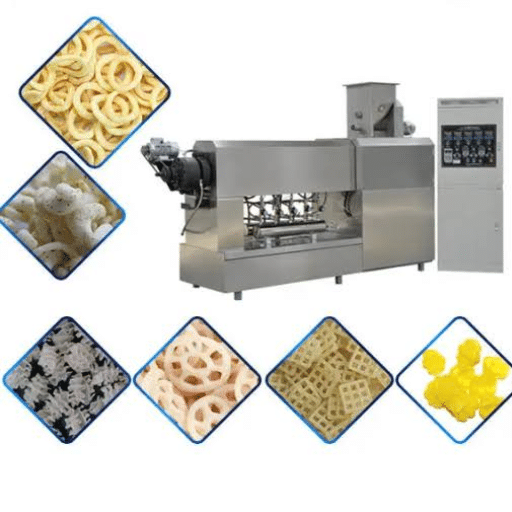
- Adequate for direct-expanded snacks like corn puffs, onion rings, and chipsticks.
Disadvantages
- Poor mixing and heat transfer, with short residence time.
- A narrow moisture window of 12 to 35%, and a narrow ingredient window.
- High screw wear on abrasive, high-protein, or high-mineral formulas.
- No self-cleaning, so dead spots can burn product and slow changeovers.
- Can’t reliably make co-extruded or filled products.
If your plan is a single, simple product at moderate volume, a single-screw extruder is often the smarter spend. You can put the savings into other parts of the line, like drying or packaging.
Twin Screw Extruder Advantages and Disadvantages
Twin-screw machines are the flexible workhorses of modern snack and food production.
Advantages
- Handles 6 to 50% moisture, fine flour to coarse granules, and sticky or difficult materials.
- Superior mixing, heat transfer, and temperature control.
- Self-wiping screws reduce downtime and product defects.
- Higher capacity, up to 1,500 kg/h and beyond for some co-rotating designs.
- Enables co-extrusion and center-filled products.
- Produces finer texture control, which is why twin-screw snacks win sensory tests.
Disadvantages
- Roughly double the capital cost of a single-screw machine.
- More complex to operate and maintain, with a heavier gearbox.
- Requires precise fitting and has limits on torque, pressure, and thrust.
In a rice-soya snack study, sensory panelists preferred the twin-screw extrudate for its crispness and texture. The single-screw version came out hard and overly loud when chewed. That difference is the twin-screw advantage in one result.
Ready to see the difference in your product? Compare snack production lines built around the right extruder for your recipe.
Matching the Screw Type to Your Product
Here’s the decision logic that turns this from a comparison into a choice.
Choose a single-screw extruder when:
- Your product is a simple, direct-expanded snack (corn puffs, onion rings, chipsticks).
- Your recipe uses granular, free-flowing ingredients like maize grits or potato.
- Your formulation is fixed and won’t change often.
- Your volume is modest and your budget is the priority.
Choose a twin-screw extruder when:
- Your product needs a complex shape, a co-extruded center, or fine texture control.
- Your recipe includes higher protein, fiber, or delicate inclusions.
- You work with fine flours or sticky, difficult-to-feed materials.
- You need a wide moisture range or want multi-product flexibility on one machine.
Run through these five questions in order: starch level, fat and fiber level, moisture range, inclusions, and product complexity. If you answer “flexible” or “complex” to two or more, lean twin-screw. For more on moisture specifically, see our guide to dry extrusion vs wet extrusion.
Applications by Product Type
Here’s how the choice maps to real products, and where they fit on a production line.
- Corn puffs and direct-expanded snacks: single-screw for simple, twin-screw for complex shapes. See our corn puff snacks production line.
- 2D/3D snack pellets: twin-screw for texture control. See our 2D/3D snack pellet process line.
- Pasta and macaroni: twin-screw cold extrusion for consistent shapes. See our pasta macaroni production line.
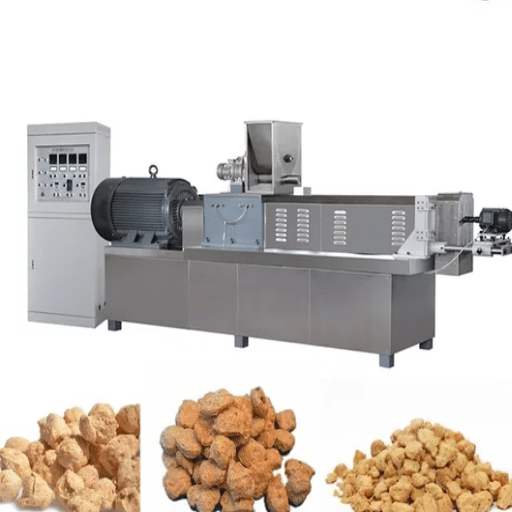
- Protein bars and texturized protein: twin-screw for high protein and fiber. See our protein bar production line.
Single Screw vs Twin Screw Extruder Cost and Total Cost of Ownership

Purchase price is where most buyers stop. That’s a mistake.
A twin-screw extruder costs 1.5 to 2.5 times a single-screw machine. But the sticker price is only part of the story. A snack plant in Jakarta ran abrasive, high-protein formulas on a single-screw machine, and the screw wore out every three months. Each replacement cost $1,200 plus a day of downtime. When they upgraded to a twin-screw extruder with a wear-resistant nitrided screw, the new screw lasted over a year. The higher purchase price paid for itself in spare parts and uptime within nine months.
Here’s what to actually budget for:
- Energy. The extruder is the single largest electricity load on most lines.
- Screw wear. Abrasive formulas chew through standard screws fast. Wear-resistant and bimetallic screws last two to three times longer.
- Maintenance. Twin-screw machines are more complex, but their self-wiping screws reduce the cleaning and downtime that eat into single-screw output.
- Changeovers. If you run multiple products, self-wiping twin-screw machines win on speed.
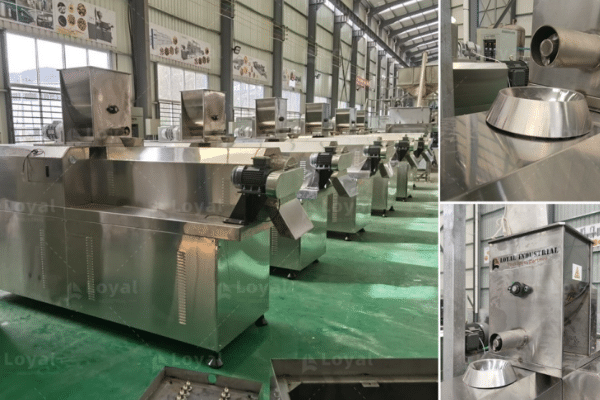
There’s also a geography gap worth knowing. Domestic Chinese extruders typically cost about a third to half the price of imported European equipment from makers like Coperion or Bühler, for equivalent capacity. The key is to demand the same quality standards regardless of origin. Our machines are built to CE certification and shipped to clients in over 50 countries. For a full breakdown of what an extruder should cost, see our food extruder machine cost guide.
Frequently Asked Questions
What is the difference between a single-screw and twin-screw extruder?
A single-screw extruder uses one screw in a cylindrical barrel, while a twin-screw extruder uses two intermeshing screws in a figure-eight bore. Twin-screw machines mix, shear, and control temperature far better, at roughly double the cost.
Which is better for snack production, single or twin screw?
For most snacks, twin-screw is better. It produces crispier, more consistent textures, handles a wider range of ingredients, and enables filled or co-extruded products. Single-screw is fine for simple, direct-expanded snacks at lower volumes.
How much more expensive is a twin-screw extruder?
A twin-screw extruder costs roughly 1.5 to 2.5 times a single-screw machine for the same throughput.
When should I use a single-screw extruder?
Use a single-screw extruder for simple, fixed formulations like corn puffs or onion rings, made from granular ingredients at modest volumes, where capital cost is the priority.
How does a twin-screw extruder work?
Two co-rotating, intermeshing screws knead and pump material through a heated barrel toward a die. The self-wiping screws mix, cook, and pressurize the dough, then force it through a shaped die where it’s cut. For the full step-by-step, see our food extrusion process guide.
Do I need a twin-screw extruder for co-extruded or filled snacks?
Yes. Center-filled and co-extruded products require the mixing, feeding control, and co-extrusion capability that only twin-screw extruders provide reliably.
Choose the Right Extruder for Your Production Line
The single screw vs twin screw extruder decision comes down to three things: your recipe, your volume, and your budget.
If you make one simple snack from granular ingredients, a single-screw extruder saves you real money and still delivers. If you want flexibility, higher quality, filled products, or a wider ingredient range, a twin-screw extruder is the machine that grows with you. Either way, budget for the whole cost of ownership, not just the sticker price, and match the screw to the recipe.
At Shandong Loyal Industrial, we’ve spent over a decade building extrusion systems and turnkey production lines for clients in more than 50 countries. Tell us what you want to make, and we’ll specify the extruder, screw profile, and line that gets you there, backed by CE-certified engineering and support from consultation to startup.