The biggest food processing equipment red flags are vague bills of materials, unverifiable CE certificates, refusal to allow live video factory tours, payment terms demanding 100% before production, and missing Factory Acceptance Test (FAT) clauses. Each one points to financial loss, downtime, or non-compliance, and each one is verifiable in under 30 minutes if you know where to look.
When Marco, a pasta startup founder in Bologna, wired a $52,000 deposit to a “manufacturer” in 2024, the quotation promised a 304 stainless steel macaroni line with CE marking and 24-month warranty. What arrived four months later was a 201-grade frame with a forged CE plate, a 220V motor wired for a 380V control box, and a sales engineer who stopped answering WeChat the day the container left port. Marco’s story is depressingly common, and almost every loss could have been prevented at the quotation stage.
You bought the wrong line because the warning signs hid inside paperwork most buyers never check. This guide walks through 12 specific food processing equipment red flags, the exact verification step for each one, and a final checklist you can attach to any RFQ. Our engineering team has shipped CE-certified production lines to more than 50 countries over the past decade, so the patterns below are drawn from real factory acceptance tests, real disputes, and real customers who corrected course in time.
Key Takeaways
- Refusal to host a live, unedited video factory tour is the single fastest red flag to detect, and it filters out roughly 30% of suspect suppliers in one call.
- Every legitimate CE certificate carries a four-digit Notified Body number you can verify in the EU NANDO database within 60 seconds.
- A trustworthy quotation names motor brand, PLC model, stainless steel grade (304 or 316), and Mill Test Certificate (MTC) availability, not vague phrases like “international standard parts.”
- Industry-standard payment terms are 30/30/40 split across deposit, pre-shipment, and post-FAT, never 100% TT before production.
- A Factory Acceptance Test (FAT) clause with measurable performance criteria correlates with about 60% fewer post-shipment disputes.
What Counts as a Red Flag When Buying Food Processing Equipment?

A red flag in food processing equipment procurement is any commercial, technical, or compliance signal that suggests the supplier cannot, or will not, deliver what the contract promises. Red flags range from missing documents and vague specifications to suspicious payment demands and unverifiable certifications. A single red flag is rarely fatal on its own. Three or more clustered together almost always predicts a dispute.
The good news: every flag in this guide pairs with a concrete verification step. You do not need to be an engineer to run them. You need a checklist, a stable internet connection, and one focused afternoon.
Commercial Red Flags Before You Even See a Quote
The first three food processing equipment red flags appear before any technical drawing arrives. They tell you whether you are talking to a real manufacturer or to a trading desk in a coworking space.
Red Flag #1: No Verifiable Physical Factory Address
Search the supplier’s claimed address on a map service that shows satellite imagery and street view. A genuine food machinery manufacturer occupies a multi-acre industrial park with overhead cranes, dust collectors, and parked container trucks. If the pin lands on a residential apartment, an office tower, or a vacant lot, you are talking to a middleman at best, a paper company at worst.
Verification step: Cross-reference the address with the supplier’s business license registration number through the local AIC (Administration for Industry and Commerce) lookup. In China this is a free public record at gsxt.gov.cn.
Red Flag #2: Generic Email Domain Instead of a Company Domain
A serious food machinery exporter invests in a custom domain and routes sales through addresses like sales@companyname.com. When the only contact email is a Gmail, Hotmail, or 163.com address, the supplier is either too small to maintain infrastructure or is operating under an alias.
Verification step: Look up the domain in a WHOIS database. A legitimate manufacturer registered its domain at least three to five years before contacting you and lists a corporate registrant.
Red Flag #3: Refusal to Allow a Live Video Factory Tour
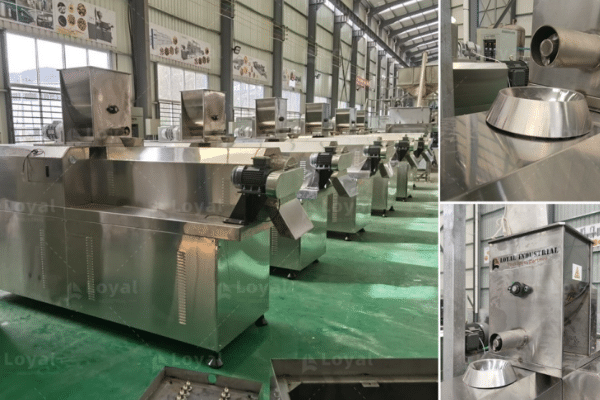
This is the single highest-signal test in the entire guide. Ask for a live, unscripted WhatsApp or WeChat video walk-through of the factory floor during local working hours, not a pre-recorded video. The walk should include the welding bay, the QC desk, machines bearing your competitor’s brand stickers (proving production volume), and the engineering office.
Verification step: Schedule the tour 24 hours in advance. A real manufacturer will host it. A trading company will offer endless excuses about “factory busy” or “manager in meeting.”
Quick CTA: Want a transparent supplier who livestreams every factory acceptance test? Explore Loyal’s turnkey food production lines and request a real-time tour today.
Red Flags Hidden Inside the Quotation and Sales Contract
Once you receive the proposal, the next four food processing equipment red flags determine whether you are signing a real contract or a wish list.
Red Flag #4: Vague Bill of Materials With No Component Brands
A professional quotation names the brand and model of every critical component. The motor brand, the PLC manufacturer, the variable frequency drive, the touchscreen HMI, the bearings, and the sensors should all appear by name and part number. Generic descriptions like “imported motor” or “international standard PLC” let the supplier substitute cheaper parts after the deposit clears.
Verification step: Demand a line-by-line BOM with exact brands such as Siemens, Schneider, Mitsubishi, ABB, or domestic equivalents like Inovance and Delta. Then verify each part number on the manufacturer’s official website.
Red Flag #5: Stainless Steel Grade Not Specified
Food-contact surfaces must be 304 stainless steel at minimum, and 316 for high-acid or high-salt applications. The price gap between 304 and 201 stainless is 25 to 35 percent because 201 contains higher manganese and less nickel, which makes it more prone to pitting corrosion in food environments. This is the most common silent substitution in the industry.
Verification step: Request a Mill Test Certificate (MTC) for every food-contact component. The MTC lists chemical composition (the nickel content of 304 should be 8 to 10.5%). At FAT, run a magnet test: 201 is slightly magnetic, 304 is essentially non-magnetic, and 316 is fully non-magnetic.
Red Flag #6: Payment Terms Demanding 100% TT Before Production
Industry-standard payment terms for food processing equipment break into three or four milestones. A typical structure is 30% deposit to start production, 30 to 40% before shipment after a successful FAT, and the balance after on-site commissioning. Any supplier demanding 100% wire transfer before production starts is asking you to absorb 100% of the risk.
Verification step: Counter-propose 30/30/40 split with the pre-shipment milestone tied to a video-witnessed FAT. A confident manufacturer accepts. A high-risk one walks away.
Red Flag #7: No Factory Acceptance Test (FAT) Clause
The FAT clause is the only contractual moment where you can refuse shipment of non-conforming equipment without lawyers. The clause should list measurable acceptance criteria, the testing duration, the raw materials to be processed during the test, and your right to attend in person or via live video. SGS field data suggests FAT-bound contracts experience roughly 60% fewer post-shipment claims.
Verification step: Insist on a FAT protocol annexed to the sales contract. Include throughput rate, finished-product specification tolerances, energy consumption, noise level, and a one-shift continuous run.
Certification and Compliance Red Flags
Compliance fraud is the most expensive food processing equipment red flag because it can stop customs clearance or trigger a recall after installation.
Red Flag #8: CE Certificate That Fails NANDO Database Lookup
A legitimate CE certificate for machinery destined for the EU bears a four-digit Notified Body identification number such as 0123 (TÜV SÜD) or 0470 (Nemko). You can verify any Notified Body in the European Commission NANDO database. When the certificate shows the CE logo but no Notified Body number, or when the number does not appear in NANDO, the certificate is decorative, not legal.
Verification step: Take 60 seconds. Type the four-digit number into NANDO. Compare the body’s listed scope against the machinery directive (2006/42/EC) the supplier is claiming.
Red Flag #9: Missing Mill Test Certificate for Food-Contact Surfaces
Beyond CE, food-contact surfaces fall under Regulation (EC) 1935/2004 in the EU and 21 CFR Parts 174 to 190 in the United States. The supplier must provide a declaration of conformity referencing these regulations, plus material traceability documents.
Verification step: Request a declaration of conformity signed by the manufacturer’s legal representative, not a sales rep. Cross-check that the MTC steel batch numbers match the declaration.
Red Flag #10: No Documentation for Destination-Country Voltage and Frequency
When Aisha, a snack producer in Lagos, received her corn puff line in February 2025, the electrical cabinet was wired for 380V 50Hz three-phase but her facility delivered 415V 50Hz. The startup cost her three weeks and an emergency transformer because no one in the quotation phase asked which voltage standard her grid used.
Verification step: Send your local utility’s voltage and frequency standard to the supplier in writing. Request a wiring diagram stamped for those exact specifications before production starts.
Engineering and Hygienic Design Red Flags
Two final red flags catch issues that cost money only after the machinery is running.
Red Flag #11: Internal Sharp Corners, Dead Zones, or Non-Hygienic Welds
EHEDG (European Hygienic Engineering and Design Group) and 3-A Sanitary Standards define what hygienic equipment looks like. Internal corners should be radiused, not square. Welds on food-contact surfaces should be ground smooth. Drainage should be self-emptying. Dead zones (low spots where product or cleaning fluid pools) harbor bacteria and are a top citation in food safety audits.
Verification step: Ask for cross-section drawings of every food-contact chamber. Reference the EHEDG design principles when reviewing. Reject any drawing showing internal corners under a 6mm radius.
Red Flag #12: After-Sales Black-Out (Disappearing Support After Deposit)
The post-deposit ghost is a well-documented pattern. The sales engineer who replied within 10 minutes during evaluation suddenly takes three days to answer once funds clear. A real food machinery partner publishes a service-level commitment: response within 24 hours, spare parts dispatched within 72 hours, remote diagnostics available during the warranty period.
Verification step: Read the warranty clause carefully. A 12-month warranty on labor only is weak. An 18 to 24-month warranty covering parts, labor, and remote commissioning support is the current industry standard for serious manufacturers.
How to Verify a Food Machinery Supplier in 7 Steps
Run these seven checks in order. The whole process will take around 90 minutes.
- Search the registered address on a satellite map and street view. Confirm an industrial-scale facility, not a residential building.
- Look up the business license in the appropriate public registry (gsxt.gov.cn for China, equivalent for other countries). Verify the registered capital, business scope, and founding date.
- Schedule a live video factory tour with 24 hours’ notice. Insist on seeing welding, QC, and engineering departments.
- Verify the CE certificate in the NANDO database. Match the Notified Body number, the issue date, and the listed product scope.
- Request a sample BOM and Mill Test Certificate for one similar past project. Cross-check component brands on the manufacturer websites.
- Compare three reference customers by phone or video. Ask each about delivery delays, FAT experience, and warranty claims.
- Send a counter-proposal with 30/30/40 payment terms, a FAT clause, and a 24-month warranty. A reliable overseas food machinery manufacturer will accept all three.
Red Flag vs. Green Flag: Quick Reference Table
| Area | Red Flag | Green Flag |
|---|---|---|
| Address | Residential or coworking pin on map | Industrial park, 5,000+ m² floor plate |
| Gmail, Hotmail, 163.com | Custom domain registered 3+ years ago | |
| Factory Tour | Pre-recorded only, refused live tour | Live unscripted WeChat/WhatsApp tour same week |
| BOM | “Imported motor”, “international PLC” | Siemens 3RV2, Schneider TM221, exact part numbers |
| Steel Grade | Unspecified or “food grade” only | 304 or 316 named, MTC provided |
| Payment | 100% TT before production | 30% / 30% / 40% with FAT milestone |
| CE Mark | Logo only, no Notified Body number | Four-digit Body number verified in NANDO |
| Warranty | 6-12 months, labor only | 18-24 months, parts plus remote support |
| Voltage | Not specified | Wiring diagram stamped for your local grid |
| Hygiene | Sharp corners, square welds | EHEDG-style radii, ground welds, no dead zones |
When James, an Australian protein bar producer, used this table to evaluate three quotations in late 2025, the cheapest option had nine red flags and the most expensive had two. He picked the middle bid (which had zero red flags), saved $18,000 on the build, and avoided a six-month dispute the cheapest supplier later entered with another buyer.
Mid-article CTA: Ready to receive a quotation engineered around these green flags? Request a transparent proposal from our team. Every Loyal quote includes a verifiable BOM, a NANDO-listed CE certificate path, and a Factory Acceptance Test clause as standard. Get a verification-ready quote in under 24 hours.
Why Transparent Suppliers Welcome the Scrutiny

Read the 12 food processing equipment red flags again and notice the pattern: every verification step is fast, free, or low-cost. None of them require trust. They require evidence. A manufacturer with nothing to hide treats your due diligence as confirmation that you are a serious buyer who will respect a serious contract.
At Shandong Loyal Industrial, we publish FAT videos for every shipment, list every Notified Body number on our certificates, share Mill Test Certificates with the contract, and host live factory tours every week. We do it because the buyers who run this checklist become long-term partners, not one-shot deals.
The food processing equipment red flags that hurt buyers most are also the easiest ones to spot. The reason buyers still get hurt is that the checklist gets skipped under deadline pressure or low-price temptation. Use the table above. Run the seven verification steps. Forward this article to your procurement team and your finance team before the next deposit goes out the door.
Frequently Asked Questions
What is the biggest red flag when buying food processing equipment?
Refusal to host an unscripted live video factory tour is the highest-signal red flag. It filters out paper companies, trading desks, and middlemen masquerading as manufacturers in a single 30-minute conversation, and it requires zero technical expertise from the buyer.
How can I verify if a CE certificate on food machinery is real?
Locate the four-digit Notified Body identification number on the certificate, then enter it into the European Commission’s NANDO database at ec.europa.eu/growth/tools-databases/nando/. The Body’s listed scope must cover the Machinery Directive (2006/42/EC). A CE logo with no Notified Body number is a self-declaration only and is not equivalent to certified compliance for the equipment classes that require it.
What payment terms are normal for international food machinery purchases?
The industry standard is a three-milestone or four-milestone structure: 30% deposit to begin production, 30 to 40% before shipment (released after a successful FAT), and 30 to 40% after on-site commissioning. Avoid any supplier demanding 100% T/T before production, and avoid escrow-only arrangements that lock funds without performance milestones.
How do I know if the stainless steel is really 304 grade?
Ask for a Mill Test Certificate (MTC) listing chemical composition, then verify the nickel content is between 8 and 10.5 percent. At the Factory Acceptance Test, run a simple magnet test on food-contact surfaces: 304 stainless is essentially non-magnetic, while the cheaper 201 substitute is noticeably magnetic.
What should a Factory Acceptance Test (FAT) clause include?
A robust FAT clause names the measurable acceptance criteria (throughput rate, product specification tolerances, energy consumption, noise level), the testing duration (typically one full production shift), the raw materials to be used, the buyer’s right to attend in person or via live video, and the consequences of failure (extension, remediation, refund). FAT clauses correlate with roughly 60% fewer post-shipment claims based on third-party inspection data.
Final Word: Treat Every Red Flag as a Conversation
Food processing equipment red flags are not reasons to abandon a deal automatically. They are reasons to slow down and ask a precise question. A confident manufacturer answers the question with paperwork. A high-risk supplier answers with pressure, urgency, or silence. Your job as a buyer is to ask the question and listen carefully to the format of the answer.
Five takeaways to keep on your desk:
- Save this 12-point list and run it on every quotation before any deposit clears.
- Run the NANDO check on every CE certificate. It costs you 60 seconds and protects six figures.
- Insist on a video FAT as a contract clause, not a courtesy.
- Demand named component brands on the BOM. Generic descriptions are silent substitution waiting to happen.
- Treat after-sales support as part of the price, not a free add-on.
If your current shortlist of suppliers will not commit to those five practices, you have already found your answer. The food machinery industry has matured, certifications are easier to verify than ever, and transparent manufacturers compete openly on quality.
Ready for a partner who treats every one of these red flags as a green-flag opportunity to prove credibility? Talk to our engineering team about your next food production line. Every Loyal quotation arrives with a verifiable BOM, a NANDO-traceable CE pathway, a FAT clause, and a 24-month warranty as standard, because that is what a real food machinery manufacturer should look like in 2026.