Dry extrusion cooks raw material with friction and little added water, while wet extrusion adds steam and moisture before cooking. The right choice depends almost entirely on the product you want to make, from puffed snacks to fibrous meat analogs.
Here’s the counterintuitive part: feed the same corn through a dry extruder and a wet extruder, and you’ll pull out two completely different products. One comes out puffed and crispy. The other comes out dense and chewy. The difference isn’t horsepower or barrel design. It’s water.
You probably already suspect that moisture matters in extrusion. What most people don’t realize is how much it changes everything else, from energy cost to nutrient retention to whether you need a boiler and a drying stage at all. In this guide, you’ll learn exactly how dry and wet extrusion differ, where each one shines, and how to pick the process that matches your product and your budget.
Key Takeaways
- Dry extrusion runs at roughly 10 to 40 percent moisture and generates heat through friction, no external steam needed.
- Wet extrusion adds steam and moisture, typically 20 to 70 percent, and produces softer, denser, or fibrous textures.
- Wet extrusion reaches 90 to 98 percent starch gelatinization versus 60 to 80 percent for dry extrusion.
- Dry extrusion is simpler to clean but uses more energy per ton; wet extrusion needs a boiler, better sealing, and often a drying stage.
- Your product type, not the machine specs, should drive the decision between dry and wet extrusion.
What Is Extrusion in Food Processing?

Extrusion is a continuous process that pushes mixed raw material through a rotating screw inside a heated barrel, then forces it through a shaped opening called a die. Along the way, pressure, heat, and mechanical shear cook the material in seconds.
Extrusion is a fast, continuous cooking method that mixes, cooks, and shapes food in one machine. High pressure and shear gelatinize starch and denature proteins in a matter of seconds, then the material expands or sets as it exits the die.
The reason this matters for manufacturers is simple. Extrusion turns raw flour or meal into a finished, shelf-stable product in one pass. It’s the backbone of snack, cereal, pet food, and plant-based protein production.
If you’re weighing a new production line, our team can help you match the right extruder to your recipe. Explore our food production lines to see what a complete turnkey setup looks like.
What Is Dry Extrusion?
Dry extrusion is a low-moisture cooking process that relies on friction to generate heat. It’s sometimes called autogenous or high-shear extrusion because the machine doesn’t need steam injection or jacket heating.
How Dry Extrusion Generates Heat
In a dry extruder, the rotating screw squeezes and shears the material hard enough to build heat on its own. Temperatures typically reach 120 to 160 degrees Celsius purely from friction. The material enters at low moisture, usually below 14 to 18 percent, and the sudden pressure drop at the die makes superheated water flash into steam.
That flash-off is what creates the puff. The moment the hot, pressurized dough hits normal air pressure, it expands. Moisture flashes away, leaving a porous, crispy structure. You’ll see this effect in corn puffs, breakfast cereals, and snack pellets.
Dry extrusion has a trade-off worth knowing. Because it depends on friction, temperature control is less precise. Operators adjust heat by changing screw speed, which means temperature and output are linked and harder to fine-tune independently.
Ideal Applications for Dry Extrusion
Dry extrusion suits products that need a light, puffed, or expanded texture. Common examples include:
- Corn puffs and puffed snacks
- Snack pellets that get fried or baked later
- Dry pet food kibble
- Full-fat soy and cereal ingredients
For snack manufacturers, dry extrusion is usually the starting point. If your goal is a crispy, expanded product, a dry expansion line gets you there with less equipment.
What Is Wet Extrusion?
Wet extrusion adds water and steam to the raw material before or during cooking. It operates at higher moisture and lower temperature, and it’s the process behind everything from soft pet food to plant-based meat.
The Role of Preconditioning and Steam
Most wet extruders feed the mix through a preconditioner first. Steam and water raise the moisture and temperature before the material even enters the barrel. This pre-cooking step hydrates and softens the material, which makes the screw’s job easier.
Temperatures run cooler than dry extrusion, often 80 to 140 degrees Celsius. Because heat comes from steam rather than friction, operators control temperature by adjusting steam pressure, independent of screw speed. That separation makes wet extrusion easier to run precisely.
The trade-off is downstream. Wet-extruded material holds more moisture, so many products need a drying or cooling stage afterward. You also need a boiler and better sealing and corrosion protection, because steam and moisture are hard on equipment.
High-Moisture Extrusion and Meat Analogs
The most talked-about form of wet extrusion is high-moisture extrusion. Here, moisture reaches 50 to 70 percent, and the material passes through a long cooling die instead of expanding.
That cooling die is the key to plant-based meat. As the protein-rich material cools under pressure, it aligns into fibers that mimic muscle tissue. The result is the chewy, layered texture you find in plant-based burgers, nuggets, and pulled “pork.”
According to research published in the IFT’s Comprehensive Reviews, this fibrous structure forms primarily in the cooling die as the extrudate exits the barrel. That’s why high-moisture extrusion produces dense, elastic, meat-like texture that dry extrusion can’t match.
Dry Extrusion vs Wet Extrusion: Key Differences Compared

The cleanest way to understand the gap between these two processes is side by side. Here’s how they compare on the factors that matter most to a manufacturer.
| Factor | Dry Extrusion | Wet Extrusion |
|---|---|---|
| Moisture content | 10 to 40 percent | 20 to 70 percent |
| Heat source | Friction (autogenous) | Steam and preconditioning |
| Typical temperature | 120 to 160 degrees Celsius | 80 to 140 degrees Celsius |
| Texture | Puffed, porous, crispy | Soft, dense, or fibrous |
| Starch gelatinization | 60 to 80 percent | 90 to 98 percent |
| Nutrient retention | 50 to 70 percent | 80 to 90 percent |
| Energy use | Higher per ton, simpler cleaning | 20 to 30 percent less energy, needs boiler and sealing |
| Downstream steps | Often just drying | Often drying or cooling |
Moisture Content
Moisture is the biggest single difference. Dry extrusion works at low moisture, often 10 to 40 percent, with raw material typically at or below 14 to 18 percent. Wet extrusion runs wetter, from around 20 percent up to 70 percent for high-moisture meat analogs.
This gap drives almost everything else. Low moisture means friction does the cooking. High moisture means steam does the cooking and the product needs drying afterward.
Heat Source and Temperature
Dry extruders make their own heat through shear. Wet extruders borrow heat from injected steam. That single difference explains why dry extrusion runs hotter and wet extrusion runs more controllable.
It also explains cost. Dry extrusion avoids the capital cost of a boiler, but it draws more power per ton. Wet extrusion uses less energy per ton, but you pay for the boiler, sealing, and corrosion-resistant parts.
Texture and Expansion
Texture is where the two processes part ways visually. Dry extrusion produces puffed, expanded, porous products because steam flashes off at the die. Wet extrusion produces denser, softer, or fibrous textures because the material doesn’t flash off in the same way.
Manufacturer testing puts numbers on this. Dry-extruded pellets measure around 30 to 50 newtons of hardness, while wet-extruded pellets sit closer to 15 to 30 newtons. If you want crunch, dry extrusion. If you want chew or a meat-like bite, wet extrusion.
Starch Gelatinization and Nutrient Retention
Wet extrusion cooks more thoroughly. It reaches 90 to 98 percent starch gelatinization, compared with 60 to 80 percent for dry extrusion. That’s why wet-extruded feed and food is often more digestible.
The cooler, shorter cooking time also protects heat-sensitive nutrients. Wet extrusion retains 80 to 90 percent of vitamins like thiamine, while dry extrusion keeps only 50 to 70 percent. For premium pet food or nutrition-focused products, that retention gap can be a selling point.
Ready to compare how these differences affect your specific recipe? Contact our engineering team for a consultation tailored to your production goals.
How to Choose Between Dry and Wet Extrusion
Choosing the right process isn’t about which one is “better.” It’s about which one matches your product. Walk through these five factors in order, and the answer usually reveals itself.
- What texture do you need? Puffed and crispy points to dry extrusion. Soft, chewy, or meat-like points to wet extrusion.
- What’s your raw material moisture? Wet, high-fat, or high-moisture ingredients process better in a wet extruder, which handles fat up to about 22 percent or more on twin-screw systems, according to the Global Seafood Alliance.
- What’s your volume and budget? Dry extruders cost less upfront but use more energy. Wet systems need a boiler and more maintenance.
- Do nutrients matter? If heat-sensitive vitamins or digestibility are a selling point, wet extrusion’s gentler cooking wins.
- What downstream steps can you handle? Dry extrusion often needs only drying. Wet extrusion frequently adds a drying or cooling stage.
Here’s a story that shows why the product drives the decision. Priya runs a snack startup in Mumbai and wanted to launch a puffed corn snack. She started with a wet-extrusion design, assuming added moisture meant a softer, better product. The result was a dense, chewy pellet that nobody wanted as a snack. Her engineer switched her to a dry expansion line, and the same corn flour suddenly puffed into the light, crispy snack she’d imagined. The recipe barely changed. The process did.
If you’re not sure where your product falls, the fastest path is to test it. Small-batch trials on a pilot extruder will tell you more in an afternoon than any spec sheet will.
Dry and Wet Extrusion in Action: Snack and Pet Food Examples
The best way to internalize the difference is to see it in real product categories.
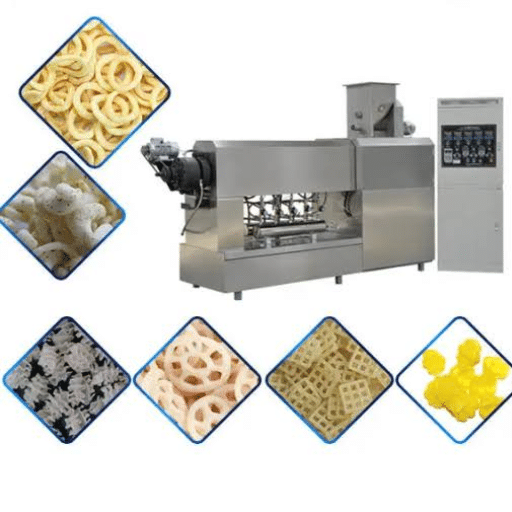
For snacks, dry extrusion dominates. Corn puffs, 2D and 3D snack pellets, Kurkure, and fried snack bases all start as dry-extruded pellets. They puff at the die or during frying, which is why our corn puff snack production line and 2D/3D snack pellet machinery are built around expansion.
For pet food, both processes appear. Dry kibble is extruded at low moisture, then dried to about 6 to 10 percent. Wet pet food is usually canned and retorted instead, but high-moisture extrusion can also produce soft, meat-like chunks. The Pet Food Institute notes wet food runs around 72 to 85 percent moisture, which is why the two categories shouldn’t be compared on label percentages alone.
Plant-based protein sits firmly on the wet side. Marcus, a founder in Berlin, spent months trying to get a dry extruder to produce the pulled-texture his meat-alternative brand needed. The product kept coming out as crunchy pellets. When he moved to high-moisture wet extrusion with a cooling die, the protein aligned into long, chewy fibers. His “pulled” products finally matched the mouthfeel his customers expected. Same plant protein, entirely different process.
For textured vegetable protein, meat analogs, and fibrous plant-based products, wet extrusion is not optional. It’s the only process that produces the muscle-like fiber structure.
Turnkey Extrusion Lines from Shandong Loyal Industrial

The choice between dry and wet extrusion is only the first decision. The harder part is configuring the machine, die, preconditioner, and downstream equipment so they work together on your specific recipe.
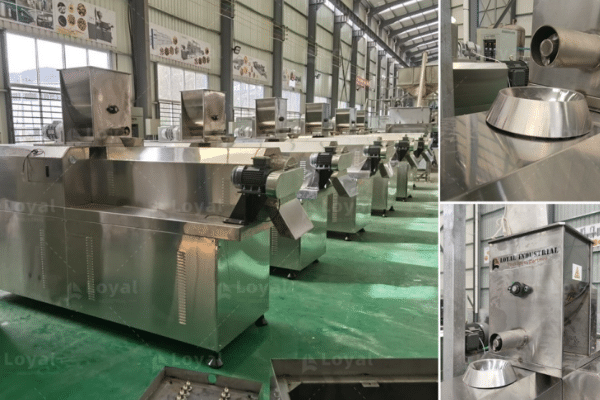
That’s where a turnkey partner helps. Shandong Loyal Industrial has spent over a decade building customized extrusion lines for snack, food, and pet food manufacturers in more than 50 countries. Our engineers configure dry and wet extrusion systems to your exact recipe, from corn puffs and fried snacks to protein and pasta products.
Every line is built to meet international standards like CE certification, and our team supports you from consultation through installation and startup. Whether you need a simple expansion line or a full production setup with mixing, extrusion, drying, and packaging, we design it around your product.
Explore our food production lines to see the range, or browse our fried snack production line and pasta production line for specific examples.
Frequently Asked Questions About Dry and Wet Extrusion
What is the difference between dry and wet extrusion?
Dry extrusion cooks material with friction and little added water, producing puffed or crispy products. Wet extrusion adds steam and moisture before cooking, producing softer, denser, or fibrous textures. The moisture level is the main difference between the two processes.
Which extrusion method is better for snacks?
Dry extrusion is usually the better choice for snacks. Corn puffs, snack pellets, and fried snack bases depend on the puffing effect that happens when low-moisture material flashes off steam at the die. Wet extrusion is used less for snacks and more for plant-based meat and soft pet food.
Is wet extrusion the same as high-moisture extrusion?
Not exactly. High-moisture extrusion is one type of wet extrusion. It runs at 50 to 70 percent moisture and uses a cooling die to create the fibrous, meat-like texture found in plant-based products. Standard wet extrusion runs at lower moisture and can still produce soft or dense textures.
How much moisture does dry extrusion use?
Dry extrusion typically runs at 10 to 40 percent moisture, with raw material usually at or below 14 to 18 percent. The low moisture is what forces the screw to generate heat through friction instead of relying on external steam.
Which extrusion process works for plant-based meat?
High-moisture wet extrusion is the standard for plant-based meat. The cooling die aligns protein into long fibers that mimic muscle tissue. Dry extrusion cannot produce this fibrous structure, so it is not used for meat analogs.
Conclusion
The dry extrusion vs wet extrusion question isn’t about picking a winner. They’re two tools for two different jobs. Dry extrusion uses friction to puff material into light, crispy products like corn puffs and kibble. Wet extrusion uses steam and moisture to create softer, denser, or fibrous textures like plant-based meat and premium pet food.
The key numbers to remember: dry extrusion runs at 10 to 40 percent moisture and reaches 60 to 80 percent gelatinization, while wet extrusion runs at 20 to 70 percent moisture and reaches 90 to 98 percent. Your product’s texture, your raw material, and your budget should decide which one you need, not the other way around.
The fastest way to remove the guesswork is to test your recipe on the right equipment. Contact Shandong Loyal Industrial today to discuss your product goals, and we’ll help you choose the extrusion process that fits, then build a line around it.