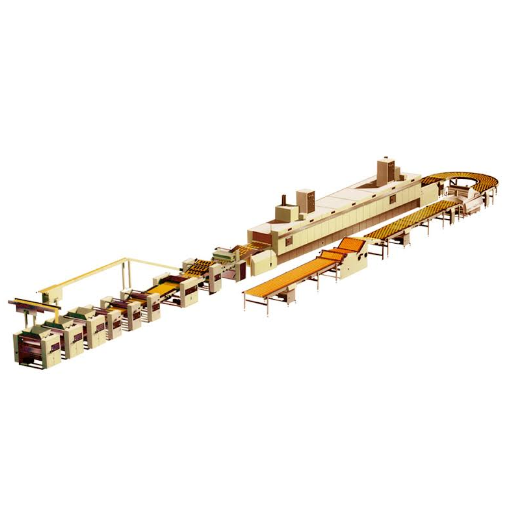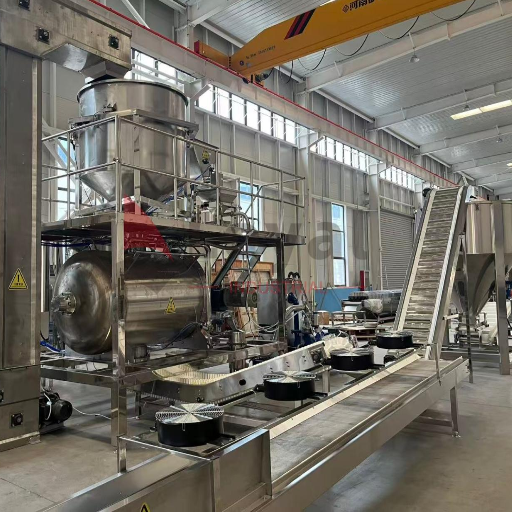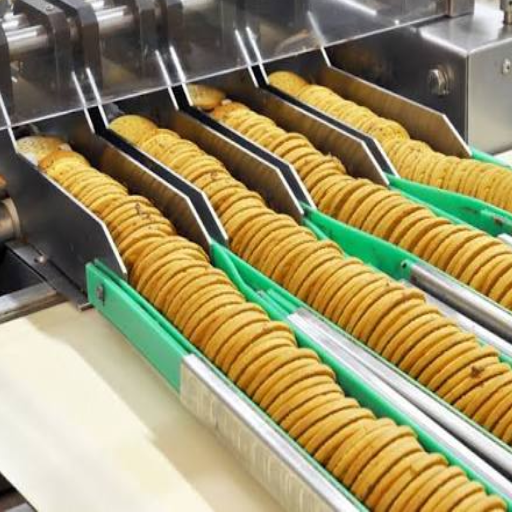
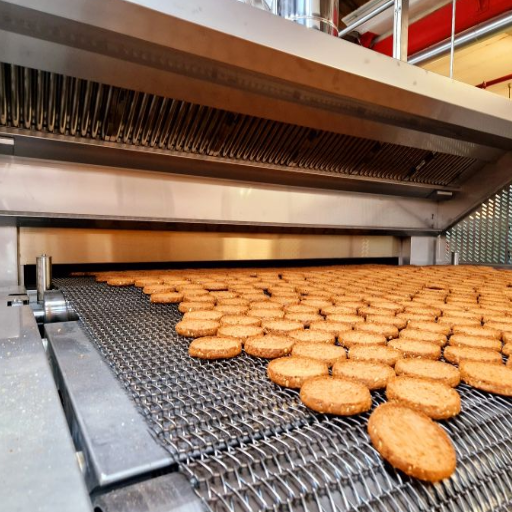
A biscuit tunnel oven is a continuous baking chamber that carries dough pieces on a band through several independently controlled temperature zones. It bakes, dries and colours the biscuit in one pass, and sets the line’s capacity, energy bill and product consistency. A tunnel oven for biscuits usually dominates the plant’s fuel use.
Two suppliers can both quote 1,000 kg/h and still be selling different machines. One may be sizing for a four-minute cracker at a narrow band. The other may be sizing for a nine-minute cookie at a heavier loading.
The number looks the same. The oven behind it doesn’t.
This guide covers the three numbers that size a biscuit tunnel oven, the heat-transfer modes, the fuel trade-off and a supplier checklist. For the full line, see how a biscuit production line is configured.
Key Takeaways
- Capacity comes from bake time, band loading and band width, not one kg/h figure.
- The profile matters more than any setpoint: roughly 160-180°C at entry, 200-220°C through dehydration, 180-200°C for colour.
- Direct gas fired suits crackers and hard biscuits. Convection suits soft, high-fat products.
- Gas usually costs less per tonne, but fuel choice depends on local supply and emissions rules.
- Agree trial-bake and factory acceptance criteria before you sign.
What Is a Biscuit Tunnel Oven?
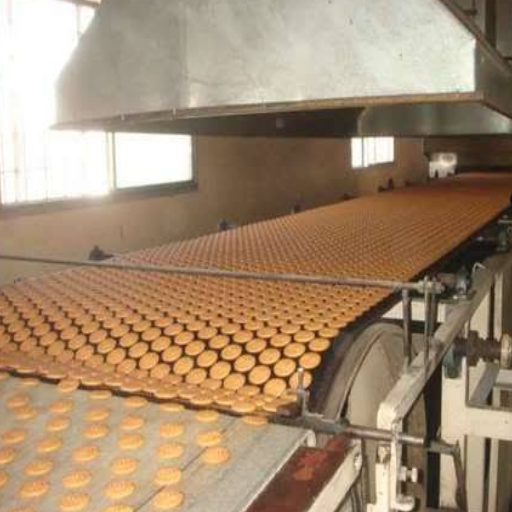
A biscuit tunnel oven is an insulated tunnel with a moving band that carries dough pieces through temperature-controlled zones. Each zone has its own heat input and airflow, so the baker controls lift, moisture removal and colour along the bake.
The biscuit tunnel oven is more than a chamber. It’s a set of systems that work together:
| Component | What it controls | Why it matters |
|---|---|---|
| Band and drive | Product transport and bake time | Band speed sets dwell time; tracking keeps the product centred |
| Zones | Temperature and airflow along the bake | Zone count and length determine how finely you can shape the profile |
| Burners or heat exchanger | Heat input and response speed | Direct, indirect and electric designs behave differently |
| Top and bottom dampers | Airflow above and below the band | Uneven top/bottom heat shows up as curl, blister or colour differences |
| Exhaust dampers | Humidity and steam removal | Too much humidity causes glazing; too little leaves a wet centre |
The main alternative is a rotary oven. A biscuit tunnel oven runs continuously and suits high volume. A rotary oven bakes in batches and suits smaller outputs or a mixed range.
Neither is automatically better. Output, product mix and changeover time decide.
Biscuit Oven Zones: How a Tunnel Oven Bakes
Baking in a biscuit tunnel oven is a sequence, not a single temperature. The dough first spreads and rises. Then the structure sets while moisture leaves. Finally, the surface browns and the remaining moisture drops to target.
A common four-stage framing looks like this:
| Stage | Main job | Typical air temperature | What goes wrong if it’s off |
|---|---|---|---|
| Entry or preheat | Leavening, spread and oven spring | About 160-180°C | Too hot sets the surface early and limits lift; too cool lets the piece collapse |
| Expansion | Blistering and structure development | Rising through the middle zones | Hot spots create uneven blister; weak heat gives a flat, dense bite |
| Dehydration | Moisture removal and structure set | About 200-220°C | Too hot can case-harden the surface and trap moisture; poor exhaust leaves a soggy centre |
| Colour | Maillard browning and final moisture | About 180-200°C | Too hot darkens edges before the centre dries; too cool gives a pale, wet biscuit |
Those temperatures are a starting point, not a universal recipe. The profile depends on product, piece weight, band loading and oven design. A cracker and a soft cookie don’t follow the same curve.
Measured profiles are usually bell-shaped: ambient at entry, a peak in the middle, falling at discharge. Research on an industrial indirect gas-fired tunnel oven confirmed the pattern. That’s why one setpoint can’t describe an oven.
Steam injection in the early zones helps some products. In most ovens, exhaust dampers do the daily work: open to remove moisture, close to hold humidity. Small damper changes can move colour more than a small temperature change.
Sizing a new oven? See how the full biscuit production line is configured, from mixing and forming through cooling and packing.
Direct, Indirect, Convection and Hybrid: Which Heat Transfer Fits Your Biscuit?
Heat reaches a biscuit in three ways. Radiation comes from flames, hot surfaces or radiant elements. Convection comes from moving air. Conduction comes through the band.
The mix of those three defines the biscuit tunnel oven type. The oven type has to fit the product.
| Oven type | How heat reaches the biscuit | Best fit | Watch-outs |
|---|---|---|---|
| Direct gas fired (DGF) | Radiant heat; combustion gases pass over the product | Soda crackers, hard biscuits, pizza-type products, high-temperature bakes | Burner balance affects colour; flue-gas purity and NOx need attention |
| Indirect | Heat exchanger or radiant tubes; clean air recirculated, often with fans | Biscuits needing even colour and no combustion contact; soft, high-fat products | Slower response; larger footprint; fan energy |
| Hybrid | Direct zones early, convection or indirect zones later | Lines that run both hard and soft products | More complex controls and higher capital cost |
| Electric | Radiant elements or electric convection | Sites without gas, clean baking, smaller or medium lines | Running cost depends on tariff; electrical capacity and element life |
Product fit comes first. A direct gas fired biscuit oven suits soda crackers and hard biscuits, which need direct heat early to develop oven spring. Soft, high-fat dough does better with convection or indirect heat. A hybrid biscuit tunnel oven gives a multi-product line the widest window, but only if the product mix uses it.
Direct versus indirect is not a quality hierarchy. It’s a product-fit decision. An indirect oven isn’t better than a DGF oven; it’s better for some products and worse for others. BAKERpedia’s comparison makes the same point.
For product-specific configurations, see the hard biscuit and cracker line and the soft biscuit production line.
Gas vs Electric Biscuit Oven: The Fuel Decision
For a biscuit tunnel oven, fuel is a site decision. Natural gas is usually cheapest where supply is reliable.
LPG suits sites without a gas main but needs storage and pressure control. Electricity avoids on-site combustion and suits strict emissions rules. Diesel carries higher maintenance and emissions.
| Fuel | What the site needs | Operating notes |
|---|---|---|
| Natural gas | Supply, pressure and flow, metering, ventilation | Usually lowest cost; confirm pressure at peak demand |
| LPG | Storage, vaporisation, delivery, leak detection | Good off-grid; pressure stability matters |
| Electricity | Connected load, switchgear, ventilation | Clean and precise; running cost varies by tariff |
Running cost is a calculation:
Cost per tonne = fuel used per tonne × local unit price
Vendor data clusters around 30-50 kg of LPG per tonne of biscuits, with diesel at 40-60 kg per tonne. One studied natural-gas oven used about 34 Nm³ per tonne. Your rate depends on product, profile, oven age and damper settings.
For electric ovens, don’t convert installed kW into running cost. Installed load ranges from roughly 80 kW at 100 kg/h to 900 kW at 1,500 kg/h, about 0.6-0.8 kW per kg/h. That’s connected load, not consumption. Ask for kWh per tonne at your bake profile.
How to Select the Right LPG System for a Continuous Biscuit Line
Size the gas train for the whole oven, not the average zone. Confirm gas type and calorific value, then size for simultaneous demand across all zones, including start-up when several burners fire.
Use modulating burners with independent zone control. Fit a pressure regulator and, if supply fluctuates, a booster or buffer. Include flame supervision, low-pressure cut-off, leak detection and anti-backfire protection. Commission the biscuit tunnel oven with a temperature map across the band width.
If pressure drops when later zones call for heat, the profile drifts and colour follows. That’s a gas-system problem, not a recipe problem.
Heat Recovery and Energy
Flue gas is the largest heat loss in a gas-fired oven. One study of a 61.5 m by 1.2 m natural-gas oven producing 1,850 kg/h found flue gas at about 230°C and calculated 58.62 kW of recoverable power. Oven energy efficiency rose from 3.90% to 11.04% with recovery. Those figures use a specific boundary, not a vendor’s.
In practice, heat recovery typically saves 15-25% of fuel. Loyal’s published line data claims up to 20%. Higher claims need site-specific engineering, so ask for the calculation. Our guide to energy-efficient food equipment covers the wider plant picture.
Not sure what fuel your site can support? Send us your utility details and we’ll check gas pressure, electrical load and ventilation against your target output.
Biscuit Oven Capacity: How to Size a Tunnel Oven
Sizing a biscuit tunnel oven is arithmetic, not a catalogue lookup. Three numbers set capacity: bake time, band loading and band width. Band speed follows from bake time and oven length.
The formulas are:
Bake time (min) = baking length (m) ÷ band speed (m/min)
Throughput (kg/h) = band loading (kg/m²) × band width (m) × band speed (m/min) × 60
Here’s a worked example. A 1.2 m band, a 24 m baking length and an 8-minute bake give a band speed of 3 m/min. At a band loading of 2.0 kg/m², throughput is 2.0 × 1.2 × 3 × 60 = 432 kg/h on a dough or piece basis.
Reverse it. For 800 kg/h at the same bake time and loading, band speed must be 800 ÷ (2.0 × 1.2 × 60) = 5.56 m/min, so baking length must be 5.56 × 8 = 44.4 m. You can reach the same output with a wider band, longer oven, heavier loading or shorter bake, but each choice changes the product.
Consider a composite example. Elena, a project engineer, compared two quotes for a 900 kg/h cookie line. Both said 900 kg/h. The first oven was 36 m long, sized around a four-minute cracker bake; her cookie needed nine minutes.
At her loading, the band would have run so fast that the centre stayed wet. The second quote was 62 m long. Same capacity, different machine.
The lesson isn’t that longer is better. The bake time behind the capacity number has to match your product.
Published biscuit tunnel oven line data shows how width, length and capacity scale together:
| Working width | Typical capacity | Oven length |
|---|---|---|
| 600 mm | 100-150 kg/h | 25-30 m |
| 800 mm | 300-400 kg/h | 30-50 m |
| 1,000 mm | 500-650 kg/h | 40-60 m |
| 1,200 mm | 800-1,200 kg/h | 60-80 m |
| 1,500 mm | 1,500-2,000 kg/h | 80-100 m |
Those ranges are representative, not a rule. A dense, thick product needs more dwell time and a longer oven.
Check the basis of every kg/h figure: dough input, oven discharge or packed product. Packed output is lower by moisture loss and reject rate. A quote without a basis isn’t comparable.
Biscuit Tunnel Oven Checklist: What to Check Before You Sign
A good biscuit tunnel oven proposal answers questions before you ask them. Start with the product: shape, piece weight, bake time, moisture, colour and the second product you expect to run. Then check gas pressure and flow, electrical capacity, ventilation, floor space and access for oven sections.
Controls deserve their own review: independent top and bottom heat, zone-level PID, recipe storage, flame supervision, low-pressure cut-off, emergency stops and guarding. Ask which standards the CE file cites, and for the declaration and test evidence.
Factory acceptance testing is where most surprises surface. Agree the criteria in writing before the oven is built:
| FAT item | What to agree |
|---|---|
| Product basis | Which product and piece weight the capacity is based on |
| Bake time and band speed | Target values and acceptable tolerance |
| Zone stability | Setpoint versus actual over a defined run |
| Colour, texture and moisture | Sample standard, scoring method and measurement point |
| Band tracking | Centring tolerance over a full shift |
| Burner and safety | Turndown, flame supervision and interlock tests |
| Cleaning and access | Doors, guards and band access demonstrated |
If a supplier can’t define these tests, the oven isn’t ready to order. The same discipline applies to the line, which is why food equipment troubleshooting starts with a clear baseline.
Biscuit Tunnel Oven Troubleshooting After Startup
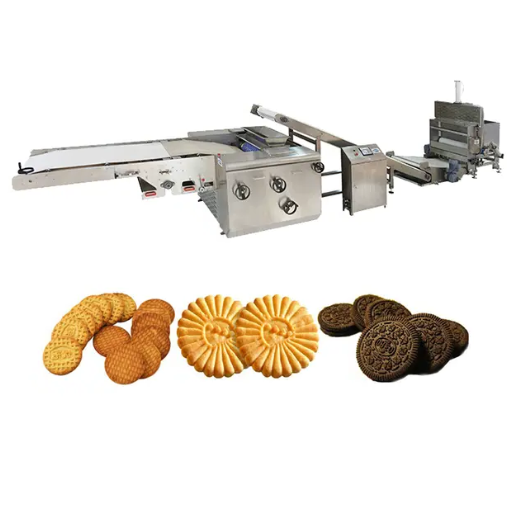
Most biscuit tunnel oven problems show up as a product defect, but the cause is usually mechanical, thermal or control-related. Use the symptom to narrow the search before changing the recipe.
| Symptom | Likely cause | First check |
|---|---|---|
| Uneven colour across the band | Burner imbalance, airflow, tracking or loading | Map temperature across the band; check burners and centring |
| Zone temperature swings | Gas pressure, PID, thermocouple or SCR fault | Compare setpoint with actual; check gas pressure and sensor placement |
| Band drifting to one side | Tension, alignment, thermal expansion or drive condition | Check sensors, tension and drive drum |
| Pale centre, dark edges | Final zone too hot or airflow too strong | Lower the final zone setpoint; review damper settings |
| Cracking after cooling | Cooling too fast or packing too warm | Check cooling time and exit temperature; target below about 35°C |
| High final moisture | Bake time, loading or exhaust setting | Check speed, loading and damper position |
Consider a composite night-shift example. Operators on a 1,000 mm line saw the right-hand edge browning faster. They lowered the final zone temperature, which made the centre pale.
The cause was a band that had drifted a few millimetres plus a burner running rich on that side. Recentring the band and balancing the burner fixed it.
Colour problems are often airflow or band problems. Moisture problems are often speed, loading or exhaust problems. Change one variable at a time.
Frequently Asked Questions
What is a biscuit tunnel oven?
A biscuit tunnel oven is a continuous oven with a moving band and multiple temperature zones. Dough enters at one end, bakes as it travels, and leaves at the other. It’s the standard oven for high-volume production.
How long do biscuits bake in a tunnel oven?
Most bake for 5-20 minutes. Soda crackers are often 4-5 minutes, semisweet biscuits 5-6, and cookies 8-10. Bake time follows oven length and band speed.
What temperature does a biscuit tunnel oven run at?
A biscuit tunnel oven usually runs at 200-250°C. Direct gas fired crackers and pizza-type products can exceed 300°C. Zones usually follow a profile: cooler entry, hotter middle, falling finish.
Is gas or electric better for a biscuit tunnel oven?
For a biscuit tunnel oven, neither fuel is universally better. Gas is usually cheaper where supply is reliable. Electric is cleaner and more precise, and suits sites without gas. Compare cost per tonne, not installed kW.
How do you calculate tunnel oven capacity?
Multiply band loading in kg/m² by band width in metres by band speed in m/min by 60. Band speed equals baking length divided by bake time. Confirm the basis.
Why are my biscuits uneven across the band?
Check the biscuit tunnel oven’s band tracking, burner balance and airflow first. A drifted band, a burner running rich on one side, or a damper set differently across the width will cause uneven colour.
Conclusion
A biscuit tunnel oven decides whether your line can hold its bake profile. Treat it as an engineering purchase, not a catalogue item.
Five points for your next meeting:
- Size from bake time, loading and band width, not one kg/h figure.
- Choose heat transfer from the product; the modes are fits, not ranks.
- Decide fuel from site conditions and cost per tonne.
- Agree FAT criteria and trial-bake your own dough.
- Keep gas, airflow and band systems in one plan.
If you have a product and a target output, we can size the oven and line around it. Talk to our engineers with your product details and utilities.