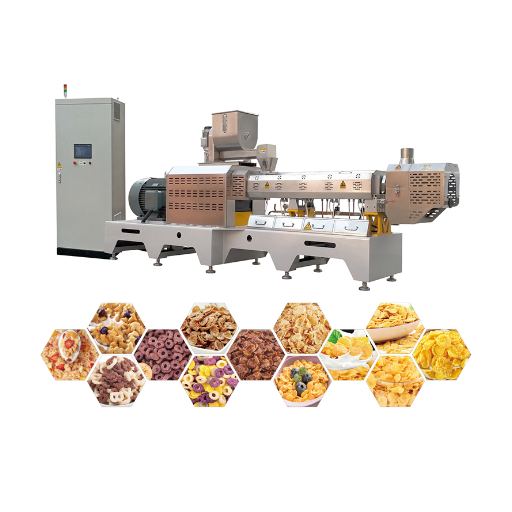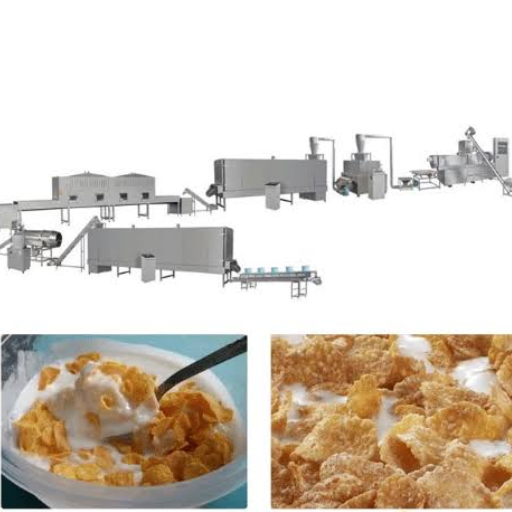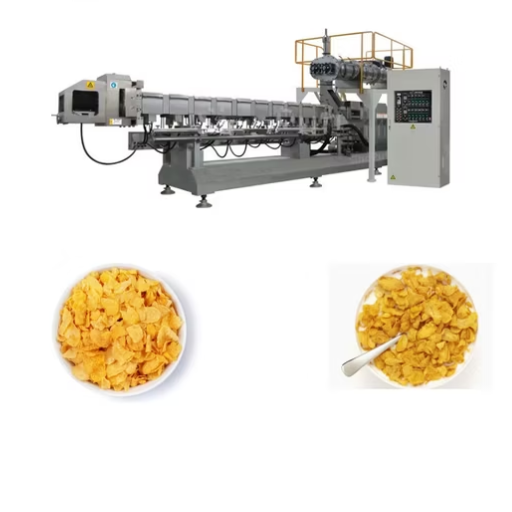
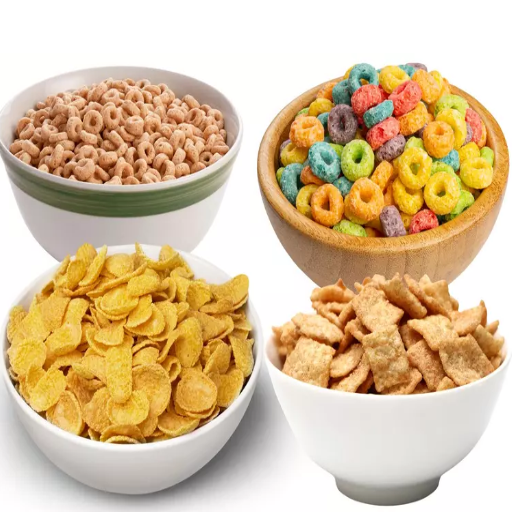
The main types of breakfast cereal are hot cereals, which are cooked before eating, and ready-to-eat cereals, which are eaten cold. Ready-to-eat cereals are then divided by how they are made. That step separates a flake line from an extrusion line, a puffing line or a shred line.
Most guides answer “types of breakfast cereal” with a list of grains. That answers a different question. Oats, wheat, corn and rice are raw materials. Flakes, puffs, shreds and clusters are forms.
A box can name a grain, a form and a brand in one line, which is why the category looks more confusing than it is.
Consider a product developer we’ll call Maya. Her brief asks for a “puffed cereal” in a ring shape. The reference product is extruded, not gun-puffed, so the line she needs is an extruder, not a puffing gun. The word on the brief and the machine on the floor are two different things.
This guide to the types of breakfast cereal separates those three axes. It covers the two main types, the seven forms that fill most of the aisle, the grain and label categories around them, and the production step behind each form. If you are here to choose equipment, the form is still the first decision, because it sets the machine set. covers the full line.
Key Takeaways
- Breakfast cereal splits into hot cereals and ready-to-eat cereals.
- Ready-to-eat types are classified by how they are made, not by grain.
- Seven forms cover most products: flaked, extruded, puffed, shredded, granola, muesli and hot cereals.
- The form sets the core machines: flaking mill, extruder, puffing gun, shredding rolls, oven or cooker.
- Published line configurations run from 120-150 kg/h to 800-1,000 kg/h, with 140-240 kW installed; final capacity is confirmed per project.
If you are specifying a line, start with the form, not the model. Send the product form, grain base and target output through our , and we’ll confirm which machine set fits.
The Two Main Types of Breakfast Cereal
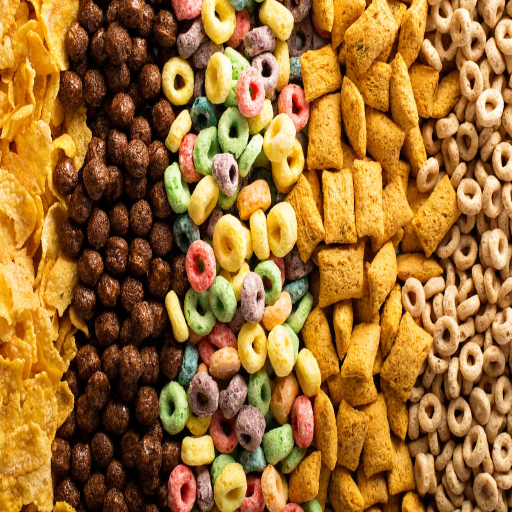
Hot cereals are cooked before they are eaten. Oatmeal, farina and grits are boiled in water or milk, and that cooking step is part of the product. Ready-to-eat cereals are fully cooked and dried at the factory, so they can be poured from the box and eaten cold. The US EPA’s cereal breakfast food section divides the industry the same way.
The split isn’t cosmetic. A hot cereal line is built around particle size, cooking and drying. A ready-to-eat line is built around forming, toasting and coating.
Ready-to-eat cereals account for six of the seven forms below. The seventh, hot cereal, is the other main type. Together, these seven types of breakfast cereal cover most of the aisle. Product developers often collapse this into “flakes, puffs and granola”, which is too coarse for line selection.
| Form | Common examples | Forming step | Texture |
|---|---|---|---|
| Flaked | Corn flakes, wheat flakes, bran flakes | Cooked grits pressed between rolls | Thin, crisp, laminated |
| Extruded | Rings, balls, stars, pillows | Dough pushed through a die and cut | Dense to light, shape-led |
| Puffed | Puffed rice, puffed wheat | Pressure release, oven expansion or extrusion | Light, hollow, crisp |
| Shredded | Shredded wheat, bite-size biscuits | Cooked wheat shredded between rolls | Layered, fibrous, firm |
| Granola | Baked clusters, bars | Oats and inclusions baked and broken | Chunky, crunchy |
| Muesli | Raw oat and fruit blends | Mixing only, no forming | Loose, chewy |
| Hot | Oatmeal, farina, grits | Milling, steaming, rolling or flaking | Soft after cooking |
Industry classifications split some families further. The Cereals & Grains Association lists extruded flakes, extruded shredded cereals, compressed flake biscuits and filled shredded pieces as separate categories. Those distinctions matter on a plant floor.
For a shopper, the seven groups above are enough. They also decide which line you need.
Flaked Cereals: Corn Flakes, Wheat Flakes and Bran Flakes
Flaked cereals are the types of breakfast cereal most shoppers picture first. They are made by cooking grain grits or groats, drying them to a controlled moisture, pressing each piece between two rolls, and toasting the thin flake. The roll doesn’t cut the grain. It flattens it, and the cell structure set during cooking decides whether the flake holds together.
Corn flakes are the reference product. Grits are cooked with sugar, malt and salt, dried below 121°C, then tempered to 10-14% moisture. The rolls are held at 43-46°C, and the flake is toasted to 1.5-3% moisture. Wheat flakes run wetter, typically 16-18% at the roll; at 19-20% the grits become too sticky to release cleanly.
Capacity is set at the mill. A modern flaking roll set passes about 180-550 kg/h, while older installations ran closer to 68 kg/h. A line with a 1,000 kg/h cooker therefore needs several mills or a larger roll set. That mismatch is a common sizing mistake.
Moisture at the roll, roll gap, roll temperature and roll speed decide whether the flake is glassy or shattered. For the full sequence, see .
Extruded Cereals: Rings, Balls, Stars and Puffs
Extruded cereals are formed by forcing a dough through a die and cutting it at the face. The die sets the silhouette, and the cutter sets the length. The extruder barrel sets how much the piece expands. Rings, balls, stars, alphabet shapes and filled pillows all belong here.
Extrusion replaces the long batch cook. A batch cooker can hold up to 1 tonne and run for 90-150 minutes. Extrusion cooking takes 1-2 minutes. That speed is why extruded products dominate shaped cereals.
There are three common routes. Direct-expanded pieces puff as they leave the die. Extruded pellets are cut dense, then dried, tempered, flaked and toasted, which is how many modern corn flakes are made. Co-extruded pieces form a shell and a filling in one pass.
A common label error appears here. Cheerios-style rings are extruded, not gun-puffed whole grain. They’re made from a dough, shaped at a die and dried. The “puffed” language on the box describes the texture, not the process.
For the machine side, see food extrusion process. Milling and Grain’s comparison of extrusion and flaking routes is a useful independent reference for the time and capacity difference.
Puffed Cereals: Three Different Processes
“Puffed” describes a texture, not one machine. Three processes produce it, and they aren’t interchangeable.
Gun puffing uses whole rice or wheat. The grain is loaded into a pressure vessel, heated, and fired at roughly 200 psi (14 bar). The lid opens, the pressure drops instantly, and the grain expands.
The process is loud and hazardous. Operators wear full face shields and ear protection, and the gun must not exceed its firing pressure. Wheat is usually pretreated with a 4% saturated brine, about 26% salt. Alternatively it is pearled at 4% of kernel weight, so it puffs evenly.
Oven puffing starts with pressure-cooked rice or corn. The grain is cooked for about an hour at 15-18 psi to 28% moisture, then dried to 17%. It’s tempered for 4-8 hours, bumped on rolls, dried to 9-11%, and puffed at 290-340°C for about 90 seconds. The oven, not a gun, creates the expansion. Rice Krispies-style rice is bumped and oven-puffed, not flaked.
Extrusion puffing uses a direct-expanded extruder. The piece leaves the die, flashes off moisture and sets in a light, crisp shape. This is the route behind many shaped puffed products.
The product, not the word, selects the machine. A rice kernel points to a gun or an oven. A ring points to an extruder.
Shredded Cereals: Shredded Wheat and Bite-Size Biscuits
Shredded cereal is built from cooked whole wheat. The wheat is cooked for 30-35 minutes in excess water below boiling to 45-50% moisture. It is then tempered for up to 24 hours.
It’s fed between a smooth roll and a grooved roll, which presses the grain into continuous strands. Those strands are layered, cut into biscuits and baked.
The hardware is distinctive. A shred line stacks 10-20 pairs of rolls, with groove widths of 0.43-0.56 mm, and holds the roll surface at 35-46°C. A state-of-the-art line can produce about 1,135 kg/h of mini-biscuits.
The form has a clear origin. Henry D. Perky patented the rectangular shredded wheat biscuit in 1895, US patent 548,086.
The patent covered the machine that made the shape repeatable. Shredded wheat survived as a category because the equipment could reproduce it.
Granola and Muesli: Baked Clusters and Raw Blends
Granola and muesli are often shelved together, but they’re different products with different lines.
Granola is a baked mixture. Rolled or quick oats are combined with nuts, coconut, sweeteners, oil, dried milk and dried fruit.
The mix is spread on a band and baked at 150-220°C to about 3% moisture. The sheet is then broken into clusters. The line is built around mixing, baking, cooling and cluster sizing, not flaking or extrusion.
Muesli is an uncooked blend. In Europe it is mainly quick rolled oats plus flavour components, eaten as it is. In North America, muesli often uses toasted corn, rice, wheat or barley flakes plus oats, sugars, dried fruit and nuts. It may share a flaking line with other products, but the final product is a mix, not a formed piece.
The name has a history. The Kellogg brothers coined “granola” at their Battle Creek, Michigan sanatorium before 1900. The modern product differs from what they made, but the name stuck to the baked cluster category.
Neither product is a type of flake, even when flakes are an ingredient. A granola line needs an oven and a mixer, not a flaking mill.
Hot Cereals: Oatmeal, Farina and Grits
Hot cereals are the traditional half of the category. About 99% of the traditional cereal market is oats (81%) and farina (18%); rice, corn and other wheat make up under 1%.
Oatmeal starts with groats. The groats are steamed from 8-10% to 10-12% moisture, then rolled. Old-fashioned oats are whole groats rolled flat. Quick oats are cut groats rolled thinner.
Instant oats are rolled thinnest and include a hydrocolloid gum so they hydrate in hot water without cooking. The same mill can produce all three, but the cut, moisture and roll gap must change.
Farina is milled wheat endosperm, cooked, dried and milled to a uniform granulation. Grits follow a similar logic with corn. Hot cereal lines are simpler in forming than ready-to-eat lines. They’re stricter in particle size, cooking and drying, because the consumer finishes the cook at home.
How the Types of Breakfast Cereal Change the Production Line
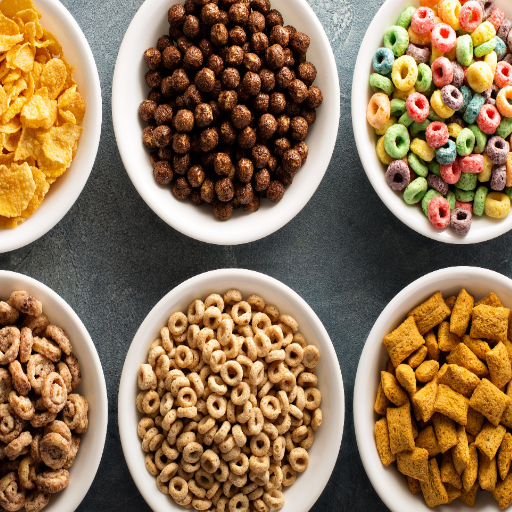
The form decides the core machine set. The table below maps the main types of breakfast cereal to the machines that make them.
| Form | Core machines | Critical control | Changeover risk |
|---|---|---|---|
| Flaked | Cooker, dryer, tempering bins, flaking mill, toaster | Moisture at the roll, roll gap, roll temperature | High: flake thickness and moisture are linked |
| Extruded | Mixer, extruder, cutter, dryer, coater | Die, cutter speed, barrel temperature | Medium: die and cutter changes are quick |
| Puffed | Gun, preheater, expansion tunnel; or oven line; or extruder | Pressure, grain pretreatment, moisture | High: gun and oven routes are different plants |
| Shredded | Cooker, tempering, shred rolls, layering, band oven | Groove width, roll pairs, layer count | High: the roll stack defines the product |
| Granola | Mixer, band oven, cooler, cluster breaker | Bake temperature, moisture, cluster size | Medium: recipe and bake profile |
| Muesli | Mixer, flaker if using flakes, packing | Blend ratio, flake quality | Low: mixing and packing |
| Hot | Cleaner, steamer, flaking rolls, dryer | Particle size, steam, moisture | Medium: cut and roll gap |
Published cereal line configurations run from 120-150 kg/h to 800-1,000 kg/h, with installed power from 140 kW to 240 kW. Final capacity is confirmed per project. The same nominal output can need a different mill count or dryer length depending on the form.
Before a quotation, have four things ready:
- The product form and target shape
- The grain base and any inclusions
- The required output in kg/h
- The finish: toasted, coated, frosted or plain
Three mistakes repeat in reviews. Buyers specify a shape before a form, then discover the shape needs an extruder rather than a gun. They assume one line can switch between flakes and puffs, when the cooking, drying and forming stages are too different. They under-size drying and tempering, which are slower than forming and often set the real line rate.
Our page lists the line configurations. The page covers the flaked route in detail, and explains which stages drive the budget.
Frequently Asked Questions
What are the main types of breakfast cereal? Hot cereals and ready-to-eat cereals. Ready-to-eat cereals are further divided by how they are made into flaked, extruded, puffed, shredded, granola and muesli.
What is the difference between flaked and extruded cereal? Flaked cereal is cooked grain pressed flat between rolls. Extruded cereal is dough forced through a die and cut into a shape. A flake is defined by the roll; an extruded piece is defined by the die.
Is granola a type of cereal? Yes, granola is a breakfast cereal, but it is a baked cluster, not a flake or a puff. It is made on a mixing and baking line.
Are puffed cereals always whole grain? No. Gun-puffed rice and wheat are whole grains. Many puffed shapes are extruded from flour or meal, so the grain has already been milled.
What is the difference between muesli and granola? Muesli is an uncooked blend of oats, fruit and nuts. Granola is baked with sweetener and oil, which creates clusters.
How many types of cereal are there? There’s no fixed number. Seven form families cover most products, and each family contains many shapes, grains and recipes.
Conclusion
The types of breakfast cereal are easier to understand once grain, form and brand are separated. Hot cereals are cooked before eating. Ready-to-eat cereals are made in six main ways, and each form has its own machine set, quality controls and changeover risks.
For a shopper, the form explains texture. For a buyer, the types of breakfast cereal are a machine-selection decision. Start there, then size the mill, extruder, gun, shred stack or oven around it. If you are planning a line, with the product form, grain and target output.