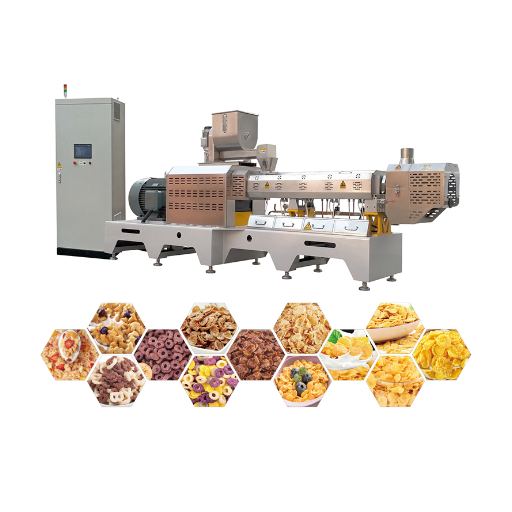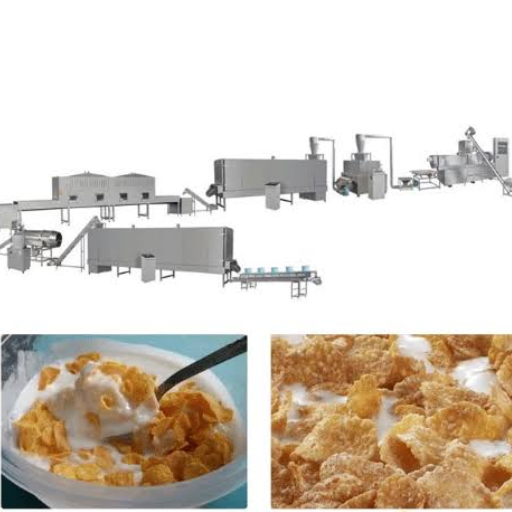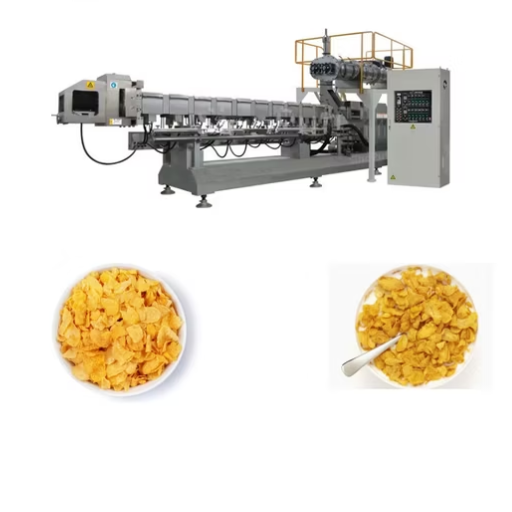
A small scale cereal production line runs about 100 to 500 kg/h and uses the same sequence as a large plant: mixing, cooking or extrusion, drying, tempering, flaking, toasting, coating and packing. The surprise is how little the long parts shrink. Our smallest published line is 39 m and the 300-500 kg/h line is 43 m.
That one comparison decides most of the budget. Buyers usually assume a small line means a small building, and they price the shed before they price the line. Then the drawing arrives and the bay is too short, the ceiling is too low, or the finished-goods pallets have nowhere to go.
You’ve probably already been quoted a footprint and a kilowatt figure, and told it fits a standard unit. This guide replaces that with published numbers you can check, the building arithmetic that goes with them, and a clear split between what to buy now and what to buy later.
If you’d rather start from the specifications, the breakfast cereal production line page lists every published configuration and the process sequence in one place.
Key Takeaways
- The small band is defined by output, not by machine bulk: 120-150 kg/h, 180-220 kg/h and 300-500 kg/h are the three published lines that fall inside it.
- Output roughly doubles from the smallest line to the 300-500 kg/h line, but line length grows by only 4 m. The long elements aren’t where the savings sit.
- Equipment height is not clear height. A 2.2 m machine needs about 4.5 m of building once hoods, ducts and lifting space are added.
- Installed power runs from 140 kW to 190 kW across the band while running power is 90 kW to 140 kW. The load schedule matters more than the headline total.
- Buy the building, the utilities and the dryer once. Add packing lanes, coating and automation later.
What “small scale” means for a cereal line
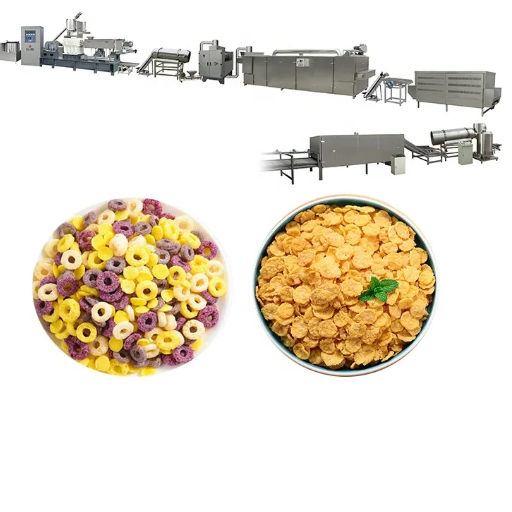
In practical terms, the band runs from about 100 kg/h to 500 kg/h. That’s one shift a day of a tonne or two on the smallest line and four tonnes or so at the top.
Below roughly 100 kg/h, a continuous line stops being the sensible answer. The process steps don’t disappear at that point, but continuous equipment sized for that output becomes oversized for the job, and batch or semi-continuous machines usually win.
Our published configurations put three models inside the band: LY65 at 120-150 kg/h, LY70 at 180-220 kg/h and LY85 at 300-500 kg/h. A fourth model, LY90 at 800-1,000 kg/h, sits outside it and matters here only as an upgrade target.
It’s worth saying what the band doesn’t mean. Small scale isn’t a factory with everything scaled down by the same factor. It’s a different operating model: fewer shifts, fewer people, more changeovers, and a much higher share of cost sitting in labour and packing rather than in the extruder.
That operating model, rather than the machine size, is what you’re really choosing between.
The published configurations for a small scale cereal production line
Here are the four published sizes with output, line dimensions and power, so you can compare the band against the building you have in mind. These are published configurations, final configuration confirmed per project, and the height column is equipment height, not clear height.
| Model | Output | Line size L × W × H | Installed power | Running power |
|---|---|---|---|---|
| LY65 | 120-150 kg/h | 39,000 × 1,200 × 2,200 mm | 140 kW | 90 kW |
| LY70 | 180-220 kg/h | 41,000 × 1,500 × 2,200 mm | 160 kW | 120 kW |
| LY85 | 300-500 kg/h | 43,000 × 3,500 × 4,300 mm | 190 kW | 140 kW |
| LY90 | 800-1,000 kg/h | 65,000 × 5,000 × 4,300 mm | 240 kW | 190 kW |
Read the table across rather than down. Width grows from 1.2 m to 3.5 m and length grows from 39 m to 43 m. Going from 120-150 kg/h to 300-500 kg/h is a step in complexity and height, not a step in length.
The same figures sit alongside the corn flakes production line specification page.
Now the building arithmetic. Take LY65. A 39 m line needs working room on both sides, so allow about 1.2 m each side, giving a 3.6 m wide envelope and about 140 m² of floor.
Then add intake, packing, aisles, stores and utilities. A rough rule that survives most projects is to double the line envelope before you add stores, which puts the building at roughly 280 m².
Length matters more than area, because you can’t bend a dryer. Add about 4 m at the intake end and about 4 m at the packing end, and a 39 m line wants roughly 47 m of clear internal length. For LY85, 43 m plus the same allowances gives about 51 m.
None of this is a specification. It’s planning arithmetic, and it has to be confirmed against a general-arrangement drawing before anyone signs a lease.
What shrinks and what doesn’t
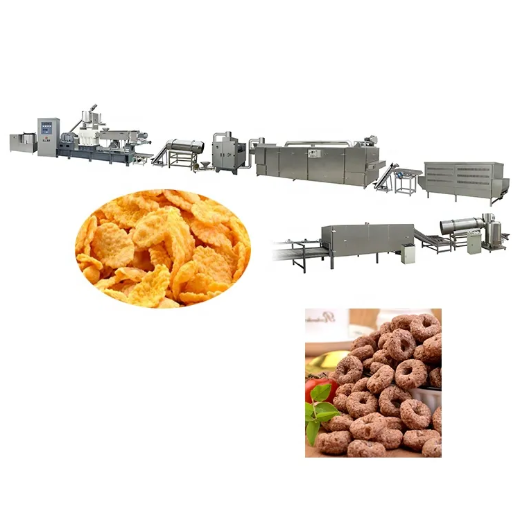
The useful distinction in this band is between the parts of the line that scale with output and the parts that don’t.
What shrinks:
- Line width, and with it the number of packing lanes
- Buffer and tempering capacity
- Silo size and the finished-goods store
- Automation at the packing end
Width is the biggest lever. The 2.3 m gap between LY65 and LY85 is most of why the bigger line costs more.
What doesn’t shrink: the process sequence itself. The EPA’s emission guidance for this industry sets out the flaked cereal sequence as preprocessing, mixing, cooking, delumping, drying, cooling and tempering, flaking, toasting and packaging (AP-42 §9.9.2). Every one of those stages survives at 120 kg/h.
Extruded flakes replace cooking and delumping with an extrusion step, which is why they’re usually the better first line at small scale. The drying, tempering, flaking and toasting stages remain.
Two more things don’t shrink: coating, which is a wet zone inside an otherwise dry plant, and the dust controls at intake and packing. Those are hygiene and safety decisions, not capacity options.
What this means commercially is uncomfortable but worth knowing. Installed power rises from 140 kW on LY65 to 190 kW on LY85, which is 36 percent more power for roughly two to three times the output. The capital saving from choosing the smaller line is real, but it’s smaller than the output saving. That gap is where most first-time buyers get their assumptions wrong.
We’ll call the next buyer Marcus. He compared two quotations on output alone and chose the cheaper one, then found during installation that it had quietly dropped the tempering section. His line could make flakes, but not consistent ones, because the product reached the flaker before it had stabilised.
The price looked 15 percent better. The line never ran to its rated output.
Which cereal type suits a small line
The three product families put different demands on a small line, and the difference is equipment count rather than quality.
Flaked cereals carry the full sequence from AP-42: cooking, delumping, drying, tempering, flaking, toasting. That’s the most equipment per kilo of output, which makes it the least forgiving choice at the bottom of the band. You can run it, but every stage has to be sized properly and cleaned properly.
Extruded flakes replace cooking and delumping with an extruder. The AP-42 description is worth reading closely: heat near the feed stays low so the ingredients mix before gelatinisation starts, the centre section cooks, and the die sits at the end of the last, cooler section. One machine replaces a vessel and a stage, and that’s usually the difference between a small line that works and one that’s over-engineered for its output.
Gun-puffed whole grain follows pretreatment, puffing, screening, drying and cooling. There’s no flaking mill, which is a saving, but the puffing guns are a batch device. Their cycle time sets the rhythm of the whole line, and at small output that rhythm is easier to live with than it sounds.
Our advice for a first line is usually extruded flakes in the 120-220 kg/h range. The equipment count is lower, the changeover is faster and the operator has fewer variables to hold steady. The guide to how a corn flakes line is put together covers the sequence in more detail if you’re still choosing a product.
Clear height, services and the building
Clear height is the item most often missed, because it’s invisible on a quotation.
Take LY65 or LY70. Equipment height is 2.2 m. Add a hood and duct plenum of 1.0-1.5 m, then 0.5-1.0 m for lifting and maintenance access. That stack-up gives roughly 3.7-4.7 m, so specify 4.5 m of clear height and treat anything lower as a design problem rather than a detail.
LY85 and LY90 are 4.3 m tall, and the same allowances put them at 5.8-6.8 m. Specify 6 m or more.
Power is straightforward on paper and awkward in practice. LY65 draws 140 kW installed and 90 kW running; LY85 draws 190 kW installed and 140 kW running. The gap between installed and running is why the load schedule, not the total, is the document you should ask for. It tells your electrician where demand actually lands and where the motor control centre should sit.
| Utility | Published figure | What it decides in the layout |
|---|---|---|
| Installed power | 140-190 kW across the band | Transformer sizing and cable route |
| Running power | 90-140 kW across the band | Supply contract and peak demand |
| Steam | Not published for this series, request the steam and condensate schedule | Boiler location, header route, condensate return |
| Compressed air | Not published, request the pneumatic schedule | Compressor position and ring main |
| Water and drainage | Not published, request connection points and floor falls | Equipment positions and washdown |
| Floor loading | Not published, request structural loads | Mezzanine, plinths, silo legs |
| Dust control | Emission points set by process, not by capacity | Hoods, ducting and filter positions |
Dust deserves its own paragraph. Particulate matter arises as ingredients are dumped, weighed and mixed, as grain is hulled, and possibly during screening, drying and packaging, according to AP-42 §9.9.2.3. The same section puts most VOC emissions at the thermal steps: drying, steaming, cooking, toasting, extruding and puffing.
Practically, that means three different air regimes along one line:
- Negative pressure at intake, where the dust is generated
- Extraction over the dryer and toaster, where the heat and volatiles are
- Positive pressure in packing, to keep the finished product clean
NFPA 61 treats combustible dust as a design input rather than an afterthought, and at this scale a dust hazard assessment is cheap compared with a retrofit.
One more number is worth planning around. Finished cereal occupies roughly 4-10 lb/ft³ of bulk density against about 48 lb/ft³ for raw grain, according to the Cereals & Grains Association. Finished product takes five to ten times the volume per tonne, so your store, not your silo, is usually the space that runs out first.
Buy now, buy later
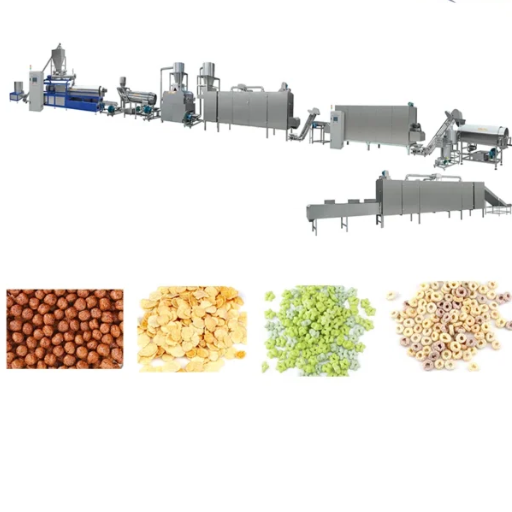
The band is forgiving about equipment and unforgiving about buildings. Split the decision accordingly.
Buy once:
- Building length and clear height
- The dryer and toaster
- Utility capacity, including the transformer and the steam header
- The opening the longest module has to pass through
- The finished-goods store
All of these are fixed by the drawing and expensive to change after the line lands.
Buy later:
- A second packing lane
- Additional tempering capacity
- Coating
- Automation at the packing end
- The step from LY65 to LY85
None of these touch the fabric of the building.
The upgrade arithmetic supports the split. LY65 is 39 m and LY85 is 43 m, a difference of 4 m for roughly double the output. If the bay was built wide enough and the ceiling was built high enough, the move from the smallest line to the 300-500 kg/h line is a line swap rather than a building project.
We’ll call the next producer Aisha. She bought the smallest line and the smallest building on the same day, and the building was sized to the line footprint rather than to the line plus its aisles and stores.
Two years later her order book justified LY85. The line fit the bay. The packing area, the finished-goods store and the ceiling didn’t. She paid twice, once for each building.
Before you commit, compare the small line you’re considering with a breakfast cereal making machine specification. If your product range may widen, the small scale puffed corn snack line shows how the same capacity band is configured for a different product family.
Small scale cereal production line FAQ
How much does a small scale cereal production line produce per day? At rated output on a single eight-hour shift, LY65 produces about 0.96 to 1.2 tonnes and LY85 about 2.4 to 4 tonnes. That’s arithmetic on the published output, not a guarantee. Apply your own utilisation factor for changeovers, cleaning and downtime before you plan sales around it.
How much space does a small cereal line need? The line envelope for LY65 is roughly 140 m² once service aisles are added, and about 254 m² for LY85. Double that before stores and utilities, and check the internal length, which is the constraint that bites first.
What clear height does a 120-500 kg/h cereal line need? About 4.5 m for the 2.2 m models and 6 m or more for the 4.3 m models. Equipment height isn’t clear height. The hood, ducting and lifting space sit above the machine.
How much power does a small cereal line use? Installed power is 140 kW for LY65 and 190 kW for LY85, with running power at 90 kW and 140 kW. Ask for the load schedule rather than working from the total.
Can a small cereal line be upgraded later? Yes, if the building was planned for it. Length grows by only 4 m from LY65 to LY85, so a bay sized for the larger line costs little more at construction and saves the second building later.
Conclusion
Every small scale cereal production line comes down to four decisions made in this order: output band, line width and length, clear height, and which utilities to build in now.
Get the order right and the project is boring, which is what you want. Get it wrong at the building stage and you spend the next five years working around a ceiling.
A line at 120-500 kg/h is a single-shift operating model, not a miniature factory. It rewards a producer who plans the building around the line’s real envelope and its real storage. It punishes one who prices the shed against the machine footprint.
Send us your building dimensions and your target output, and we’ll tell you which published configuration fits, and what has to change if it doesn’t.