Most food plants buy the wrong inspection equipment. They buy a metal detector, install it at the end of the line, and discover eighteen months later that it cannot see the contaminant that actually put them at risk. The fix was available the whole time. It just was not on the spec sheet.
Food inspection systems are the equipment stack that catches foreign objects, verifies weight, and sorts product before it reaches a customer. Selection matters more than price, because the wrong technology does not just underperform. It gives you false confidence, which is worse than having nothing at all.
This guide covers what each inspection technology actually does, how to match it to your product, where it belongs in your line, and what it really costs. We will also cover the failure mode almost nobody warns you about: why your metal detector rejects good product on a wet line.
Key Takeaways
- No single food inspection system catches everything. Metal detectors find metal, X-ray finds metal plus glass, bone, and stone, and checkweighers verify weight. Most lines need more than one.
- Match the technology to your contaminant risk and your product, not to the brochure. Wet, salty, or conductive products degrade metal detector performance through an effect called product effect.
- Inspect before packaging whenever you can. A contaminant sealed inside a pack is invisible to every downstream inspection device.
- Indicative pricing runs from roughly 5,000foranentry−levelunitto5,000foranentry−levelunitto60,000+ for a high-end X-ray system, before installation, validation, and service.
- An unmaintained inspection system is a liability. It drifts out of calibration and quietly stops catching what you bought it to catch.
What Is a Food Inspection System?
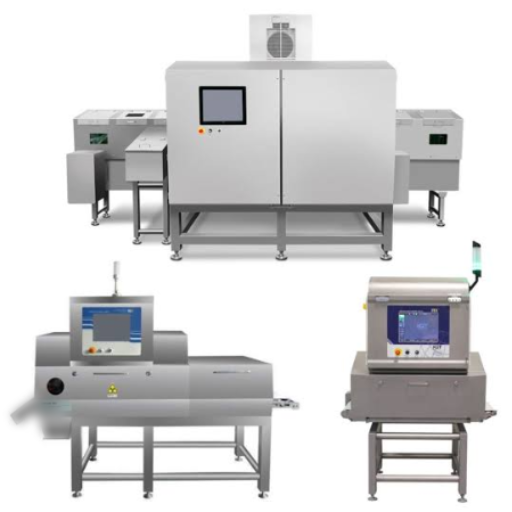
A food inspection system is any device on a production line that automatically checks product for contamination, correct weight, or packaging defects, then accepts or rejects each unit. It is not one machine. It is a stack of checks, each doing a job the others cannot.
Inspection does three distinct things on a line:
- Detect. Find foreign objects such as metal fragments, glass, bone, stone, or hard plastic.
- Verify. Confirm measurable attributes like net weight, fill level, or package seal integrity.
- Sort. Physically separate rejected product from good product, usually with a reject arm, pusher, or flap.
This matters because of how food safety programs are structured. Under HACCP (Hazard Analysis and Critical Control Points), a step where a hazard can be prevented, eliminated, or reduced to an acceptable level is a critical control point, or CCP. Foreign body detection is one of the most common CCPs in food manufacturing, and the monitoring device at that point is your inspection system.
That has a practical consequence. Your inspection equipment is not just a quality tool. It is the evidence your auditor asks for. If the device has no calibration record, the CCP has no monitoring record, and the program has a hole in it.
Inspection sits alongside hygiene design as one of the two things that separate a documented food safety program from a hopeful one. Both start with the equipment you buy, which is why we cover the food grade machinery materials that make both work.
The 4 Types of Food Inspection Equipment
Four technologies cover nearly every application on a food line. Each has a specific job, and each has a specific blind spot.
Metal Detectors
A food metal detector generates an electromagnetic field and watches for disturbances. When ferrous, non-ferrous, or stainless steel passes through, the field reacts and the system triggers a reject.
Metal detectors are the most common inspection device in food manufacturing. They are relatively inexpensive, compact, easy to install, and highly sensitive to small metal particles. They are also the right choice for most dry, non-conductive products.
The limitation is what they cannot see. A metal detector detects metal. It is blind to glass, bone, stone, and hard plastic, and it struggles with wet, salty, or electrically conductive products.
X-Ray Inspection Systems
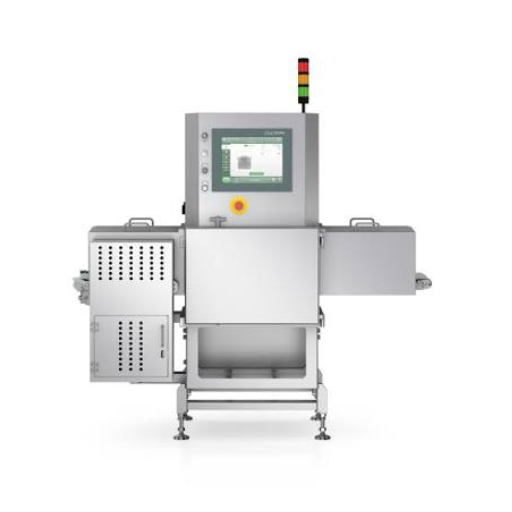
An X-ray food inspection system passes low-dose radiation through the product and reads the resulting image. Dense materials absorb more radiation than the surrounding product, so contaminants appear as dark spots on the sensor.
X-ray catches everything a metal detector catches, plus the contaminants metal detection misses entirely: glass, bone, stone, calcified matter, and some hard plastics. It can also inspect a sealed package for fill level, missing product, broken pieces, or seal defects without opening it.
The tradeoffs are real. X-ray systems cost substantially more, take more floor space, and require radiation safety procedures and regulatory registration in most jurisdictions. They are also generally less sensitive than a metal detector to very small metal particles, so the two are not perfectly interchangeable.
Checkweighers
A checkweigher is a high-speed conveyor scale that weighs every unit and rejects anything outside a set tolerance band. It does not detect contamination. It detects weight.
That sounds mundane until you run the numbers. Overfill is product you are giving away, and it compounds silently across millions of units. A checkweigher closes that gap, keeps packs compliant with net-weight regulations, and pays for itself faster than almost any other inspection device.
Checkweighers are also the least controversial inspection purchase in the food industry. There is no technology choice to agonize over, and the ROI is arithmetic rather than judgment.
Vision and AI Inspection Systems
Machine vision systems use cameras and, increasingly, deep learning models to inspect product for defects. They catch what the physics-based technologies cannot: wrong color, broken shape, misaligned labels, incorrect sorting, and surface damage.
Vision inspection is the fastest-moving segment. Deep learning models trained on thousands of example images can now classify defects at line speeds that were impossible with rule-based systems a few years ago. MVTec’s technical work on deep learning for machine vision notes that high speeds and high defect detection rates are no longer the bottleneck they once were.
The limitation is training data and changeover. A vision system is only as good as the examples it learned from, and a new product or a new defect type means retraining.
Metal Detector vs X-Ray vs Checkweigher: Full Comparison
This is the table most vendor sites will not show you, because most of them sell one of these three. Here it is without a sales agenda attached.
| Capability | Metal Detector | X-Ray System | Checkweigher |
|---|---|---|---|
| Detects ferrous metal | Yes | Yes | No |
| Detects non-ferrous metal | Yes | Yes | No |
| Detects stainless steel | Yes | Yes | No |
| Detects glass | No | Yes | No |
| Detects bone and stone | No | Yes | No |
| Detects hard plastic | No | Sometimes | No |
| Verifies net weight | No | Sometimes | Yes |
| Checks fill level and seal | No | Yes | No |
| Inspects sealed packaging | No | Yes | No |
| Works with metallized film | No | No | N/A |
| Indicative price band | 5,000–5,000–25,000 | 25,000–25,000–60,000+ | 8,000–8,000–30,000 |
| Relative sensitivity to small metal | Highest | Moderate | N/A |
| Affected by wet or salty product | Yes | No | No |
Two rows on that table decide most purchasing conversations.
The contaminant row. If your hazard analysis says metal is your risk, a metal detector is the targeted and cost-effective answer. If your risk includes glass from jarring or bottling, bone in meat or fish, or stone from agricultural intake, metal detection alone will not protect you.
The metallized film row. Metallized film and aluminum trays are opaque to both metal detectors and X-ray systems. If your packaging roadmap includes metallized film, inspection has to happen before packaging, or you need a different approach entirely.
Here is the honest verdict the table implies. Most production lines need more than one device. A common configuration runs X-ray inspection on the packed product to catch the full contaminant range, with a metal detector at the very end of the line as a final high-sensitivity check where the product is dry and product effect is minimal.
How to Choose Food Inspection Equipment for Your Product
Technology selection is not a budget question first. It is a hazard question first. Work through these five criteria in order, and the equipment choice usually makes itself.
Match the Technology to Your Contaminant Risk
Start with your hazard analysis, not with a brochure. Ask what physical hazards are realistic in your process, not just what is theoretically possible.
Metal contamination in food almost always comes from wear on your own equipment. Grinders, mixers, screws, blades, sieves, and conveyor components all shed material over time. Glass risk concentrates wherever you handle jars and bottles. Bone and stone risk tracks agricultural intake and any deboning step.
The realistic hazard set determines the technology. Everything else is preference.
Wet, Salty, or Conductive Products Change Everything
This is the single most important technical point in this article, and the one most buyers learn about after installation.
Metal detectors work by detecting electrical and magnetic disturbances. The problem is that some foods behave like metal. Wet, salty, and electrically conductive products, including brined meats, cheeses, soups, sauces, wet dough, and many ready meals, produce a signal that mimics or masks a contaminant. The industry calls this product effect.
Product effect causes three specific problems:
- False rejects. Good product gets rejected because the detector reads the product itself as a contaminant.
- Reduced sensitivity. To stop the false rejects, the operator turns the sensitivity down. That directly reduces the smallest metal particle the system can catch.
- Instability. The signal drifts as product temperature, moisture, or salt content changes between batches, so a setting that worked this morning fails this afternoon.
X-ray is fundamentally unaffected by conductivity, salinity, or moisture, because it reads density rather than electrical response. That is why a food x-ray inspection system is the standard choice for pumped, liquid, and heavily salted products.
Detection limits also differ in a way that surprises people. Metal detectors are generally more sensitive to very small metal particles than X-ray systems, while X-ray detects the broader contaminant range. Typical industry figures put metal detection at roughly 1.0 to 1.5 mm for ferrous metal and 2.0 to 2.5 mm for stainless, with X-ray systems typically higher at roughly 2.0 to 3.0 mm ferrous and 3.0 to 4.0 mm stainless. Treat those numbers as indicative only. Actual performance varies with product density, packaging, aperture size, and configuration, and vendor documentation for your specific product is the only reliable source. METTLER TOLEDO’s product inspection resources and the Thermo Fisher food safety inspection FAQs are useful starting points for per-technology detail.
Packaging Material Constraints
Metallized film and aluminum trays are essentially opaque to X-ray and metal detection alike. If you inspect through packaging, you are limited to transparent or non-metallized materials. If your brand roadmap includes metallized film, either inspect before packaging or plan for a different configuration.
Product form matters too. X-ray sensitivity drops with product density and thickness, and contaminants near the edge of a pack can be missed. Small flat contaminants such as wire or blade fragments can be nearly invisible from one viewing angle, which is why dual-view systems exist for high-risk applications.
Throughput and Line Speed
Every inspection technology has a maximum throughput, and the number is not just about belt speed. It is about how long each unit spends inside the detection field. A detector sized for 100 packs per minute cannot be pushed to 300 by running the belt faster. If your line is expected to grow, spec the inspection system for the capacity you will need in three years.
Budget Reality
Price the whole installation, not the box. Equipment is typically one-third to one-half of installed cost once integration, guarding, reject mechanisms, data logging, commissioning, and training are counted. The same pattern holds across food automation generally, where roughly 32% of automation projects finish over budget.
Want the full cost picture across your line investment? Our guide to automated food processing equipment covers how inspection fits into the wider equipment stack, and our breakdown of food automation cost covers the project math.
Where to Place Food Inspection Systems in Your Production Line
Placement is not a detail. A perfectly good inspection device in the wrong position will miss the hazard it was bought to catch.
Inspect in this order of preference:
- Raw material intake. Catch contamination before it enters your process and has a chance to be fragmented into smaller, harder-to-detect pieces. This is especially valuable for bulk powders, grains, and agricultural inputs.
- After a high-risk process step. Immediately after grinding, milling, cutting, or any step where your own equipment wears. This is where self-generated metal contamination originates.
- Before packaging. This is the most important position for foreign body detection. A contaminant inside a sealed pack is invisible to every downstream device, because nothing can see inside it.
- On or after the packaged product. X-ray can inspect sealed packs for fill level, missing product, and seal defects. Checkweighers also work well here.
- End of line. A final check before palletizing. Useful as a last line of defense and for compliance data capture.
The most common and most expensive mistake is inspecting only the final packed product. If your hazard analysis identifies metal wear in the mixer as a realistic hazard, and your only inspection point is after the bag is sealed, you have no control over that hazard at all. You have only a record of it.
The rule that prevents most inspection mistakes: inspect before packaging wherever your hazard analysis allows it. Once product is sealed, you are inspecting the package, not the product.
Food Inspection Equipment Costs and Pricing
Vendors rarely publish prices, and the ranges that do circulate online are often unreliable. Here are indicative 2026 bands, and they are indicative only. Real pricing depends on aperture, throughput, detection limits, software, and service terms, and it requires a quote.
| System Type | Indicative Range (USD) | Notes |
|---|---|---|
| Entry-level metal detector | 5,000–5,000–12,000 | Smaller aperture, basic reject, limited data logging |
| Mid-range metal detector | 12,000–12,000–25,000 | Larger aperture, better reject options, HACCP data logging |
| Entry X-ray system | 18,000–18,000–30,000 | Basic contaminant detection, single view |
| Mid-range X-ray system | 30,000–30,000–60,000 | Better detection, integrity checks, better software |
| High-end X-ray system | 60,000–60,000–150,000+ | Multibeam, dual-view, high throughput, pharma-grade |
| Checkweigher | 8,000–8,000–30,000 | Depends on speed, accuracy class, and reject type |
| Vision inspection system | 15,000–15,000–50,000+ | Highly application-dependent |
Four cost drivers explain almost all of the spread:
- Aperture size. A larger opening means a bigger machine and more cost. Size it to your product plus the reject mechanism, not bigger.
- Throughput. Faster lines need faster, more capable systems.
- Detection limit. Finer detection costs more, and the relationship is not linear.
- Software and data. HACCP-grade logging, reporting, and line integration add real cost and real value.
Two honest notes on total cost. First, service and validation are ongoing expenses, not one-off items. Second, Chinese OEM equipment is genuinely cheaper and genuinely capable in the mid-range, but varies in documentation quality and local support. If your market demands rigorous audit trails, verify the documentation before you buy, not after.
Why Food Metal Detectors False Reject (And How to Fix It)
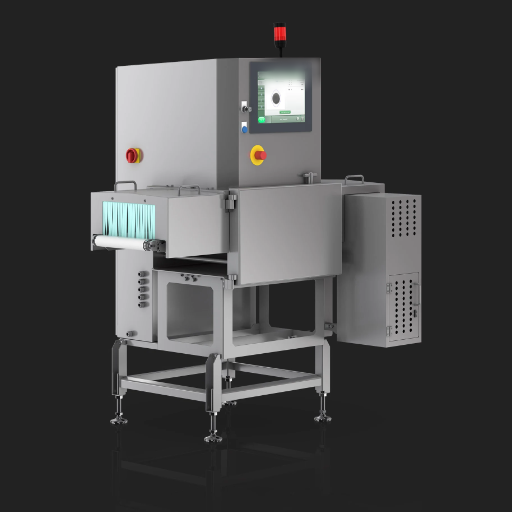
If you searched for this topic, you are probably living it right now. Your detector is throwing away good product, your operators are complaining, and someone has suggested the machine is broken. Usually it is not broken. It is being asked to do something it cannot do.
False rejects have five common causes, in rough order of frequency.
Product Effect
This is the most common cause by a wide margin. Wet, salty, and conductive products generate signals that look like contamination.
The fixes, in order of preference:
- Move inspection upstream. Inspect before salting, marinating, or any step that makes the product conductive. This is often the cleanest solution.
- Lower the operating frequency. Metal detectors for dry and bulk products typically run around 800 kHz. Wet and conductive products usually need a lower frequency, roughly 25 to 100 kHz. This is a configuration change, not a repair.
- Use product auto-learning. Modern systems learn the product’s own signal and compensate for it. If yours is not doing this, it may be an older unit.
- Switch to X-ray. If the product is fundamentally conductive and the sensitivity requirement is non-negotiable, X-ray sidesteps the problem entirely.
Temperature Drift
Product signal changes with temperature. A detector calibrated on ambient product will behave differently on chilled or hot product. If false rejects cluster around a particular product or shift, check temperature as the first variable.
Vibration
Detectors are sensitive instruments. Nearby equipment, an unbalanced conveyor, or a structurally unsupported frame will induce signal noise that reads as contamination. Check mounting and surrounding equipment before anything else.
Aperture Too Small
An aperture sized too tightly for the product forces product closer to the detector walls than the system expects, which distorts the field. This is a design error, not an operational one, and it is expensive to fix after installation.
Calibration Drift
Sensitivity drifts over time. A detector that was commissioned correctly and never verified since will slowly become either too sensitive or not sensitive enough. This is also the failure mode an auditor will catch.
When Ravi took over a seasoned snack line in Pune, his metal detector was rejecting about three percent of good product, roughly forty bags a shift at his volumes. His first instinct was that the unit was faulty and needed replacing. It was four years old and had never been re-verified.
The service technician’s first question was not about the detector. It was about the product. The line had switched to a wetter seasoning blend six months earlier, which made the product conductive enough to trigger the detector.
The fix was not a new machine. It was moving the inspection point upstream, before the seasoning drum. The reject rate fell to under half a percent the same week, and the detector became more sensitive than before, because it no longer had to run detuned to cope with the product.
That is the pattern worth remembering. When a detector starts rejecting good product, suspect the product before you suspect the machine.
Maintenance, Calibration, and Validation
An inspection system that is not maintained is not a control. It is a liability that produces paperwork.
Verification with Test Pieces
Every metal detector and X-ray system should be verified regularly with certified test pieces of known size and material. Standard practice is to pass test pieces through the system at the start of each shift, after any changeover, and at the end of production, confirming the system still detects at the required sensitivity.
Keep the records. Under HACCP, the monitoring record at a critical control point is the evidence the CCP is working. No record means no evidence.
Preventive Maintenance
Routine maintenance is unglamorous and non-negotiable. Typical items include cleaning the aperture and conveyor, checking reject mechanism function and timing, verifying reject bin capacity, inspecting belt condition and tracking, and confirming the reject confirmation sensor works.
A reject mechanism that fails silently is one of the most dangerous failures on a food line, because the system still records a reject that never physically happened.
Validation Versus Verification
These are different activities and the distinction matters at audit. Verification confirms the system still detects what it is supposed to detect, using test pieces. Validation confirms the system is capable of detecting your specific hazard at the required sensitivity in your specific product, which usually happens at commissioning and after any significant product or packaging change.
The Honest Risk
A miscalibrated inspection system is worse than no inspection system, because it generates compliance records that are not true. An auditor who finds a calibration gap does not just question the device. They question every record the device produced since the last verification.
Inspection and sanitation are the two pillars of a documented food safety program. If you are also mapping out your cleaning process, our guide to clean in place food processing covers the other half.
The Future of Food Inspection Systems: AI and Multi-Sensor Fusion
Three trends are reshaping this category, and it is worth knowing which ones are real.
AI is reducing false rejects, which is the actual bottleneck. The problem with inspection has never been detecting contaminants. It has been detecting them without rejecting good product. Deep learning models trained on large example sets are getting meaningfully better at telling the difference, and that is where the value is.
Multi-sensor fusion is becoming standard. Rather than choosing between metal detection, X-ray, and vision, modern lines increasingly combine them. A single X-ray unit might handle contaminant detection and integrity checks, with a checkweigher for weight and a vision system for label and appearance. Future Market Insights identifies this multi-sensor integration as a defining trend in the inspection machines market.
Regulatory pressure keeps increasing. Traceability requirements continue to tighten, with FDA’s Food Traceability Rule under FSMA 204 driving demand for inspection systems that produce better records, not just better rejection. The specific compliance dates have shifted through 2026, so verify current requirements for your market rather than relying on any single published date.
For market context, Future Market Insights sizes the inspection machines market at roughly USD 825.7 million in 2026, projected to reach USD 1,357.8 million by 2036 at a 5.1% compound annual growth rate. That is steady, not explosive, which tells you something useful: inspection is a mature category being upgraded rather than a new one being invented.
How to Spec Inspection Into a New Production Line
A disclosure before this section. We do not manufacture metal detectors, X-ray tubes, or checkweigher load cells. We build production lines and integrate inspection stations into them. That means we have no reason to steer you toward one inspection brand over another, and no margin riding on which technology you choose.
That is a different position from the one an inspection vendor occupies, and it is the reason this guide can be direct about the limitations of each technology.
When we spec a line, the inspection stations are designed in from the start rather than bolted on afterward:
- Hazard analysis drives placement. We identify the realistic physical hazards in your process first, then position inspection points where they actually control those hazards, which is frequently upstream of where clients expect.
- Inspection is sized for growth. Apertures, throughput, and reject capacity are specified against your three-year capacity plan.
- Integration is planned, not improvised. Reject mechanisms, conveyor heights, control system integration, and data logging are part of the line design, not a retrofit.
- Documentation ships with the machine. Calibration procedures, verification schedules, and CE documentation come with the line so your audit trail starts on day one.
On a fried snack line, for example, the wear points are the fryer belts, the seasoning drum paddles, and the transfer conveyors. Inspection after the fryer and before seasoning addresses the highest-risk self-generated contamination, and the checkweigher at the end of the line handles net weight compliance. That is a different configuration than inspecting only the sealed bag at the end, and it is a meaningfully safer one. Our fried snack production line is laid out with exactly this inspection logic in mind.
Tell us your product, your capacity target, and your hazard analysis, and we will design a line with inspection built into the layout rather than bolted onto it. Contact us for a quote and we will walk the placement with you before you commit to equipment.
Conclusion
Food inspection systems are not a single purchase. They are a stack of checks, and the selection depends on your realistic hazard set rather than on any vendor’s product range.
The points worth carrying away:
- Match the technology to the hazard. Metal detectors find metal. X-ray finds metal plus glass, bone, and stone. Checkweighers verify weight. Most lines need more than one.
- Product chemistry changes the answer. Wet, salty, and conductive products degrade metal detector performance. If your product is conductive, plan for X-ray or move inspection upstream.
- Placement beats specification. Inspecting before packaging controls hazards that inspecting the sealed pack can only record.
- Maintenance is the control. An unverified inspection system produces compliance records that are not true, which is a worse position than having no system at all.
The inspection stations on your line are only as good as the hazard analysis behind them. Get that part right and the equipment choice mostly makes itself.
That is where we come in. Tell us your product, capacity, and hazard analysis, and we will design a line with the right inspection points in the right places, sized for the capacity you are growing into rather than the one you have today. Contact us for a quote, and let’s build the line so the inspection question is answered before the equipment arrives.