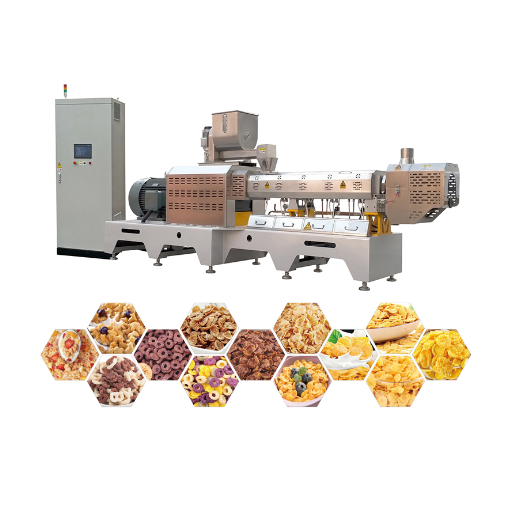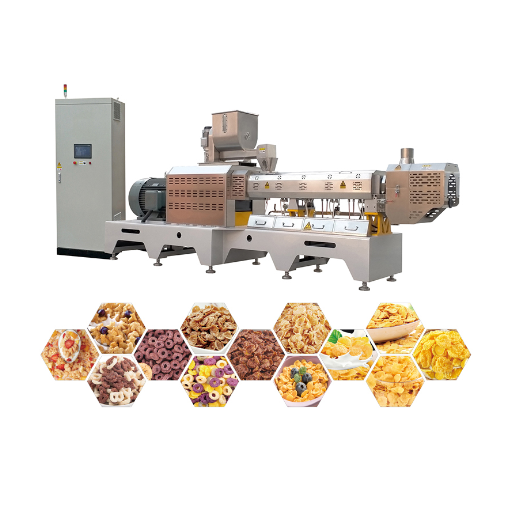
A corn flakes production line is a continuous system that mixes corn grits with sugar, malt and salt, pressure-cooks them, dries and tempers them, presses each grit flat between chilled rolls, then toasts, coats, cools and packs the flake. It is sized by the slowest stage in that chain, not by the cooker or the toaster alone.
That is where projects go wrong. A buyer sizes the cooker to the budget, then finds one flaking mill passes far less than the cooker can produce. The line runs at the mill’s pace.
This page covers what the line contains, the published models, the two machines that set flake quality, site utilities, and the data to send before a quote. If you know your product and output, and we will review the configuration. For the process itself, stage by stage, read how corn flakes are made.
Key Takeaways
- Published models run from 100 to 1,000 kg/h, with steam demand of 120 to 800 kg/h and installed power of 50 to 250 kW.
- Flake thickness is set at the flaking mill, normally 0.5-0.8 mm, with roll surfaces held at 43-46°C.
- A modern flaking roll set passes about 180-550 kg/h, so one mill cannot carry a 1,000 kg/h line.
- Toasting at 275-330°C for roughly 90 seconds leaves 1.5-3% moisture and sets the colour.
- Grit and extrusion routes share the flaking, toasting, coating and packing stages, where most of the capital sits.
What a Corn Flakes Production Line Includes

A complete corn flakes production line has eight stages, each with one job and one output the next stage depends on.
| Stage | Main machine | What it sets |
|---|---|---|
| Milling | Dry mill and sifter | Grit size, 3.5-6 mesh (3.4-5.8 mm), about 12% of the kernel |
| Cooking | Pressure cooker with sugar, malt and salt | Gelatinised starch, moisture below 32% |
| Drying and tempering | Dryer and tempering bins | 10-14% moisture, even through each grit |
| Flaking | Chilled roll mill | Flake thickness and surface structure |
| Toasting | Hot-air toaster | Colour, flavour, 1.5-3% final moisture |
| Coating | Coating drum or spray | Sugar or vitamin film, then drying |
| Cooling | Cooling conveyor | Flake temperature before packing |
| Packing | Weighing and bagging line | Fill weight, breakage, shelf life |
The table is also a capacity map. Cookers come in batch sizes, dryers in belt widths, flaking mills in roll diameters, and toasters in bed areas. A corn flakes processing line is balanced when every stage is rated at the same output and flake thickness.
Buyers who ask only for total output get an optimistic number; buyers who ask for a stage-by-stage balance get a line they can run. The extends the same map to other cereal products.
Published Corn Flakes Production Line Models and Capacity
The table below lists the configurations published for this corn flakes production line. Final configuration is confirmed per project, because steam pressure, flake thickness and pack format all move the usable output.
| Model | Output (kg/h) | Steam demand (kg/h) | Installed power (kW) | Published width (mm) |
|---|---|---|---|---|
| CFPL-100 | 100 | 120 | 50 | 500 |
| CFPL-200 | 200 | 180 | 75 | 600 |
| CFPL-300 | 300 | 250 | 100 | 800 |
| CFPL-500 | 500 | 400 | 150 | 1,000 |
| CFPL-1000 | 1,000 | 800 | 250 | 1,200 |
Three notes on reading it.
Output means finished flake, not cooked grits. Corn flakes line capacity is stated as packed flake, after toasting losses and coating pickup. Quoting on grit throughput flatters the result by a wide margin.
Published width rises with capacity. The flaking roll face widens from 500 mm on the smallest model to 1,200 mm on the largest. Width is a machine dimension, not a thickness setting; thickness comes from roll gap and roll speed together.
Installed power is not running power. These are connected loads for motors, heaters and drives. A line rarely draws that load for a full shift; the average depends on recipe and running pattern. Ask for a load profile rather than estimating one.
The Two Machines That Set Flake Quality
On a corn flakes production line, thickness is decided at the flaking mill and colour at the toaster. Everything upstream can be perfect and the product will still fail if either is set badly.
The flaking mill sets flake thickness
Commercial corn flakes run about 0.5-0.8 mm. An early process patent covers 0.010-0.050 in (0.25-1.27 mm) and names 0.025 in, about 0.64 mm, as preferred.
The gap alone does not hold that number. Grit springs back as it leaves the nip, so the gap is set below target and adjusted against measured output. Roll speed, grit moisture and roll temperature all shift the result.
Roll temperature is the setting most often ignored. Published guidance holds the roll surface at 110-115°F (43-46°C). Above about 120°F (50°C) the rolls wear faster and wet grit sticks. Below 110°F they lose grip and the grit slips instead of flattening. That is why a corn flakes production machine uses chilled, water-cooled rolls rather than dry ones.
Throughput is the constraint that catches planners. A modern roll set passes roughly 400-1,200 lb/h, or 180-550 kg/h, depending on roll size and flake thickness. Older babbitt-bearing rolls managed about 150 lb/h (68 kg/h). That gap explains why a used mill from a legacy plant will not carry a modern line.
Consider a buyer we will call Amara, planning a 300 kg/h line outside Lagos. She matched cooker and toaster to 300 kg/h, then chose a single flaking mill at the small end of the range. The corn flakes production line could cook and toast 300 kg/h and flake roughly half that. The fix was a second mill, not a bigger cooker.
Chilled rolls resist the thermal creep that opens a gap over a shift. Hydraulic gap control holds the setting under load, and scrapers parallel to the roll face stop build-up from lifting grit out of the nip.
The toaster sets colour and final moisture
Toasting does two things at once. It drives moisture down to 1.5-3%, which makes the flake crisp and gives it shelf life, and it develops the colour and toasted flavour that define the product. Published windows run 275-330°C for about 90 seconds.
A fluid-bed toaster works differently from a conventional oven. US patent 4,013,802 describes a unit running 350-400°F for 22-30 seconds, against 300-340°F in a conventional oven. The hotter, shorter cycle holds colour more evenly because every flake meets the same air.
Three settings decide the result: zone temperature, air velocity and bed depth. Raise the temperature and the flake darkens before the core dries. Raise the bed depth and the bottom layer scorches. Lower the velocity and the bed stops behaving like a fluid, which produces the streaky colour buyers reject.
Toasting is often the bottleneck on a line that looks balanced on paper. It has the least thermal headroom of any stage, because the margin between pale and burnt is a few degrees.
Grit Line or Extrusion Line: Two Routes to the Same Flake
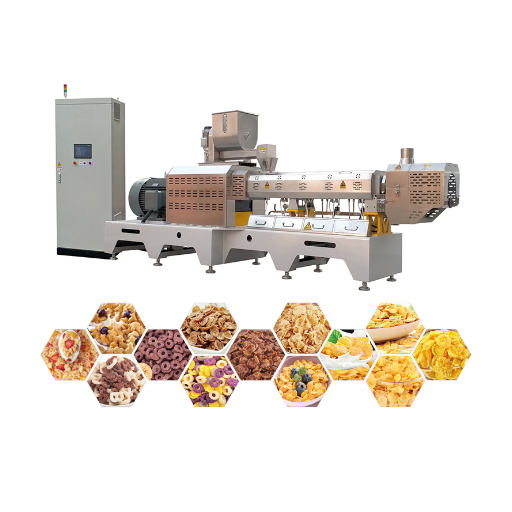
Both routes end with a flat, toasted flake. They start differently.
The grit route mills field corn into flaking grits, cooks them in batches under pressure, then dries and tempers them. The extrusion route mixes corn flour into a dough, cooks it in a twin-screw extruder and cuts pellets. Those pellets then follow the grit path: drying, tempering, flaking, toasting, coating, cooling and packing.
What changes is upstream. A grit line needs a mill, a sifter and pressure cookers, with long cycles and large batches. An extrusion line needs a mixer, an extruder and a pellet dryer, and changes product faster because the cook happens in the barrel.
What a corn flakes production line shares across both routes is most of the capital: flaking mills, toasters, coating drums, cooling conveyors and packing lines. That matters if you plan to add products later, because the second route costs far less than a second line.
The trade-off is product character. Grit flakes keep an irregular surface and a traditional bite. Extruded pellets flake more uniformly and accept whole-grain and multi-grain blends that will not pass a grit sifter. Neither is a defect; markets differ on which they want.
If extrusion is the likely route, the explains what happens inside the barrel and why screw configuration matters.
Utilities, Footprint and Site Requirements
Utilities decide whether a corn flakes production line can be installed at all, and they are most often left out of a first quotation.
Steam. Across the published range, demand runs from 120 to 800 kg/h at rated output, so the boiler must cover the line plus the rest of the plant. Pressure and dryness matter as much as flow, because wet steam delivers less heat per kilogram and upsets cooking and toasting.
Power. Installed load runs from 50 to 250 kW. Starting current is the practical issue, since several motors can start close together after a stoppage. A motor-by-motor load schedule is more useful than a single total.
Water. Flaking rolls are water-cooled, so the circuit needs a stable supply and a return path. Scale on a roll face changes heat transfer, which is why water quality matters where the circuit is open.
Compressed air and drainage. Pneumatic actuators need a dry, filtered supply; moisture shows up as sticking valves. Washdown water, condensate and spillage need floor falls and drains, which belong in the layout drawing rather than a later retrofit.
Footprint depends on the route, the dryer and toaster type, and the buffer storage between stages. Published machine dimensions do not add up to a building size, so ask for a layout drawing showing clearances, access and product flow.
Air emissions matter too. Cereal breakfast food plants emit particulate matter from dryers, toasters and handling, and the US EPA’s AP-42 section 9.9.2 gives the factors used in permitting. If your site needs an air permit, toaster and dryer exhaust are where the numbers come from.
Quality Control on a Corn Flakes Line
Quality control on a corn flakes production line is mostly measurement at four points.
Incoming grits. Sieve analysis confirms the grit range and moisture confirms the mill and storage are behaving. Grit size drift causes most thickness complaints.
After tempering. Moisture is checked before flaking, because 10-14% is the window where grit flattens without cracking. Too dry and it shatters; too wet and it sticks.
After flaking. Thickness is measured across the roll face, not only at the centre, because roll crown and gap taper show up at the edges. Surface inspection catches doubles and ragged edges.
After toasting. Final moisture, colour and bulk density are the release checks. Bulk density tells you whether the pack will hit its declared fill weight at a given bag volume.
Write the sampling points, frequency and acceptance range into the operating procedure, so the record stands up to a customer audit. Equipment built for cleanability makes the routine easier, and the EHEDG hygienic design standards explain the principles behind it. Our equipment can be configured to meet standards such as CE; certification status is confirmed per project.
What Drives the Price of a Corn Flakes Production Line
No useful price for a corn flakes production line exists without a scope. Two quotations at the same nominal output can differ by a factor of two, and both can be honest.
- Route. A grit line carries a mill, sifter and pressure cookers. An extrusion line carries an extruder and pellet dryer.
- Stage count. A line that stops at toasting costs less than one that includes coating, cooling and packing.
- Materials and finish. Food-grade stainless steel in product contact areas, polished welds and hygienic framing add cost and cut cleaning time.
- Automation level. Manual valves cost less than a PLC line with recipe management and interlocks. The second is easier to run consistently.
- Utilities scope. Boiler, chiller, compressor and water treatment may sit inside or outside the quotation; comparing totals without checking is the commonest tender error.
- Spare parts and documentation. A recommended spares list and a full documentation set belong in the comparison, not a footnote.
Listings for corn flake machinery vary widely, and other suppliers’ published figures are not our prices. For a structured view of what moves a cereal budget, read .
How to Specify Your Corn Flakes Production Line
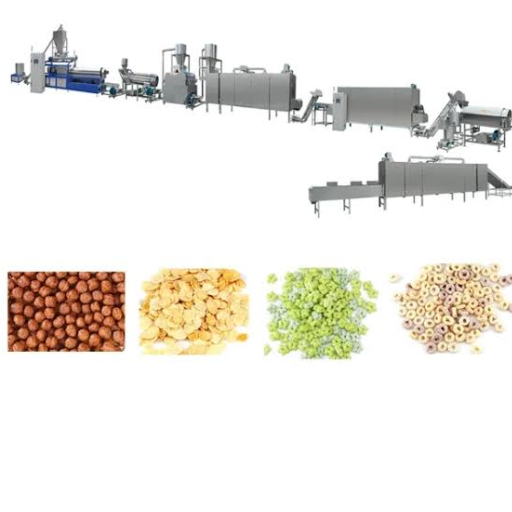
A full automatic cornflakes production line cannot be quoted from a single number. Send these ten items and the reply becomes an engineering answer rather than a brochure.
- Product description. Traditional grit flake, extruded flake, coated, fortified, whole grain, or a mix.
- Target output. kg/h of finished, packed flake, plus the shift pattern you plan to run.
- Flake thickness. The range you will accept and how you will measure it.
- Raw material. Field corn, corn flour, or bought-in grits with the supplier’s typical analysis.
- Coating and fortification. Sugar or malt level, vitamin premix, allergen constraints.
- Pack format. Retail pack sizes, bulk bags and the packing speed you need.
- Utilities available. Steam pressure and capacity, power supply and voltage, water quality and flow, compressed air.
- Building data. Floor area, ceiling height, floor loading, columns and access constraints.
- Compliance and market. Destination, voltage and frequency, document language, standards the equipment must be configured to meet.
- Scope boundaries. Process design only, or equipment plus installation and commissioning support.
With those ten, a supplier can size the stages, propose a layout and state the assumptions behind the output figure. A corn flake making machine quoted without them is a guess dressed as a specification.
Frequently Asked Questions
What capacity does a corn flakes production line come in? Published configurations run from 100 kg/h to 1,000 kg/h of finished flake. Other sizes are engineered per project, limited by how many flaking mills and how much toaster area the layout can hold.
How much steam and power does a corn flakes line need? Across the published range, steam demand runs from 120 to 800 kg/h and installed power from 50 to 250 kW. Steam pressure, dryness and the site’s starting-current capacity all affect what the plant must supply, so a load schedule is more useful than a single total.
How thick should a corn flake be? About 0.5-0.8 mm for most commercial products. An early patent covers 0.25-1.27 mm with roughly 0.64 mm preferred. Thinner flakes toast faster and break more in the bag; thicker flakes need more toasting time and pack less densely.
Can one line make both traditional and extruded flakes? The flaking, toasting, coating, cooling and packing stages are shared, so a line can often run both once the upstream equipment exists. Doing so means buying both upstream sets.
What is the difference between a corn flakes production line and a breakfast cereal production line? A corn flakes line is one configuration: grit or pellet preparation, flaking, toasting, coating and packing. A breakfast cereal line is the broader category and may add extrusion, gun puffing, shredding or granola equipment. If your range covers several cereals, specify the shared stages first.
Conclusion
A corn flakes production line is a chain of eight stages, and its capacity is the capacity of the slowest link. The published range runs from 100 to 1,000 kg/h, with steam demand of 120 to 800 kg/h and installed power of 50 to 250 kW.
Three decisions shape the rest. Choose grit or extrusion before specifying machines. Size the flaking mills against the target thickness, not against the cooker. Treat toasting as the stage with the least headroom, because colour and moisture leave little room to push.
After that, the work is in the detail: utilities that match the site, a quality plan with sampling points, and a scope listing what sits inside and outside the quotation. Those decide whether the line reaches rated output in month one or month six.
If you have a product brief and an output target, . We will review the stages, flag the constraints in your data, and tell you which configuration fits before price is discussed.