To measure food extrusion energy consumption, divide metered kWh by accepted product kg. Use the same loads and time period for both readings. Specific mechanical energy (SME) is screw work per unit of feed or other stated mass. It does not measure the whole line’s electricity use.
Two figures can use kWh/kg yet cover different equipment. Which one belongs in your buying comparison? A low food extrusion energy consumption figure means little until you know which loads it counts.
This guide shows how to set the scope, count the right output and check the maths. Use it to agree the test record before a run, then review the supplier’s readings with your own team.
Key Takeaways
- List every included load before calling a result whole-line consumption.
- Match energy readings to accepted output, including material still inside the line.
- State final moisture, quality criteria and the kilogram basis beside each ratio.
- Report screw SME separately, with its calculation and correction convention.
Food extrusion energy consumption: electrical SEC versus SME
Start with scope. Units alone don’t define food extrusion energy consumption. Electrical specific energy consumption (SEC) is electricity used per unit of output.
SME is screw work divided by a stated amount of material. Ask what each figure counts.
The US Department of Energy’s energy-intensity guidance stresses an appropriate boundary and matching time frame for energy and productive output.
Illustrative scenario: One offer quotes screw SME. Another quotes electricity for an extruder and dryer. Which line uses less electricity per accepted kg?
Neither number alone can tell you. Ask both suppliers for the same scope before comparing the figures.
For your enquiry, contact Loyal about your extrusion project with the product, accepted-output requirement and equipment you want included. Ask which configuration-specific measurement information is available.
Separate the energy paths
| Metric | Numerator | Denominator to disclose | What it answers |
|---|---|---|---|
| Line electrical SEC | Metered electricity inside the boundary | Accepted product kg at a defined stage | How much electricity was used per accepted kg? |
| Screw SME | Mechanical work under a declared torque convention | Feed or other declared material mass | What mechanical input did the material receive? |
| Thermal energy intensity | Delivered heat or fuel energy on a stated basis | Declared product mass | What separate heating input was required? |
Food extrusion energy consumption may also involve gas or steam. Record these inputs apart from the electricity reading. If you leave those inputs out, electrical SEC cannot describe all utility use.
Does your meter cover an electric boiler? If so, don’t count its electricity again as a separate load.
Understand the screw-power calculation
For corrected torque at a stated screw measurement location:
P_net [kW] = 2 × pi × N [rpm] × T_net [N m] / 60000
SME [kWh/kg] = P_net [kW] / q [kg/h]
Here, N is screw speed. T_net is torque after the stated correction. The chosen mass flow is q.
The 2014 Fayose and Huan extrusion study describes a corrected-torque method for its experimental apparatus. It explains one test method. It does not define how all controllers work.
Where is torque measured: at the motor, gearbox output or screws? That choice matters when comparing SME with food extrusion energy consumption. For twin screws, check the scope.
Does the reading cover both shafts or just one? Record any drive-loss or no-load correction already applied; don’t subtract it twice. The broader food extrusion process guide provides process context, while the measurement convention must come from the tested system.
Define the line boundary, product basis and trial conditions
Define food extrusion energy consumption before a run starts. A meter for just the extruder won’t show what drying, cooling and packing use. Draw the scope on a line diagram.
Mark the loads each meter covers. Use this suggested register. Adapt it to the process you have.
Build a boundary register
For food extrusion energy consumption, list each load that is present:
- Mixer, feeder and preconditioner.
- Extruder main drive, cutter and electrical heaters.
- Dryer, cooler, fans and pumps.
- Conveyors, coating equipment and packer.
For each item, name the meter. Say if it is included and when it ran.
Shared services can change reported food extrusion energy consumption. Give each one its own entry. Check compressed air, cooling water and central steam.
Does the report use direct readings or an assigned share? If a service is left out, say so. Don’t assign a shared compressor’s whole meter reading to one line without a stated basis.
Show how you assigned that share, so another reader can check it.
The food machinery utility requirements worksheet helps organize supply interfaces. Connection capacity and utility availability belong in that preparation; measured energy per kilogram needs the additional run data described here. Keep those two questions separate in the test brief.
Choose the product you will count
For food extrusion energy consumption, define the kilograms you count. One basis is accepted uncoated product after drying, at the agreed final moisture. Are bags, trays, oil or seasoning included?
Say which ones you count. Tare the containers. Leave packaging out of product kg unless you clearly define a different metric.
Feed mass, wet discharge, dry matter and accepted packed product are different bases. Don’t swap one for another without saying so. A wet product can weigh more because it holds more water.
Coating also adds mass. Neither change alone proves that the extruder performs better.
Before comparing food extrusion energy consumption, fix these test conditions:
- Recipe revision and raw-material lot.
- Feed moisture and target quality.
Record screw configuration, die, screw speed, thermal settings, drying conditions and the required accepted rate. Use food extrusion trial preparation for the materials and sample brief, then add the energy boundary to that brief.
The result is a defined test. It is not a broad promise about the machine. Did a setting change during the run?
Log it and split the result where needed. Do not blend unlike product periods into a single attractive average.
Measure food extrusion energy consumption over a matched run
A running meter total helps only when you can match it to the product you count. Use the steps below to plan the report. First check which instruments the line has. Before the test, name the people who will log energy, weigh output and judge quality.
1. Confirm the instruments and operating window
Have a qualified person choose suitable meters. Check the loads each one covers. Log the meter ID, units and multiplier.
Record its accuracy or check status too. Read actual kWh, or calculate energy from logged real power over time. A motor’s nameplate kW can’t establish food extrusion energy consumption.
You need actual readings.
Choose the period for food extrusion energy consumption: a stable run, full batch or full shift. Record start and end times, including the time zone. Log heater cycles, stops and recipe changes so the reader can explain changes in use.
Set the test length and logging rate to suit the process and meter. No single test length fits every line.
2. Match energy to product collection
Read the meter’s total kWh at the window’s start and end. Collect and weigh the accepted output from that period. Label each container or batch.
To measure food extrusion energy consumption, track how long product stays in the line. Log stock still inside it at the start and end. Check what is already in the dryer when product collection starts at the extruder.
Illustrative scenario: The extruder stops at the nominal test end, but product remains in the dryer. Counting that product after the energy window closes leaves part of its drying electricity outside the result. Where you can, start and end with an empty line.
Otherwise, show how you matched the stock to the energy used. Can’t match the periods? Flag the run: it cannot support a fair per-kg comparison.
Use the extruded snack dry-matter mass balance worksheet to reconcile product, water and stock movements. Record rejects, samples and rework separately. Count reworked product once, when it becomes accepted output. Keep the energy used within the stated test period.
3. Preserve a reproducible run record
| Worksheet field | Entry for this run |
|---|---|
| Run ID, recipe revision and equipment configuration | To complete |
| Included loads, meters and shared-service allocation | To complete |
| Start/end timestamps, time zone and meter readings | To complete |
| Accepted product kg, collection point and container tare | To complete |
| Moisture result, wet/dry basis and test method | To complete |
| Rejects, samples, rework and opening/closing stock | To complete |
| Startup, idle, stops and excluded utilities | To complete |
| Quality decision, instrument checks and record owner | To complete |
Keep raw readings with the food extrusion energy consumption calculation. Repeat under normal test conditions. Show how much the results vary; don’t choose just the lowest run. Do not subtract idle electricity from an all-in electrical result unless a separate metric explains what you took out.
Worked calculations: accepted kilograms, dry matter and SME
These food extrusion energy consumption calculations use hypothetical inputs. They are not Loyal specifications, customer results or industry benchmarks. The electrical and mechanical examples use different mass bases. Read them separately.
Calculate electrical SEC from accepted output
Start with the meter difference: E = E_end - E_start. Then use Electrical SEC = E / m_accepted. Keep the original readings, even if the report shows only their difference.
If accepted output is zero, the ratio has no valid value. Report the energy used. Explain why there was no accepted output.
Suppose a matched two-hour period uses 150 kWh and produces 500 kg of accepted product. The calculation is:
Electrical SEC = 150 kWh / 500 kg = 0.300 kWh/kg accepted product
Average electrical power is 150 / 2 = 75 kW. Accepted throughput is 500 / 2 = 250 kg/h. Dividing 75 kW by 250 kg/h also gives 0.300 kWh/kg because both averages describe the same interval and boundary.
How do rejects affect food extrusion energy consumption? Suppose total discharge is 550 kg, including 50 kg of rejects. Dividing 150 by 550 gives about 0.273 kWh/kg of total discharge.
That is a different result with a different name. Calling it accepted-output SEC would hide the rejects.
If the accepted 500 kg contains 10% moisture on a wet basis, its dry matter is:
Accepted dry matter = 500 × (1 - 0.10) = 450 kg
Dry-matter electrical SEC = 150 / 450 = 0.333 kWh/kg dry matter
Changing the mass basis saved no energy. It changed how food extrusion energy consumption was stated. Both ratios use the same 150 kWh.
Keep the moisture test method and collection point with the maths. This matters when one report weighs wet discharge and another weighs dried product.
Calculate SME using a declared feed basis
In a separate hypothetical screw calculation, corrected total torque is 1,000 N m at 300 rpm. Net mechanical power is 2 × pi × 300 × 1000 / 60000 = 31.416 kW. At a declared feed rate of 250 kg/h, SME is 31.416 / 250 = 0.1257 kWh/kg feed.
Multiply the unrounded result by 3,600 to obtain about 452.39 kJ/kg feed. Keep the original inputs if you round SME to 0.126 kWh/kg. Converting the rounded figure back gives a slightly different result.
Do not subtract this feed-based SME from accepted-product electrical SEC to infer dryer demand or drive efficiency. The examples use different mass bases and energy paths. To split the loads, measure each on the same scope and period. Their arithmetic difference is not a measured load.
Measured food extrusion energy consumption is only one input to an electricity-cost estimate. A tariff, demand charges, separate fuels and the operating schedule may also matter. This worked example therefore makes no total utility-cost or payback claim.
Compare food extrusion energy consumption without sacrificing quality
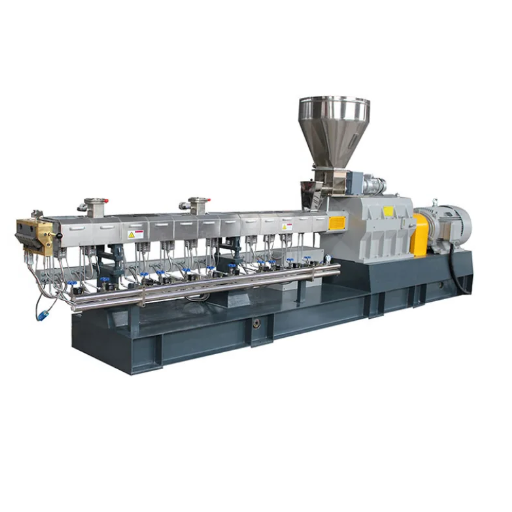
A lower food extrusion energy consumption figure is useful only if you know what product was made. Read energy beside accepted yield, throughput, final moisture and the agreed texture, expansion or other quality criteria. Record differences instead of assuming two runs are equivalent because their products have the same name.
Keep research results within their scope
The wheatgrass and pea-starch extrusion study published on 15 April 2026 examines SME and product responses under a specified experimental design. It shows why a food extrusion energy consumption report needs both recipe and run settings. It does not establish a commercial whole-line electricity benchmark for a different recipe or machine.
For optional process background, NPTEL IIT Kharagpur’s Food Extrusion Technology: Part 2 lecture introduces extrusion processing factors. Use it as educational context, rather than an electrical-metering demonstration or evidence of Loyal equipment performance.
Illustrative scenario: A second run reports less electricity per wet kilogram, but its product leaves the dryer above the agreed moisture limit. The extra water adds weight. The drying target has also changed.
That is not a fair comparison of accepted product. Restore matched specifications before judging performance.
Request a food extrusion energy consumption report you can compare
Ask for a food extrusion energy consumption report you can check:
- Line setup and included loads.
- Raw meter readings and times.
- Product mass, its basis and quality results.
- Excluded loads and utilities.
Include meter limits and variation between runs. Agree the allowed range before the test. This guide sets no universal limit and promises no result.
The food machinery factory acceptance test checklist helps place that evidence inside the wider acceptance agreement. A valid energy calculation does not by itself establish overall equipment acceptance. If a report lacks a meter scope or quality result, ask for that missing record before using its ratio to rank offers. Keep the original report so changes remain traceable.
If you have a proposed test specification, send Loyal your extrusion project requirements and ask which readings and configuration details can be discussed. Include the required product quality alongside the output rate so an energy question does not become a capacity-only enquiry.
Questions about extrusion kWh/kg and SME
Is SME the same as the electricity used by an extrusion line?
No. SME describes mechanical input on a declared material basis. Line electrical SEC counts the loads its meter covers.
These may include heaters and downstream loads. Both can use kWh/kg, but their energy paths and mass bases differ. Ask for the formula and boundary before comparing them.
Can I divide motor nameplate kW by rated capacity?
That calculation produces a rated-power-to-capacity ratio, not measured consumption. Measure actual loads and accepted output over the same period. A nameplate also does not establish which heaters, dryers or shared services are included.
Use it to identify the motor. Then ask for meter readings and the matching accepted mass.
Should I use feed, wet product, dry matter or packed product?
Choose the basis that answers your question. Name it clearly. Feed-based SME supports a process calculation; accepted-product electrical SEC supports an output-based electricity comparison.
Dry matter can help explain moisture differences. For packed product, define the coating and packaging scope; keep separate ratios for each mass basis.
Should startup, idling, rejects and rework be included?
Include them when reporting an all-in batch or shift within the declared boundary. A steady-state result can leave out startup. Label it clearly and report it on its own.
Rejects reduce accepted output, while their processing energy remains in the period. Avoid counting rework twice as accepted mass when it passes through again.
How do I convert kWh/kg, kWh/tonne and kJ/kg?
Multiply kWh/kg by 1,000 for kWh per metric tonne, or by 3,600 for kJ/kg. For example, 0.300 kWh/kg equals 300 kWh/tonne or 1,080 kJ/kg. The unit changes; the scope and mass basis stay the same.
Converting food extrusion energy consumption does not change what you measured. Screw SME remains screw SME after conversion, even when its unit matches line electrical SEC.
What is a good energy figure for my food extrusion line?
There is no universal food extrusion energy consumption benchmark in this guide. Compare measured runs with matched formulation, quality, moisture, accepted throughput, utility scope and operating window. Investigate changes in those conditions before crediting the machine for a lower ratio.
Ask for the raw readings and variation between runs. Your team should be able to check the comparison.
Bring a defined measurement question to your enquiry
Before comparing food extrusion energy consumption, write the result you need: “Electrical kWh per kg of accepted product, with stated moisture and listed loads.” Name the point where product is weighed. Say whether the test covers steady production or a full operating period. This gives the supplier a clear question and your team a way to check the answer.
When reviewing food extrusion energy consumption, recall the three illustrative scenarios. Leaving out equipment changes the energy counted. Unmatched product windows break the ratio.
Wetter output changes the mass counted. A credible report makes each choice visible. If one is unknown, flag the reading as incomplete.
Don’t turn it into a performance claim.
Send the product and recipe, required accepted kg/h, final moisture and quality limits. List the equipment and available utilities. Include the planned test window and your questions about the method. If the recipe is still being developed, say which details may change before asking for a firm comparison.
Contact Loyal with that project brief to discuss the equipment enquiry and ask what supporting information can be supplied. Keep measured food extrusion energy consumption, screw SME and separate thermal inputs clearly named throughout the discussion.