Pet food HACCP compliance means identifying and controlling food safety hazards at every stage of manufacturing using the Hazard Analysis and Critical Control Points framework. For pet food producers, this involves establishing documented controls for biological threats like Salmonella, chemical contaminants such as mycotoxins, and physical hazards including metal fragments, with extrusion cooking typically serving as the primary validated kill step.
Here is a sobering reality: over 166,000 pounds of pet food were recalled in 2025, and Salmonella topped the violation list. For manufacturers, the gap between a thriving brand and a recall headline often comes down to one thing: whether HACCP compliance was engineered into the production line from day one.
You already know food safety matters. What you may not realize is that the most important HACCP decision happens before you write a single procedure. It happens when you choose your equipment. The right extrusion system, with validated kill-step temperatures and continuous monitoring, creates an audit trail regulators expect. The wrong system turns every batch into a gamble.
In this guide, you will learn the seven HACCP principles applied specifically to pet food manufacturing, how to identify critical control points for dry, wet, and raw products, what equipment design choices simplify certification, and how to budget for the full compliance journey. Whether you are building a new facility or upgrading an existing line, this article gives you a practical, equipment-grounded roadmap.
Key Takeaways
- Pet food HACCP compliance centers on seven principles, with extrusion cooking as the primary biological kill step requiring validation at 120-160 degrees Celsius and 20-40 bar pressure.
- Full HACCP certification costs range from 5,000forsmallfacilitiesto5,000forsmallfacilitiesto50,000 or more for large operations, typically taking 3 to 9 months to complete.
- Equipment design decisions, including SUS 304 or 316 stainless steel, clean-in-place systems, and PLC-based monitoring, directly impact audit outcomes and certification speed.
- Only 41.5% of pet food manufacturers currently hold HACCP certification, creating a significant competitive advantage for compliant producers.
- A single production line can be engineered to meet FDA FSMA, EU Regulation 183/2005, and Chinese GB standards simultaneously, enabling global market access.
What Is HACCP for Pet Food?

HACCP stands for Hazard Analysis and Critical Control Points. It is a systematic, preventive approach to food safety that identifies where hazards could enter your process and establishes controls to prevent them. Originally developed for human spaceflight food in the 1960s, HACCP has become the global standard for food manufacturing across every category, including pet food.
For pet food specifically, HACCP means mapping each step of your process, from ingredient receiving through final packaging, and asking a simple question at each stage: what could go wrong here that would harm an animal or a human handling the product?
The hazards fall into four categories.
Biological hazards include Salmonella, Listeria monocytogenes, and E. coli. These pathogens can survive inadequate heat treatment and sicken pets or the humans who handle their food.
Chemical hazards cover mycotoxins in grain ingredients, heavy metals from fish meal, and drug residues such as sodium pentobarbital in meat and bone meal. Excess vitamins can also become toxic at high concentrations.
Physical hazards are foreign objects like metal fragments from worn extruder screws, plastic pieces from packaging, or bone shards from raw materials. Radiological hazards, while less common, are now addressed under FDA’s Food Safety Modernization Act.
It is important to understand one regulatory distinction. The FDA does not legally mandate a traditional HACCP plan for pet food. Unlike seafood or juice for human consumption, pet food operates under different rules.
However, under the Food Safety Modernization Act, pet food manufacturers must comply with 21 CFR Part 507. This rule requires current Good Manufacturing Practices and a written Food Safety Plan with hazard analysis and risk-based preventive controls. This Food Safety Plan is essentially HACCP in a broader framework. Many facilities choose to build their required plan using traditional HACCP principles because the structure is familiar to auditors, retail buyers, and export regulators worldwide.
The Regulatory Landscape: What Manufacturers Must Know
Pet food safety regulations vary by market, and export manufacturers often must satisfy multiple frameworks simultaneously. Understanding these requirements before you design your food production line prevents expensive retrofits later.
United States: FDA FSMA and 21 CFR Part 507
The FDA regulates pet food as animal food under the Food Safety Modernization Act. Facilities must establish current Good Manufacturing Practices covering staff procedures, building maintenance, waste treatment, equipment upkeep, and production practices.
Every facility that manufactures, processes, packs, or holds animal food must develop a written Food Safety Plan. This plan must be signed by a Preventive Controls Qualified Individual. It must include hazard analysis, preventive controls, monitoring procedures, corrective actions, verification activities, recordkeeping, and a recall plan.
European Union: Regulation 183/2005 and FEDIAF
EU Regulation 183/2005 sets feed hygiene rules that apply to pet food manufacturing. The European Pet Food Industry Federation, known as FEDIAF, publishes the Guide to Good Practice for the Manufacture of Safe Pet Foods.
This guide serves as the primary reference for EU manufacturers and export facilities shipping to European markets. National schemes, such as the German QS Guideline Pet Food, require integrated HACCP systems verified at least annually.
China: GB/T 13078 and GB/T 5915
Chinese national standards govern feed hygiene and pet food quality. GB/T 13078 addresses feed hygiene, while GB/T 5915 covers compound feed quality. Export-oriented Chinese manufacturers often seek additional certifications such as ISO 22000, HACCP, and SQF to meet buyer requirements in Europe and North America.
Global Standards: Codex and GAPFA
The Codex Alimentarius General Principles of Food Hygiene provide the accepted baseline for HACCP worldwide. The Global Alliance of Pet Food Associations publishes the Global Pet Food Safety Guidance, which aligns pet food safety plans with Codex HACCP principles and emphasizes traceability, supplier control, and validated heat treatment.
| Region | Primary Regulation | Key Requirement |
|---|---|---|
| United States | FDA FSMA, 21 CFR Part 507 | Food Safety Plan with preventive controls; PCQI required |
| European Union | Regulation 183/2005, FEDIAF | Integrated HACCP; annual verification |
| China | GB/T 13078, GB/T 5915 | Feed hygiene and compound feed quality standards |
| Global | Codex CAC/RCP 1, GAPFA | HACCP principles; traceability; validated kill steps |
The Seven HACCP Principles: A Step-by-Step Breakdown
Every pet food HACCP plan, whether for dry kibble, wet food, or raw diets, follows the same seven principles established by the Codex Alimentarius. Here’s how its principles apply to making pet food.
Principle 1: Conduct a Hazard Analysis. Map each process step. Assess biological, chemical, physical, and radiological hazards at every stage.
For extruded dry food, biological hazards center on Salmonella survival through inadequate heat treatment. For raw pet food, the focus is on keeping things cold and stopping harmful bugs using freezers since they skip the heat treatment. FeedHACCP gives very specific guides for both dry and raw pet food.
Principle 2: Identify Critical Control Points. A CCP is where we act to prevent, eliminate, or reduce hazards to safe levels. In dry pet food manufacturing, extrusion cooking is almost always a CCP because it is the primary thermal kill step. Metal detection before packaging is another CCP because it is the last opportunity to intercept physical contaminants.
Principle 3: Establish Critical Limits. Critical limits are measurable, science-based boundaries. For extrusion, the critical limit might be a minimum barrel temperature of 82 degrees Celsius at the die. For drying, the limit might be a maximum final moisture of 11 percent. These numbers must be validated for your specific recipe, equipment model, and throughput rate.
Principle 4: Establish Monitoring Procedures. Monitoring answers four questions: what, how, when, and who. For extrusion temperature, the answer might be: barrel temperature at the die, measured by a calibrated thermocouple, recorded continuously on a chart recorder, reviewed by the production supervisor every two hours.
Principle 5: Establish Corrective Actions. If a critical limit is breached, we’ve gotta follow set procedures next. If extrusion temperature drops below the validated minimum, take immediate action.
Segregate the affected batch into a hold bin. Evaluate the product for rework or disposal. Identify and correct the equipment malfunction. Document the deviation, root cause, and product disposition. Every step must be recorded.
Principle 6: Establish Verification Procedures. Verification confirms that the HACCP system is working correctly over time. This includes calibration of monitoring equipment, record review by quality assurance, microbial testing of finished product, and annual reassessment of the entire plan.
Here is an important distinction many manufacturers confuse. Validation proves your process can achieve the intended food safety outcome before routine production begins. Verification confirms that your validated process is actually working during day-to-day operations. Do not mix them up.
Principle 7: Record-Keeping and Documentation. Maintain detailed records of hazard analysis, CCP determinations, critical limits, monitoring logs, corrective actions, verification activities, and calibration schedules. Many guidelines require archiving records for at least two years. Local law may demand longer retention. Check your jurisdiction.
Critical Control Points for Pet Food HACCP Compliance
The specific CCPs in your facility depend on the type of pet food you produce. Here is how critical control points differ across the three main product categories.
Dry and Extruded Pet Food
For extruded kibble, four CCPs are standard across the industry.
Pre-conditioning is the first CCP. Raw materials enter the extruder at 10 to 12 percent moisture. That is too dry for effective heat penetration.
Pre-conditioning raises moisture to 25 to 30 percent. Temperature reaches 60 to 90 degrees Celsius. This prepares the mixture for the kill step. Inadequate pre-conditioning means the extruder cannot achieve validated lethality. The entire process fails.
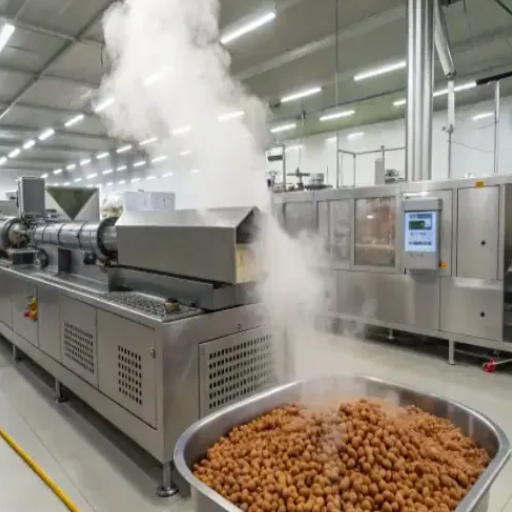
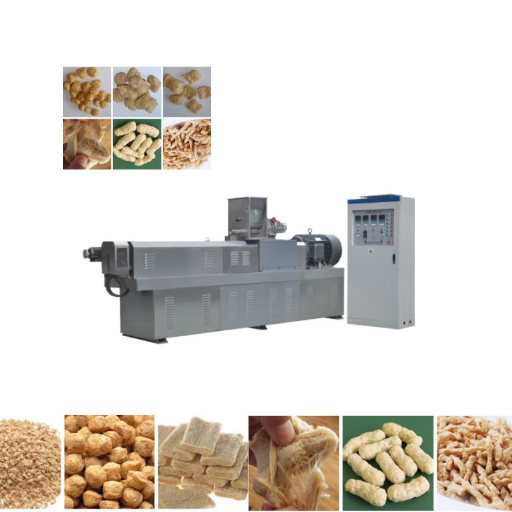
Extrusion cooking is the critical kill step. It is the most important CCP in the entire process. Barrel temperatures typically reach 120 to 160 degrees Celsius under pressures of 20 to 40 bar. These conditions gelatinize starch. They denature proteins. These steps eliminate pathogens.
However, extrusion does not automatically kill Salmonella. The specific time-temperature combination must be scientifically validated for your recipe, equipment, and throughput. Regulators and auditors will ask for this documented validation. Do not skip it.
Drying reduces final moisture to 8 to 11 percent, preventing mold growth and bacterial regrowth after the kill step. Inline moisture sensors provide continuous monitoring, with deviations triggering immediate corrective action.
Metal detection serves as the last line of defense before packaging. Extruder screws and dies wear over time, and metal fragments can enter the product stream. Zero tolerance is the standard, with continuous monitoring and routine calibration checks.
Wet Pet Food and Canning
Wet pet food manufacturing uses retort sterilization rather than extrusion. The CCPs reflect this different thermal process.
Seaming and sealing integrity ensures cans, trays, or pouches are properly closed before sterilization. Product in the seal or damaged flanges can compromise the sterile barrier.
Retort sterilization is the kill step, measured by F0 value, which must reach at least 3 for commercial sterility. Time, temperature, and initial product temperature are all monitored and calibrated.
Cooling water quality prevents post-process contamination. Unchlorinated or contaminated cooling water can reintroduce microorganisms into the sealed package through micro-leaks.
Raw and Fresh Pet Food
Raw pet food carries higher microbiological risks and relies on cold rather than heat for pathogen control.
Cold chain maintenance keeps ingredients and finished product at or below minus 17 degrees Celsius. Incoming product should be at or below minus 12 degrees Celsius. Temperature logging at receiving, storage, and distribution is continuous.
Rapid freezing using in-line tunnel freezers or blast freezers minimizes the time bacteria can multiply during the transition from fresh to frozen.
Metal detection after grinding and mixing catches bone fragments and equipment wear debris.
| Product Type | CCP 1 | CCP 2 | CCP 3 | CCP 4 |
|---|---|---|---|---|
| Dry/Extruded | Pre-conditioning | Extrusion cooking | Drying | Metal detection |
| Wet/Canned | Seaming integrity | Retort sterilization | Cooling water quality | Metal detection |
| Raw/Frozen | Cold chain receiving | Rapid freezing | Cold chain storage | Metal detection |
Equipment Design: Building Pet Food HACCP Compliance Into Your Line
When Chen Wei prepared for his first SQF audit, he discovered a problem that no amount of paperwork could fix. Chen runs production at a mid-sized pet food facility in Jiangsu Province. His extrusion line used carbon steel components in the mixing zone. The auditor flagged them immediately.
Food contact surfaces must use stainless steel. No exceptions. The retrofit cost his company three weeks of downtime and $12,000 in replacement parts. Had the line been designed with HACCP-compliant materials from the start, the audit would have been a formality.
This is why equipment design is the most overlooked yet most consequential part of pet food HACCP compliance. Here is what to demand from your production line.
Food-Contact Materials
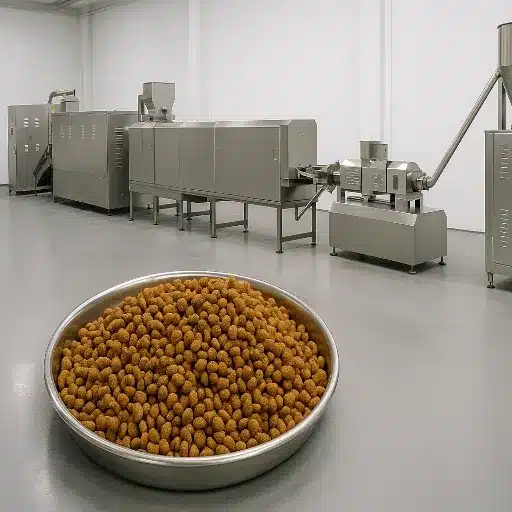
Food-contact surfaces must use SUS 304 or SUS 316 stainless steel. SUS 304 is the standard choice for most pet food applications. It offers excellent corrosion resistance and cleanability at a reasonable cost.
SUS 316 contains molybdenum. That means superior resistance to chlorides and acidic ingredients. It is the better choice for facilities using high-acid flavor coatings or aggressive cleaning chemicals. Surface finishes should be at or below 0.8 micrometers Ra. Smooth surfaces resist bacterial adhesion. They clean more effectively.
Cleanability and Sanitation
Clean-in-Place systems allow you to sanitize equipment without disassembly, reducing both labor costs and contamination risk. Look for designs with smooth welds, minimal dead legs, sloped surfaces that drain completely, and quick-disconnect fittings for components that must be removed for periodic deep cleaning. The time saved during sanitation directly translates to more production hours per day.
Automated Monitoring and Traceability
Modern extrusion systems use programmable logic controllers to log temperature, pressure, moisture, and metal detection events automatically. It creates a timestamped audit trail that regulators and retail buyers expect to see.
Supervisory Control and Data Acquisition systems take monitoring to the next level, so we go beyond what CCPs do alone. They aggregate data across multiple production lines into a centralized dashboard. Quality managers can spot trends, predict maintenance needs, and generate compliance reports with a few clicks. No manual logging required.
Modular Multi-Standard Design
Export-oriented manufacturers face a unique challenge: one production line must satisfy FDA inspectors, European Union auditors, and Chinese regulators, each with different emphasis and documentation requirements. Modular equipment design addresses this by building compliance features into the standard configuration rather than adding them as aftermarket modifications. Temperature sensors are positioned for optimal monitoring. Material certifications are documented at the factory. Control systems are programmed to generate reports in multiple formats.
At Shandong Loyal Industrial, our turnkey pet food production lines are engineered with these principles from the ground up. With over 10 years of experience building extrusion systems for global clients, we understand that HACCP compliance is not an add-on. It is built into the steel, the welds, and the software.
Prerequisite Programs: The Foundation Before HACCP
HACCP cannot function without solid prerequisite programs in place. These foundational controls create the environment where CCPs can work effectively.
Supplier approval and control ensures incoming ingredients meet your safety specifications. Approved supplier programs, certificates of analysis for high-risk ingredients, and incoming inspection protocols prevent hazards from entering your facility in the first place.
Pest control programs prevent birds, rodents, and insects from introducing pathogens into production areas. Integrated pest management, including exterior bait stations, interior monitoring devices, and documented inspection rounds, is essential.
Personnel hygiene and training addresses the reality that people are a primary source of contamination. Handwashing stations at entry points, hygiene zoning that separates raw from cooked areas, and ongoing training on food safety practices reduce human-borne risks.
Environmental monitoring uses ATP swabbing and pathogen screening to verify that your sanitation program is working. High-risk post-extrusion areas deserve particular attention, since this is where recontamination after the kill step can occur.
Water quality standards apply to both steam used in pre-conditioning and contact water in cooling and cleaning. Potable water, with documented microbial and chemical testing, is a basic requirement that auditors always verify.
Traceability and recall systems enable two-way tracking from raw material suppliers through finished product distribution. Lot coding, production records, and shipping documentation must connect seamlessly so that if a problem is discovered, you can identify affected product within hours, not days.
HACCP Certification: Cost, Timeline, and Common Pitfalls
Achieving HACCP certification follows a predictable sequence, though the timeline and cost vary significantly based on your starting point.
The Eight-Step Certification Process
- Gap analysis compares your current practices against HACCP requirements, identifying what is missing before you begin formal plan development.
- Team formation brings together production, quality assurance, engineering, maintenance, and management representatives who will own the HACCP system.
- Prerequisite program implementation establishes sanitation, pest control, supplier controls, and traceability systems before the HACCP plan itself is written.
- HACCP plan development creates the documented hazard analysis, CCP determinations, critical limits, monitoring procedures, corrective actions, and verification schedules.
- Implementation and record generation runs the system in production, generating the monitoring logs, deviation reports, and calibration records that prove the system works.
- Stage 1 audit is a documentation review conducted by your chosen certification body to verify that your plan is complete and adequate before the site visit.
- Stage 2 audit is the on-site compliance audit where the auditor observes operations, interviews staff, checks records, and verifies that CCPs are under control.
- Certification is issued if no major non-conformities exist, typically valid for three years with annual surveillance audits.
Cost Breakdown
| Cost Component | Small Facility | Medium/Large Facility |
|---|---|---|
| Training (per person) | $300-600 | $300-600 |
| Gap analysis | $500-1,500 | $1,500-3,000 |
| Consultant fees | $2,000-8,000 | $8,000-20,000+ |
| Certification audit | $3,000-6,000 | $6,000-12,000+ |
| Infrastructure upgrades | $1,000-5,000 | $5,000-20,000+ |
| Annual surveillance | $1,500-3,000 | $3,000-5,000 |
| Total first-year investment | $5,000-15,000 | $15,000-50,000+ |
Common Reasons Audits Fail
The most frequent certification failures trace back to preventable issues. An incomplete hazard analysis misses hazards at specific process steps. It might overlook allergens during ingredient transitions.
CCPs without real-time monitoring rely on operator memory rather than calibrated instruments. Auditors flag these gaps immediately. Missing corrective action records create a documentation void. Every deviation at a CCP goes undocumented, undermining the entire system’s credibility. Weak prerequisite programs attempt to layer HACCP on top of inadequate sanitation. That approach collapses under audit scrutiny.
Consider Maria Santos, a quality director at a Brazilian pet food exporter. Her facility passed the Stage 1 documentation review with flying colors. But the Stage 2 audit revealed a critical weakness.
Her extrusion temperature logs showed consistent readings. But the thermocouple calibration records told a different story. The sensor had not been calibrated in 14 months. The auditor issued a major non-conformity. Maria had to reschedule the follow-up audit at additional cost.
The lesson is simple: verification procedures matter as much as the CCPs themselves.
Beyond HACCP: Advanced Safety Certifications

HACCP is the foundation, but many pet food manufacturers pursue additional certifications to meet buyer requirements and access premium markets.
SQF, or Safe Quality Food, includes pet food-specific manufacturing codes and covers both safety and quality management. It is widely required by major retailers in North America and Australia.
FSSC 22000 is a full food safety management system recognized by the Global Food Safety Initiative. Major brands such as Mars Petcare operate under FSSC 22000 with integrated HACCP plans.
BRCGS, formerly the British Retail Consortium Global Standard, is particularly important for suppliers to UK and European retailers.
ISO 22000 provides the international framework for food safety management systems and integrates well with existing ISO 9001 quality management certifications.
Each of these frameworks incorporates HACCP principles while adding additional requirements for quality management, environmental monitoring, and supplier verification. The good news is that a well-designed HACCP plan serves as the backbone for any of these advanced certifications.
Conclusion
Achieving pet food HACCP compliance is not a paperwork exercise. It is a manufacturing philosophy that starts with equipment selection and extends through every batch you produce.
The seven principles give you a structured framework. The critical control points give you measurable controls. The prerequisite programs give you a clean foundation. Your equipment determines how easily all of it comes together.
The pet food processing market is growing at 6.17 percent annually. So is regulatory scrutiny. For insights into production processes and equipment, see our guide on high protein pet food manufacturing. Facilities that treat HACCP as an afterthought will face rising recall risk, buyer rejection, and market access barriers. Facilities that engineer compliance into their production lines from the start will capture the trust of retailers, regulators, and pet owners worldwide.
If you are planning a new pet food facility or upgrading an existing line, start with the equipment. A turnkey extrusion system designed for HACCP compliance transforms certification from a burden into a competitive advantage. Validated kill-step parameters, continuous monitoring, and multi-standard certification support give you everything auditors expect.
Contact Shandong Loyal Industrial today for a consultation on HACCP-compliant pet food production lines. With over 10 years of expertise and installations in more than 50 countries, we design extrusion systems that meet FDA FSMA, EU Regulation 183/2005, and Chinese GB standards from day one. Tell us your production goals, and we will deliver a solution tailored to your needs.