A biscuit packaging machine is chosen backwards from the pack on the shelf: pack style fixes handling, handling fixes the machine class, and line output fixes the speed you need.
Most buyers start with the packs-per-minute headline. Then the format nobody discussed constrains them for the next decade.
Packaging is usually offline: CUTM’s biscuit technology notes say packing is generally offline unless the line is dedicated to a single product. That explains most interface problems between bakery and wrapper.
This guide covers five pack styles, the arithmetic that converts output into packs per minute, and the film and seal decisions that set shelf life.
If you already know your pack style, send your product dimensions and target output to our engineering team for a configuration review.
Key Takeaways
- Pack style comes before wrapper speed, and each format carries a different breakage risk.
- A wrapper quoted at 300 packs/min can run far slower on your biscuit.
- Required speed is line output divided by pack count, then divided by efficiency.
- Film and seal integrity decide whether biscuits stay crisp. Nitrogen is a target, not a fixed percentage.
- Ten specification items in the RFQ prevent most post-installation disputes.
What Is a Biscuit Packaging Machine?
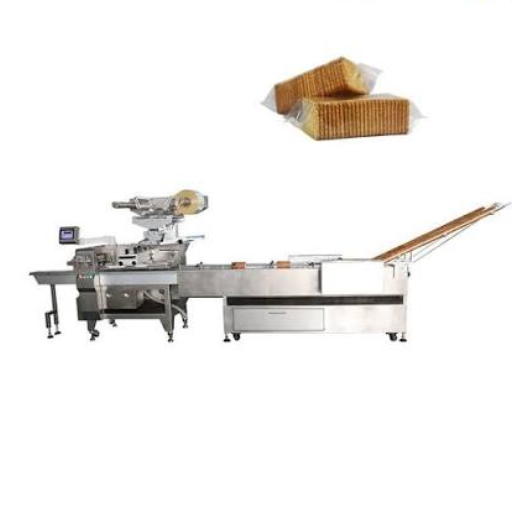
A biscuit packaging machine forms, fills and seals the retail pack after the biscuits have cooled. It is not the whole line: it is the primary packer that turns a stream of biscuits into a counted, wrapped unit, usually a flow pack, on-edge slug, pile pack, pillow bag or carton.
It sits after the oven and cooling conveyor. The line makes biscuits. This machine makes packs.
| Machine class | What it does | Typical pack | Where it sits |
|---|---|---|---|
| Horizontal form-fill-seal (HFFS) | Forms film around the product and seals it | Flow pack, pillow pack, on-edge slug | Primary packer |
| Vertical form-fill-seal (VFFS) | Forms a bag from flat film and fills by weight | Pillow bag, gusset bag, block-bottom bag | Primary packer |
| Cartoner | Erects, fills and closes cartons | Carton, tray, shelf-ready unit | Secondary |
| Case packer | Groups retail packs into shippers | Corrugated case | End of line |
| Palletizer | Stacks cases on a pallet | Pallet | End of line |
The wrapper is often bought from another supplier against a line it has never seen. The interface is where projects slip.
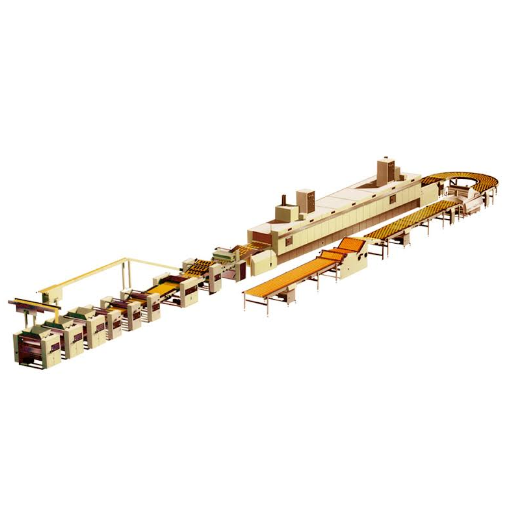
The complete biscuit production line guide shows how upstream stages set the output this machine must match. For the cross-industry view, see automated food packaging equipment.
The Pack Style Decision Comes First
Pack style fixes how a biscuit packaging machine handles the product. Flat pile protects fragile products, on-edge packs tighter and faster, flow wrap is the general format, and vertical bags suit loose product.
Flat pile and pile packs
Flat pile means biscuits stacked horizontally, then wrapped or trayed. The biscuit never stands on its edge, so the fragile rim carries no load. It suits large, decorated and cream sandwich products, at the cost of speed and film.
On-edge and slug packs
On-edge means biscuits stood upright like coins, counted into a slug and wrapped. The pack is tight, shelf presence is strong, and the format runs fast because the product travels in a stable column.
The trade-off is geometry. On-edge packing needs consistent dimensions, and chipping happens on the edge the customer sees first. A biscuit that survives flat pile at full speed may chip on-edge at 70% of the quoted rate.
A buyer we will call Tomas chose an on-edge line for its shelf presence. Commissioning told a different story: edge chipping rose above about 70% of quoted speed, and the damaged biscuits were the ones customers saw first. He moved to flat pile at a lower speed. The pack used more film, but the complaints stopped.
Flow wrap and pillow packs
Flow wrap is the default retail format in most markets. A horizontal form-fill-seal machine forms film around the product, seals a fin or lap seam and cuts the pack free. It is what most people mean by a biscuit wrapping machine, and it offers the widest film and seal range.
Vertical bags
A vertical form-fill-seal machine makes a bag from a flat reel, fills it by weight and seals the top. It tolerates loose, small, broken or irregular product, costs less per pack, but presents less well on shelf.
Cartons, trays and bag-in-box
The carton is often the real retail unit, especially for club stores, gift packs and export. A cartoner runs after the primary packer and is specified separately.
| Pack style | Best for | Machine class | Typical speed band | Breakage risk | Notes |
|---|---|---|---|---|---|
| Flat pile / pile pack | Large, fragile, cream sandwich, decorated biscuits | Flow wrapper with pile infeed, tray packer | Low to medium | Low | More film; best presentation for fragile products |
| On-edge / slug pack | Round, square and rectangular hard biscuits; crackers; sandwich biscuits | On-edge flow wrapper with count feeder and slug former | Medium to high | Medium to high | Tight pack, strong shelf presence; edge damage is visible |
| Flow wrap / pillow pack | Single serves, multipacks, most retail biscuits | Horizontal form-fill-seal (HFFS) | Medium to high | Medium | Most common format; wide film and seal options |
| Vertical pillow bag | Small, broken or irregular product, value packs | Vertical form-fill-seal (VFFS) with multi-head weigher | Medium | Low to medium | Lower cost per pack; less premium presentation |
| Carton / tray / bag-in-box | Shelf-ready and secondary packaging | Cartoner, tray sealer, case packer | Matches primary packer | Low | Often the real retail unit; specify separately |
Matching a Biscuit Packaging Machine to Your Product
Hard biscuits and crackers
Hard biscuits and crackers are flat, dense and low in moisture. Semi-sweet products such as Marie and Rich Tea finish at roughly 1.5 to 3.0% moisture; crackers finish at roughly 1.5 to 2.5%.
That makes them the most forgiving products to pack. They tolerate on-edge handling and higher speeds, and the limit is usually edge quality. A hard biscuit and cracker line that produces a clean edge can run on-edge; one that leaves a ragged edge will show every chip.
Soft, short-dough and cream sandwich biscuits
Soft and short-dough biscuits carry more fat and sugar, break more easily and deform under load. Cream sandwiches add a registration problem: the cream must sit in the same place on every biscuit, and the pack must not squeeze it sideways.
Flat pile or a gentle on-edge format is usually the answer. Avoid drop transfers and keep stack heights low.
Cookies and wire-cut products
In the United States, the same machine is usually sold as a cookie packaging machine. Cookies and wire-cut products have irregular edges, inclusions and more spread variation than a stamped biscuit, so fixed pockets and tight count feeders struggle. Weight or volume counting is more reliable, usually with a multi-head weigher and a vertical bag. Our cookie production line guide covers the upstream differences.
Wafers
Wafers are the hardest common product to pack at speed: large, light, weak, and intolerant of pressure from a stacker or slug.
Pressure-free handling, gentle transfers and often vertical bagging are the practical answers. Ask what happens at the first transfer if a supplier quotes a standard on-edge line without a trial.
Gluten-free and high-fibre products
Gluten-free and high-fibre biscuits are brittle, variable and low in cohesion. They are the products most likely to break in a machine that looks fine on paper. Specify a trial on your own product before you commit.
Speeds: Biscuits per Minute vs Packs per Minute
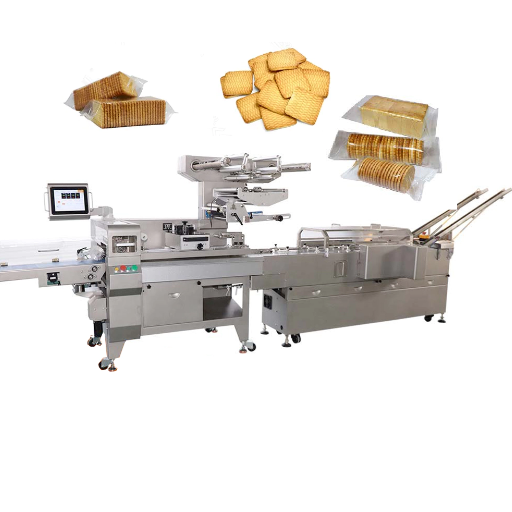
The line runs in biscuits per minute. The wrapper is sold in packs per minute. The two numbers meet at the pack count and the efficiency nobody quotes.
Required packs per minute = (biscuits per minute ÷ biscuits per pack) ÷ efficiency
A line producing 1,500 biscuits/min into 12-biscuit packs needs 125 packs/min at 100% efficiency. At 85% efficiency, installed capacity must be about 147 packs/min:
- 1,500 ÷ 12 = 125 packs/min at perfect efficiency
- 125 ÷ 0.85 = 147 packs/min of installed speed
A biscuit packaging machine rated at 125 packs/min will not deliver 125 on a real line with changeovers, rejects and operators. Ask every supplier what efficiency the quoted speed assumes.
| Line output (biscuits/min) | 12 per pack | 20 per pack | 30 per pack |
|---|---|---|---|
| 1,000 | 98 packs/min | 59 packs/min | 39 packs/min |
| 1,500 | 147 packs/min | 88 packs/min | 59 packs/min |
| 2,400 | 235 packs/min | 141 packs/min | 94 packs/min |
| 3,600 | 353 packs/min | 212 packs/min | 141 packs/min |
Figures assume 85% efficiency.
One manufacturer publishes 350 packs/min on an on-edge line with a count feeder rated at 3,600 biscuits/min. Another publishes 75 to 80 packs/min on an eight-lane X-Fold line. Both are vendor-stated and product-specific.
Consider a buyer we will call Priya, comparing three quotations for a 300 packs/min wrapper for her glucose biscuit line in Gujarat. Her line makes 1,200 biscuits/min at 7 g, and she packs 14 per sleeve. The arithmetic asks for about 101 packs/min at 85% efficiency, not 300. The larger machine would have idled most of the shift and wasted film on every start and stop. She bought the smaller one and added a second packing lane.
Ready to check the arithmetic against your own line? Send your biscuits per minute, piece weight and pack count to our engineering team. We will convert them into a realistic wrapper specification.
Film, Sealing and Shelf Life
Biscuits are moisture-sensitive, and high-fat products are oxygen-sensitive too. A pack that gains moisture loses its snap; one that gains oxygen turns rancid.
The common structures:
- OPP/CPP: general-purpose laminate with a good moisture barrier and reliable heat seal.
- Metallized OPP: better oxygen and light barrier, glossy, common on premium packs.
- PET/PE: robust and printable, often used where puncture resistance matters.
- Paper-based: premium feel and a recyclability story, lower barrier, needs a seal layer.
- Mono-material PP: designed for recyclability, with a narrower seal window.
Flow wrappers use a fin or lap seal; vertical baggers use a crimp or jaw seal. Chocolate-coated products sometimes use cold seal, because heat near the coating is a quality risk.
Nitrogen flushing is a target, not a slogan. The residual oxygen level depends on product, film and shelf life. Agree the target with the film supplier, and make one party responsible for it.
Material choice is now a regulatory question too. Regulation (EU) 2025/40 (PPWR) entered into force on 11 February 2025 and applies from 12 August 2026, so it is already in scope for any pack sold into the EU. It sets requirements on recyclability, recycled content, minimisation and PFAS limits. The European Commission’s packaging waste page has the detail.
Temperature matters as much as film. Biscuits leave the oven near 100 °C, and packing them warm traps moisture inside the pack. CUTM recommends at least a 1.5:1 ratio of cooling to baking time to avoid checking, the hairline cracks that appear after packing. As a rule of thumb, pack below about 35 °C, or within roughly 5 °C of the packing room. Ignoring it causes complaints a week after dispatch.
The biscuit manufacturing process explains where cooling fits, and the biscuit tunnel oven page covers the bake that sets the moisture you are protecting.
Breakage, Changeover and What the Machine Really Costs
Breakage should be measured at the packer, not the oven. By then the biscuit has survived forming, baking and cooling. Damage usually happens in the last few metres: drop height, transfers, stack height and film tension. Measure it on your product at rated speed, per pack rather than per shift.
Changeover is the second hidden cost: former, folding box, sealing jaws and recipe recall. Ask for the measured time in minutes and the tools required. “Quick” is not a specification.
The third cost is film: waste at start-up, film wider than needed, and giveaway from overfilling all show up in cost per pack, not on the purchase order.
Utilisation matters too: a 300 packs/min machine at 60% OEE is a 180 packs/min machine, and the bottleneck is often the case packer or the changeover.
The price of a biscuit packing machine is driven by pack style, speed, servo versus mechanical drives, film capability, inspection, case packing and automation. Price is the strongest search signal and the weakest specification.
What to Specify Before You Buy a Biscuit Packaging Machine
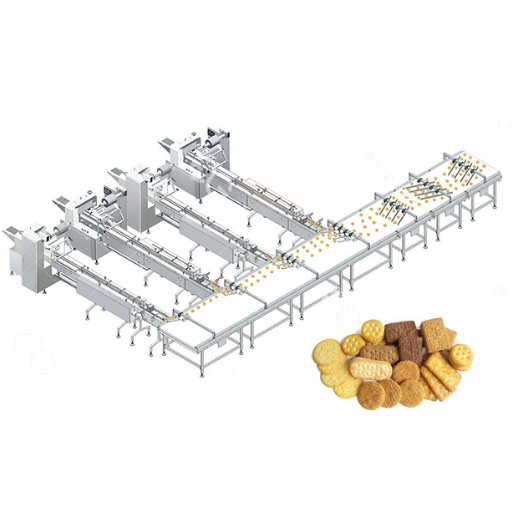
A usable RFQ describes the product and the pack, not the machine. Most disputes trace back to a missing dimension, an unrecorded pack count or an unstated efficiency assumption.
- Product family and named references. “Marie-type, 5 g, 44 mm” is a specification. “Biscuit” is not.
- Dimensions, weight and thickness. Length, width, diameter, thickness and edge shape.
- Pack style and count. Flat pile, on-edge slug, flow wrap, pillow bag or carton, plus biscuits per pack.
- Target output. Packs per minute at your pack count, with the efficiency assumption behind it.
- Film. Structure, thickness, print direction and recyclability requirement.
- Seal. Fin, lap or crimp, plus the test method and acceptance criteria.
- Atmosphere. Nitrogen or modified atmosphere, residual oxygen target, and who guarantees it.
- Changeover. SKUs, pack sizes, tooling, measured time and tools required.
- Inspection. Checkweigher, metal detector, X-ray, coding and reject handling.
- End of line and utilities. Carton, case pack, palletize, power, air, extraction, footprint and floor loading.
Ask for a factory acceptance test at rated speed on your product, not a demonstration on a recipe chosen for the occasion. Our factory acceptance test checklist lists what to record.
Common Faults and What They Usually Mean
Most packaging faults have a short list of likely causes. Use this table to structure the conversation with your supplier, not to replace a line trial.
| Defect | Likely cause | What to check or adjust |
|---|---|---|
| Broken biscuits in the pack | Drop height, transfers, stack height, film tension | Reduce the drop; add gentle transfers; check the stacker and film tension |
| Loose or leaking seal | Jaw temperature or pressure, film coating, product in the seal area | Verify jaw settings and dwell; check the film; clean the seal area |
| Film wrinkling or misregistration | Web tension, former alignment, film stiffness or width | Rebalance tension; check the former; confirm the film runs on this machine |
| Wrong count per pack | Counter sensitivity, product overlap, line speed | Recalibrate the counter; reduce overlap; run at a resolvable speed |
| Biscuits soft after packing | Packed too warm, seal leak, film barrier too low | Check packing temperature; leak-test packs; verify the moisture barrier |
| Cracks days after packing | Moisture gradient, insufficient cooling | Extend cooling; target at least 1.5:1; verify final moisture |
These are typical causes, not diagnoses. A trial with your own product confirms which one applies.
Frequently Asked Questions
What is a biscuit packaging machine?
A biscuit packaging machine forms, fills and seals the retail pack after cooling. It is the primary packer in the line, not the whole line, and it usually produces flow packs, on-edge slugs, pile packs, pillow bags or cartons.
How much does a biscuit packing machine cost?
There is no useful single figure. Price depends on pack style, speed, drive type, film, inspection, case packing and automation. Compare on those variables at your piece weight and pack count.
What is the difference between flat pack and on-edge packaging?
Flat pack stacks biscuits horizontally, protecting fragile products but running slower and using more film. On-edge stands them upright in a slug, tighter and faster but exposing the edge to chipping.
How many packs per minute do I need?
Divide line output in biscuits per minute by the biscuits per pack, then divide by expected efficiency. At 1,500 biscuits/min and 12 per pack, you need 125 packs/min at perfect efficiency and about 147 at 85%.
What film is used for biscuit packaging?
OPP/CPP is the common laminate. Metallized OPP adds oxygen and light barrier, PET/PE adds toughness, and paper-based or mono-material PP structures address recyclability. The choice depends on fat content, shelf life and PPWR requirements.
Can one machine pack biscuits and cookies?
Often yes, if the product dimensions and pack style are similar. Cookies with inclusions or irregular edges may need weight-based counting rather than fixed pockets. Confirm on a trial with both products before you buy.
Conclusion
Pack style comes first. Flat pile, on-edge, flow wrap, vertical bag and carton each protect the product differently, and no brochure can decide for you. Then size the machine from your line: convert biscuits per minute into packs per minute, divide by efficiency, and ask for output at your piece weight in writing.
Specify the film, seal, atmosphere and changeover too. Those details decide whether the pack is still crisp at the end of its shelf life.
A biscuit packaging machine is a long-term constraint on what you can sell and how fast. Ten clear numbers in the RFQ will save more than a tenth supplier quotation.
Send your product dimensions, pack style and target output to our engineering team for a machine-configuration review. We will tell you which format fits and what to test before you sign.