To start a pet food business, you research your niche, secure FDA and state compliance, develop an AAFCO-compliant formula, choose a manufacturing path (co-packing or in-house), and build your brand and sales channels. The process is not just “make a recipe and sell it.” It’s a regulated, capital-intensive business where the founders who win start with compliance, not marketing.
Here’s the number that should make you sit up: the global pet food market is worth roughly $158 billion in 2026 and growing at about 7.9% a year. Premium formats now command 40 to 60 percent price premiums over standard kibble. The demand is real, and it keeps climbing as owners treat their pets like family.
You probably already believe there is room for a better product. You’re right. This guide will walk you through every step of starting a pet food business, from choosing your niche to the exact equipment you need if you decide to manufacture in-house, so you can launch without tripping over a regulation or a hidden cost.
Key Takeaways
- Start with compliance, not product: FDA facility registration, FSMA preventive controls, and state feed registration come before your first sale.
- Choose a niche and a manufacturing path early. Co-packing is low cost and fast; in-house production gives you control and margin but needs real capital.
- Startup costs vary wildly by model: roughly 15,000–15,000–50,000 for a home-based treat business, 120,000–120,000–225,000 for small commercial kibble, and $500,000+ for industrial scale.
- AAFCO does not approve anything. It sets the labeling and ingredient standards states adopt, and every state where you sell can require its own registration.
- The fastest way to move in-house is a turnkey pet food production line, which is where a manufacturer like Shandong Loyal Industrial comes in.
Is Starting a Pet Food Business Worth It in 2026?

Yes, if you go in with clear eyes. The opportunity is large and still growing, but the barrier to entry is higher than most food businesses because of regulation.
North America holds roughly 44 percent of the global pet food market, making it the center of both premium spending and manufacturing investment. Dry food still dominates at about 68 percent of product-form share, but pouches and fresh formats are growing fastest. Dogs lead the pet-type split at roughly 59 percent.
What is driving all of this? Pet humanization. A recent Mars survey across 20 markets found that more than a third of dog and cat owners consider their pets “the most important thing in their lives.” That figure rises to 45 percent for Gen Z and 40 percent for millennials.
When owners think of their dog as family, they buy organic, grain-free, single-protein, and functional formulas. They also pay more for them.
The financial picture is honest but encouraging. Manufacturers typically see gross margins of 30 to 40 percent and net margins of 10 to 15 percent. A small commercial operation can break even in 18 to 27 months. A full manufacturing plant is a longer play, often three to five years to payback.
The catch is that pet food is not a hobby industry. It sits under a dual regulatory system that can feel overwhelming to a first-time founder. Treat that reality seriously, and the market rewards you.
Choose Your Niche and Business Model
Before you spend a dollar, decide what you’re actually selling and how you will make it. This single decision shapes your regulations, your costs, and your equipment.
Pick a product format
Your format choice is the biggest lever on cost and complexity:
- Treats are the lowest barrier to entry. They face fewer rules than complete diets and are a smart first product.
- Dry kibble is the largest market but requires extrusion equipment and more formulation work.
- Wet and canned food involves retort sterilization and higher safety stakes.
- Raw, fresh, and frozen formats are growing fast but demand strict cold-chain handling.
- Freeze-dried and air-dried products command premium prices but need specialized, expensive equipment.
If you’re new, start with treats or a single-format premium product. You can always expand later.
Pick a species and life stage
Dogs are the largest segment, but cats are a strong second and tend to need higher protein and a larger share of wet food. You can also go narrower: senior cats, sensitive-stomach dogs, or large-breed puppies. Narrower niches mean less competition and often higher margins.
Pick a manufacturing path
This is the decision most guides skip, and it’s the one that matters most. You have three real options:
- Co-packing (contract manufacturing). You pay an existing manufacturer to make your formula. Low capital, fast to market, lower margin and less control.
- Private label. You put your brand on a manufacturer’s existing formula. Fastest path, least differentiation.
- In-house production. You own the facility and equipment. Highest control and margin, but highest capital cost.
Most founders start with co-packing to validate demand, then move in-house as volume grows. We’ll dig into this more in a later section.
Not sure which format fits your budget? Explore our pet food production line guide to see what each format costs to produce.
Research Pet Food Regulations and Licensing First
If you remember one thing from this guide, make it this: in pet food, compliance comes before product. Start here, not with your recipe.
Federal rules: FDA and FSMA
The FDA’s Center for Veterinary Medicine regulates pet food under the Federal Food, Drug, and Cosmetic Act. There is no premarket approval for pet food, but there are real requirements:
- Facility registration. Any facility that manufactures, processes, packs, or holds pet food for U.S. distribution must register with the FDA and renew every two years.
- FSMA preventive controls. Under 21 CFR Part 507, manufacturers must have a food safety plan, conduct a hazard analysis, and designate a Preventive Controls Qualified Individual, or PCQI.
- Truthful labeling. Labels must meet federal rules, including the guaranteed analysis panel, ingredient list, and feeding directions.
Foreign facilities must appoint a U.S. agent, and all imported pet food requires prior notice.
AAFCO and nutritional standards
Here’s a common misconception worth clearing up: AAFCO does not regulate or approve anything. It is a voluntary association of state feed officials. What AAFCO does is publish model regulations and ingredient definitions that individual states adopt into their own laws.
When a pet food claims to be “complete and balanced,” that claim is measured against AAFCO nutrient profiles. An ingredient generally cannot be used until the FDA accepts it and AAFCO defines it. So you cannot just invent a new ingredient; it has to fit an existing definition.
State registration and licensing
This is where many founders get surprised. Most states regulate pet food as commercial feed through their Department of Agriculture, and you generally have to comply in every state where you sell, including online. That can mean dozens of registrations and fees.
States use one of two schemes: registration (a fee per product) or licensing (a fee for the firm). Several states also assess tonnage fees. A label that passes in one state can be rejected in another for a naming violation, which brings us to the next point.
Labeling requirements
A compliant label includes the AAFCO eight elements: product name, intended species, quantity, guaranteed analysis, ingredient list, nutritional adequacy statement, feeding directions, and manufacturer contact. The guaranteed analysis (minimum crude protein and fat, maximum fiber and moisture) usually requires lab testing at around 75to75to150 per product.
Naming rules are strict. A treat with only 15 percent chicken cannot be called “Chicken Peanut Butter Treats.” It has to be “Peanut Butter Treats with Chicken.” Small mistakes like this are a top reason labels get rejected.
Develop Your Recipe and Formulation

Once you understand the rules, you can build a product that fits them.
Work with an animal nutritionist or veterinary nutritionist to formulate against AAFCO nutrient profiles. Decide early whether your product is “complete and balanced” or a supplemental treat, because that changes everything about your label and your testing.
Vet your ingredient suppliers carefully. Ask for samples and certifications, and test for microbiology, heavy metals, and mycotoxins. Your recipe is only as safe as your supply chain.
Mini-story: Maya launched a small-batch dog treat brand with a single-protein chicken recipe. Her formula was excellent and her packaging was beautiful. Then her first state registration came back rejected.
Her label read “Chicken Peanut Butter Treats,” but the chicken was only 15 percent of the recipe, so the state required “Peanut Butter Treats with Chicken.” The fix cost her a reprint run and three weeks of delay. She now tells every founder she meets: compliance first, packaging second.
Choose Your Manufacturing Path: Co-Packing vs. In-House
This is the hinge decision of your business, and it deserves its own section.
| Factor | Co-packing | Private label | In-house |
|---|---|---|---|
| Upfront capital | Low | Lowest | High ($120K+) |
| Time to market | Fast | Fastest | Slow (12-18 months) |
| Profit margin | Lower | Low | Highest |
| Control over formula | High | Low | Highest |
| Best for | Validating demand | Testing a brand | Scaling profitably |
Co-packing and private label
Co-packing lets you launch fast and lean. You pay a manufacturer to produce your formula, so you avoid buying equipment and building a facility. The tradeoffs are lower margins, minimum order quantities, and less control over quality and supply.
When you vet a co-manufacturer, ask about minimum order quantities, shelf life, packaging options, cost structure, and whether they can match your formula. Confirm they are FDA registered and follow FSMA preventive controls.
In-house production
In-house manufacturing gives you full control, higher margins, and the ability to scale on your own timeline. It also means you own the facility, the food safety plan, the equipment, and the staff. That’s a serious commitment.
What does going in-house actually require?
- A compliant facility with proper hygiene zoning and one-way flow
- A HACCP-based food safety plan
- A production line sized to your target capacity
- Trained operators and a quality program
The equipment you need
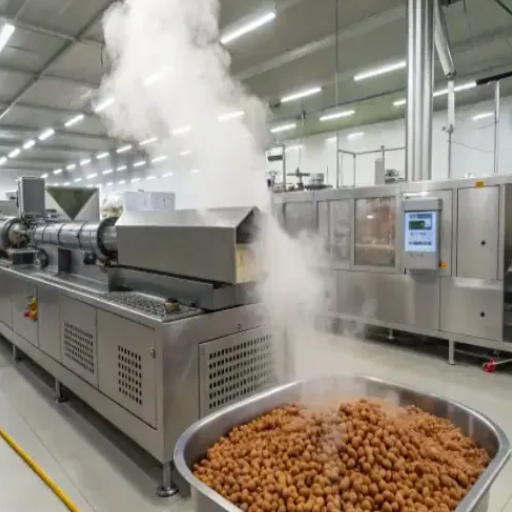
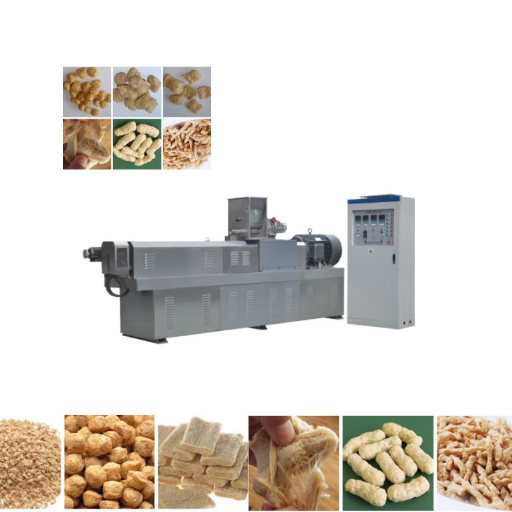
If you go in-house for dry food, a typical line includes:
- Pre-processing: a grinder and mixer to prepare raw materials
- An extruder: the heart of kibble production, available as single-screw or twin-screw
- A dryer and cooler: to reach target moisture and lock in shelf life
- A coater: to apply fats and flavor
- Packaging: vertical form-fill-seal machines, weighing, and metal detection
For a complete breakdown of each stage, see our pet food manufacturing process guide. When you’re ready to compare equipment options, our pet food manufacturing equipment buyer’s guide walks through capacity, materials, and total cost of ownership.
Mini-story: Daniel started a single-protein kibble brand and validated demand through a co-packer for two years. Sales grew, but his margin stayed thin and he kept hitting minimum order quantities.
In 2024 he made the jump to a small in-house line at 300 to 500 kg per hour. He chose a turnkey setup so one supplier handled the extruder, dryer, and packaging integration. Eighteen months in, he had doubled his margin and added a vacuum coater for a premium functional line. The lesson: co-pack to test, go in-house to scale.
Ready to see what an in-house line would cost? Explore our turnkey pet food manufacturing options and get a custom quote for your capacity.
Source Your Equipment and Set Up Production
When you move in-house, your equipment decision determines your quality, your capacity, and your payback timeline.
Pet food production lines come in capacity tiers, from pilot lines for testing and small runs up to industrial lines producing multiple tons per hour. Matching capacity to your sales forecast matters because oversized equipment ties up capital and undersized equipment becomes a bottleneck.
A practical note on cost: Chinese-made lines typically run 50 to 67 percent lower than comparable European equipment. For a 5,000 kg per hour twin-screw line, that can be the difference between roughly 129,000and129,000and400,000. A manufacturer like Shandong Loyal Industrial delivers CE-certified, turnkey systems in that lower band without sacrificing quality, and offers customization to your recipe and capacity.
When you evaluate a supplier, confirm they offer:
- Turnkey integration, so one partner handles extrusion, drying, coating, and packaging
- CE or ISO certification for export markets
- Factory layout and installation support
- After-sales technical support and training
For species-specific guidance, our dog food manufacturing equipment page covers the exact specs for dog kibble and treat lines. If you’re chasing the premium end of the market, our high-protein pet food manufacturing guide covers high-meat inclusion and twin-screw extrusion.
Create Your Brand, Packaging, and Go-to-Market Strategy

Your product is only part of the business. You also need a brand and a way to reach customers.
Position around a clear differentiator: single-protein, organic, functional, human-grade, or a specific life stage. Your packaging has to be food-safe, with barrier films and, where relevant, nitrogen flush to protect shelf life.
Then choose your channels:
- Direct-to-consumer through Shopify or a subscription model gives you margin and data
- Marketplaces like Amazon and Chewy bring traffic but take fees and have stricter requirements
- Wholesale and pet specialty build credibility but move slower
Customer acquisition isn’t free. Expect to pay roughly 25to25to75 to acquire each new DTC subscriber, so build retention into the model from day one.
See our full range of food production lines to understand how your pet food line fits alongside snacks, pasta, and other formats.
Pet Food Business Startup Costs and Funding
Here’s the honest money picture. Costs scale dramatically with your business model:
| Business model | Typical startup cost | Equipment share |
|---|---|---|
| Home-based treat business | 15,000–15,000–50,000 | 30–40% |
| Small commercial kibble | 120,000–120,000–225,000 | 45–55% |
| Industrial manufacturing | 500,000–500,000–1,000,000+ | 50–60% |
A small commercial operation might break down roughly like this: a basic extrusion line at 25,000to25,000to40,000, facility modifications at 10,000to10,000to20,000, ancillary equipment at 15,000to15,000to25,000, raw inventory at 5,000to5,000to10,000, and licensing and compliance at 3,000to3,000to8,000.
Funding typically comes from a mix of founder equity (20 to 35 percent), term debt (45 to 65 percent), and a working-capital line (10 to 20 percent). The SBA 7(a) program can lend up to 5million,andthe504programfinancesfixedassets.Expertsalsorecommendkeepingacashreserveof5million,andthe504programfinancesfixedassets.Expertsalsorecommendkeepingacashreserveof200,000 to $800,000 for manufacturing businesses to cover payroll, recalls, and held inventory.
Mini-story: Priya built a detailed business plan for her freeze-dried cat food brand and thought she had budgeted generously. Then she priced the actual freeze-drying equipment and realized her in-house plan needed double the capital she had earmarked.
Rather than stretch herself thin, she launched through a co-packer for the first 12 months, used the profits to validate her unit economics, and only then committed to equipment. Her capital went further, and she avoided the classic mistake of over-investing before demand was proven.
Frequently Asked Questions
How much does it cost to start a pet food business?
It depends on the model. A home-based treat business can start for 15,000to15,000to50,000, a small commercial kibble operation for 120,000to120,000to225,000, and industrial manufacturing for $500,000 or more.
Do I need FDA approval to sell pet food?
No. Pet food does not require premarket FDA approval, but you must register your facility with the FDA, comply with FSMA preventive controls, and produce a safe, truthfully labeled product.
Can I make and sell pet food from home?
Generally no for complete diets sold commercially. Most states require even in-home manufacturers to register, and commercial production must occur in a compliant facility.
What licenses do I need to sell pet food?
You need FDA facility registration, state feed registration or licensing in every state where you sell, local business permits, and appropriate liability insurance.
Is a pet food business profitable?
It can be, with gross margins of 30 to 40 percent and net margins of 10 to 15 percent. Small operations can break even in 18 to 27 months; manufacturing plants take three to five years.
Should I start with treats or complete food?
Start with treats. Treats face fewer regulatory requirements than complete diets and are a lower-risk way to validate demand and build a brand.
Conclusion
Starting a pet food business is a real opportunity, but it rewards founders who treat it as a regulated manufacturing business rather than a recipe hobby. Get compliance right first, choose a niche and a manufacturing path early, and budget honestly for the model you pick.
To recap: understand FDA and AAFCO rules before you formulate, decide between co-packing and in-house production as your hinge decision, and know your startup costs down to the equipment line item. If you start with treats or a single premium format, you lower your risk while you learn the market.
When you’re ready to move from recipe to production line, Shandong Loyal Industrial is here. We design turnkey, CE-certified pet food production lines tailored to your capacity and format, with over a decade of experience serving food manufacturers worldwide.
Get a custom pet food production line quote today and turn your recipe into a product.